Relationship Science Exam
 Call Kai
 Learn
Learn Practice Test
 Spaced Repetition
 Match
Match Flashcards
 Knowt Play
1/376

There's no tags or description
Looks like no tags are added yet.
Name | Mastery | Learn | Test | Matching | Spaced | Call with Kai |
|---|
No analytics yet
Send a link to your students to track their progress
377 Terms
Commitment
The intention to persist with a relationship
Could be positive or negative depending on the context
The best psychological predictor of whether a relationship will ultimately last
More of a choice compared to other aspects in relationships
Why do we have commitment?
evolutionary perspectives
investment model
marginalization
attachment
Why do we have commitment? → evolutionary perspective
we have an evolutionary based cognitive bias towards maintaining existing partnerships (even in the face of attractive alternatives)
study: art auction and commitment
They ran a study that simulated a fake art auction and each participant was supposed to make as much money as possible
There was always one buyer in the auction who would always bid the highest amount
Thus, people established a relationship with this buyer
Then, another buyer offered a higher bid
People preferred to sell to the person they had established a relationship with, even when there was profitable alternative outcomes
Why do we have commitment? → investment model
proposes that commitment has three components:
satisfaction
investment
quality of alternatives
according to the investment model of commitment, which three components = the most commitment?
More satisfaction, more investments, and less alternatives
study: relationship satisfaction and social media
Those who posted more dyadic profile pictures of Facebook felt more satisfied in their relationship and closer to their partner
And, after a daily diary study, on days when people felt more satisfied in their relationship, they were more likely to share relationship relevant information on Facebook
In addition, people (outsiders) could assert relationship satisfaction and commitment from photos
Why do people commit to abusive relationships even though satisfaction is gone?
investments
Women who returned to their partners reported more commitment, investment, and lower quality alternatives
Young adults who intended to stay with violent partners had higher investments
Sexually coerced women reported more investments than noncoerced women
Why do we have commitment? → marginalization
People in marginalized relationships commit more than people in non-marginalized relationships
However, prejudice can also hold people back in their relationships
Ex: buying a home together (a big commitment) may make same-sex couples more apparent
Why do we have commitment? → attachment style
avoidant attachment = more attentive to alternatives; less committed; less invested
anxious attachment = strongly value commitment but are actually less committed
secure attachment = have partners who are more commitment; can easily maintain commitment and recall instances of partner commitment
Three components of commitment theory
Suggests there's only one type of commitment comprised of various types components:
(1) personal commitment
(2) constraint commitment
(3) moral commitment
Three components of commitment theory → (1) personal commitment
people’s want to commit
most common + desired by partners
Three components of commitment theory → (2) constraint commitment
commitment based on feelings that you have to continue a relationship
it may be too costly to leave
Three components of commitment theory → (3) moral commitment
feeling like you “ought” to continue
better at indicating who stays together in a long distance relationship
How can commitment help explain problems with cohabitation before marriage?
Cohabitating before marriage is associated with negative outcomes, but only for those who are not engaged before moving in together
This effect is seen when controlled for many factors
This is largely similar for same-sex couples
when is cohabitating before marriage risky?
when individuals are not engaged and they move in together
for cohabitating individuals who are not married, why does living together have negative effects?
it can lead to:
relationship inertia
constraint commitment
relationship inertia
when cohabitating leads to sliding into marriage
constraint commitment
when cohabitating individuals live together for the wrong reasons and it might be hard to leave
i.e, they may be living together for convenience or for a test of their relationship
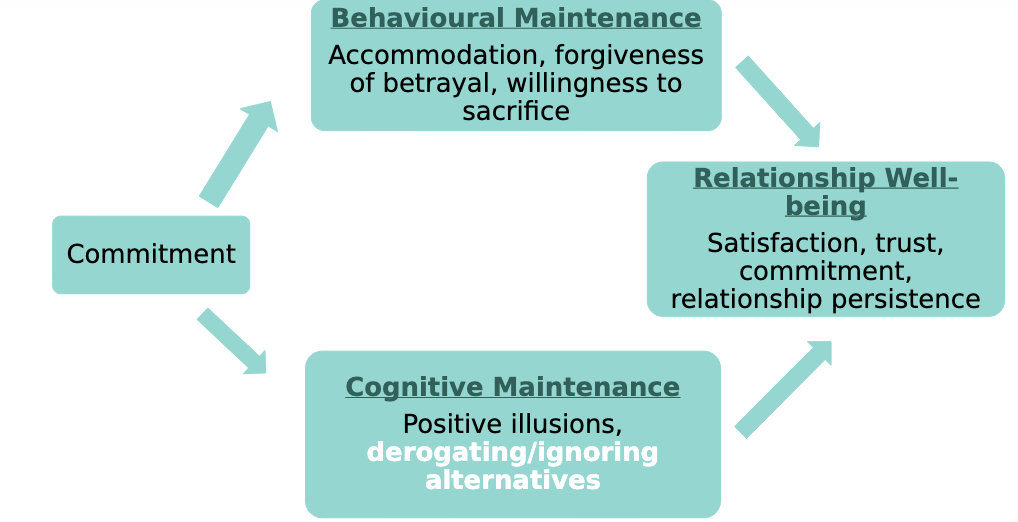
process of commitment
commitment can lead to:
behavioural maintenance → accommodation, sacrifices, forgiveness
cognitive maintenance → positive illusions + derogating alternatives
as a result, relationship well-being increases
consequences of commitment → perception of alternatives
Commitment leads to underestimating the number of alternatives
More committed people pay less attention to alternatives
Eye tracking studies show committed individuals are less vigilant to attractive alternatives
commitment calibration hypothesis
posits that we have two cognitive tools that help us stay committed:
1. derogation of potentially threatening alternatives
More derogation of attractive and available others
Highly committed people derogate strong threats but not moderate threats
2. augmentation of our partners attractiveness
After a relationship threat, more commitment led to rating a partner as more physically attractive, intelligent, warm, and funny
how do we typically communicate commitment?
saying i love you
having relationship talks
who says “i love you” first?
one study found that people assume women will say it first, but also recall from personal relationship experiences that men said it first
on avg, men think about saying I love you 6 weeks into a relationship
men are happier hearing i love you before sex
women are happier hearing i love you after sex
study: cold feet
marital doubts are more common in women, and research has found women with more doubts where 2.5x more likely to be divorced in 4 years
however, marital doubts had no impact on divorce rates for men
this is a significant gender difference
conclusion: cold feet may signify a precursor to marital distress for women
why is cold feet a precursor to divorce for women, but not for men?
Women may be more attuned to relationship problems
Evolutionary perspective = error management; women need to be cautious to avoid significant cost of poor quality partner
Men who have doubts may be less likely to act on them
is love universal?
the experience of love is universal; present in 89% of cultures
love may have an evolutionary basis → we focus on one partner to conserve time and use it for more important things
expressions and norms of love differ cross culturally
examples of cross cultural differences in love
white day in japan
non-monogamy has less stigma in France
in a culture in Papua New Guinea, people cannot eat in front of their dates
love songs from China depicted love as more embedded, and conveyed more suffering and pain than US love songs
where are verbal expressions of “I love you” more common?
more common in western countries
newcomers to the US say it more the longer they've been in the country
and, these people are more likely to say it in english over their native language
where are non-verbal expressions of “I love you” more common?
in collectivistic cultures
what are the differences between loving our friends and loving our partners?
Friendships tend to be less intense in the feelings/emotions people have, they are easier to dissolve, and people spend less of their free time together
Romantic relationships have greater fascination, sexual desire, exclusivity, and more stringent rules for each other
what are the similarities between loving our friends and loving our partners?
Warm evaluations of partner
Respect
Trust
Capitalization
Social support
Responsiveness
sternberg’s love triangle
depicts love along three points:
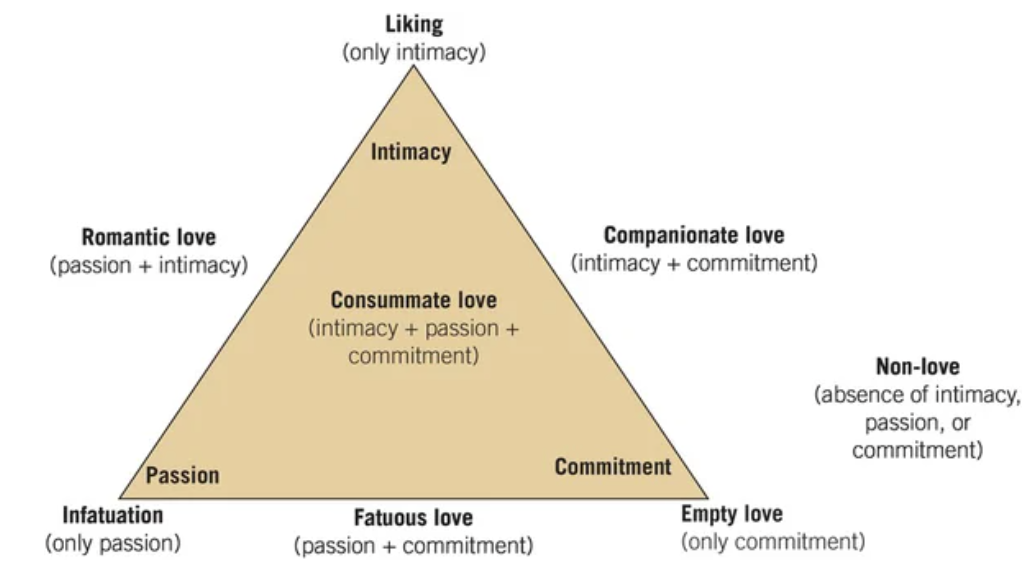
intimacy → the emotional aspect
commitment → the cognitive aspect
passion → the motivational aspect
which can produce 8 types of love
what are the 8 types of love produced by sternberg’s love triangle?
nonlove
liking
infatuation
empty love
fatuous love
romantic love
companionate love
consumate love
sternberg’s love triangle → nonlove
NO passion
NO intimacy
NO commitment
sternberg’s love triangle → liking
NO passion
Intimacy
NO commitment
sternberg’s love triangle → infatuation
Passion
NO intimacy
NO commitment
sternberg’s love triangle → empty love
NO passion
NO intimacy
commitment
sternberg’s love triangle → fatuous love
passion
NO intimacy
commitment
sternberg’s love triangle → romantic love
passion
intimacy
no commitment
sternberg’s love triangle → companionate love
NO passion
intimacy
commitment
sternberg’s love triangle → consumate love
intimacy
passion
commitment
this is the type of love people strive for
love languages
the argument → there are five key love languages (words of affirmation, acts of service, receiving gifts, quality time, & physical touch) and each person must communicate love to your partner in their language
not backed by research
created by a pastor who worked with couples so it was developed in a christian heterosexual framework
overall, can be used as a tool to start conversations and can be integrated in relationships appropriately
what are the problems with tests that “determine” your love language?
they often involve forced choice (people might like both things!)
when researchers tried to make a more psychometrically sound test, people liked all types of love almost equally
couples who where matched in love languages had = relationship satisfaction to couples who where mismatched
are there gender differences in love expressions?
Researchers followed couples for weeks and examined how they expressed love in everyday life
They found that men and women are equally likely to show love through affectionate behaviours
On days when men felt more loved, they showed love by initiating sex, sharing leisurely activities, and doing household work together
in the modern (scientific) conceptualization of love, what are the three systems involved in romantic love?
the sexual system
the attachment system
the caregiving system
all three systems are needed for romantic love
the sexual system
one of the three components of the modern conceptualization of love
involves sexual attraction to someone and having sexual desire
what distinguishes romantic love from friendships
the attachment system
one of the three components of the modern conceptualization of love
viewing your partner as a safe haven and a secure base
the caregiving system
one of the three components of the modern conceptualization of love
understanding your role as someone’s safe haven and secure base
unrequited love
romantic or passionate love for someone that is not reciprocated
a fairly common experience for adolescents and young adults
in unrequited love, who has it worse (the rejector, or would be lover)?
Research suggests that the experience of unrequited love can be more distressing for the person rejecting the lover
This process is often associated with distress and guilt
The pursuer may be bordering obsessive
Why does unrequited love happen?
The pursuer assumes that the relationship is worth waiting for
They overestimate how liked they are
Experience may provide many of the rewards of falling in love
the biology of love
Falling in love is associated with neurochemical changes that are similar to "obsession"
And, it activates reward systems (the dopaminergic system)
study: lovesickness and obsession
Participants = newly falling in love couples, unmedicated OCD patients, and controls
Measured serotonin density in blood platelets
The lovers matched OCD patients more than controls
Implication: falling in love is an "obsessive" experience
study: passion and reward fMRI study
Participants = 10 women and 7 women who were newly, intensely in love; the avg. relationship length was 7 months
Compared to controlled images, viewing images in their loves ones was associated with:
Activation in the VTA
Specifically, in the right VTA - associated with wanting rather than liking
They saw greater activation for those who reported higher levels of romantic love (using the passionate love scale)
your brain on love ____?
Love = obsession & rewarding/addiction
study: lasting love
Looked at data from a nationwide survey on love in long-term couples
They found a high proportion of participants reported being intensely in love with their spouses
Intense love was associated with → physical affection, quality time, novel activities, sex, general happiness
The Michelangelo phenomenon
our partner has an idea of who their "ideal self" is and it's our job as their partner to help them become that person
we can sculpt our partners through:
perceptual affirmation: our partner perceiving us in ways that our consistent with our ideal selves
behavioural affirmation: the elicitation of behaviors that are congruent with one's ideal self
relationship “turning points”
distinct moments in a relationships trajectory that changed the relationship
ex: a first kiss
relationship trajectories
an arc or path that plots how romantic relationships change over time
there is no "one size fits all" trajectory, but we generally see common relationship experiences
provide a temporal context that help us understand a given romantic evaluation at one moment in time
what are the four typical patterns of increasing commitment for partners moving from dating to marriage?
accelerated → a steep and steady ascent into interdependence
accelerated-arrested → starts strong but stalls
intermediate → progresses less intensely
prolonged → an extended, lengthy courtship
the RECAST (relationship coordination and strategic timing) model
posits that:
Short-term relationships could be long-term relationships that end prematurely
Long-term relationships could be short-term relationships that last
falling in love
a transitional period where individuals move from a state of "not in love" to a state of "in love"
is generally an intense experience
The emotions and behaviors of people falling in love reveal it to be a stressful experience, consistent with evidence showing that people newly falling in love exhibit higher levels of cortisol
commitment and the social network effect
globally, people struggle when their family or friends fail to or inconsistently support their relationships
having a lack of support predicts a lower relationship quality, feelings of security, and worse mental and physical health
individuals with non-traditional relationships (such as inter-racial couples and same-sex couples) are especially likely to be marginalized
aligns with the romeo and juliet effect
The Romeo and Juliet effect
the idea that family interference can intensify (not dampen) love and commitment
Common transitions in established relationships
long-term relationship trajectories are typically speckled with major life-altering decisions and experiences
many of these are considered positive life events that escalate commitment and interdependence, even if they introduce turbulence
examples:
cohabitation
marriage
parenthood
experiencing new parenthood
Common transitions in established relationships → cohabitation
Moving in together marks a major relationship transition for most couples
Escalates commitment and alters the interdependence within a relationship
In some places, cohabitation is more common than marriage → it is on the rise worldwide
openness to cohabitation (regardless of marriage intent) may vary systematically by age, race, religion, and political leaning
demographics of cohabitatiors
very diverse!
around half of cohabitators live with children (thus, cohabitation is not limited to young adults!)
cohabitation rates are converging across race and educational attainment
peoples motivations for cohabitation
May range from the social and emotional, to the practical, to the political (rejecting the institute of marriage)
The "mere convenience" motivation is cited more frequently by individuals with lower SES than individuals with higher SES
what are the different types of cohabitators?
serial cohabitation
cohabitation as a permanent alternative to marriage or single hood
cohabitators by choice
cohabitators who play to marry
what are the different types of cohabitators? → serial cohabitation
the practice of sequentially living with dating partners
what are the different types of cohabitators? → cohabitation as a permanent alternative to marriage or singlehood
they are highly committed to their partner yet cannot, or do not want to, marry or live alone
what are the different types of cohabitators? → cohabitators by choice
people choose to cohabitate with no interest in marriage
what are the different types of cohabitators? → cohabitators who plan to marry
there are two types:
Those who view cohabitation as a trial marriage
Those who view cohabitation as a prelude to marriage
Common transitions in established relationships → marriage
Getting married is a major event in a relationships trajectory, whether it occurs after cohabitation or directly
In American cultures, couples enter into an agreement to marry through an engagement ritual / proposal (typically the man proposes to the woman)
The desire for marriage in the west is still high
Arranged marriages
In areas of Asia, Africa, and the Middle East, marriages are predominantly arranged marriages, unions orchestrated by a third party → often parents
People who enter arranged marriages are not necessarily "forced" to so do, they may enter for varied reasons (economic stability; people may trust their parents judgements)
Common transitions in established relationships → parenthood
Many parents make the decision to have children with a great deal of self-reflection and careful deliberation
Having children may be an assumed, culturally approved pathway for many
in fact being childfree subjects an individual to social stigma
There are several pathways to parenthood
People enter parenthood at different ages
What is the current mean age of first birth in American women? what does this pattern reflect?
The mean age of first birth for American women is 27
this number has risen over time and is expected to continue rising as more women are having their child when they are of an advanced maternal age (over 35)
Current sociocultural trends in the transition into parenthood
Education and SES are contributing to the delayed entry into parenthood
We are seeing a societal shift in the number of mothers married at the time of their babies birth
The context in which mothers enter parenthood and become pregnant varies quite alot; individuals may become pregnant through sexual encounters with strangers, or within casual relationships
People can become single parents by choice
Podcast: men are from mars, women are from venus → background
a famous relationship help book written by John Gray, a complete fraud and grifter
Podcast: men are from mars, women are from venus → how did John Gray gather his information?
All of his research was based on his own personal observations in therapy sessions with clients and his own introspection
Podcast: men are from mars, women are from venus → how does gray describe the differences in communication style between men and women?
women communicate because they want to feel
men communicate because they want to deliver information
Podcast: men are from mars, women are from venus → what is the conversation tip Gray offers men?
do not immediately provide a solution to a woman’s problem; instead reply by reflecting their emotions
Podcast: men are from mars, women are from venus → what is Gray’s advice for women?
women should skip to the end of their stories first
when looking for support, women should use the words “could” or “can” instead of “would”
Podcast: men are from mars, women are from venus → what is a tactical misunderstanding?
pretending to not know the true meaning of words
Podcast: men are from mars, women are from venus → what are some true situational gender differences in communication?
women talk more than men situationally
men don’t see it as their job to initiate conversation
Self-expansion theory
Passionate love motivates the intense merging of the self and other
Gradually, we come to include the "other" In our sense of self:
We see the world through new POV's
We gain access to new resources (knowledge, material, + societal aspects)
We also develop a identity, as the partner has become a part of the self
Self-expansion is highly pleasurable and occurs rapidly in new relationships
self-expansion study
Single undergrads where asked at the beginning of the semester to describe their self-concept
The researchers followed up every two weeks
Falling in love broadened people's descriptions of self-concept → As participants reported falling in love, they used a larger variety of words to describe themselves
when is self expansion very prominent/common?
when people are from small towns with limited exposure to different cultures and perspectives
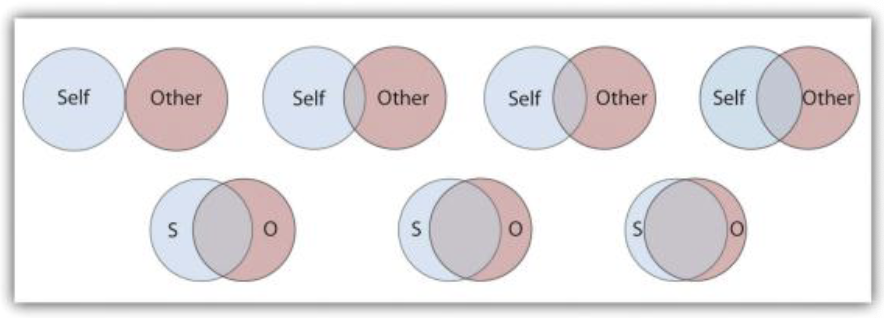
Inclusion of other in self (IOS) scale
Show participants the image and ask them which diagram best depicts them and their partner
There is a thing as "too much closeness”?
Being too close for comfort is a threat for personal control and may involve giving up parts of yourself
Alongside our need for closeness, we also have a need for autonomy
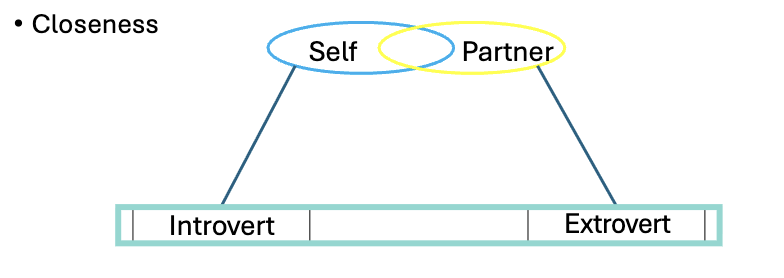
A mismatch in actual and desired closeness = lower relationship quality
What do cognitive repsentations of the self and close others look like?
Cognitive representations of the self and other are highly overlapping
This concept is called confusing the other in self
confusing the other in self
people may start to identify themselves with concepts that align with their partner, and NOT them
study: confusing the self and other
Presented participants with words that described just themselves, just their partners, or described both
They where given a me / not me reaction time test
Results:
Reaction times are slower for unshared traits
Speed reaction to merged traits predicted relationship maintenance and closeness longitudinally
If you are so overlapped with your partner, you can mistake your self and your partner over time
Process of self-expansion
We start off motivated to include the self in other to gain access to resources (this is generally unconscious)
As the relationship forms, each partner makes resources readily available to the other
You begin a cognitive reorganization of the self and partner (more overlap)
Cognitive overlap = take on partners perspectives and identities
You return to step two and strengthen the conscious and unconscious experience of including other's resources in the self
self expansion study 1: self-expansion activities
Assigned couples to three conditions:
Self-expanding condition → the couples had to participate in an obstacle courses + questionnaire
Mundane condition → the couples rolled a ball to each other back and forth + questionnaire
Control condition → only answered the questionnaire
Those in the self-expanding condition had higher relationship quality after the task
Objective observers suggested individuals in the self-expansion condition looked more satisfied
self expansion study 2: daily diary study
Used the daily diary method - asked: have you done anything novel / new with your partner today?
Not ecologically valid
People experienced boosts in relationship satisfaction when they completed self-expanding activities
Implication: anything can count as self-expansion, it depends on the couple
self-expansion study 3: inducing self-expansion
They randomly assigned participants to 1 of 3 conditions:
(1) Where given an article featuring a self-expanding activity to implement in their life
(2) Where given an article depicting a comfortable activity to implement in their life
(3) Control: no information
Those in the comfort and self-expansion activity groups felt more satisfied in their relationships
Self-expansion condition showed further benefits
what is required for self-expansion to happen?
self-disclosure
the “fast friends” task
A set of 36 questions that increases self-disclosure between any two people
The media labels these questions as a recipe for falling in love
It speeds up and mimics disclosure that happens naturally
Breadth increases more quickly than depth