Lecture 1 -- Retrovirus (Feline leukopenia + Feline immunodeficiency virus)
 Call Kai
 Learn
Learn Practice Test
 Spaced Repetition
 Match
Match Flashcards
 Knowt Play
1/44

Earn XP
Description and Tags
These flashcards cover key concepts regarding feline and canine infectious diseases, specifically focusing on Feline leukaemia virus (FeLV), Feline immunodeficiency virus (FIV), and their implications in veterinary medicine.
Name | Mastery | Learn | Test | Matching | Spaced | Call with Kai |
|---|
No analytics yet
Send a link to your students to track their progress
45 Terms
What are the key structural features of a retrovirus?
Enveloped viruses with an RNA genome
What are the characteristics of an enveloped viruses?
Envelope is made of lipids, which are dissolved by soap, detergents, alcohol and disinfectants, disrupting the viral envelope and inactivating the virus.
What are the characteristics of a RNA viruses?
RNA viruses require an RNA polymerase to replicate their genome BUT enzyme lacks proofreading activity = Tend to mutate
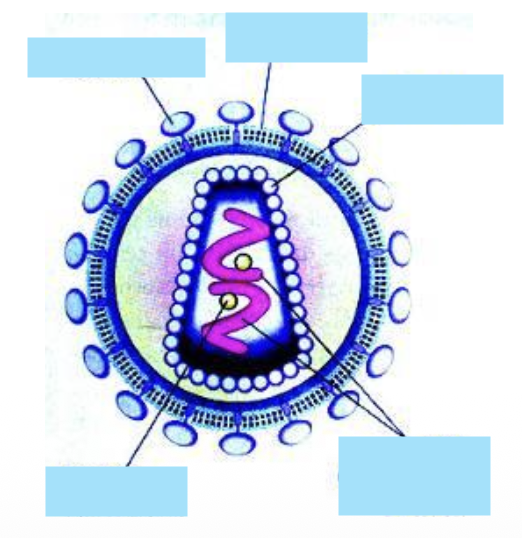
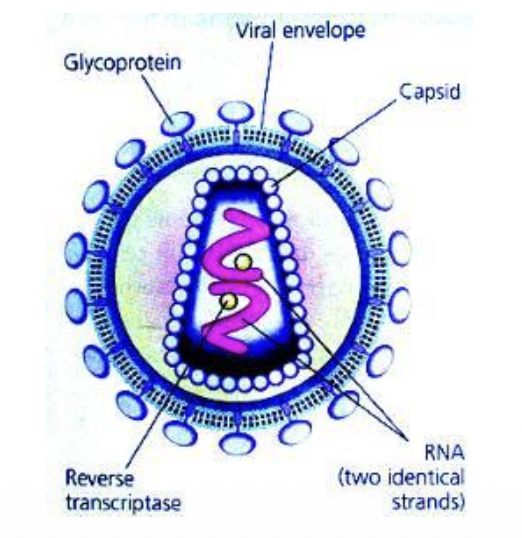
List out the key structure of a retrovirus
The RNA genome of a virus and reverse transcriptase are enclosed within a protein coat (capsid)
In enveloped viruses, this nucleocapsid is further surrounded by a lipid envelope
Embedded within this lipid envelope are viral glycoproteins, which are essential for attachment to host cell receptors and entry into the host cell
Retrovirus Life Cycle
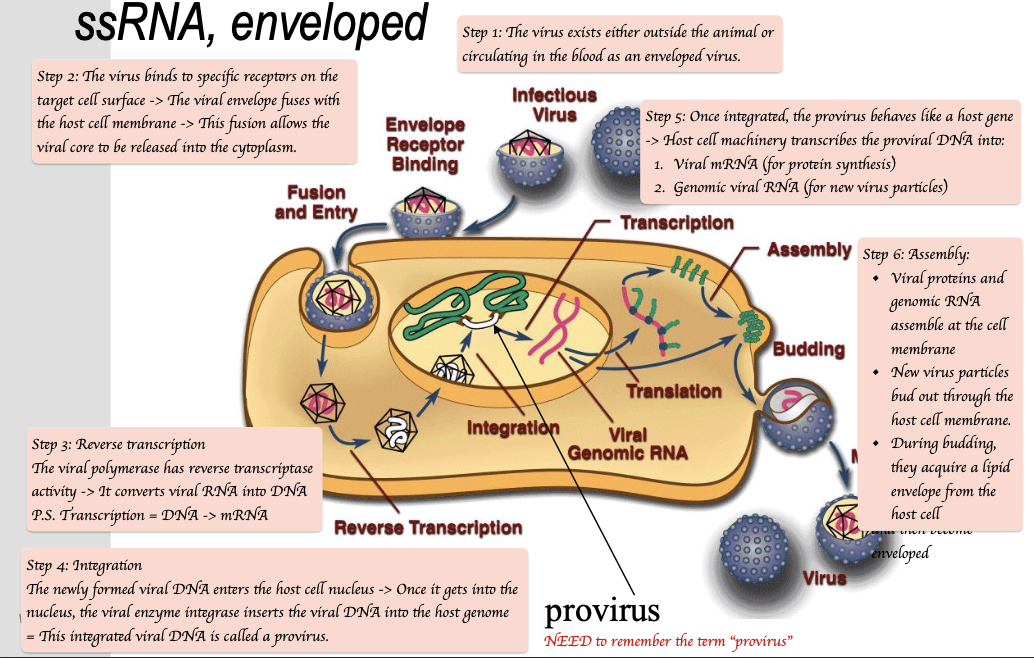
How does a retrovirus enter a host cell?
It binds to specific receptors on the target cell → The viral envelope fuses with the host cell membrane, releasing the viral core into the cytoplasm.
What is reverse transcription in retroviruses?
Viral reverse transcriptase converts viral RNA into DNA
What happens during integration?
Once viral DNA enters the host nucleus, integrase inserts it into the host genome →The integrated DNA is called a provirus
What happens once the provirus is integrated?
The provirus acts like a host gene → Host machinery transcribes DNA into viral mRNA (for protein) and genomic RNA (for new virus particles).
What are the main subtypes of FeLV?
Subtypes A, B, and C
Which subtype is transmissible?
Only Type A is transmissible between cats
How do Types B and C arise?
Type B: Recombination of Type A with endogenous retroviruses
Type C: Mutation of Type A genome
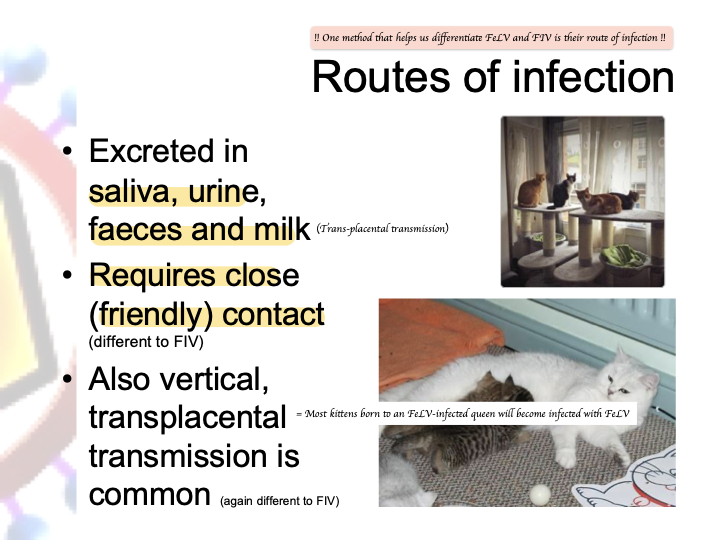
What are the main routes of FeLV transmission?
Require close contact
Saliva, urine, feces, milk, and vertical (transplacental) transmission
Explain the feline leukopenia pathogenesis
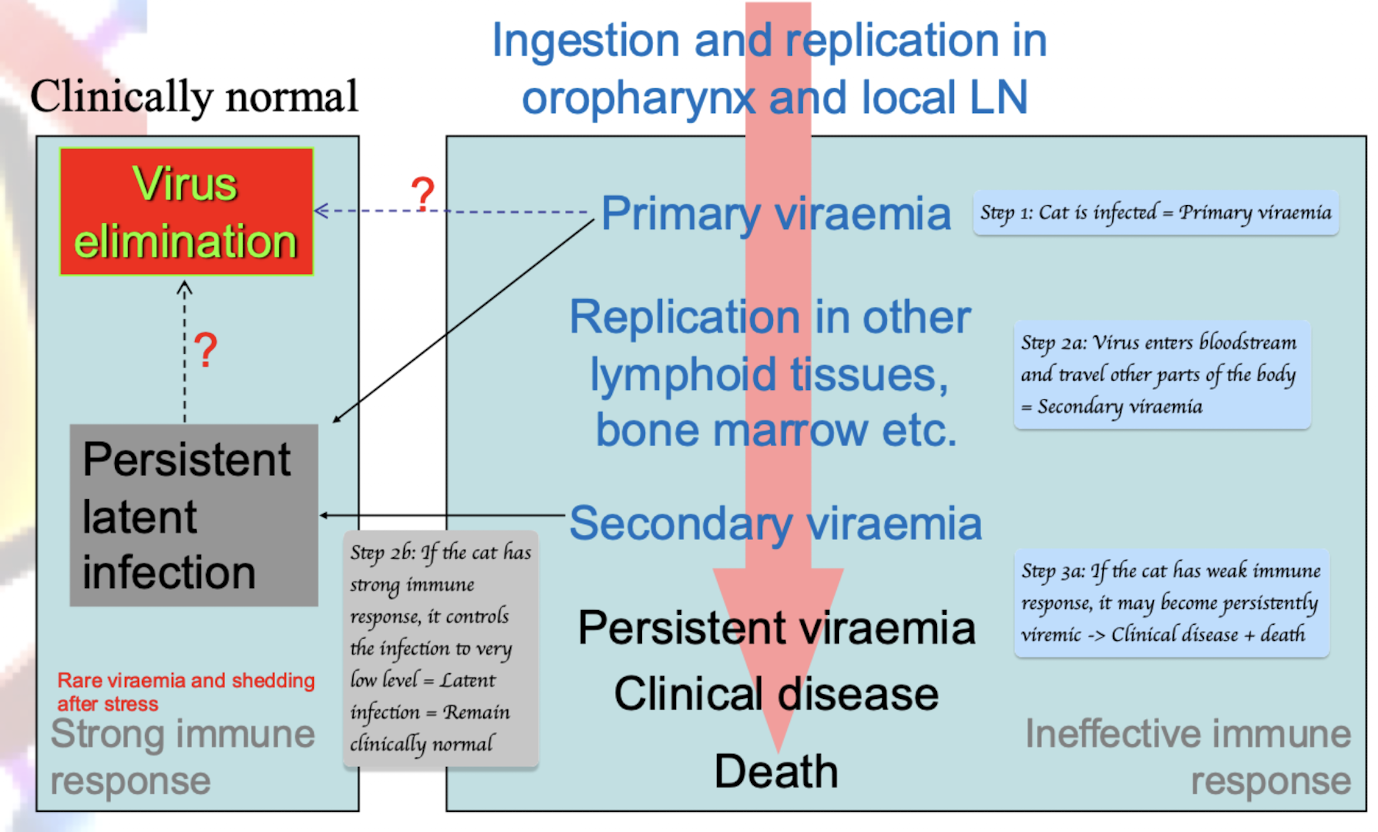
Describe the antigen and antibody levels in FeLV during primary viraemia
Antigen: High
Antibody: Negative
Explanation: Virus is replicating rapidly; antibodies have not developed yet.
Describe the antigen and antibody levels in FeLV during persistent viraemia
Antigen: Positive
Explanation: Ongoing infection
Antibody: Positive
Explanation: Immune system produces antibodies as virus persists
Viral load: High
Describe the antigen and antibody levels in FeLV during persistent latent infection
Antigen: Negative
Explanation: Strong immunity so the virus is cleared → No circulating antigen
Antibody: Positive
Explanation: Antibodies remain from previous exposure but do not indicate current infection
What factors influence susceptibility to persistent FeLV infection?
Virus dose/route
Contact with persistently infected cats
In utero
Age
Young cats more susceptible
Immune status
Virus-Neutralizing antibodies
Maternal derived antibodies
What are the main clinical syndromes caused by FeLV?
“RAIN”
Neoplasia
Immunodeficiency
Anemia
Reproductive failure
How can FeLV cause neoplasia?
Retroviral DNA inserts near proto-oncogenes or disrupts tumor suppressor genes, increasing cell proliferation
What are the four main types of FeLV-associated lymphoma and their associated symptoms?
Mediastinal
Respiratory signs e.g. dyspnoea or tachypnoea
Regurgitation and weight loss if the lymphoma interferes with the oesophagus
Multicentric
Any organ my be involved
Epidural → Posterior paralysis
Kidneys → renal failure
Alimentary 消化道
Anorexia, weight loss, vomiting/diarrhea, often anemic
Leukemic (bone marrow)
Pyrexia, weakness, anorexia
Describe primary anemia caused by FeLV.
Non-regenerative anaemia
because FeLV destroys erythroid precursors in bone marrow
Can either be red cell aplasia (normal WBC, low RBC) or total marrow aplasia (Low RBC and WBC)
Often caused by subtype C FeLV
Describe secondary anemia in FeLV infection
Regenerative anaemia
Bone marrow is functional, but production compromised by space-occupying lesions in bone marrow (myeloid tumors)
Haemolytic anemia can occur, usually mild
What happens if a fetus is infected with FeLV at 3–5 weeks of gestation?
Fetus may be resorbed
What happens if an infected kitten survives to birth?
It is persistently infected - Fading kitten syndrome
What is the risk to kittens of a persistently infected queen?
Most kittens will be FeLV positive → Since they are young, they are more likely to develop persistent infection and clinical signs
What is the “Test and Remove (T&R)” strategy for FeLV?
Test all cats in a colony with a lateral flow test.
House positive cats separately.
Retest all cats 12 weeks later:
Cats -ve twice (or +ve only on first test) → can rejoin main colony
Cats +ve twice → permanently remove from colony (rehomed or euthanized)
Cats negative first, positive second → isolate and retest after 12 weeks
Ongoing monitoring: Retest every 6–12 months and all new arrivals
Apart from “Test and remove” strategy, what are the other method to control FeLV?
One food bowl per cat → Reduce friendly contact
Is FeLV vaccination available?
Yes
Either killed or subunit, or recombination canarypox
First dose at 8–9 weeks → Second 3 weeks later → Annual boosters
What are the treatment options for FeLV-positive cats?
Largely supportive care
No specific antivirals
Interferon may prolong survival
May treat some lymphomas with cytotoxic drugs
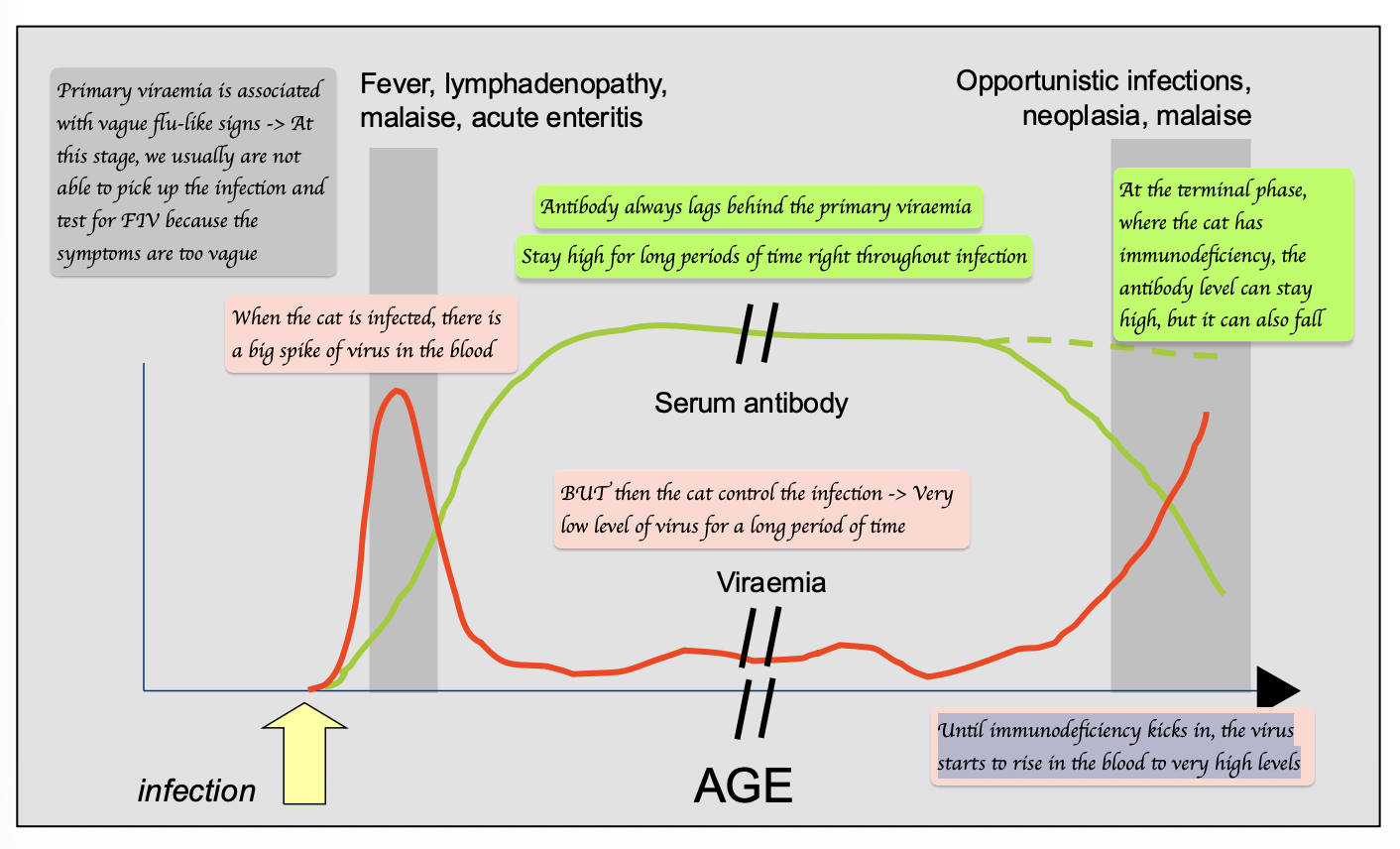
FIV pathogenesis
What type of virus is FIV?
A lentivirus, related to HIV.
Is FIV zoonotic?
No.
HIV does not infect cats
FIV does not infect humans
What is the main route of FIV transmission?
Different from FeLV, FIV is primarily transmitted through bites and aggressive behavior during fights between cats = Unfriendly contact → High viral load in saliva
Which cats are most commonly affected by FIV?
Male > Female
Because transmission is mainly through fighting and biting, which occurs more often in males.
Free-roaming and feral 野生的 cats
Cats in unstable colonies
Can FIV be transmitted from queen to kittens like FeLV?
Yes, via placenta or milk — but this is rare in practice
Most kitten which were born from an FIV infected queen will be negative (completely opposite to FeLV)
Which immune cells does FIV primarily infect? What immune changes develop over time in FIV infection?
Normally:
Antigen-presenting cells (APCs) e.g. dendritic cells, macrophages present antigens via MHC II molecules to CD4+ T cells → CD4⁺ T cell proliferates (clonal expansion) and differentiates into subsets:
Th1 → produce IFN-γ → activate macrophages, enhance MHC II
BUT FIV primarily infects CD4+ T cells → Depletion of CD4 + T cells causes decreased expression of MHC II → Immunodeficient
What occurs during primary viraemia in FIV?
High viral load in blood BUT low level of antibodies
Vague flu-like signs:
Fever
Lymphadenopathy = Enlargement of lymph nodes
Malaise = Discomfort
Acute enteritis
Why is FIV often missed during primary infection?
Clinical signs are nonspecific
Antibodies lag behind viraemia
What happens after the initial viraemia phase?
The cat controls the virus + Viral levels drop to very low levels
Cats remain clinically healthy for 3-5 years, and perhaps for life
How do antibody levels behave during FIV infection?
Appear after primary viraemia
Remain high for long periods
May stay high or fall in terminal disease
What are the clinical signs during the terminal phase of FIV?
Severe immunodeficiency
Opportunistic infections
Neoplasia
Chronic malaise
Chronic infections e.g. not respond to treatment as the animals should
Is there a specific treatment for FIV?
No. Treatment is mainly supportive
How can FIV infection be prevented and controlled?
Prevent fighting: Keep cats indoors and neutered
Isolate infected cats
Is there a vaccine for FIV?
Not licensed in Europe yet