Ch.7 Ionic Bonding
 Call Kai
 Learn
Learn Practice Test
 Spaced Repetition
 Match
Match Flashcards
 Knowt Play
1/12

There's no tags or description
Looks like no tags are added yet.
Name | Mastery | Learn | Test | Matching | Spaced | Call with Kai |
|---|
No analytics yet
Send a link to your students to track their progress
13 Terms
Valence electrons definition
The electrons in the highest occupied energy level of an element's atoms
Valence electrons group 1A
Group 1A elements have one valence electron (they all end in s1)
Valence electrons group 2A
Group 2A elements will have two valence electrons (ends in s2)
Valence electrons group 3A
Group 3A elements will have three valence electrons (ends in s2p1)
Valence electrons group 4A
Group 4A elements will have four valence electrons (ends in s2p2)
Valence electrons group 5A
Group 5A elements will have five valence electrons (ends in s2p3)
Valence electrons group 6A
Group 6A elements will have six valence electrons (ends in s2p4)
Valence electrons group 7A
Group 7A elements will have seven valence electrons (ends in s2.p5)
Valence electrons group 8A
Group 8A elements will have eight valence electrons (ends in s2p6)
Ionic bonds
Ionic bonds result from a transfer of valence electrons from the cation to the anion.
Ionic compound def
An ionic compound is a chemical compound made of positively charged ions (cations) and negatively charged ions (anions) that are held together by strong electrostatic attraction—an ionic bond. ex. NaCl
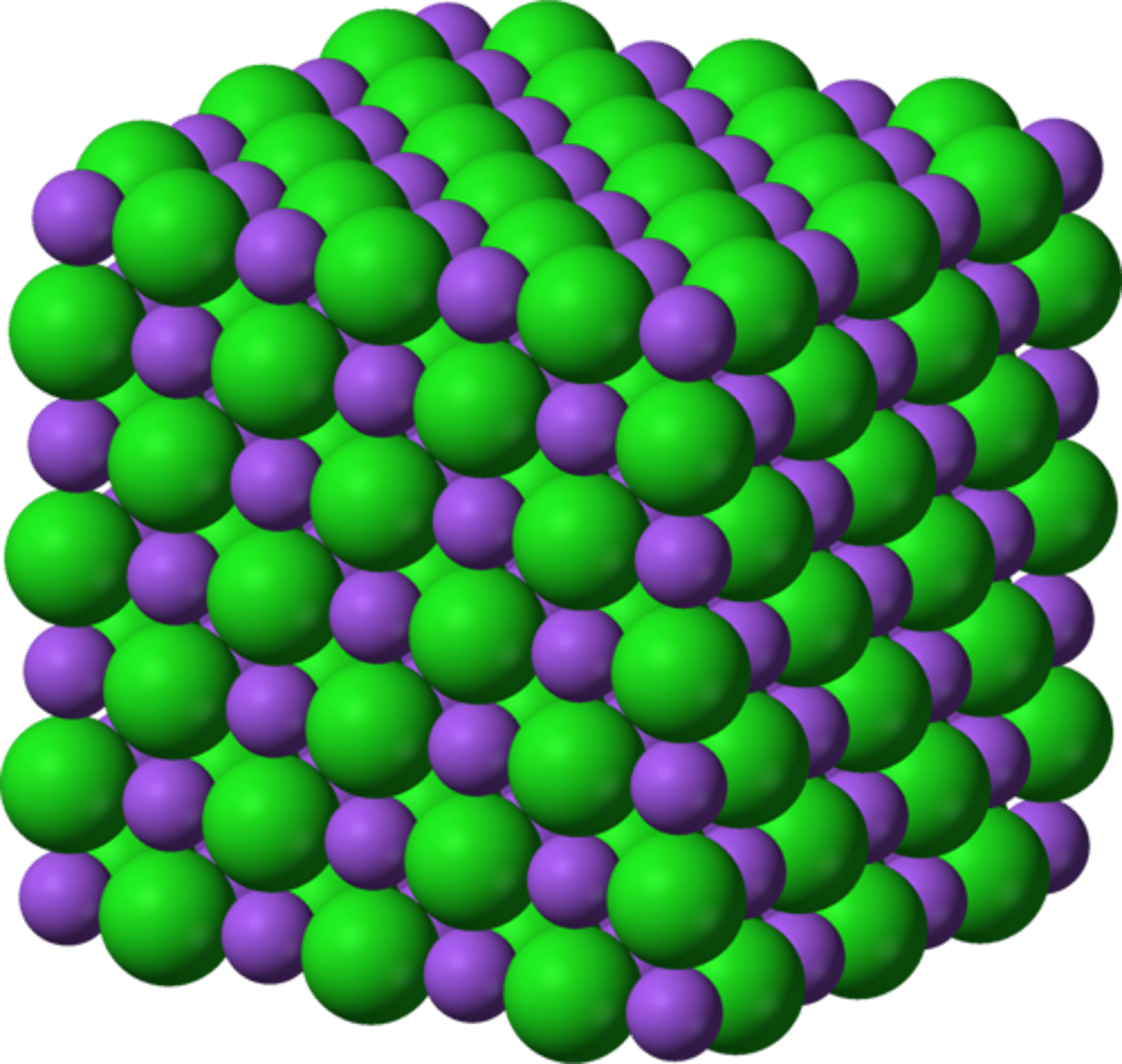
Properties of Ionic compounds
1. High melting points and boiling points
2. Most ionic compounds are crystalline solids at room temperature
3. Crystals - molecules which have a repeating three-dimensional structure
4. Ionic compounds are brittle. They will break apart if a force is applied to them.
5. Good conductors of electricity when dissolved in water or melted
Using e- Dot Structures to Derive Chemical Formulas for Ionic Compounds
1. write the dot structures for each element, placing the cation (metal) on the left side and the anion (nonmetal) on the right side.
2. Draw arrows from the valence electrons on the cation to the anion, to indicate transfer of e-s.
3. Bring in as many atoms of each element as needed to obtain a completely filled outer s and p sublevels for each atom present.