T22 - Nucleotide Metabolism
 Call Kai
 Learn
Learn Practice Test
 Spaced Repetition
 Match
Match Flashcards
 Knowt Play
1/22

There's no tags or description
Looks like no tags are added yet.
Name | Mastery | Learn | Test | Matching | Spaced | Call with Kai |
|---|
No analytics yet
Send a link to your students to track their progress
23 Terms
4 Example Roles of Nucleotides in Cell Metabolism
Building blocks of DNA and RNA
Co-substrates such as ATP
Supply components to other cofactors
Signalling molecules
3 Components of a Nucleotide
Nitrogenous base
Ribose/Deoxyribose sigar
1-3 phosphoryl groups (ATP essentially)
Nitrogenous Base vs Nucleoside vs Nucleotide
Nitrogenous base → Just the base by itself (adenine, guanine, thymine, cytosine)
Nucleoside → Base + Sugar
Nucleotide →> Base + Sugar + Phosphate
How many Rings do Purines have? Pyrimidines?
purines 2, pyrimidines 1
Which Bases are Purines
Adenine and Guanine → Silver (Ag) makes nice rings (plural for two rings)
Which Bases are Pyrimidines
Cytosine, Thymine(DNA), and Uracil (RNA)
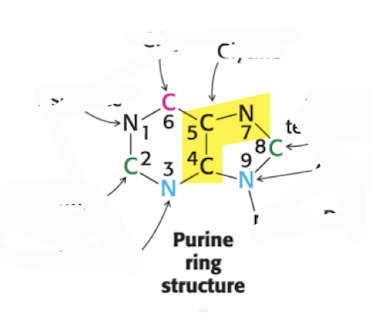
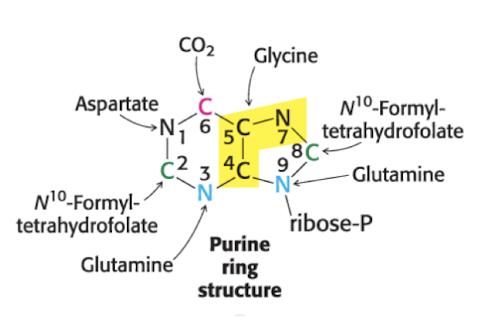
List Where the Atoms in a Purine Structure comes from (1-9)
Asparte
N-formyl tetrahydrofolate
Glutamine
Glycine
Glycine
CO2
Glycine
N-formyl tetrahydrate
Glutamine
Ribose-P
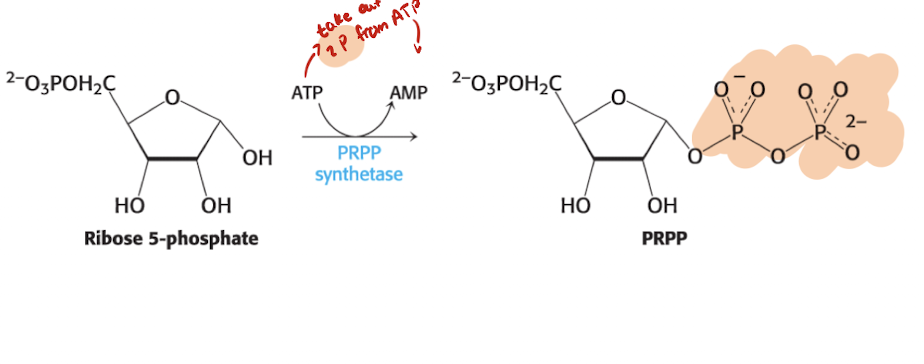
How is PRPP used in Purine and Pyrimidine Synthesis
AKA Phosphoribosyl Pyrophosphate
both purines and pyrimidine nucleotides utilize an activated phosphorylated form of ribose 5-phosphate (PRPP) as part of their respective pathways
purines → uses it as a scaffold upon which its nucleotides are built
pyrimidines → its nucleotides uses PRPP at a later stage of its synthesis pathway
What Enzyme is Responsible for transforming Ribose 5-phosphate → PRPP
PRPP Synthetase
Requires an ATP → AMP and the 2 terminal phosphoryl groups are attached onto the carbon 1 of Ribose 5-P to form Phosphoribosyl Pyrophasphate (see highlighted part in image)
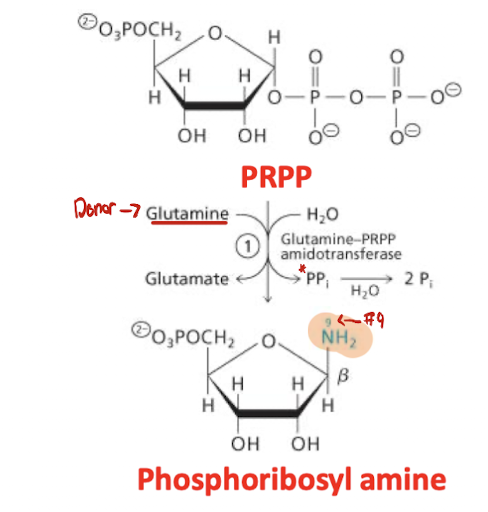
1st Step of Purine Synthesis
PRPP → Phosphoribosyl Amine
Uses transfer of an amino group from glutamine to PRPP
enzyme: Glutamine-PRPP Amidotransferase
In: Glutamine de-aminase into Glutamate
NH2 attaches to carbon 9
In: H2O Out: PPi → H2O → 2 Pi
How many Reactions to get from Phosphoribosyl Amine → Inosine Monophosphate (IMP)
(Apart of purine synthesis)
9 reactions (we don’t go into detail)
What must Happen to IMP to Create Adenine/Guanine-based Nucleotides (General)
The nitrogenous base of IMP must be altered
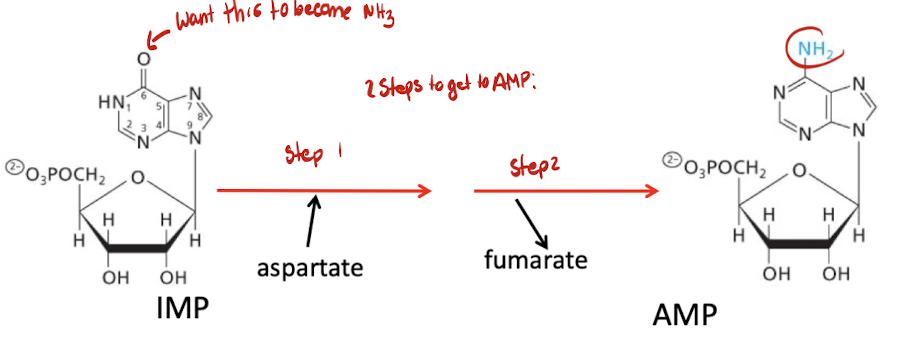
How to make Adenine-based Nucleotides from IMP (2)
IMP → AMP requires an amino group to be added on Carbon 6 of IMP
2 reactions required:
Aspartate in → donates amino group to another molecule
Fumarate out
How to make Guanine-based Nucleotides from IMP (2)
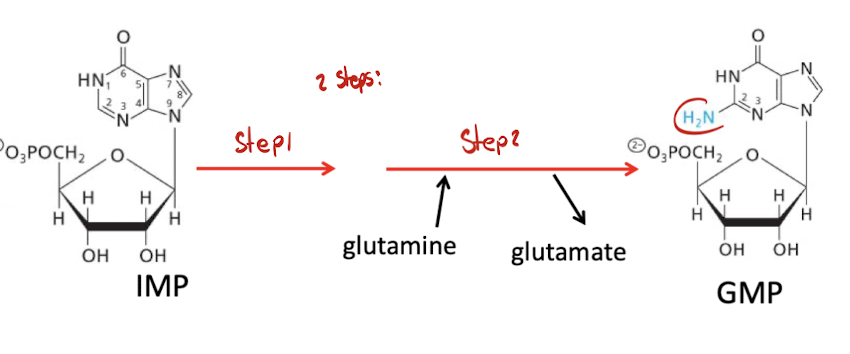
IMP → GMP requires an amino group to be added on carbon 2 of IMP
2 Steps required:
(not specified in course)
amino group comes from glutamine → glutamate
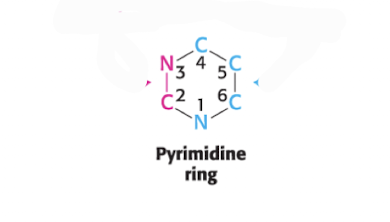
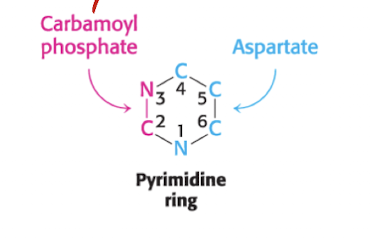
List Where the Atoms in a Pyrimidine Structure comes from (1-6)
1,4-6: Aspartate
2+3: Carbamoyl phosphate
T/F Carbamoyl phosphate used for pyrimidine synthesis is the same as the one found in urea cycle
False; the one used for pyrimidines is made in the cytosol, the one in urea cycle is made in the mitochondria
T/F Pyrimidine synthesis does not start with the PRPP scaffold
True; PRPP is added to orotate later in the pathway
1st Step of Pyrimidine Synthesis
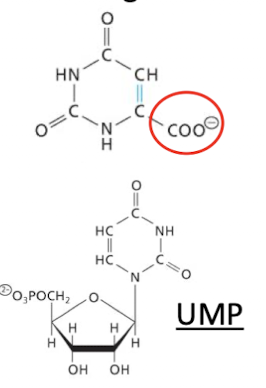
Begins with a nitrogenous base called Orotate → formed after a series of 6 reactions that we don’t cover in this course
PRPP is then added to Orotate and then COO (circled in red) is removed from the Orotidine ring to generate Uridine Monophosphate (UMP)
How to make Cytosine-based Nucleotides from UMP
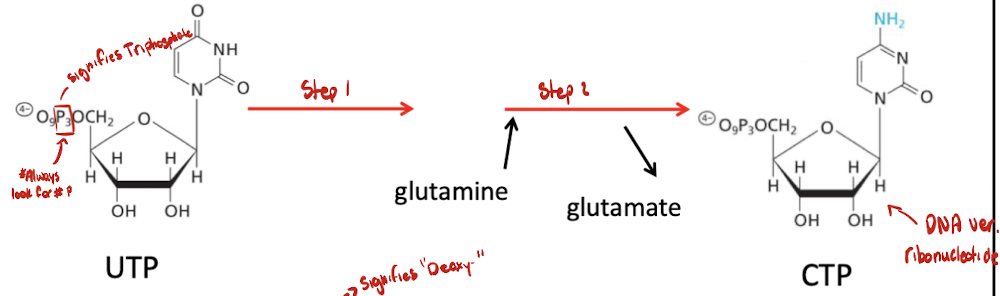
UMP → UDP → UTP → CTP
CTP cannot use UMP as stock, therefore we will have to change UMP into UTP by adding two phosphoryl groups
Requires 2 steps to add amino group to uracil to change into cytosine:
not covered in class
glutamine in, glutamate out
How to make Thymine-based Nucleotides from UMP
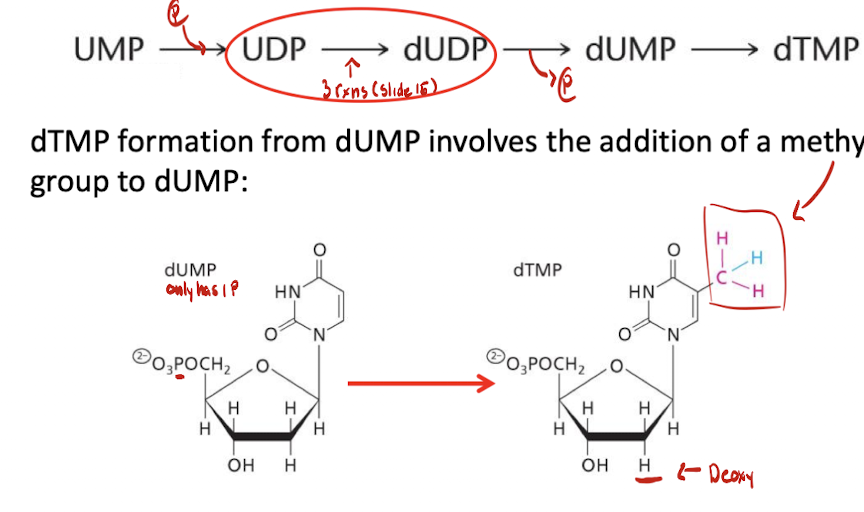
Thymine-based Nucleotides use a deoxyribose sugar (AKA will be in the form dTMP) so going from UMP to dTMP:
UMP → UDP → dUDP → dUMP → dTMP
A phosphate goes in UMP → UDP
UDP → dUDP modification to become deoxyribose (write out)
A phosphate goes out dUDP → dUMP
dUMP → dTMP requires an addition og a methyl group
Why are Purine Bases Recycled? What happens if they aren’t?
Purine synthesis if energetically costly and as a consequence, most of the purine bases are recycled to form new nucleotides
purines that are not recovered are broken down into Uric Acid and Sodium Urate
T/F Uric acid and Sodium urate are relatively soluble
False; they are relatively insoluble → accumulation leads to gout
Explain Gout
excess concentrations of the waste products uric acid and sodium urate (stems from purine degradation) leads to the formation of crystal structures in the soft tissues of the kidneys, toes and joints.
accumulation of the crystals in tissues mention leads to the painful symptoms associated with gout