Lecture 7: Helping, Sabotage, Collusion and Risk-Taking in Tournaments
 Call Kai
 Learn
Learn Practice Test
 Spaced Repetition
 Match
Match Flashcards
 Knowt Play
1/27

There's no tags or description
Looks like no tags are added yet.
Name | Mastery | Learn | Test | Matching | Spaced | Call with Kai |
|---|
No analytics yet
Send a link to your students to track their progress
28 Terms
What is an important potential problem with tournament-type incentives?
Ex-post:
Agents lose if they take actions that help their co-workers (e.g. sharing info, training, simple co-operation)
Agents gain if they can take actions that hurt their co-workers (i.e. sabotage)
Agents gain if they conspire to keep effort low
Name direct evidence of helping and sabotage in tournaments
Carpenter, Jeffrey, Peter Matthews and John Schirm. “Tournaments and Office Politics: Evidence from a real effort experiment” American Economic Review,100(1), 2010, 504-17
What were the facts of “Tournaments and Office Politics”?
“Real effort” experiment where 160 subjects spent 30 mins each stuffing envelopes
8 student subjects per session
Each student has computer, work table, “output box”, access to shared printer and list of names and addresses
Task: Complete form letter w/ names/addresses from list, hand address envelope, print letter, stuff it into envelope, add envelope to output box
After production, all participants (and experimenter) examined each others’ output boxes → counted no. of completed envelopes and rated quality of randomly-selected envelope on scale from 0 to 1
Quality also measured independently by US postal service letter carrier
What were the four treatments in “Tournaments and Office Politics”?
(1) Piece rates (baseline) - pay was $1 for each quality-adjusted envelope produced
Total pay = Nsi x Qsi (Nsi = no. of envelopes produced by subject i, Qsi = i’s quality, both as assessed by experimenter)
(2) Tournament - same as piece rates + $25 bonus to worker w/ highest Nsi x Qsi
(3) Tournament w/ sabotage - same as tournament BUT quantity and quality measures were mean assessments of your 7 co-workers + experimenter
(4) Piece rate w/ sabotage - same as piece rate BUT quantity and quality measures were mean assessments of your 7 co-workers + experimenter
How did workers assess each other’s performance?
(1) Piece rate - workers assessed each other’s output more generously than ‘objective’ postal worker (11.74 > 11.12)
(2) Tournament - even though evaluations didn’t affect how workers were ranked, workers now less generous than objective measure (11.34 < 12.30)
(3) Tournament w/ sabotage - workers sabotaged each other and dramatically underestimated co-workers’ outputs (7.60 < 9.63)
(4) Sabotage was ‘shameless’ - involved misreporting of both quality and quantity
(5) Sabotage was directed - workers more likely to undercount colleague’s output if colleague produced more envelopes than they did
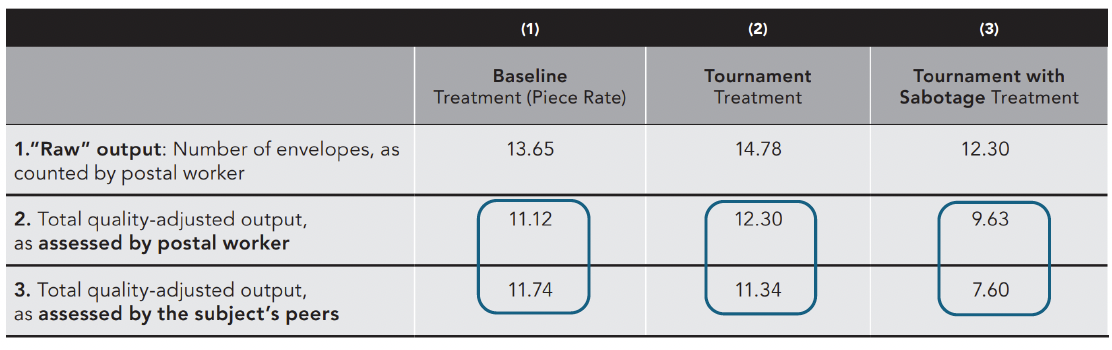
How did different incentive schemes affect workers’ actual performance?
(1) Strengthening incentives by adding a prize (BUT not using peer evaluations) raises both quality and quantity of output → as assessed by objective observer
(2) Allowing for peer evaluations in presence of prize dramatically reduces both measured output and actual objective output
Objective output even falls below output w/ straight piece rate → despite firm offering stronger, more costly incentives than in straight piece rate
Thus, workers anticipate competitors will ‘undervalue’ their work → not worth supplying as much effort
What were the overall findings of “Tournaments and Office Politics”?
Sabotage can occur and cooperation between workers likely reduced when workers compete in tournaments → effect can be large enough to make tournaments less effective scheme than piece rates
Note: Sabotage can inc. more than just destroying or undervaluing co-workers’ output → e.g. failing to help, co-operate, train and share info
What are the implications of “Tournaments and Office Politics”?
Don’t use tournaments when worker cooperation/info sharing is important aspect to production and when workers can observe each other’s performance (allows them to direct their sabotage most effectively)
Don’t use tournaments + peer performance valuation together
If you must use tournaments → reduce prize spread when cooperation/info sharing is important, try conceal workers’ performance info from each other, consider inc. measures of worker cooperation in job performance criteria
Name direct evidence of collusion in tournaments
Bandiera, Oriana, Iwan Barankay, and Imran Rasul. “Social Preferences and the Response to Incentives: Evidence from Personnel Data” Quarterly Journal of Economics, 2005, 120(3). 917-62
What were the facts of “Social Preferences and the Response to Incentives”?
Study “soft fruit” pickers on British farm → output measured in kg of fruit picked
Worker’s output does NOT meaningfully depend on other workers’ job performance
Bandiera et al. know friendship networks of all workers at farm
1st half of 2002 season → workers paid under relative incentive scheme
2nd half of 2002 season → received straight individual piece rate
Under both incentive schemes → worker’s pay for day given by bKi (Ki = kg individual picks, b = day’s piece rate)
How was b determined under piece rate scheme?
b fixed at beginning of day by manager → based on her assessment of field and fruit conditions
How was b determined under relative incentives?
Manager announced expected b at start of day → BUT actual b determined at end of day based on formula (see pic)
e.g. If firm wants avg worker to earn £50 per day and avg output today was 40kg → piece rate paid to all workers is £50/40kg = £1.25/kg picked
Worked who picked avg amount (Ki = K) earned w
Above-avg workers earned more than w for the day → below-avg workers less

Under relative incentives, how does an individual workers’ productivity affect other workers?
Since working hard raises both Ki. and K → my choice to work hard hurts other workers on the field that day
Farm introduced relative incentive scheme during 1st half of season to difference out common productivity shocks (e.g. weather and field conditions)
Why did the firm switch back to piece rates in the middle of the 2002 season?
Output under relative incentives were very disappointing
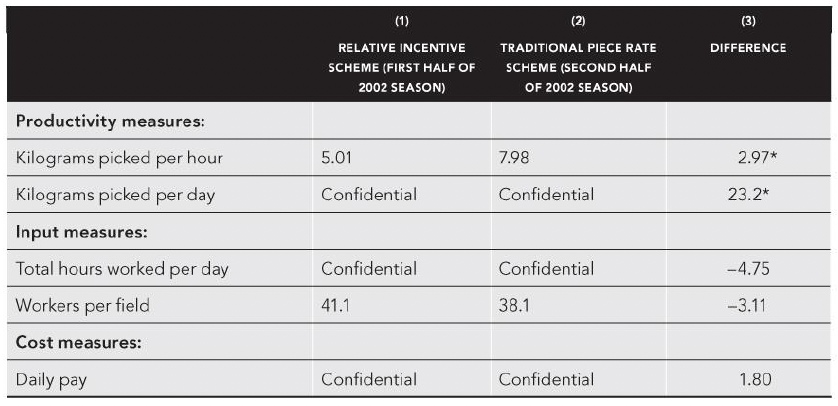
Was the lower output under relative incentives due to factors other than the difference in pay policy?
Field quality - authors checked for this using field fixed effects and field life cycle variable
Worker quality - adjusted for this using worker fixed effects and control for worker experience
Seasonality - authors corrected for this using time trend and data from 2004
What are the most likely explanations for low output under relative incentives?
Altruism → if workers care about co-workers’ incomes, may restrain themselves to avoid reducing group’s piece rate
Collusion → selfish workers could be implicitly co-operating to keep piece rate high (by keeping output low)
Both altruism and collusion should be more prevalent when working w/ friends → under relative incentives, avg worker’s productivity is 21% lower when working w/ 5 of their friends than working w/ no friends
Suggests either altruism or collusion (or both)
How did the authors of “Social Preferences and the Response to Incentives” distinguish between altruism and collusion?
Looked at workers’ performance when picking “type 2 fruit” → even on same field, workers can’t observe each other
Smaller avg group size (about 10) → should intensify altruism effects if they exist
Relative incentives did NOT reduce workers’ output of type 2 fruit → thus likely collusion
What were the overall findings of “Social Preferences and the Response to Incentives”?
Collusion can occur when workers compete in tournaments → effect can be large enough to make tournaments less effective incentive scheme than piece rate
Collusion more common when workers know each other and generally possible only when workers can observe each other’s output
Thus, don’t use tournaments when collusion likely to be major problem (e.g. small work groups, workers know each other well, expect to stay together long time)
If using tournaments → larger work groups, reshuffle work groups periodically, keep worker performance info confidential
Theoretically, how does changing the role of luck affect agents’ (ex post) interests?
Hvide (2002) - changing role of luck almost always in agents’ (ex post) interests and is socially inefficient
Raising role of luck is attractive strategy for agents who (due to low ability, high effort costs or unlucky interim results) have little chance of winning tournament → even w/ high levels of effort
Reducing role of luck can be attractive to agents ahead in a tournament
Name empirical evidence of risk-taking in tournaments
Brown, K., Harlow, W., Starks, L., 1996. “Of tournaments and temptations: an analysis of managerial fund incentives in the Mutual Fund Industry”. Journal of Finance, 51, 85–110
What were the facts of “Of tournaments and temptations”?
Study of mutual fund managers (1976-1991)
Pay of mutual fund managers → generally % of assets under management
Assets under management → depend on fund’s relative performance during recent ratings periods as assessed by various rating agencies
Thus, managers’ compensation depending on fund’s relative performance for entire calendar yr
What were the hypotheses in “Of tournaments and temptations”?
(1) Did managers whose funds were ‘behind’ (i.e. performing below avg for their type of fund) at mid-year take actions to increase riskiness of their portfolios?
2 reasons to expect this → (1) effect of being behind in tournament itself and (2) even when assets under management fall, managers’ compensation can’t fall below certain base level each yr
Thus, low-performing fund managers have little to lose by increasing riskiness of portfolios in mid-yr
(2) Above effect likely stronger for smaller, newer funds w/ less established track record
Results: Both hypotheses confirmed → effect much stronger in last half of sample period when many more funds entered and investor awareness of relative performance was much higher
How did managers alter risk in “Of tournaments and temptations”?
Passively? → by just holding on to stocks that have become more risky
Actively? → selling safe stocks and buying risker ones
Based on simulations of what an unmanaged portfolio would do over this period → managers actively raise risk levels
What are the implications of “Of tournaments and temptations”?
Consider avoiding tournaments in situations where agents can take actions that increase riskiness of production process or add noise/confusion to evaluation process
If you must use tournaments in these situations → consider limiting agent’s discretion over risk OR penalising high level of variance in agent’s performance
What did Leuven et al. (2011) find regarding selection into tournaments?
Conducted experiment where students could self-select into 1 of 3 competitions w/ different prize levels - €1000, €3000, €5000 → student w/ highest grade in each competition won the prize
Most-able students (based on prior course performance) self-selected into highest-prize tournaments
Avg grades much higher in high-prize competitions → none of the grade differences due to increased student effort - entire performance gap due to self-selection
Thus, tournaments w/ large prize spreads (i.e. jobs w/ chances for big promotions) likely to attract more qualified workers
What did Eriksson et al. (2009) find regarding selection into tournaments?
Let laboratory subjects choose between tournament-based pay and individual piece rate w/ equal expected value
Under-confident subjects and risk-averse workers avoided tournament
Performance under both pay schemes higher when subjects could self-select than when they were randomly assigned
What did Camerer and Lovallo (1999) find regarding selection into tournaments?
Studied decisions of students to enter competitive ‘industry’ where payoff per entrant decreases w/ no. of entrants
Before contest → used sports trivia to assess each contestant’s level of confidence (comparing actual versus predicted rank)
Large majority of subjects were overconfident
Overconfident subjects more likely than others to enter competition
Led to dramatic over-entry → entrants earned positive profits in only 3 out of 48 possible cases
Thus, systematic overconfidence may help explain very high failure rates of new businesses in essentially all countries
Do humans receive intrinsic rewards from rank?
Blanes i Vidal, Jordi and Mareike Nossol. “Tournaments Without Prizes: Evidence from Personnel Records” Management Science, 57 (10)1721-1736
Data from single warehouse for German wholesale/retail company → workers’ jobs were filling orders for goods, pay had piece rate component and quality was not an issue
Management experimented w/ policy of showing employees their relative rank when they were paid
Authors found significant upticks in productivity for all ranks of workers
Thus, in short run → extra productivity w/o paying any more