Phys ii final Long's Problems
 Call Kai
 Learn
Learn Practice Test
 Spaced Repetition
 Match
Match Flashcards
 Knowt Play
1/22

There's no tags or description
Looks like no tags are added yet.
Name | Mastery | Learn | Test | Matching | Spaced | Call with Kai |
|---|
No analytics yet
Send a link to your students to track their progress
23 Terms
A uniform 4.5-T magnetic field passes through the plane of a wire loop 0.10 m2 in area. What flux passes through the loop when the direction of the 4.5-T field is at a 30° angle to the normal of the loop plane?
a. 5.0 Tm2
b. 0.52 Tm2
c. 0.39 Tm2
d. 0.225 Tm2
ϕ = BAcosθ
= (4.5 T)(0.10m2) cos(30°)
= 0.39 Tm2
A solenoid with 500 turns, 0.10 m long, carrying a current of 4.0 A and with a radius of 10-2 m will have what strength magnetic field at its center? (magnetic permeability in empty space µ0 = 4π * 10-7 Tm/A)
a. 31 10−4 T
b. 62 10−4 T
c. 125 10−4 T
d. 250 10−4 T
B = μ0(N/L)I
= (4π x10-7)(500/0.10m)(4.0 A)
= 250 × 10-4 T
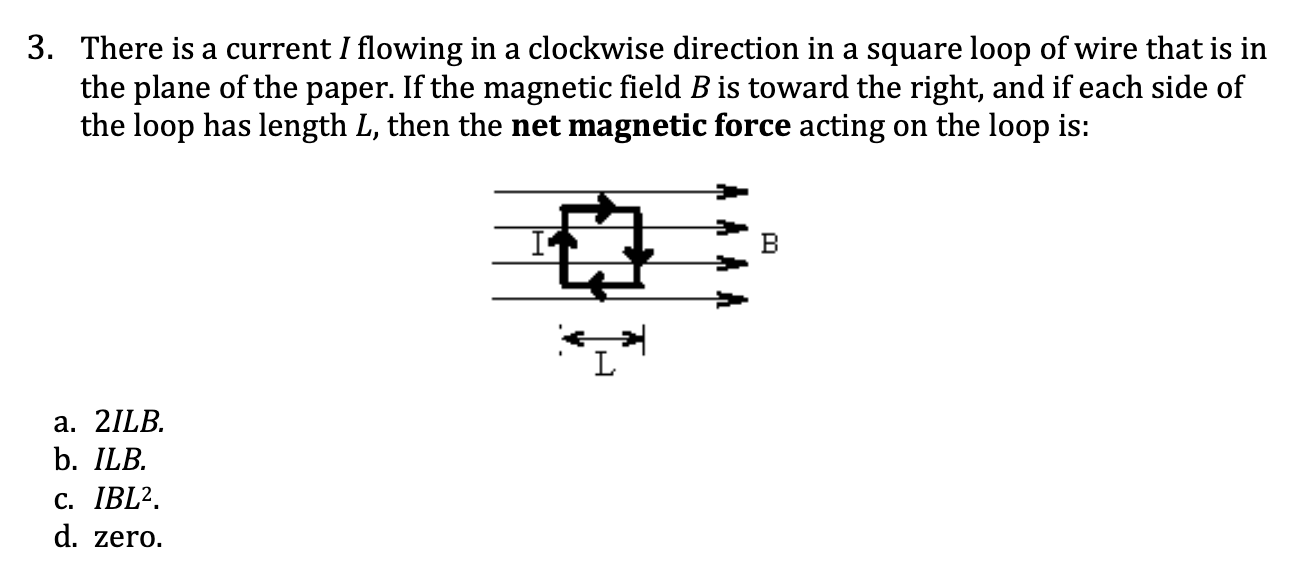
There is a current I flowing in a clockwise direction in a square loop of wire that is in the plane of the paper. If the magnetic field B is toward the right, and if each side of the loop has length L, then the net magnetic force acting on the loop is:
a. 2ILB.
b. ILB.
c. IBL2.
d. zero
zero
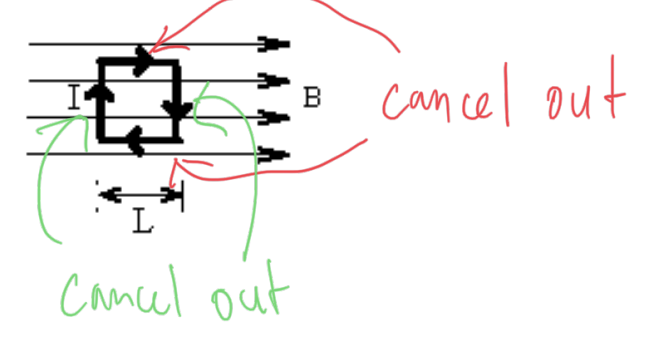
Protons are accelerated through a potential difference of 1000 volts and then enter a magnetic field of 0.1 tesla perpendicular to their direction of motion. Find the speed of the proton when it first enters the region of magnetic field. (The mass of proton is mp = 1.67x10⁻²⁷ kg)
a. 0
b. 1.25*10^3m/s
c. 2.19×10^4m/s
d. 4.38×10^5m/s
(1/2)mv2 = qV —> v = √(2qV)/m
velocity = √ 2(1.6×10^-19 C)(1000V) / (1.67×10^-27)
= 4.38×10^5m/s
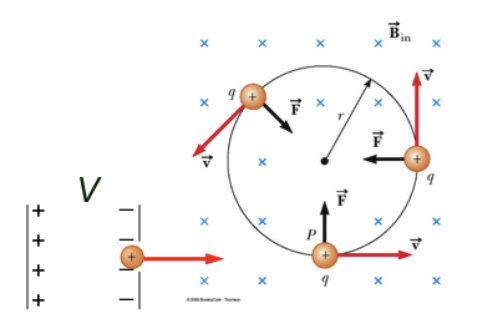
Following the previous problem (v = 4.38×10^-27kg), calculate the radius of their path. mp = 1.67x10⁻²⁷ kg and e =1.6×10^-19 C
a. 0.023 cm
b. 0.046cm
c. 0.046mm
d. 0.023km
Fc = qvB = (mv)2/r —> r = (mv)/(qB)
r = (1.67×10⁻²⁷)(4.38×10⁻²⁷kg) / (1.6×10⁻¹⁹ C)(0.1T)
= 0.046 m
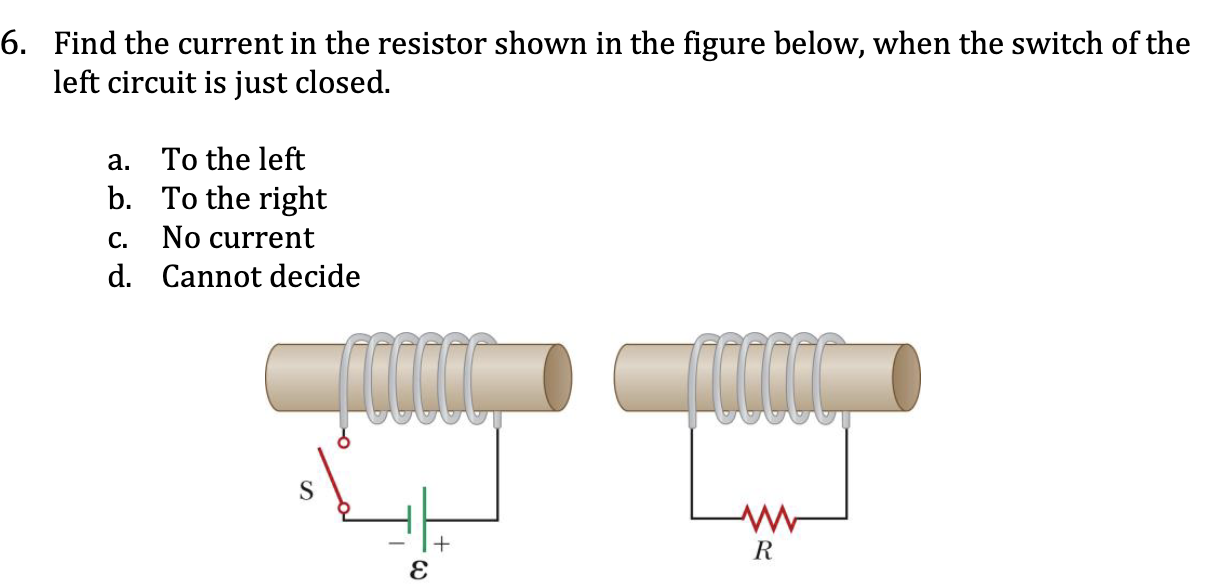
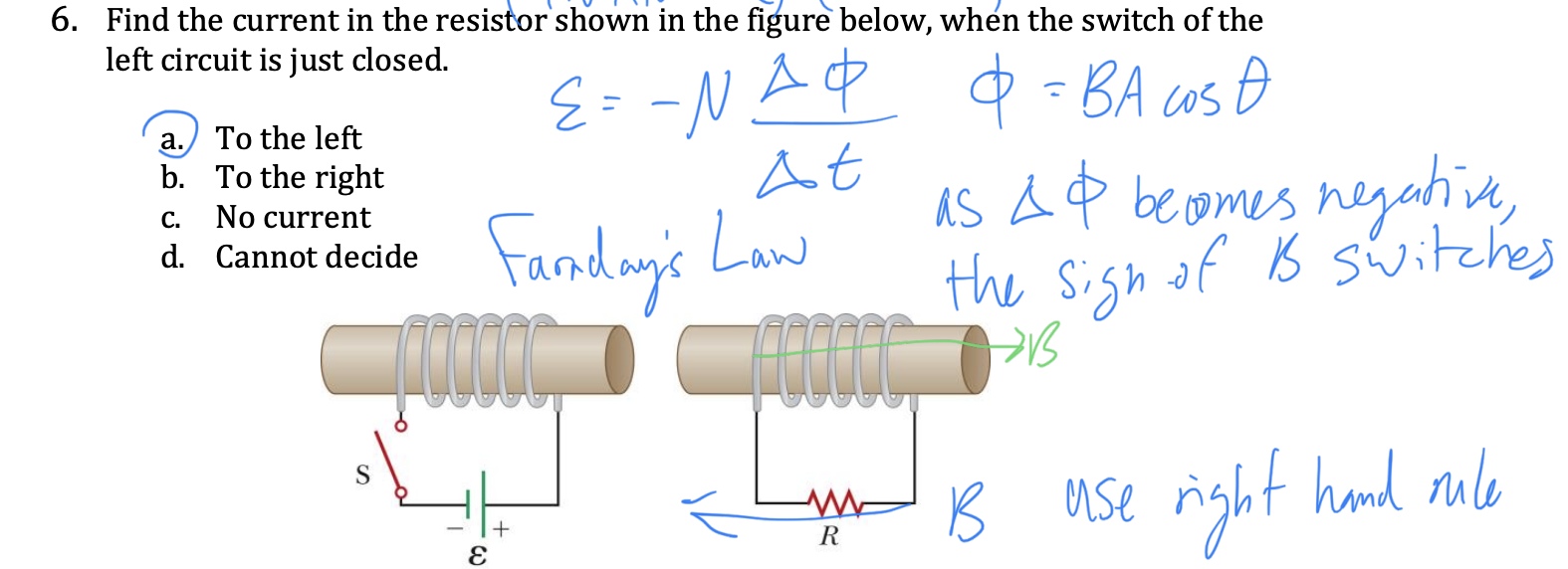
Find the current in the resistor shown in the figure below, when the switch of the left circuit is just closed.
a. To the left
b. To the right
c. No current
d. Cannot decide
a
Calculate the inductance of a solenoid containing 300 turns if the length of the solenoid is 25.0cm and its cross-sectional area is 4.00 * 10-4 m2.
a. 0mH
b. 0.045 mH
c. 0.181 mH
d. 0.09 mH
L = μ0n2V
where n = N/ℓ ; V = A*ℓ
turns to L = μ0(N/ℓ)2 (A*ℓ)
L = (1.256×10⁻⁶)(3002/0.250)(4.00×10-4)
= c. 0.181 mH
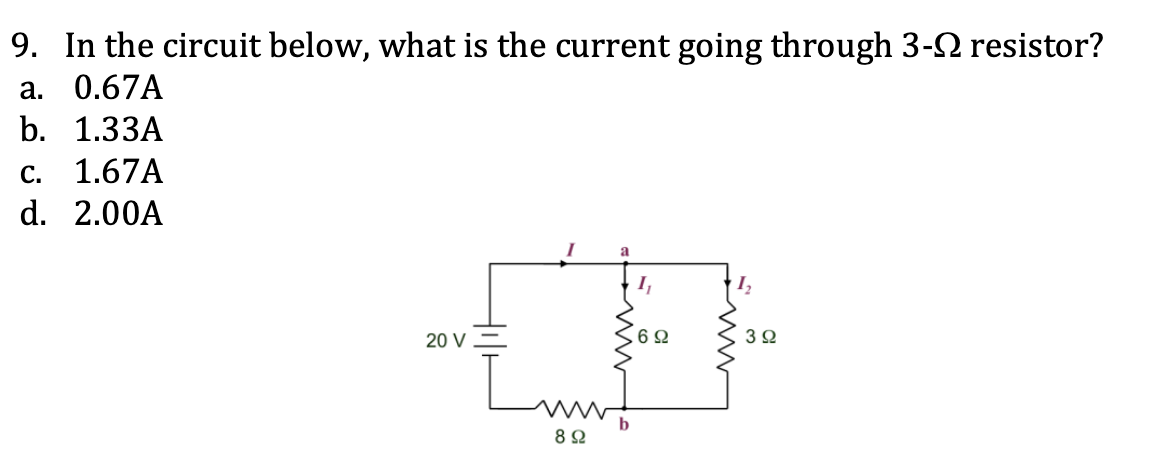
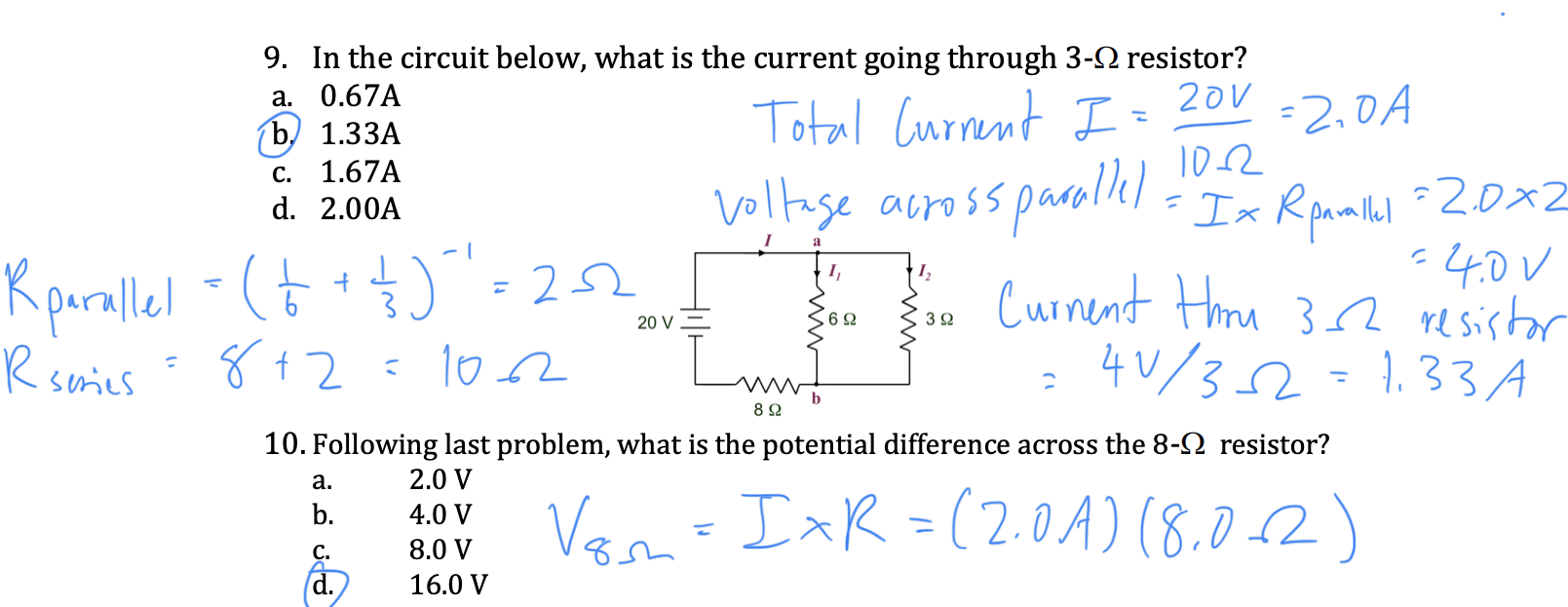
in circuit shown, whats the current going through 3 ohm resistor?
a. 0.67 A
b. 1.33 A
c. 1.67 A
d. 2.00 A
1) start with parallel by finding resistance
1/Rp = 1/R1 + 1/R2
1/Rp = 1/R1 + 1/R2
= 1/6 + 1/3 = 3/6 = ½
FLIP —> Rp = 2
2) add 8 ohm to find total resistance
Rtotal = 8+2 = 10 ohm
3) Find total current
I = V/R = 20/10 = 2A
4) find voltage across parallel section
Vparallel = Itotal Rparallel = 2×2= 4V
5) find current through 3 ohm resistor
I = Vparallel / R = 4/3
= 1.33 A
10) following last problem (total current = 2 A) , whats the potential difference across the 8-ohm resistor?
a. 2V
b. 4V
c. 8V
d. 16V
V8 ohm = I x R = (2A)(8 ohm)
= 16 V
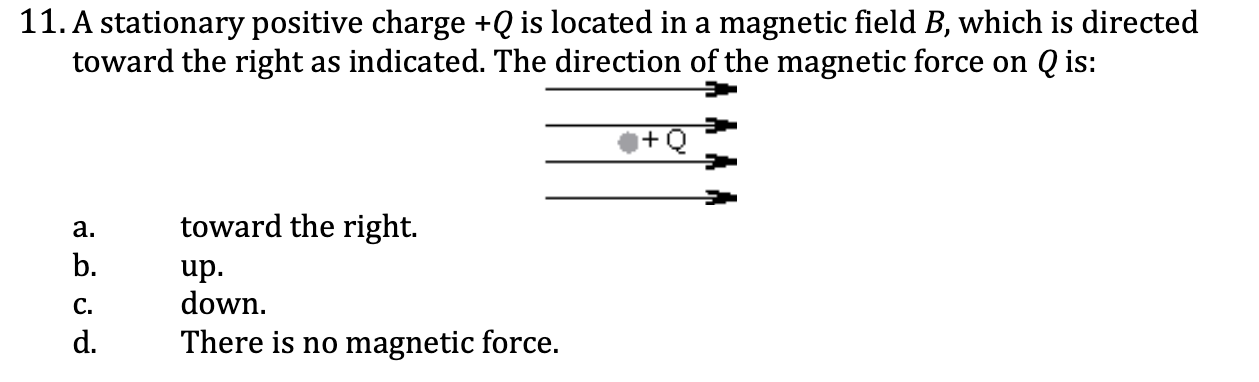
A stationary positive charge +Q is located in a magnetic field B, which is directed toward the right as indicated. The direction of the magnetic force on Q is:
a. toward the right
b. up
c. down
d. theres no magnetic force
F = qvBsinθ
“stationary” means v = 0
= theres no magnetic force
12. An AC voltage source, with a peak output of 200 V, is connected to a 50-ohm resistor. What is the rms current in the circuit?
a. 2.8 A
b. 4.0 A
c. 5.6 A
d. 2.0 A
1) for AC circuits:
Vrms = (Vmax) / √ 2
= 200/√2 = 141.4 V
2) Irms = 141.4 / 50
= 2.8 A
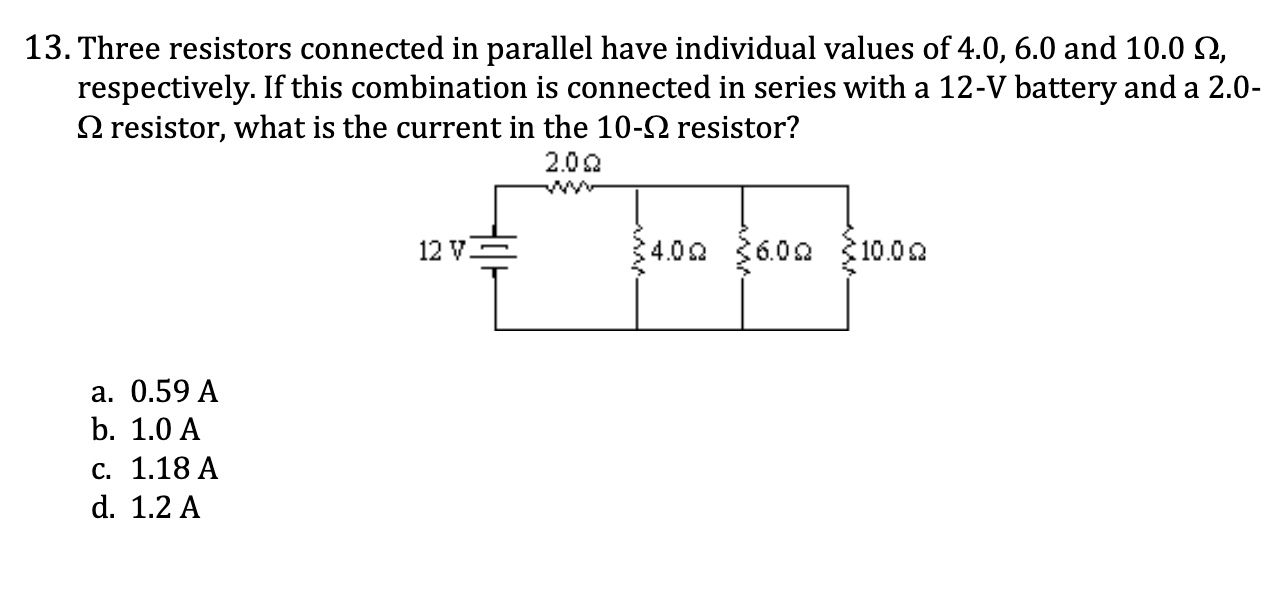
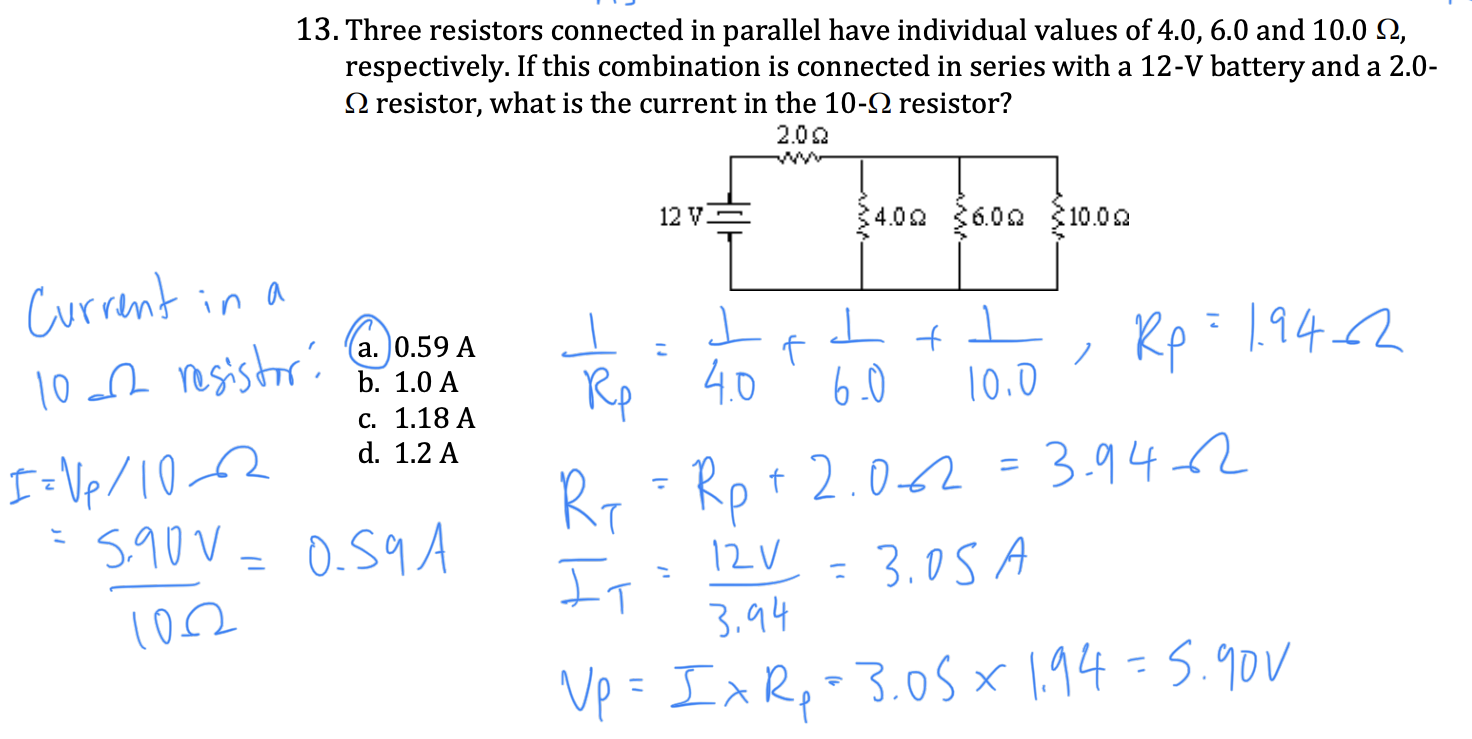
13. Three resistors connected in parallel have individual values of 4.0, 6.0 and 10.0 -ohm, respectively. If this combination is connected in series with a 12-V battery and a 2.0- ohm resistor, what is the current in the 10-ohm resistor?
a. 0.59 A
b. 1.0 A
c. 1.18 A
d. 1.2 A
1) find equiv resistance of parallel part
1/Rp = ¼ + 1/6 + 1/10 = 31/60
FLIP —> 60/31 = 1.94-ohm
2) add series resistors
Rtotal = 2 + 1.94 = 3.94-ohm
3)Find total current
I = V/R = 12V / 3.94 = 3.05A
4) find voltage across parallel branch
Vp = Itotal x Rparallel
= (3.05) x (1.94)
= 5.9 V
5) current thru 10-ohm
I = Vparallel/R
= 5.9V / 10-ohm
= 0.59 A
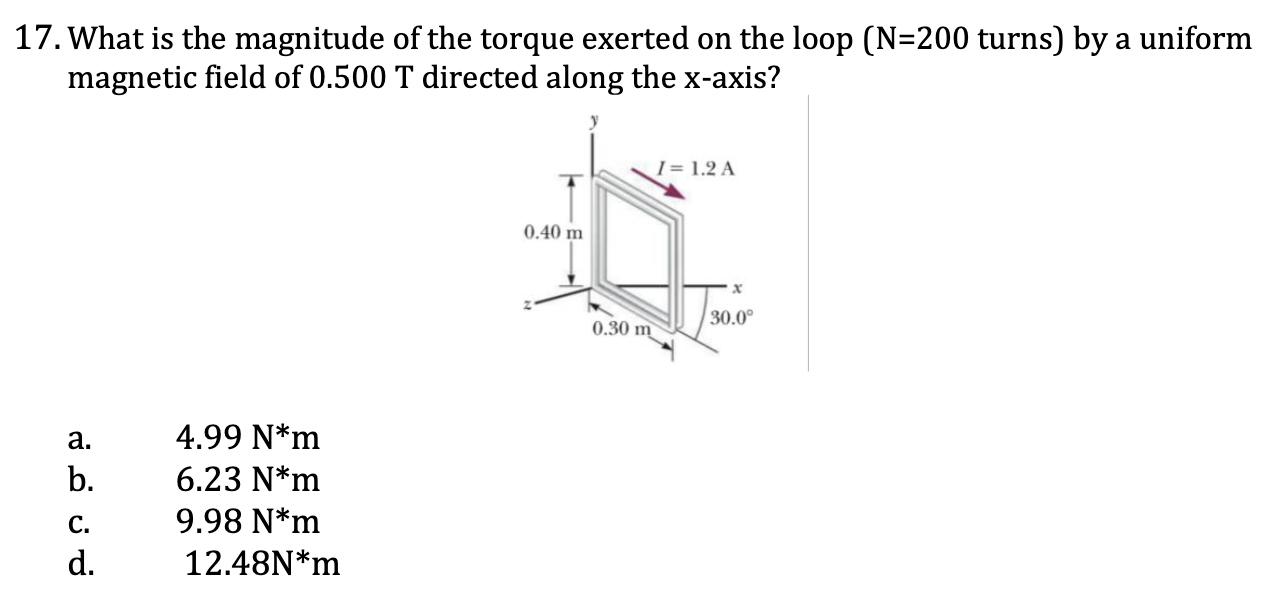
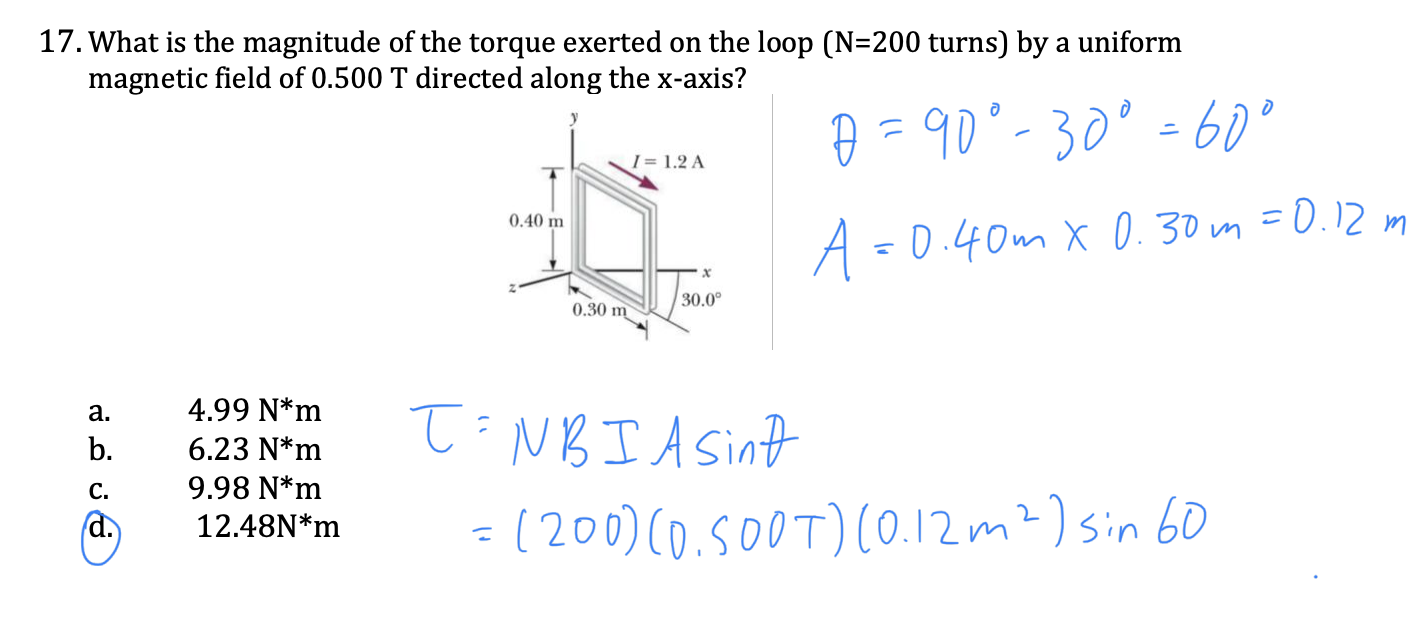
17. What is the magnitude of the torque exerted on the loop (N=200 turns) by a uniform magnetic field of 0.500 T directed along the x-axis?
a. 4.99 N*m
b. 6.23 N*m
c. 9.98 N*m
d. 12.48N*m
1) find prereq DEGREES for τ formula
θ = 90deg - 30deg = 60deg
do (90deg - theta) ONLY when problem gives angle of the surface
⭐ Example where you DO subtract:
“A magnetic field makes a 20∘20^\circ20∘ angle with the plane of the loop.
👉 KEYWORD plane. That means: 90−20=70 deg
Use: θ =70 deg
⭐ Example where you DO NOT subtract:
“A magnetic field makes a 20∘20^\circ20∘ angle with the normal to the loop.”
👉 KEYWORD normal. That already IS the perpendicular arrow.
So: θ = 20 deg. No subtraction.
2) find prereq AREA for formula
A = (0.40m) x (0.30m) = 0.12 m2
3) solve formula
τ = NBIAsinθ
= (200)(0.500T)(0.12m2)sin60
= 12.48 N*m
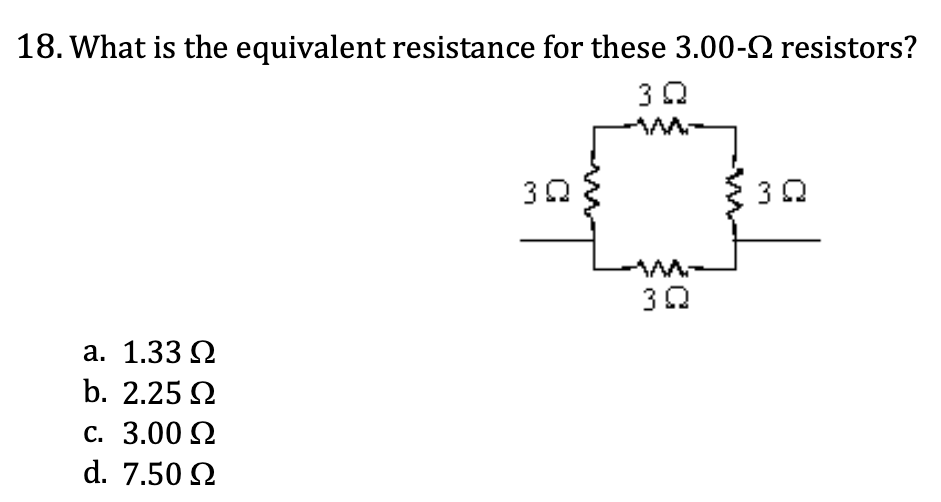
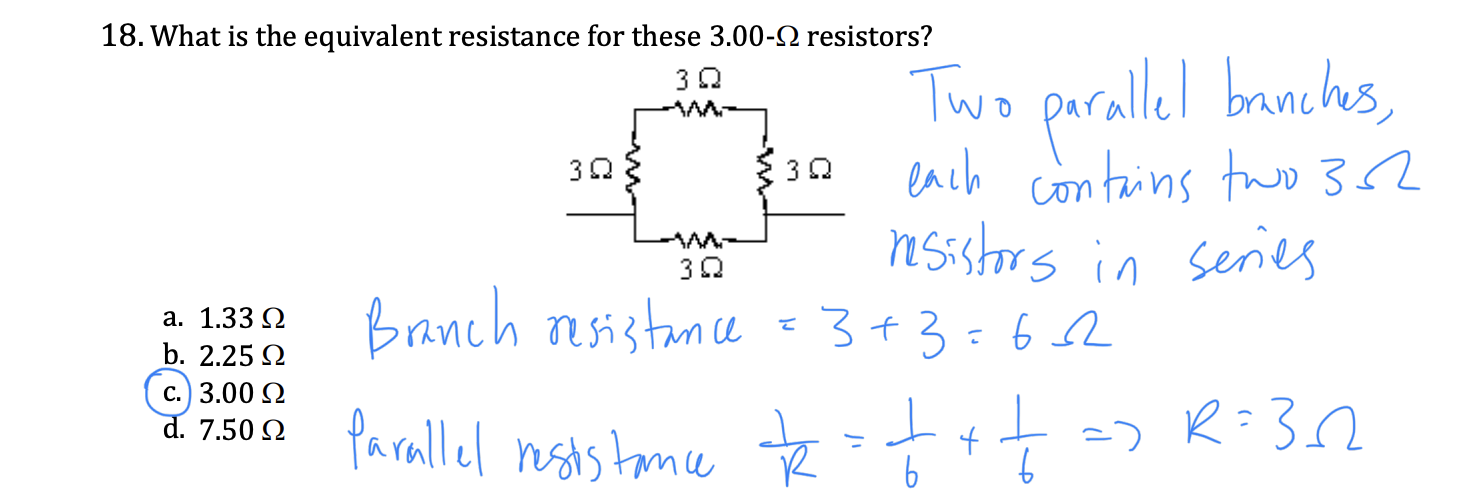
What is the equivalent resistance for these 3.00-ohm resistors?
a. 1.33
b. 2.25
c. 3.00
d. 7.50
3.00 ohm
the rod in the diagram is moving at a speed of 15.0m/s perpendicular to a magnetic field of 0.5 T. the rod has a length of 2 m and has negligible resistance, as do the rails. the resistance of R is 20-ohm. whats the electric power produced in the resistor?
a. 1.125 W
b. 22.5 W
c. 2.25 W
d. 11.25 W
ε = BLv, P = V2/R
ε = (0.5 T)(2m)(15.0m/s)
= 15V
P = 152V / 20-ohm
= 11.25 W
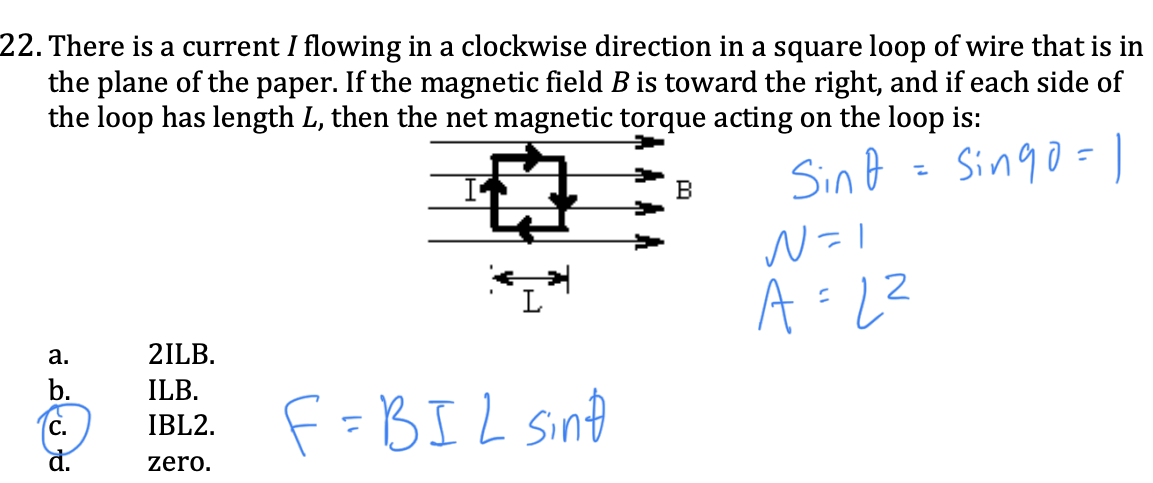
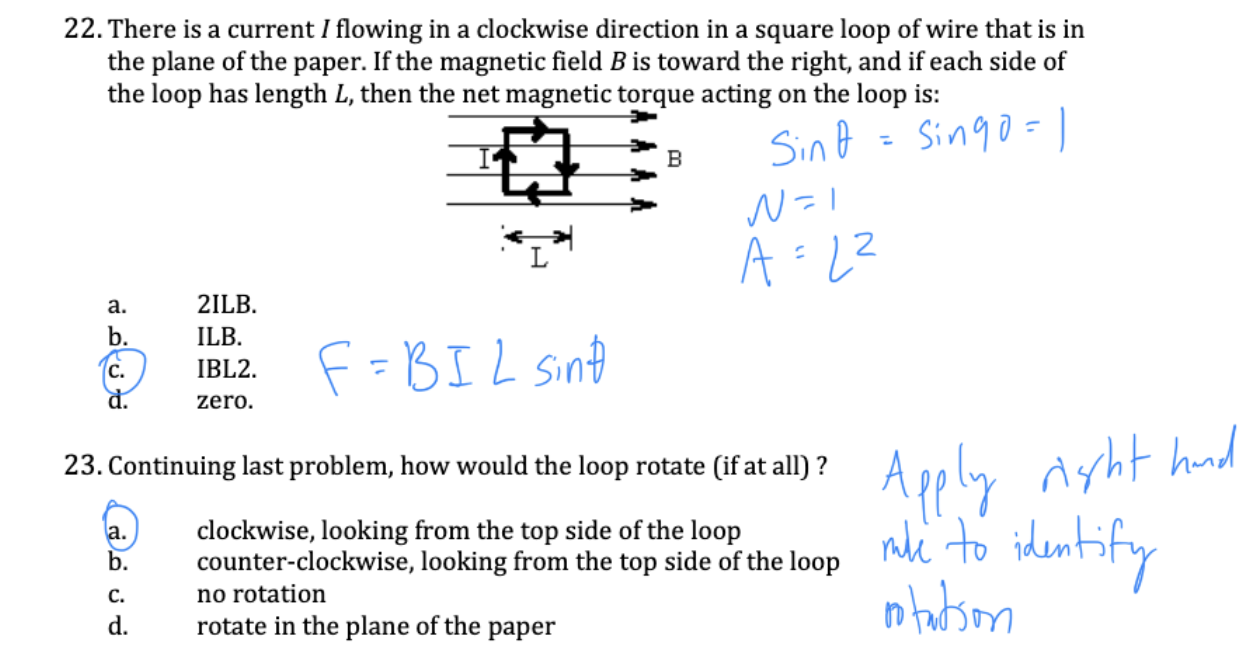
There is a current I flowing in a clockwise direction in a square loop of wire that is in the plane of the paper. If the magnetic field B is toward the right, and if each side of the loop has length L, then the net magnetic torque acting on the loop is:
a. 2ILB
b. ILB
c. IBL2
d. zero
w/ q3 ?????sin θ = sin 90 = 1
N = 1
A = L2
F = BILsinθ (force on a wire key formula)
= IBL2
2 comes from the fact that its a square loop and has two sides of the loop contributing equally
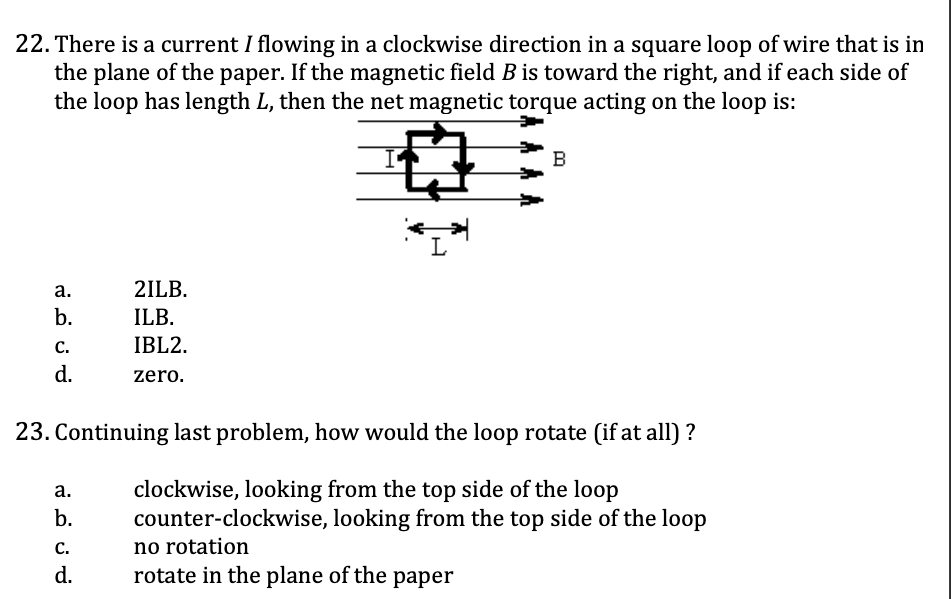
continuing last problem , how would the loop rotate (if at all)?
a. clockwise, looking from the top side of the loop
b. counter-clockwise, looking fr the top side of the loop
c. no rotation
d. rotate in the plane of the paper
a. clockwise, looking fr the top side of the loop
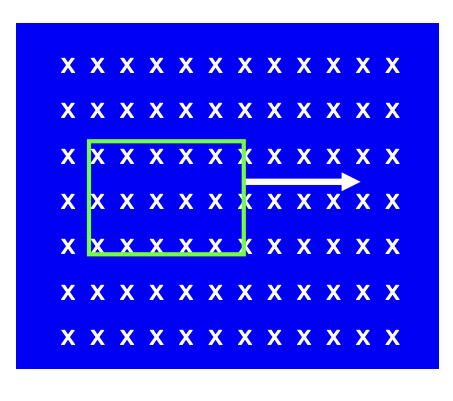
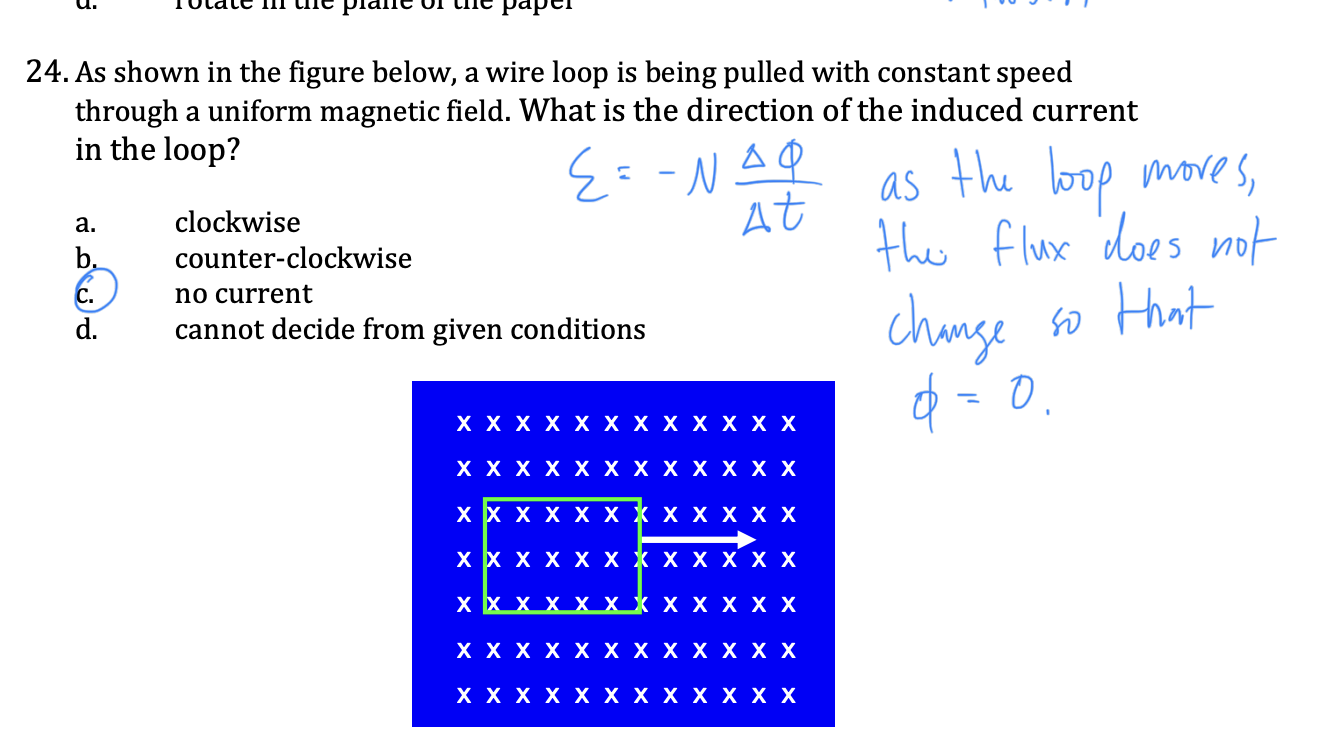
As shown in the figure below, a wire loop is being pulled with constant speed through a uniform magnetic field. What is the direction of the induced current in the loop?
a. clockwise
b. counter-clockwise
c. no current
d. cannot decide fr given conditions
no current
“x x x” means: magnetic field is like arrows going into the screen
even though the loop is moving, its still sitting in the same “magnetic environment” the whole time. So nothing is changing → noting is induced.
flux is constant, not changing
25. Consider a series RLC circuit for which R=150-ohm, L=20.0mH, delta Vrms=20.0V, and the resonance frequency f0=796s-1, Determine the value of the capacitance.
a. 2.00 uF
b. 3.00 uF
c. 4.00 uF
d. 6.00 uF
f0 = 1/ (2π√ LC) —> 1) solve for C —> C = 1/ 4π2f02L
2) convert units of mH to H
20.0 mH —> L= 0.020 H
3) Plug everything in
C = 1/ 4π2(796)2(0.020)
C = 2.0 × 10⁻⁶ F
4) convert to microfarads
= 2.0 uF
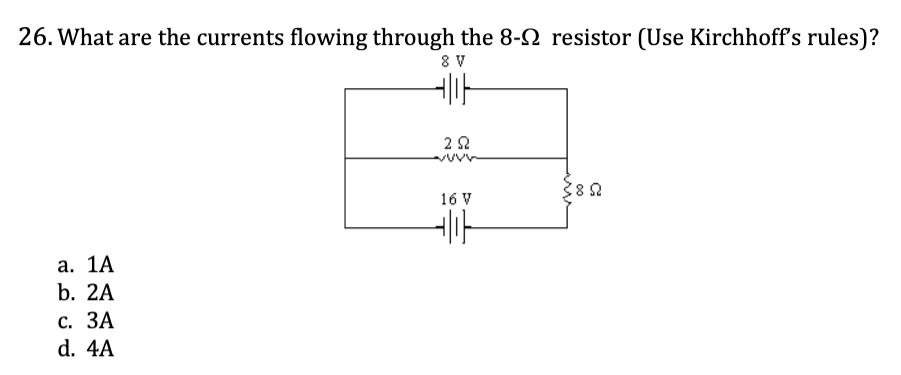
26. What are the currents flowing through the 8-ohm resistor (Use Kirchhoff’s rules)?
a. 1A
b. 2A
c. 3A
d. 4A
I = V/R
= 16V / 8Ω
= 2A
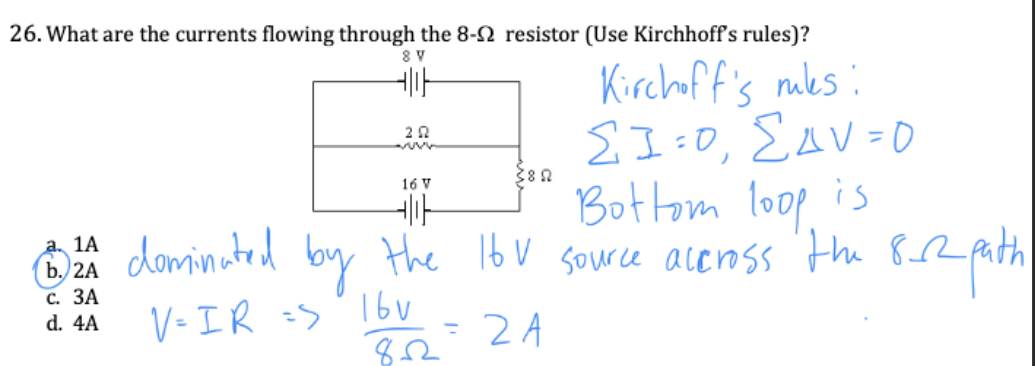
28. Consider two long, straight parallel wires, each carrying a current I. If the currents
are flowing in same directions: please draw the directions of magnetic field for the
two wires on the figure below will the wires repel each other or attract each other?
(Consider the direction of the magnetic force, from the magnetic field of one wire, on
the other wire.)
a. the two wires will attract each other.
b. the two wires will repel each other.
c. the two wires will exert a torque on each other.
d. neither wire will exert a force on the other.
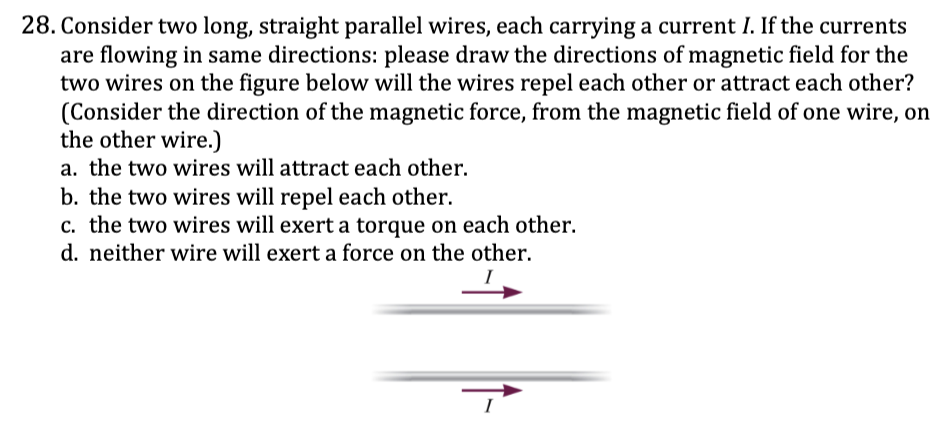
parallel currents attract, opp currents repel
use right hand rule
thumb = curent direction
fingers curl = magnetic field around wire
ea wire creates a magn field
that field exerts a force on the other current
F = BILsinθ
the two wires will attract each other
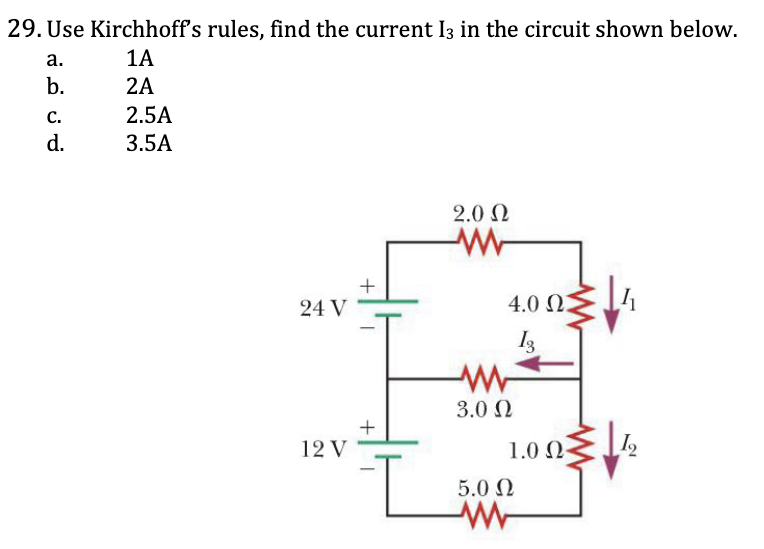
29. Use Kirchhoff’s rules, find the current I3 in the circuit shown below.
a. 1A
b. 2A
c. 2.5A
d. 3.5A
1) Apply KCL at right node:
I1 = I2 + I3
I3 = I1 - I2
2) Apply KVL to loop (clockwise): TOP
+24V - 2I1 - 4I1 - 3I3 = 0
→ 6I1 + 3I3 = 24
→ 2I1 + I3 = 8
3) Apply KVL to bottom loop (clockwise): BOTTOM
+3I3 - 1I2 - 5I2 + 12V = 0
→ 6I2 - 3I3 = 12
→ 2I2 - I3 = 4
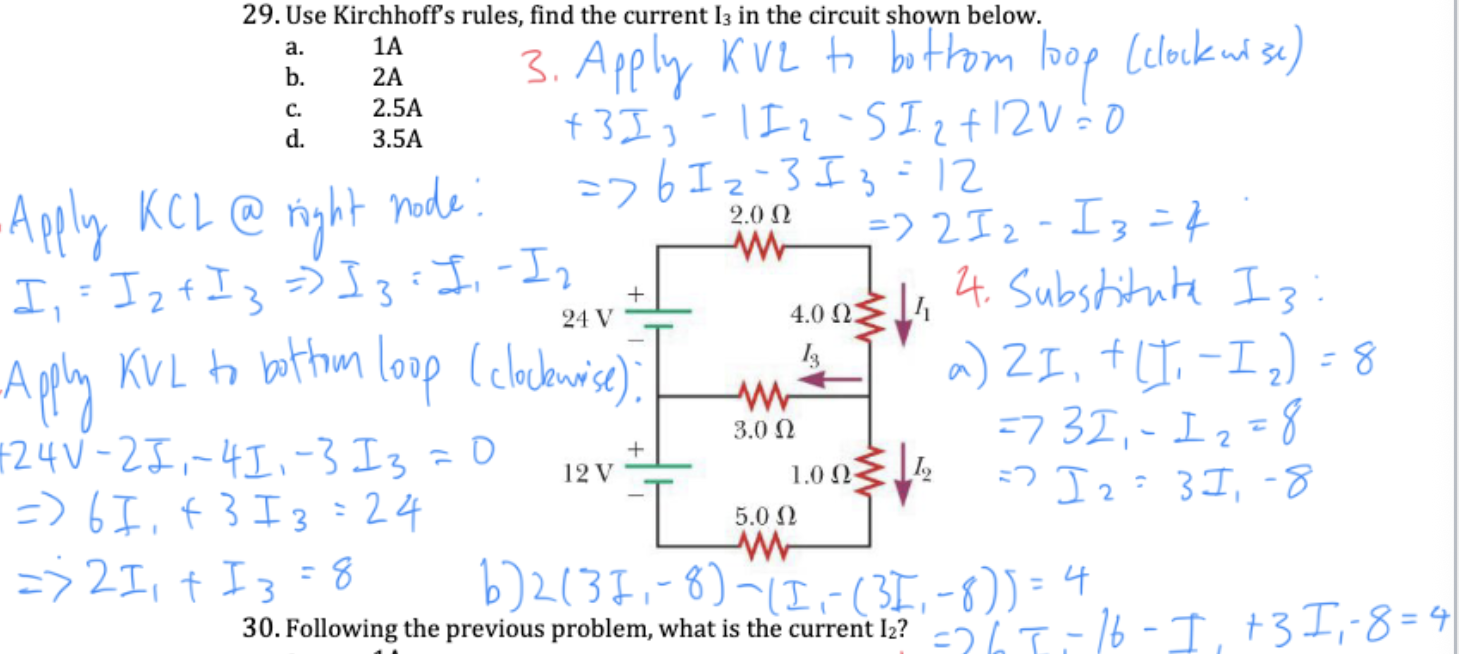
4) Substitute I3:
a)
2I1 + (I1 - I2) = 8
→ 3I1 - I2 = 8
→ I2 = 3I1 - 8
b)
2 (3I1 - 8) - (I1 - (3I1 - 8)) = 4
→ 6I1 - 16 - I1 + 3I1 - 8 = 4
→ 8I1 - 24 = 4
→ 8I1 = 28
→ I1 = 3.5A
5) find I2
I2 = 3I1 - 8
Substitute I1 = 3.5
I2 = 3 (3.5) - 8
I2 = 2.5 A
6) find I3
I3 = I1 - I2
I3 = 3.5 - 2.5
I3 = 1.0 A
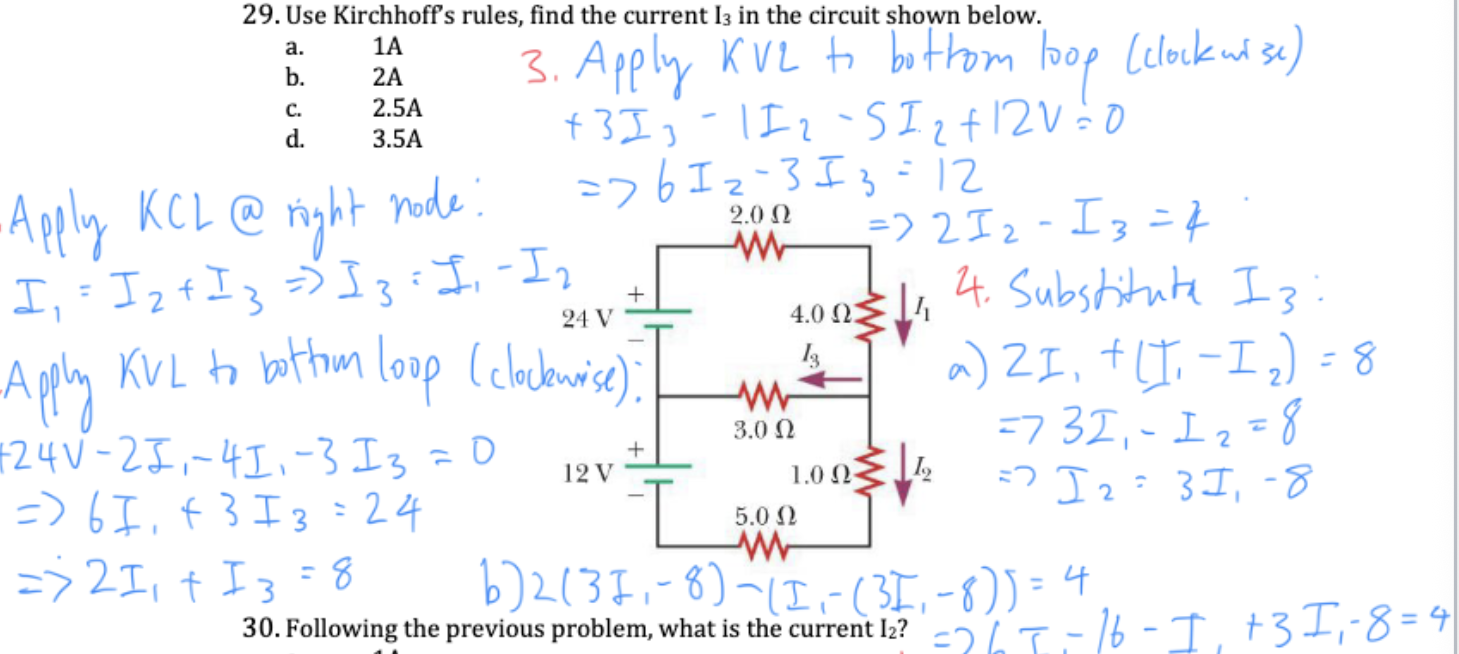
Following the previous proble, whats the current I2?
a. 1A
b. 2A
c. 2.5A
d. 3.5A
I2 = 3I1 - 8
= 3 (3.5A) - 8
= 10.5 - 8
= 2.5A