Principles of Economics Week 2
 Call Kai
 Learn
Learn Practice Test
 Spaced Repetition
 Match
Match Flashcards
 Knowt Play
1/24

Earn XP
Description and Tags
Covers surplus, welfare, government controls, and externalities
Name | Mastery | Learn | Test | Matching | Spaced | Call with Kai |
|---|
No analytics yet
Send a link to your students to track their progress
25 Terms
Collective Welfare
well-being of buyers and sellers in the market of a specific good.
Goal of the market
to maximize collective welfare
when is the market at max. collective welfare
at equilibrium, there is no surplus on either side (prod or con)
Consumer Surplus
what buyers are willing to pay (WTP) - what they actually paid (P*)
Producer Surplus
how much a seller is paid (P*) - what price they were willing to sell at
Total Surplus
Consumer Surplus + Producer Surplus
When WTP is [above or below] market price
above: sale
below: no sale
When cost to producers is [above, below, at] P*
above: no sale, cost to producer is greater than price receiver
below or at: producer will sell
Expanded Total Surplus Equation
TS= (WTP-P*) + (P*-WTS)
Goals of Producers and Consumers (2)
Goal of consumers is to receive high value
Goal of producers is to receive low cost
State of efficiency
Total surplus is maximized, collective welfare is as high as it can possibly be
The supply curve shows:
the minimum price that a producer will accept, at any price above that the producer is happy to sell!
The demand curve shows:
The maximum price a consumer will pay, any price below that the consumer is happy to buy!
Effect of Taxes
Drives up the cost of a good without any benefit to producers or consumers
Tax Price for Consumers, Pc
Pc= Pp+ t (Price Paid + Tax)
Buyers receive a higher price
Tax Price for producers (Pp)
Pp= Pc- T (Consumer Price - Tax)
Sellers receive a lower price (think about change in q)
Three rules of taxes
Qtax < Qequilibrium
Pconsumers > Pequilibrium
Pproducers < Pequilibrium
Loss in total surplus
Tax Revenue + Deadweight loss
Burden of Taxes (elasticity) (2)
Falls on the curve with less elasticity (greater inelasticity)
the side that is less resistant to price change will shoulder more of the burden.
Subsidies (3)
Gov provides incentives for a good
results in an overproduction
buyers can buy at a lower price
Subsidies effect on supply and demand
Subsidies create an excess consumer and producer surplus
Rule for Subsidies (3)
Qsubsidy> Qequilibrium
Pconsumer < Pequilibrium
Pproducer > Pequilibrium
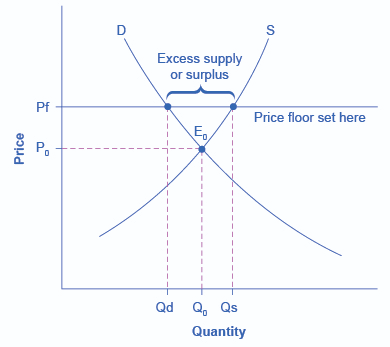
Price Floors effect (2)
Price floors create an excess on supply, or surplus
Buyers don’t want to buy at a higher $, but sellers want to sell
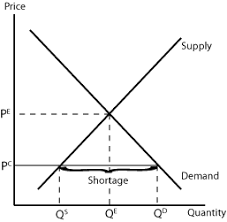
Price ceilings effect
Price ceilings create an excess demand, or shortage
Buyers want to buy at a lower $, sellers don’t want to sell