PERCEPTION - the visual sense
 Call Kai
 Learn
Learn Practice Test
 Spaced Repetition
 Match
Match Flashcards
 Knowt Play
1/15

There's no tags or description
Looks like no tags are added yet.
Name | Mastery | Learn | Test | Matching | Spaced | Call with Kai |
|---|
No analytics yet
Send a link to your students to track their progress
16 Terms
What FORM of energy is VISUAL energy? HOW FAST does it travel? What 2 KINDS OF PROPERTIES does it have?
Form of ELECTROMAGNETIC RADTIATION
TRAVELS 186,000 miles/second
WAVE properties
PARTICLE properties
What 3 PROPERTIES do LIGHT ENERGY WAVES have?
Wavelength–horizontal distance between the same point on two successive waves
Amplitude (intensity)–vertical height of the wave
complexity–interaction of many different waves
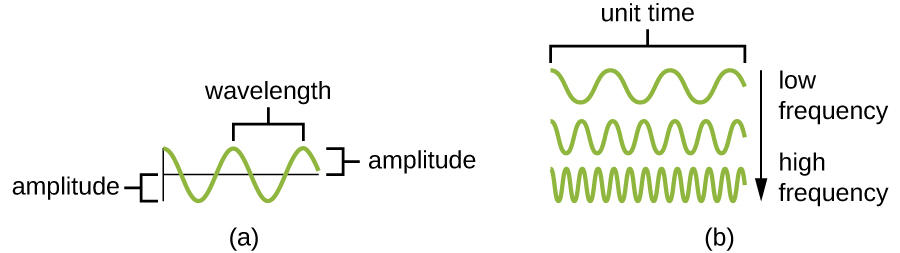
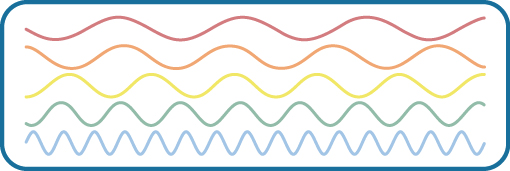
What LIGHT WAVE FREQUENCIES (high/low) represent WHICH colors?
HIGH frequency = BLUE
LOW frequency = RED
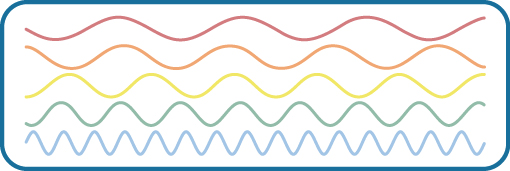
What LIGHT WAVE AMPLITUDES (great/small) represent WHICH colors?
GREAT amplitude = YELLOW
SMALL amplitude = GREEN
What SHAPE is the EYEBALL in? HOW BIG is it (diameter (mm))?
(almost) complete sphere
24mm in diameter
What are the THREE LAYERS in the EYEBALL?
Fibrous tunic
Middle, Vascular tunic (Choroid Layer)
Retina
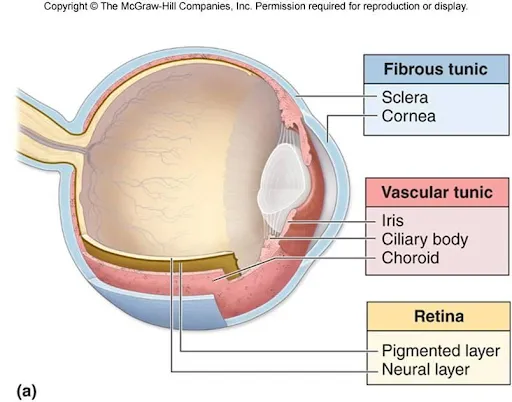
WHAT (structurally) is the FIBROUS TUNIC?
Hardened surface that protects the eye
WHAT 2 STRUCTURES make up the FIBROUS TUNIC? WHAT (structurally) are they?
Sclera: white of eye
Cornea: transparent bulge
WHAT 6 STRUCTURES make up the MIDDLE, VASCULAR TUNIC?
CHOROID
CILIARY BODY
IRIS
PUPIL
LENS
VITREOUS CHAMBER
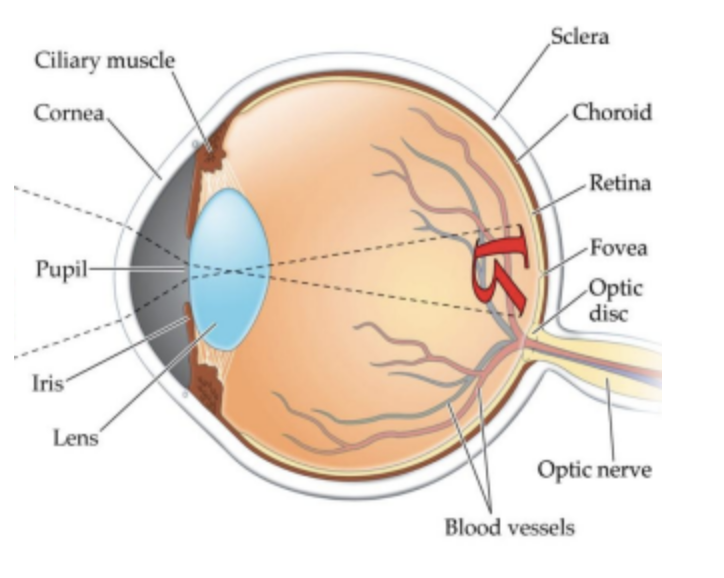
What (structurally) is the CHOROID?
spongy structure with network of blood vessels for nourishment
Located in MIDDLE, VASCULAR TUNIC
What does the CILIARY BODY do?
Produces aqueous humor (fluid in the eye)
Located in MIDDLE, VASCULAR TUNIC
What (structurally) is the IRIS? What do its TWO LAYERS contain?
two-layered structure at front of eye
Front layer has pigment;
Inner layer contains blood vessels
Located in MIDDLE, VASCULAR TUNIC
What (structurally) is the PUPIL?
The center of iris
Located in MIDDLE, VASCULAR TUNIC
What (structurally) is the LENS? What does it PERFORM?
transparent structure behind iris
performs ACCOMODATION ("autofocus" process through changing lens’s shape)
Located in MIDDLE, VASCULAR TUNIC
What (structurally) is the VITREOUS CHAMBER? HOW MUCH of the eyeball’s VOLUME does it make up?
fluid-filled region–⅔ total volume
Located in MIDDLE, VASCULAR TUNIC
What are 4 COMMON PROBLEMS with the LENS?
HYPEROPIA (farsightedness) –lens focuses BEHIND retina
MYOPIA (nearsightedness) –lens focuses IN FRONT of retina
PREBYOPIA–loss of lens elasticity with age
CATARACTS–reduced transparency with age