AP Psychology Unit 2: COGNITION
 Call Kai
 Learn
Learn Practice Test
 Spaced Repetition
 Match
Match Flashcards
 Knowt Play
1/160

There's no tags or description
Looks like no tags are added yet.
Name | Mastery | Learn | Test | Matching | Spaced | Call with Kai |
|---|
No analytics yet
Send a link to your students to track their progress
161 Terms
What is perception?
Perception is the process of organizing and interpreting sensory information so you can recognize meaningful objects and events.
What is sensation?
Detecting physical energy (light, sound waves, chemicals)
What are the two processes of perception?
Bottom-up processing and top-down processing.
What is bottom up processing?
Starts with sensory receptors
Builds from details —> whole picture
Data-driven
Example: Looking at random shapes and slowly realizing they form a face
What is top-down processing?
Starts with prior knowledge, expectations, schemas
Uses memory and context to interpret data
Concept-driven
Example: Reading sloppy handwriting because you expect certain words in a sentence.
What is a mental schema?
Mental frameworks built from experience that organize knowledge
Can help you quickly interpret situations
Can create bias (you see what fits your framework).
What is a perceptual set?
A predisposition to perceive something in a certain way. It is influenced by expectations, motivations, emotion, and culture. Think of the “B” v.s. “13” example.
What is the Gestalt principle?
The Gestalt principles describe how the brain automatically organize visual elements into organized patterns, groups, or “unified wholes” rather than separate components.
What is figure-ground in the context of gestalt principles?
The tendency to separate a focused object from it’s background.
What is closure in the context of gestalt principles?
The tendency to mentally fill in missing parts to see a complete object.
What is proximity in the context of gestalt principles?
The tendency to group nearby objects together
What is similarity in the context of gestalt principles?
The tendency to group objects that look alike together
What is attention?
The process of focusing conscious awareness on a specific stimuli.
What is selective attention?
Focusing on one stimulus whilst filtering out others.
What is the cocktail party effect?
The ability to notice personally meaningful information amid background noise.
What is divided attention?
Trying to attend to multiple tasks (like texting and listening in class).
What is sustained attention?
Maintaining focus for an extended period of time.
What is inattentional blindness?
Failing to see something visible because attention is directed elsewhere.
What is change blindness?
FAiling to notice changes in the environment due to inattention.
What is depth perception?
The ability to see in three dimensions and judge distance.
What is retinal disparity?
A binocular cue created when each eye sees a slightly different image, the greater the difference the closer the object.
What is convergence?
A binocular cue in which eyes turn inward for near objects, more inward strain = closer object.
What are the five monocular depth cues?
Relativity clarity
Relative size
Texture gradient
Linear perspective
Interposition
What is relative clarity?
A monocular cue where hazier objects are perceived as farther away.
What is relative size?
A monocular cue where smaller retinal objects are judged as further away.
What is texture gradient?
A monocular cue where coarse textures look closer and finer from far away.
What is linear perspective?
A monocular cue where parallel lines converge.
What is interposition?
A monocular cue where closer objects block parts of further ones.
What is size constancy?
A perceptual constancy that lets you perceive an object at the same size despite changes in it's retinal image.
What is shape constancy?
A perceptual constancy that allows you to perceive an object as keeping the same shape despite changes in it’s viewing angle.
What is brightness constancy?
A perceptual constancy that allows you to perceive an object as having consistent brightness despite changes in it’s lighting.
What is the phi phenomenom?
An illusion of movement between adjacent lights.
What is stroboscopic movement?
Rapid sequence of still images creating the illusion of motion (movies, animation, ect).
What are concepts?
Mental categories that group similar objects, events, ideas, or people.
ex. “Bird” includes robins, eagles, and penguins
What are mental prototypes
The best or most typical example of a concept. When you are deciding if something fits a category, you compare it to the prototype (ex. the penguin is a weaker match for a bird compared to a robin).
What is assimilation in the context of mental schemas?
Introduced by Jean Piaget, it is the process of taking new information and fitting it into an existing schema.
ex. A child sees a zebra and calls it a horse
What is accommodation in the context of schemas?
Introduced by Jean Piaget, it is the process of adjusting the schema to fit new information.
ex. A child creates a new “zebra” category
What are algorithms?
A step-by-step procedure that guarantees a correct answer if followed correctly. (e.g. math formulas, ect).
What are heuristics?
A heuristic is a mental shortcut. They are faster then algorithms but more error-prone.
What is a representativeness heuristic?
Judging likelihood based on similarity to a prototype.
ex. If someone seems "quiet and bookish,” you may assume librarian over salesperson, even if salespeople are far more common.
What is a availability heuristic.
Judging likelihood by how easily example come to mind.
ex. After seeing news about shark attacks, you overestimate their frequency.
What is mental set?
Continuing to use a mental strategy that worked before, even if a better one exists.
What is functional fixedness?
Struggling to see new uses for familiar objects.
ex. A paperclip is “for holding paper”, not a lock pick or phone stand.
What is priming?
Exposure to one stimulus influences your response to another, often unconsciously.
What is framing?
The way a choice is worded changes how people respond to it.
ex. “90% survival rate” feels better than “10% death rate”, even if they are factually identical
What is gamblers fallacy?
A cognitive bias where there is a belief that random events balance out in the short term.
After five heads, you think tails is “due”, even if coin clips are independent.
What is the sunk-cost fallacy?
A cognitive bias where you continue a choice because you’ve already invested time, money, or effort.
What is confirmation bias?
A cognitive bias where an individual seeks information that supports their personal beliefs.
What is hindsight bias?
A cognitive bias to develop the tendency to believe after the fact you knew it all along
What is overconfidence bias?
A cognitive bias where you overestimate the accuracy of your knowledge.
What are executive functions?
Higher-order processes linked to the prefrontal cortex. They allow goal-directed behaviour.
What is working memory?
The ability to hold and mentally use information for a short time.
What is cognitive flexibility?
The ability to shift thinking, strategies, or perspectives.
What is inhibitory control?
The ability to resist impulses and distractions.
What is convergent thinking?
Thinking that narrowing options to one get correct answer. Used on multiple-choice tests.
What is divergent thinking?
Thinking that generates many possible ideas or solutions. Core of creativity.
What is the creative process?
Preparation
Incubation
Illumination (“aha!”)
Verification
What is explicit memory?
Memory you consciously recall and describe in words. Relies heavily on the hippocampus and parts of the frontal lobes.
What are the two types of explicit memory?
Episodic memory and semantic memory.
What is episodic memory?
Memories for a personal experience tied to a specific time and place. It is vulnerable to distortion and includes context like who was there and how you felt.
What is semantic memory?
Memories for facts, meanings, and general knowledge.
What is implicit memory?
Memory that affects behaviour without conscious awareness. It is shown through performance instead of explanation and involves areas like the cerebellum and basal ganglia.
What is procedural memory?
Implicit memory for skills and habits your perform automatically.
What else is considered implicit memory?
Classical conditioning and priming, but procedural memory is the main one.
What is prospective memory?
Remembering to do something in the future.
ex. remembering to attend an appointment
What is long-term potentiation?
The strengthening of synaptic connections when neurons fire together rapidly.
What does LTP (long-term potentiation) explain?
It explains how practice physically changes your brain. When you rehearse terms, you’re strengthening neural pathways.
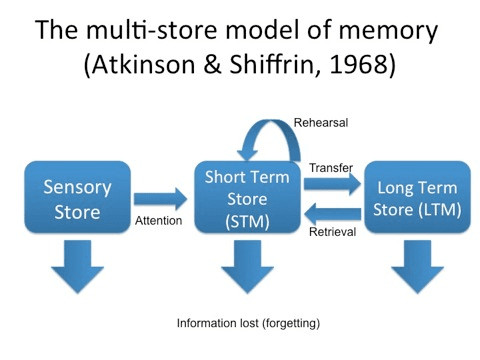
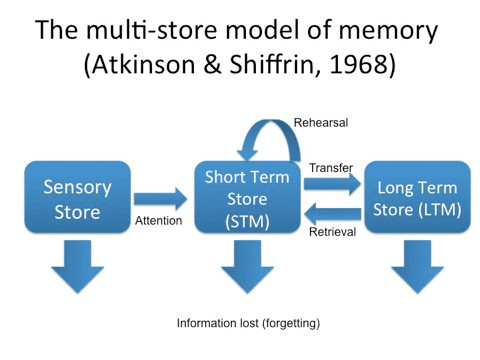
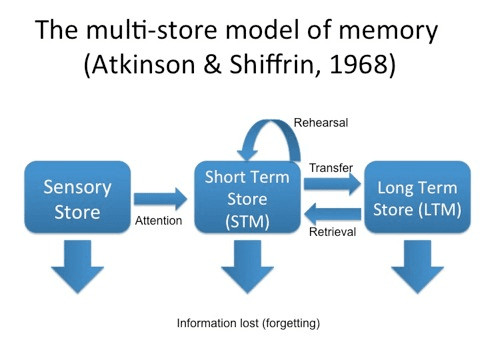
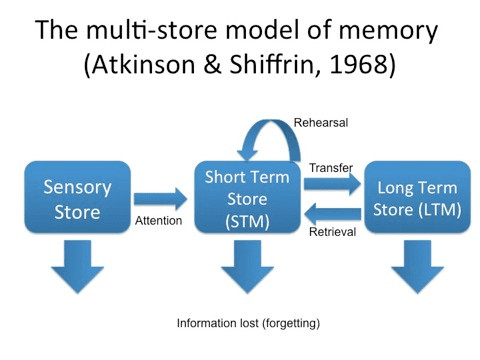
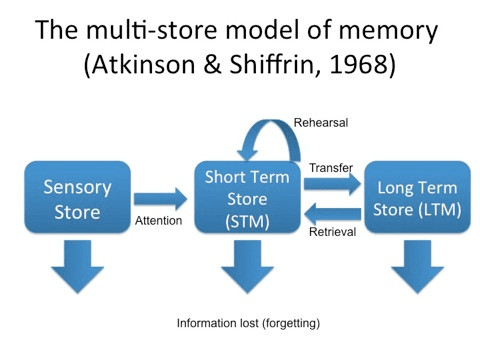
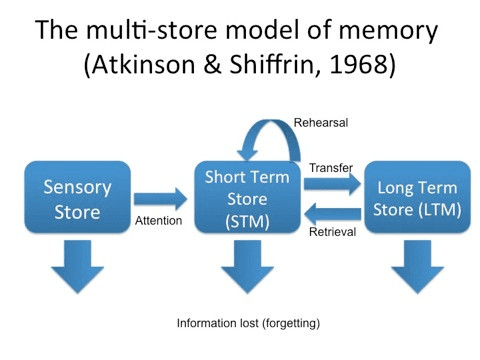
What is the multi-store model of memory?
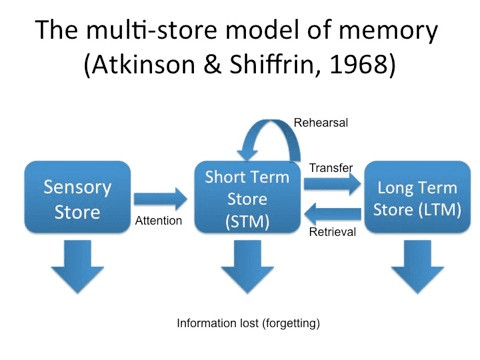
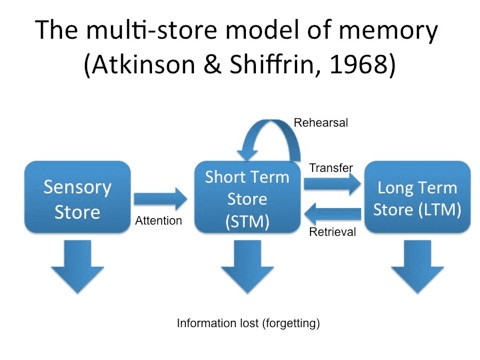
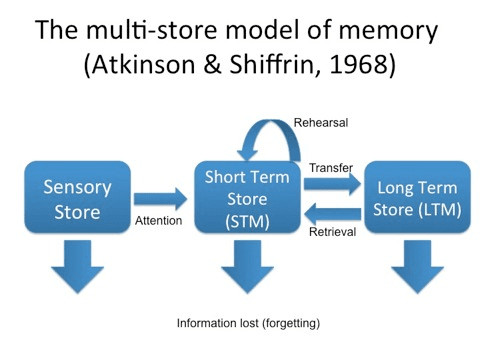
Proposed by Atkinson & Shiffrin, it is the idea that information flows from the sensory store to short-term memory through attention, then into long-term memory through rehearsal and transfer. Retrieval brings it back to short-term memory when you need it. At any point, information can be lost if it isn’t maintained.
What is sensory memory?
Brief storage of incoming sensory input, attention determines what moves forward.
What is iconic memory?
A very brief visual memory that lasts less than 1 second. Part of sensory memory.
What is echoic memory?
A brief auditory sensory memory that lasts about 3-4 seconds.
What is short-term memory? (STM)
A temporary workspace
Capacity around 7-2 items (George Miller)
Duration about 20-30 seconds without rehearsal
Maintenance rehearsal keeps it active
What is long-term memory (LTM)?
Relatively permanent storage
Vast capacity
Can last a lifetime
Includes explicit and implicit memory
What is automatic processing?
Processing that happens without conscious effort or focused attention. Includes space, time, and frequency. Involves space, time, and frequency ect.
What is effortful processing?
Encoding that requires attention and rehearsal. Involves vocabulary terms and formulas ect.
What is the working memory model?
A system developed by Baddeley & Hitch that briefly holds and actively manipulates information
What are the components of the working memory model?
Central executive, phonological loop, visuospatial sketchpad, and episodic buffer.
What does the central executive do?
Directs attention, coordinates the system, and limits capacity
What is the phonological loop?
Verbal and auditory info. Explains why repeating a phone number helps.
What is the visuospatial sketchpad?
Mental images and spatial tasks. Visualizing a map or diagram.
What does the episodic buffer do?
Integrates information from subsystems. It links working memory to long-term memory.
What are the three levels of processing proposed by Craik & Lockhart
Structural, Phonemic, and Semantic
What is structural’s focus and what is it’s memory strength?
It is focused on physical features (is it capitalized?) and has weak memory strength.
What is phonemic’s focus and what is it’s memory strength
It is focused on sound (does it rhyme?)l and has moderate memory strength.
What is semantic’s focus and what is it’s memory strength.
It is focused on meaning (what does it mean?) and has the strongest memory strength.
What is encoding?
The process of transforming sensory input into a form the brain can store.
What are the 3 steps of the memory process?
Encoding
Storage
Retrieval
What are the three main types of encoding?
Visual encoding, acoustic encoding, semantic encoding.
What is visual encoding?
Encoding images and spatial layouts
Remembering what a brain diagram looked like on the page
What is acoustic encoding?
Encoding sound, especially words
Understanding that the hippocampus helps form new memories
What is semantic encoding?
Encoding meaning and connections
Understanding that the hippocampus helps form new memories
What type of encoding is the strongest for long-term memory?
Semantic encoding
What is the levels of processing theory?
Originally proposed by Craik and Lockhart, it is the idea that deeper, more meaningful processing leads to better memory than shallow processing.
What is shallow processing?
Processing structure or sound (What does it look like? What does it rhyme with?)
What is deep processing?
Processing meaning (What does it mean? How does it connect?)
What are mnemonic devices?
Memory aids that improve recall by creating strong associations.
What are common types of mnemonics?
Acronyms: OCEAN (Big Five traits)
Acrostics: “My Very Educated Mother…” (planets)
Method of loci (memory palace)
Peg-word system (number-rhyme: 1 = bun, 2=shoe)
Imagery and visualization
Why do mnemonics work?
They use dual coding (visual + verbal)
They provide strong retrieval cues
What is chunking?
Grouping bits of information into larger, meaningful units.
ex. Phone numbers
What is the spacing effect?
The finding that studying over spaced-out sessions helps imrpove long-term memory.