3.1.4 - Proteins
 Call Kai
 Learn
Learn Practice Test
 Spaced Repetition
 Match
Match Flashcards
 Knowt Play
1/22

There's no tags or description
Looks like no tags are added yet.
Name | Mastery | Learn | Test | Matching | Spaced | Call with Kai |
|---|
No analytics yet
Send a link to your students to track their progress
23 Terms
What is the structure of an amino acid?
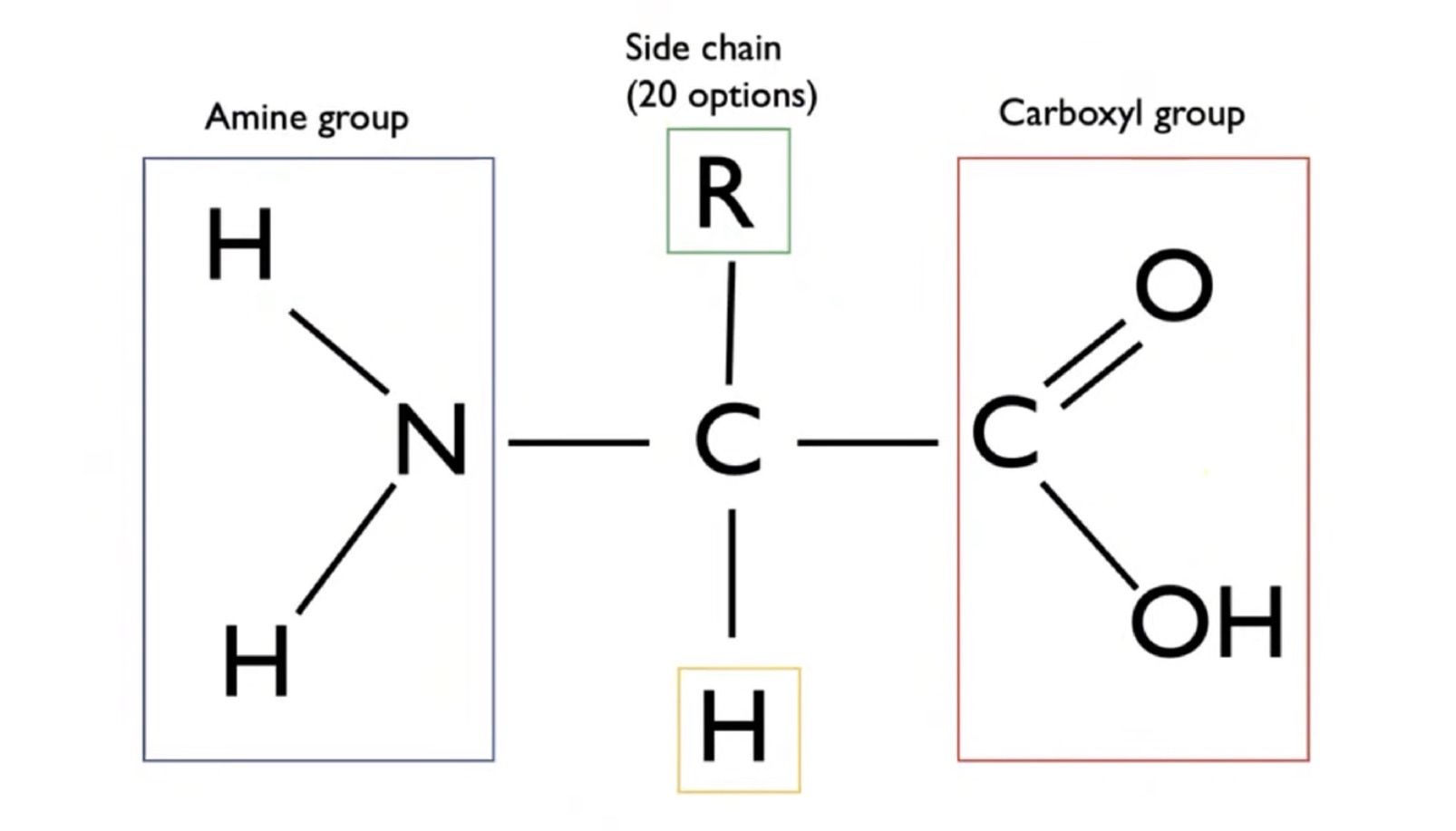
What is type of amino acid is formed via by the condensation reaction of two amino acids and what is the bond between them?
Dipeptide
Peptide bond
What is the primary structure of a protein?
The specific sequence of amino acids held by peptide bonds
After the primary structure of a protein is formed, where does it go and why?
The Golgi body to be packaged into the secondary structure of a protein
What is the secondary structure of a protein?
The sequence of amino acids folding to make either an α helix or a β pleated sheet held together by hydrogen bonds
Where do hydrogen bonds form on a secondary structure of a protein?
Between the carboxyl group of one amino acid and the amine group of another
What is the tertiary structure of a protein?
The further folding of the secondary structure forming a unique 3D shape held together by ionic and hydrogen bonds and disulphide bridges
What is the quaternary structure?
A protein made up of more than one polypeptide chain
What is the importance of the primary structure?
If an amino acid is in a different sequence the bonds that will form in the tertiary structure will have a different location resulting in a different 3D shape
What is the test and positive result for a protein?
Add biuret
Positive result = solution turns blue to purple
What are enzymes?
Proteins with a 3D tertiary structure
What is the function of enzymes and how do they do this?
They catalyse reactions by lowering the activation energy
How is the active site specific?
Due to the specific folding in the tertiary structure of the protein
What is formed after a substrate and enzyme bind together?
An enzyme-substrate complex
Describe the induced fit model
The substrate enters the active site of the enzyme and is not fully complimentary
The active site changes shape slightly to mould around the substrate and become complimentary to one another
When the E-S complex occurs it puts strain on the bonds and lowers the activation energy
The products are removed and the enzyme active site returns to its original shape
What are 5 factors that affect enzymes?
Temperature
pH
Inhibitors
Substrate concentration
Enzyme concentration
How does temperature affect enzymes?
If too low, not enough kinetic energy for successful collisions between enzyme and substrate
If too high, enzymes denature and E-S complexes can’t form
How does pH affect enzymes?
If too acidic or too alkali that will interfere with the charges in the amino acids in the active site denaturing the enzyme causing less E-S complexes
How do substrate and enzyme concentration affect rate?
If there are too few substrates then reaction will be slower as there will be fewer collisions
If there are too few enzymes then active sites will become saturated and therefore unable to work faster
How do competitive inhibitors lead to fewer E-S complexes being formed?
They have a similar shape to the substrate and can bind to the active site preventing the substrate from binding with the enzyme therefore less E-S complexes
What happens to competitive inhibitors when more substrate is added?
The substrate will out-compete the competitive inhibitor knocking them out of the active site
How do non-competitive inhibitors lead to fewer E-S complexes?
They bind to the allosteric site which causes the active site to change shape meaning the substrate is no longer complimentary therefore less E-S complexes
What happens to the maximum rate of reaction when there is a high substrate concentration but competitive inhibitors are present?
It has the same maximum rate of reaction as no inhibitors