Electric Circuits Review
 Call Kai
 Learn
Learn Practice Test
 Spaced Repetition
 Match
Match Flashcards
 Knowt Play
 Podcast
1/34

Earn XP
Description and Tags
Vocabulary-style flashcards covering electric circuits, including fundamental laws, resistance combinations, power, resistivity, and component behavior.
Name | Mastery | Learn | Test | Matching | Spaced | Call with Kai |
|---|
No analytics yet
Send a link to your students to track their progress
35 Terms
Electric Current (I)
The rate of flow of charged particles, or the flow of charge per unit time, calculated by the formula I=ΔtΔQ, where ΔQ is the change in charge and Δt is the change in time.
Potential Difference (V)
The energy transferred per unit charge between two points in a circuit, expressed as V=QW, where W is the energy transferred and Q is the charge.
Resistance (R)
A measure of how difficult it is for charge carriers to pass through a component, calculated as R=IV.
Ohm’s Law
A principle stating that for an ohmic conductor, current is directly proportional to the potential difference across it, provided that physical conditions such as temperature remain constant.
Principle of Charge Conservation
The principle stating that the total electric charge in a closed system does not change.
Kirchhoff’s First Law
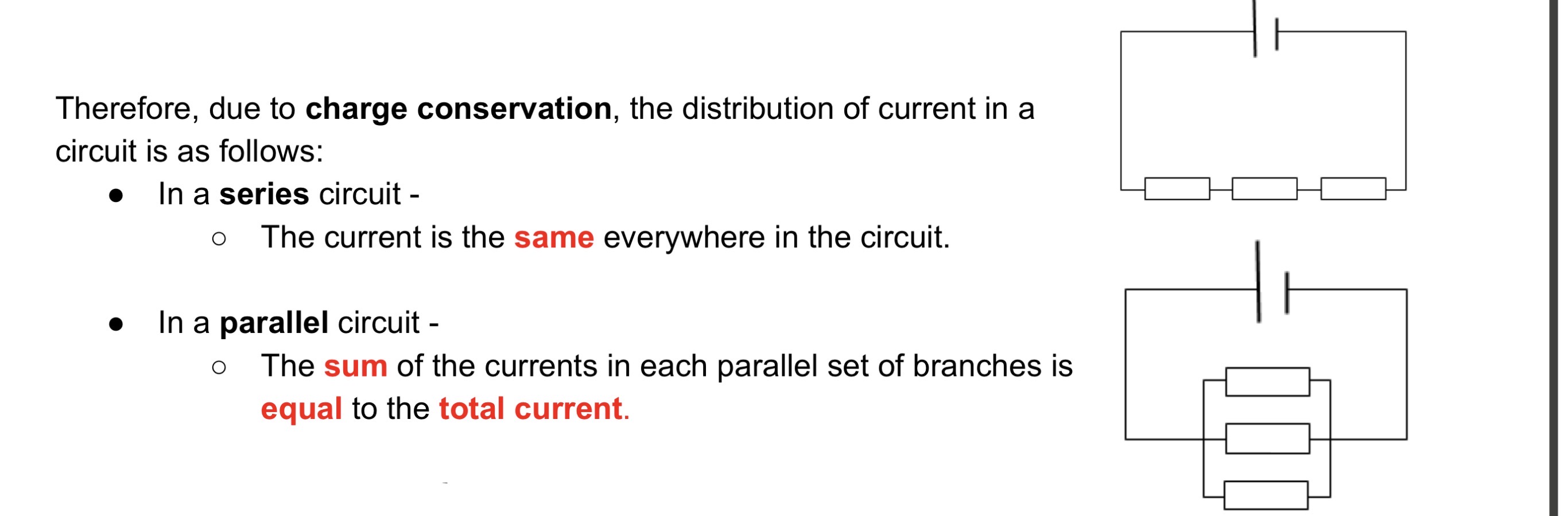
An application of charge conservation stating that the total current flowing into a junction is equal to the current flowing out of that junction.
Kirchhoff’s Second Law
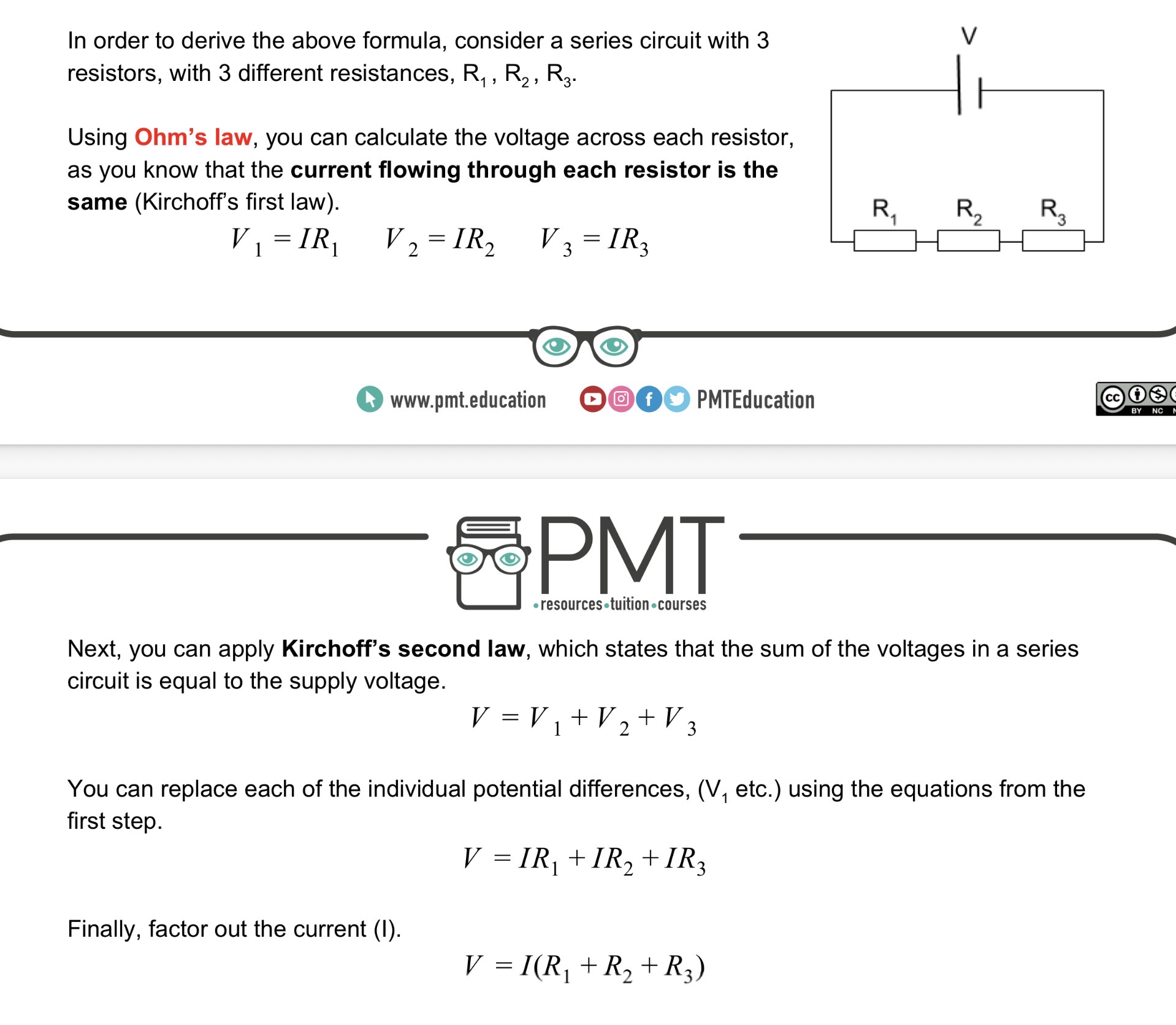
An application of energy conservation stating that the sum of all voltages in a series circuit is equal to the battery voltage, or the sum of all voltages in a loop is zero.
Series Circuit Resistance
The total resistance (RT) is the sum of individual resistances: RT=R1+R2+R3+⋯+Rn.
Parallel Circuit Resistance
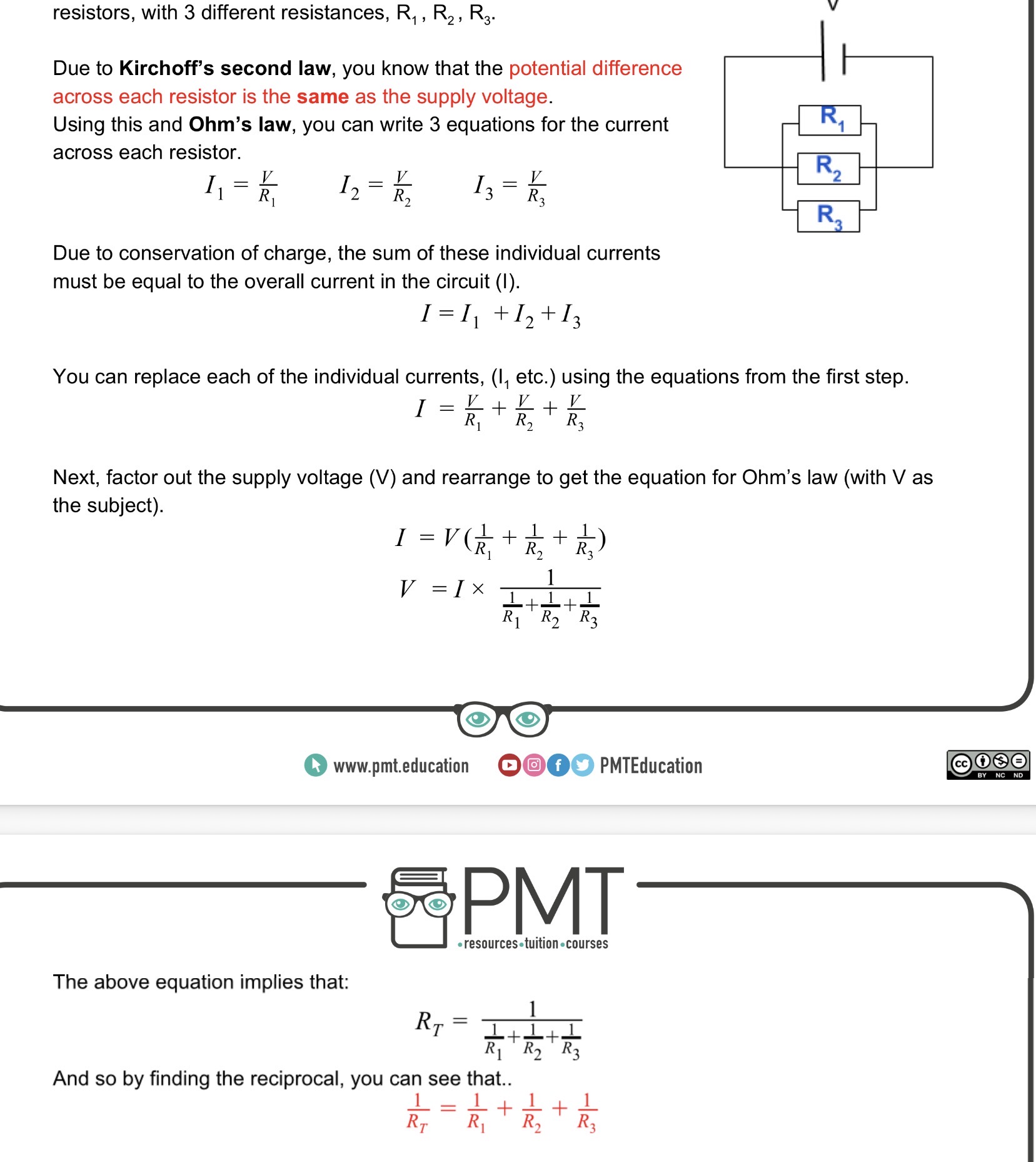
The reciprocal of the total resistance is equal to the sum of the reciprocals of the individual resistances: RT1=R11+R21+R31+⋯+Rn1.
Power (P)
The rate of transfer of energy, calculated using the formulas P=VI, P=I2R, or P=RV2.
Energy Transferred (W)
The product of power and time, expressed as W=Pt or W=VIt.
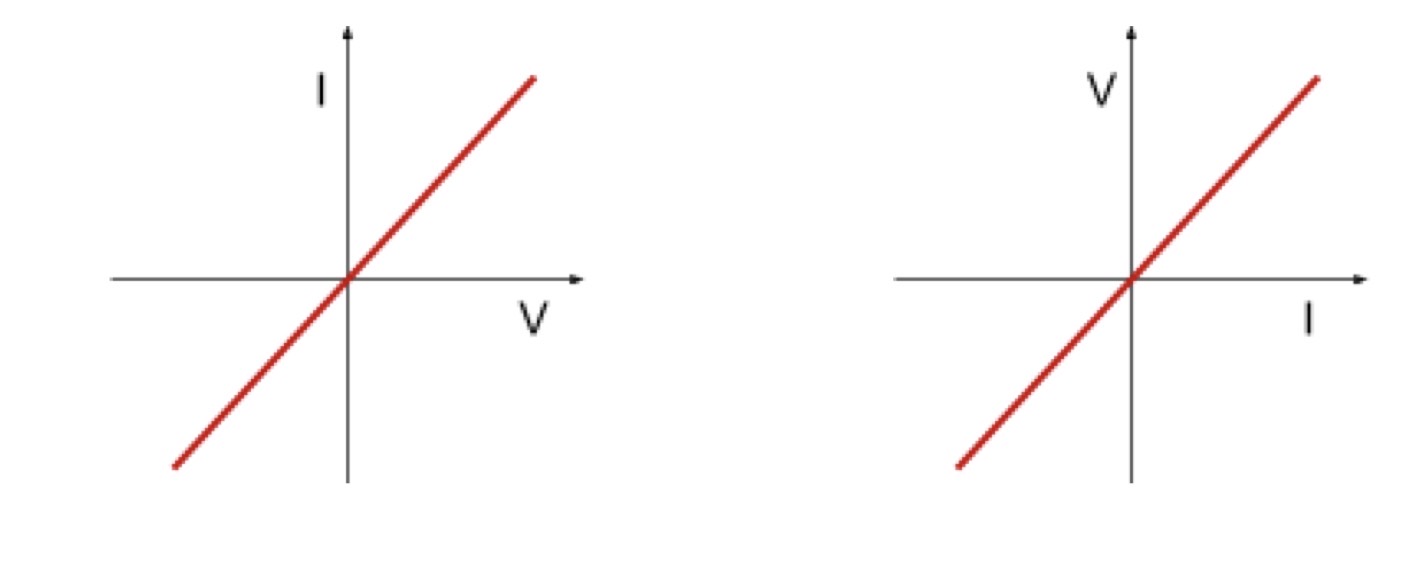
Ohmic Conductor
A component that follows Ohm’s law, resulting in a current-voltage graph that is a straight line through the origin.
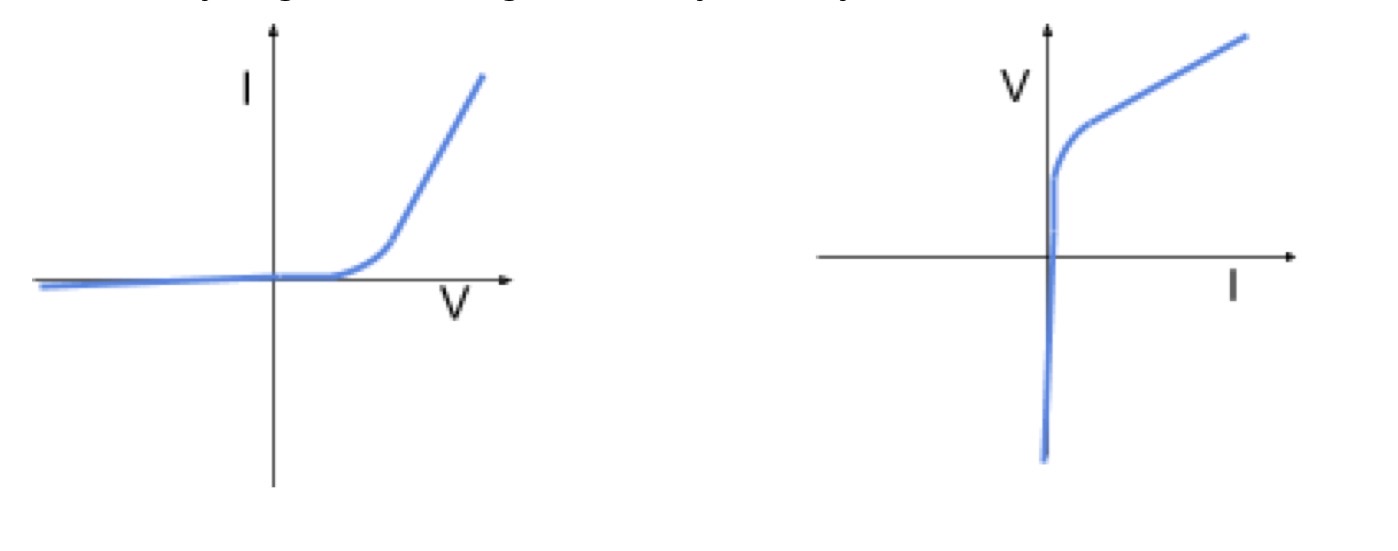
Forward Bias
The direction in which a diode allows current to flow easily once the threshold voltage is reached.
Reverse Bias
The direction in which a diode has extremely high resistance, allowing only a very small current to flow.
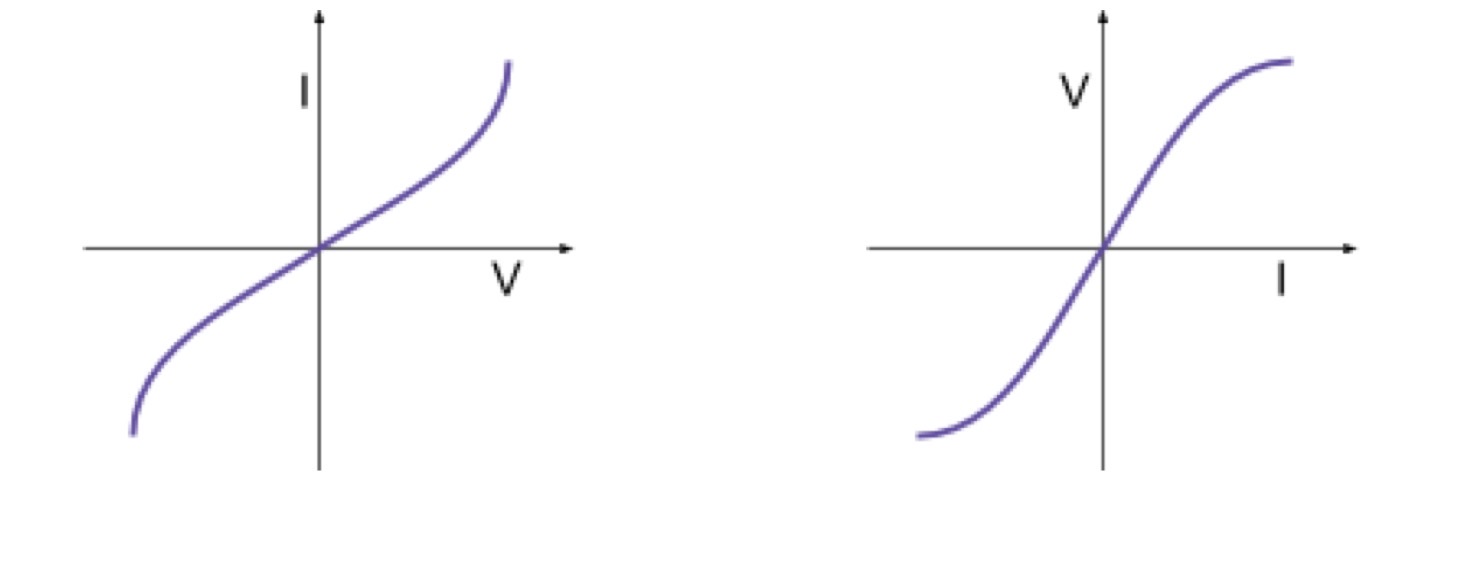
Semiconductor diode graph
Forward and reverse bias
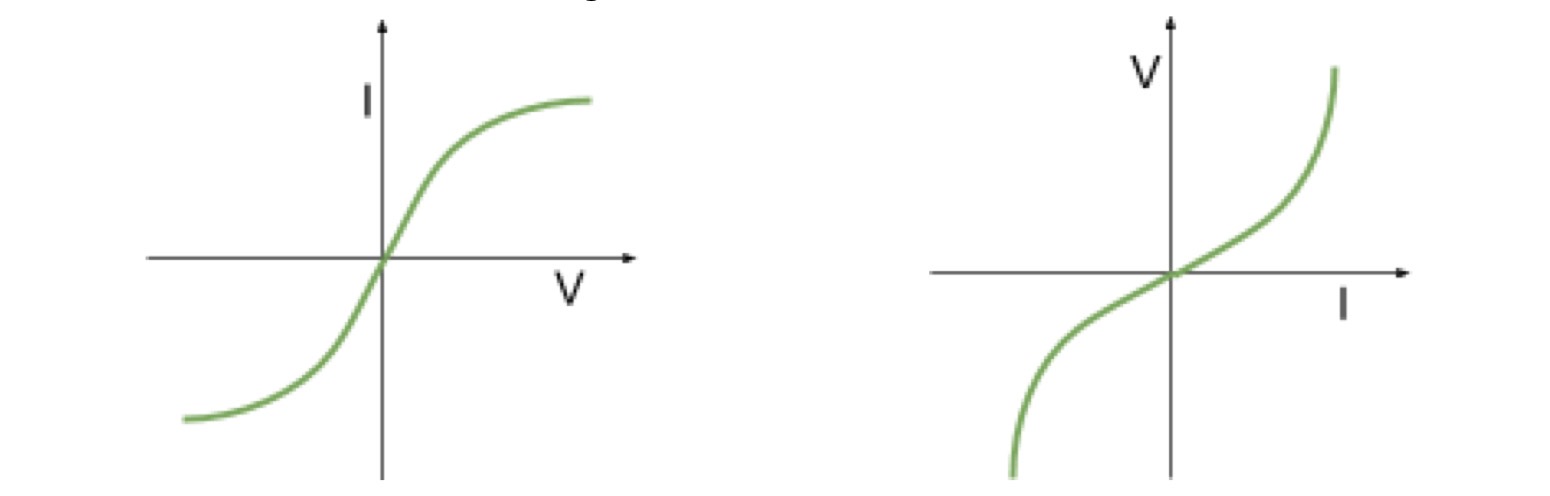
Filament Bulb Graph
A current-voltage graph that curves as current increases because the metal wire heats up, increasing its resistance.
Negative Temperature Coefficient Thermistor
A Negative Temperature Coefficient component where resistance decreases as temperature increases because the release of more charge carriers outweighs the effects of lattice vibrations.
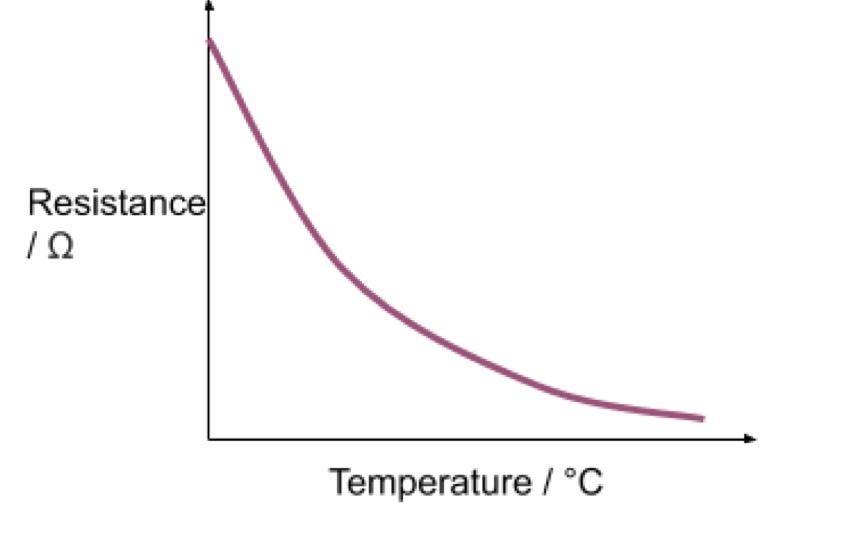
Negative Thermistor Coefficient graph
Resistivity (ρ)
Measure of how easily a material conducts electricity. A material property defined as the product of resistance (R) and cross-sectional area (A), divided by length (l): ρ=lRA.
Charge Carrier Density (n)
The number of charge carriers contained in a material per unit volume.
Drift Velocity (v)
Charged particles in a conductor are constantly colliding with other particles in the conductor and so do not travel straight through a conductor. The average speed at which charged particles move along a conductor while colliding with other particles.
Elementary Charge (q)
The charge carried by a single electron, which is approximately 1.6×10⁻¹⁹C.
Current Formula (Microscopic)
The formula relating current to material properties: I=nqvA, where n is carrier density, q is charge, v is drift velocity, and A is cross-sectional area.
Potential Divider
A circuit with resistors in series used to produce a required fraction of the source potential difference.
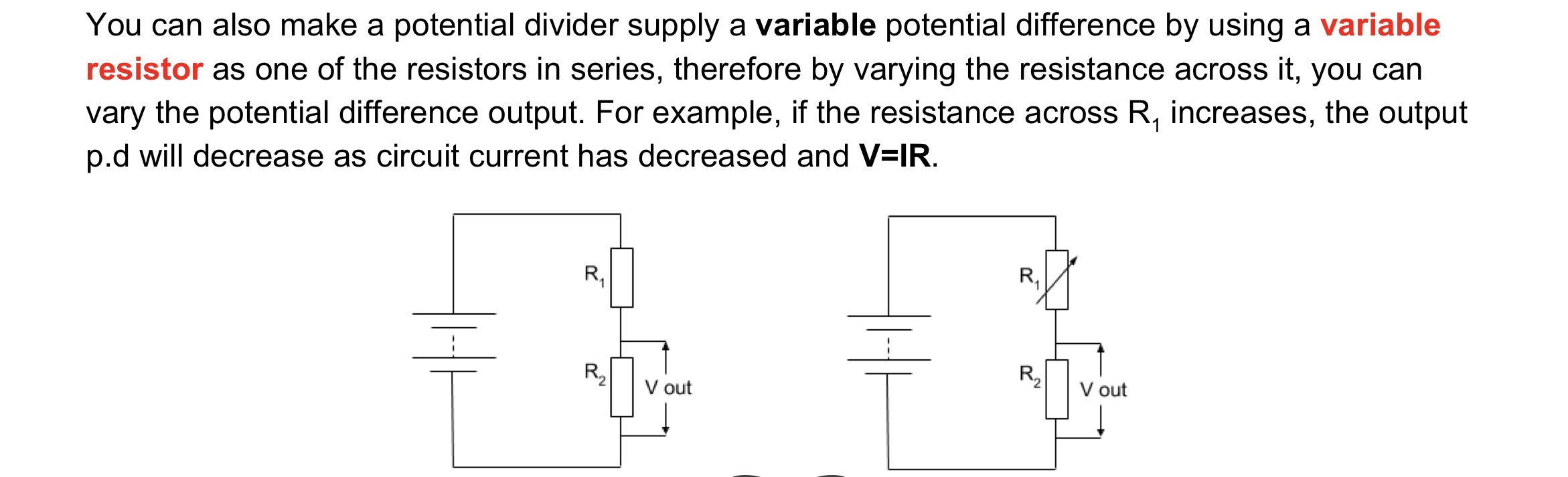
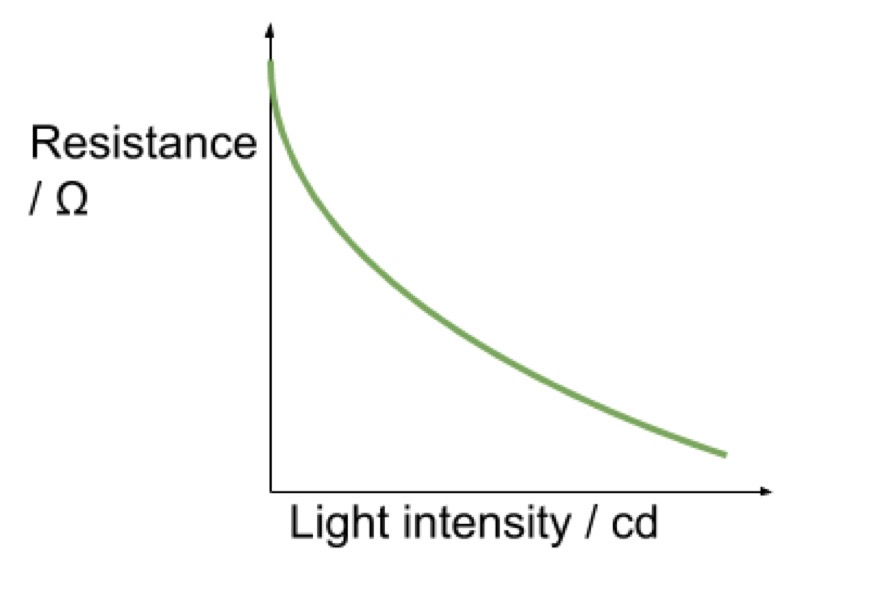
Light Dependent Resistor (LDR)
A component made from photoconductive materials (meaning release electrons in presence of light). As light intensity increases, electrons are released, increasing number of charge carriers available to conduct electricity and resistance decreases
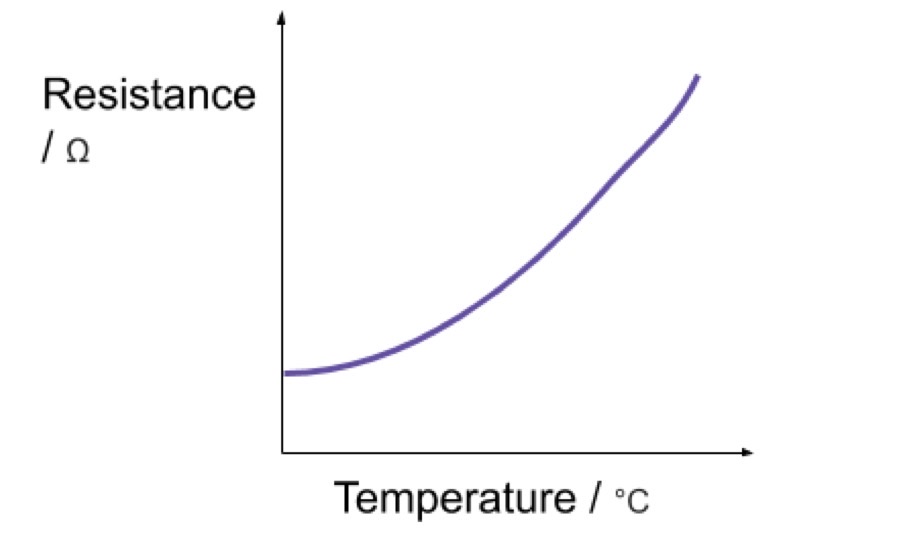
Metallic conductors reaction to temp increase
As temperature increase resistance increases due to lattice vibrations in conductor becoming more intensely causing. More electrons released but not quickly enough to counter the disruptive effect of the lattice vibrations
Internal Resistance (r)
Resistance within a battery caused by electrons colliding with atoms, leading to energy loss represented as a small resistor inside the battery.
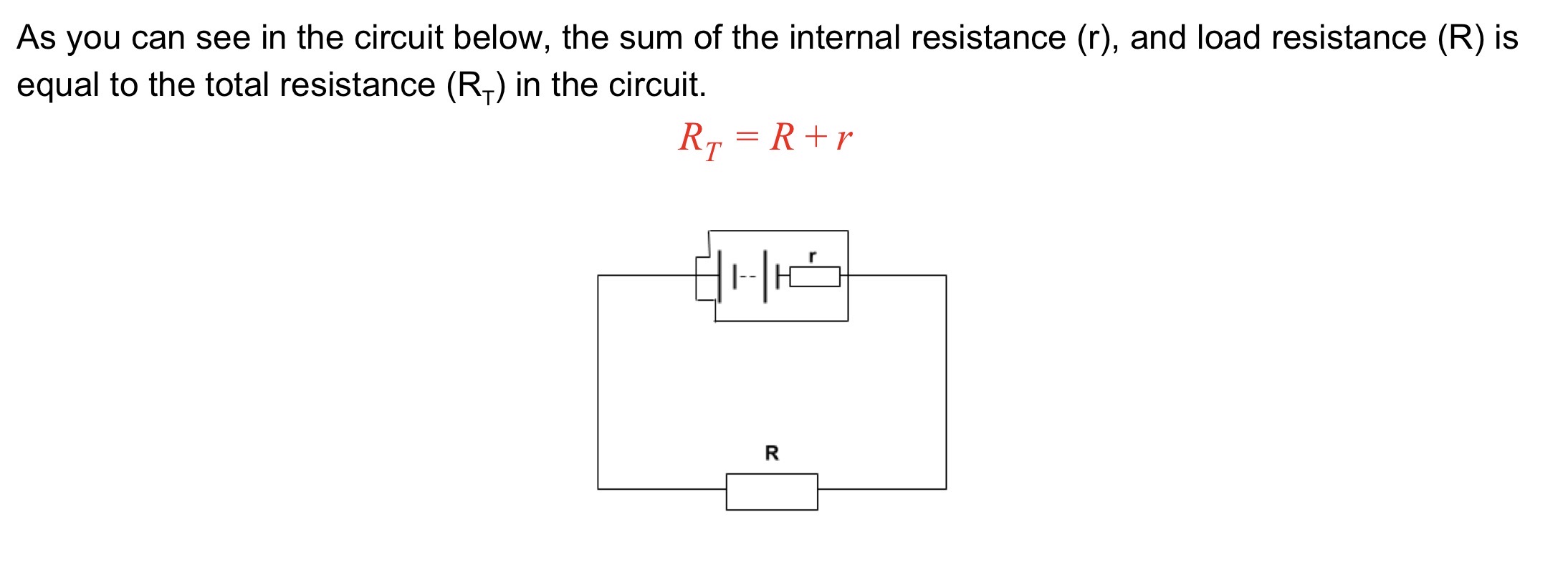
Electromotive Force (EMF or ϵ)
The energy transferred by a cell per coulomb of charge that passes through it, represented by ϵ=QE or ϵ=I(R+r). E,f of a battery can be measure by measuring the voltage across a cell using a voltmeter when there is no current running through the cell which means it’s an open circuit
Terminal Potential Difference (V)
The potential difference across the external load resistance (R), calculated as V=IR.
Lost Volts (v)
The potential difference across the internal resistance of a cell, calculated as v=Ir, representing wasted energy per coulomb of charge.
Thermionic Emission
The process by which atoms in a metal or semiconductor gain enough thermal energy to release electrons, causing them to release electrons, increasing the number of charge carriers which decreases resistance
Principle of Conservation of Energy
The principle stating that energy cannot be created or destroyed, only transformed from one form to another, ensuring that the total energy in a closed system remains constant.
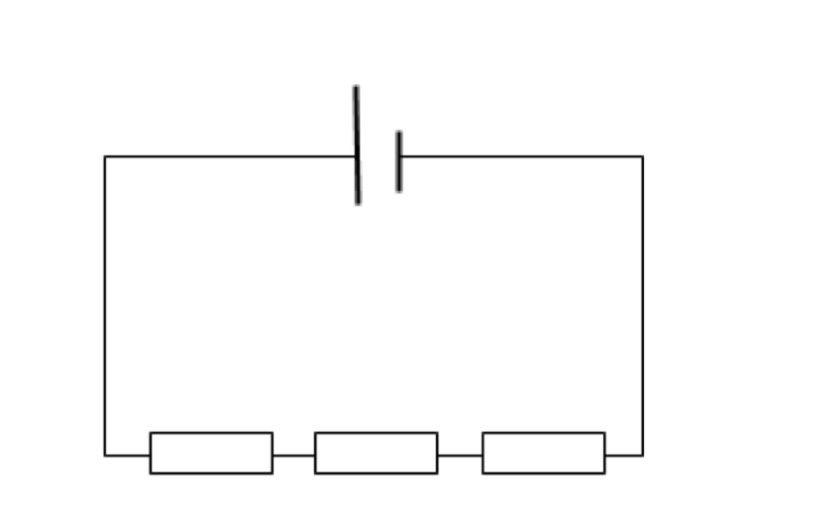
Kirchhoff’s Second Law in Series Circuits
In a series circuit, Kirchhoff’s Second Law states that the sum of all potential differences (voltages) across the components equals the total voltage supplied by the source. Mathematically, V<em>1+V</em>2+V<em>3+⋯+V</em>n=Vbattery.
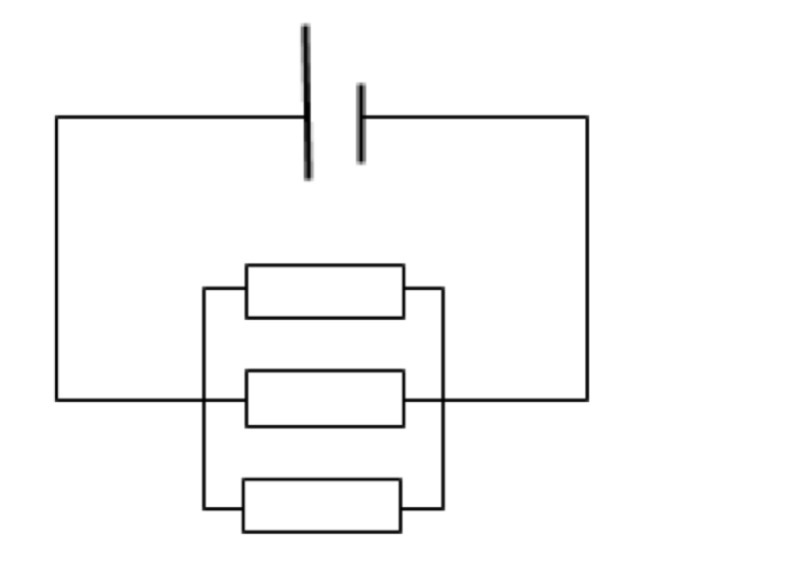
Kirchhoff’s Second Law in Parallel Circuits
In a parallel circuit, Kirchhoff’s Second Law indicates that the total potential difference across each branch is equal to the potential difference of the battery. Therefore, V<em>1=V</em>2=V<em>3=⋯=V</em>battery for all branches.
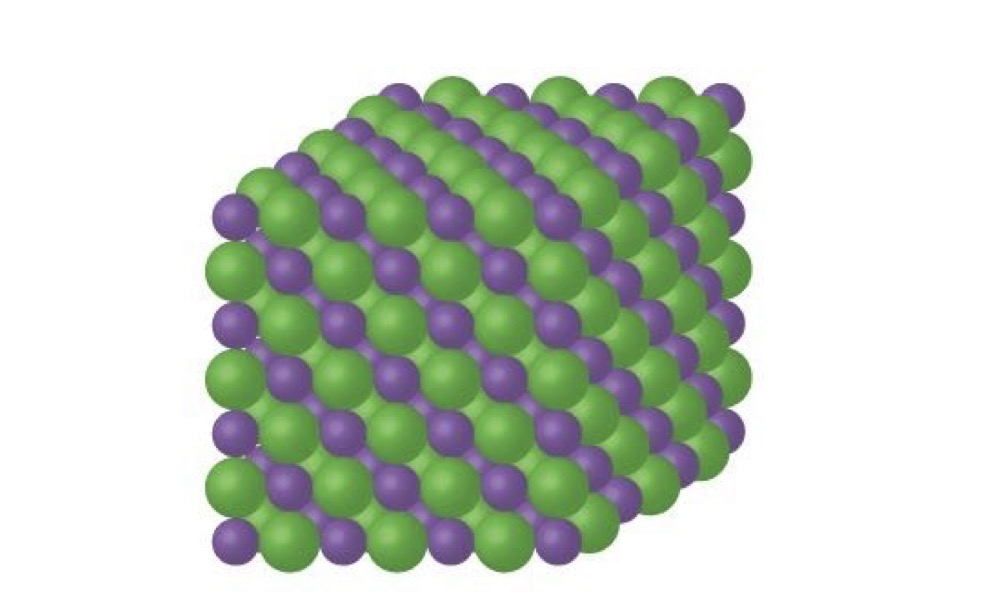
Crystal lattice structure
Atoms in most solids arranged in lattice structure, provides a medium of vibration of atoms about equilibrium position. As temperature of solid increases, intensity of the vibration of its atoms also increases. So more difficult for free electrons to pass through material as electrons more likely to collide with vibrating atoms if oscillating more intensely causing them to slow down. This increases resistance of material.