AP Human Geography Unit 6 + 7
 Call Kai
 Learn
Learn Practice Test
 Spaced Repetition
 Match
Match Flashcards
 Knowt Play
1/18

There's no tags or description
Looks like no tags are added yet.
Name | Mastery | Learn | Test | Matching | Spaced | Call with Kai |
|---|
No analytics yet
Send a link to your students to track their progress
19 Terms
Define range.
How far people are willing to travel to receive urban services and goods
In the contemporary pattern of migration to cities in more developed countries, where are migrants most likely to settle in?
In more developed countries migrants are more likely to settle in suburbs
Seoul is the largest city in South Korea, with a 2018 population of approximately 10 million. Busan is the second-largest city in South Korea, with a 2018 population of approximately 3.5 million. Do these cities follow the rank-size rule or primate city model? How do you know?
No because it is more than twice the size of the second largest city.
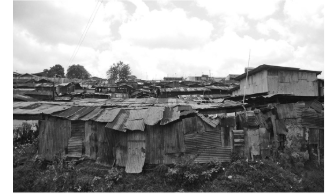
The construction of makeshift housing in a country within the periphery, as shown in the photograph, is often the result of what?
It is the result of Urban Sprawl
Define New Urbanism and some of its goals when city planning
Urban design movement that promotes walkable, mixed-use neighborhoods and environmentally sustainable communities
Define bulk-reducing industries
Industries where the final products weigh less than the raw materials used. EX: Mining and lumber production.
Define Bulk gaining industries
Industries where the final product weighs more than the raw materials used to make it. EX: automobile manufacturing and beverage production.
Describe Primary Sector
Focuses on retrieving, harvesting, and producing raw materials from the earth. (Extraction)
Describe Secondary Sector
Transforms the raw materials from the primary sector into finished, usable goods.(Manufacturing)
Describe Tertiary Sector
Provides intangible services to consumers and businesses rather than tangible products. (Services)
Describe Quaternary Sector
Deals with intellectual and knowledge-based services, acting as an evolution of the tertiary sector. (Knowledge and Info)
Describe Quinary Sector
Represents the highest level of decision-making and policy formulation in an economy or society. (Decision making)
Describe Rostows Stages of economic Growth
1) Traditional Society, 2) Preconditions for Take-off, 3) Take-off, 4) Drive to Maturity, and 5) Age of High Mass Consumption.
Define agglomeration
the clustering of people and activities in proximity to one another, often resulting in economic benefits.
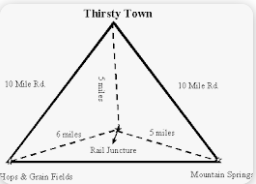
What is the goal of Webers Least Cost Theory
To explain and predict the location of industries
What is deindustrialization
The decline of industrial activity in a region or economy.
Describe the effects of the four industrial revolutions
1st (Late 1700s) — Steam & Water
Tech: Mechanization, steam engine, textiles.
Effect: Urbanization; shift from farms to factories.
2nd (Late 1800s) — Electricity & Assembly
Tech: Steel, oil, internal combustion engine.
Effect: Mass production, global trade, higher living standards.
3rd (Late 1900s) — Digital & IT
Tech: Computers, internet, early automation.
Effect: Information economy, instant global communication.
4th (Present) — Cyber-Physical Systems
Tech: AI, IoT, robotics, smart automation.
Effect: Blurs physical/digital worlds; tech job displacement.
What are Free Trade Zones? What are their purposes?
specially designated, fenced-in geographic areas where goods can be imported, stored, manufactured, and re-exported without having to pay the extra taxes.
How does Weber’s Least Cost Theory determine where a company is located?
finding the exact point where transportation, labor, and agglomeration costs are minimized.