All Special Procedures Info & Other Modalities
 Call Kai
 Learn
Learn Practice Test
 Spaced Repetition
 Match
Match Flashcards
 Knowt Play
1/174

Earn XP
Description and Tags
Info gathered from notes on: peds imaging, working with bariatric PTs, diagnostic & therapeutic procedures, digestive system imaging, patient communication from 3065, and 3062 other modalities
Name | Mastery | Learn | Test | Matching | Spaced | Call with Kai |
|---|
No analytics yet
Send a link to your students to track their progress
175 Terms
Full term newborns are born between how many weeks of pregnancy?
39-40 weeks
Extreme premature newborns (preemies) are born between how many weeks of pregnancy?
23-28 weeks
What is the #1 cause of death in children world wide?
Being born premature
Taking preemies to a NICU increases their survival rate by what percent?
90%
What technical factors should be used when imaging a preemie?
0.5 mAs, 58-64 kVp
Between what ages are patients asked about pregnancy status?
11-55 years old
If PT is unsure/confirms chance of pregnancy, what are some options the ordering physician may choose to do?
Continue with exam if urgent/time sensitive
Postpone imaging until pregnancy test is done
Adjust exam to have less exposures
Choose non-radiating modality
Favour PA imaging
What are examples of exams unique to pediatric PTs?
Braces/temporary orthopedic device fitting
Scanograms
Scoliosis exams
Bone age
Pigg-o-stat chest
Skeletal surveys for S.C.A.N. or congenital abnormalities
When considering pediatric cases, what may scanograms be used for?
Pre-surgery
Bowing of the legs
Leg length differences
What are attention techniques used for?
Directing a child’s gaze to a specific area
What are distraction techniques used for?
Diverting attention away from a procedure
(helps child relax + less aware of stress/pain)
What are visual indications of an inspiration in children?
Seeing the ribs/intercostal spaces through the skin
Does a cry indicate inspiration or expiration?
Expiration
Does the quiet pause between cries indicate inspiration or expiration?
Inspiration
According to Bontragers, grid use begins at what body part thickness?
~10 cm
With advancements of DR systems, grid use can begin at what body part thickness?
~20 cm
At what may grids start to be used for CXRs of average sized children?
~10 years old
Pelvis grids appear starting when a child reaches what age?
~18 months old and above
Pigg-o-stats can be used for children between what ages?
4 months to 4 years
What may happen if the sleeve on a Pigg-o-stat is too large?
Acrylic will overlap causing density artifact
What may happen if the sleeve on a Pigg-o-stat is too small?
Skin at the chest will be squeezed
A BMI of ___ = obese
30-39.9
A BMI of ___ = morbidly obese
40+
If a PT is ~100 lbs overweight or more, they are considered ___
Morbidly obese
The aperture diameter of a CT or MRI machine is accurately measured in what plane?
Horizontally
The vertical measurement of a gantry/bore must consider what?
The table thickness entering the aperture
Typically, the table takes up ___cm of the stated gantry/bore vertical diameter
15-18
Bariatric PT beds have a width of ___in and can hold PTs up to ___lbs
34 inches, 750 lbs
Transferring a PT from a cart to a table may require up to how many people?
8-10
What exams are considered as attainable with bariatric PTs?
skull
c-spine
upper limb
lower limb distal to the knee
What exams are considered usually obtainable with bariatric PTs?
Shoulder and femur
What exams are considered challenging to obtain with bariatric PTs?
All projections of the thorax/abdomen
(T/L-spine, lungs, abdomen, pelvis, hips)
What exams are considered very difficult to nearly impossible
Organs (stomach, small and large bowel)
Your PT is < 5 ft. Symphysis is approximately how many inches below jugular notch?
21 inches
Your PT is between 5-6 ft. Symphysis is approximately how many inches below jugular notch?
22 inches
Your PT is taller than 6 ft. Symphysis is approximately how many inches below jugular notch?
24 inches
When imaging bariatric PTs, placing the bottom edge of a 35×43 IR lengthwise/portrait shows what anatomy?
L-spine and abdomen
When imaging bariatric PTs, placing the bottom edge of a 35×43 IR crosswise/landscape shows what anatomy?
Pelvis and hips
What range of mA may automatically engage the large focal spot?
250-320 mA
A backup timer greater than the customary __% of anticipated mAs is likely required when imaging bariatric PTs
150% of anticipated mAs
Clinical indications: esophagogram
Achalasia
Esophageal carcinoma
Esophageal varices
Foreign bodies
GERD
What exam is used to demonstrate the form and function of the pharynx and distal esophagus?
Esophagogram (AKA Ba swallow – different from MODIFIED Ba swallow)
An Esophagogram/Ba swallow demonstrates what?
Form and function of pharynx and esophagus
Esophagogram: placing the PT in an RAO position does what?
Displaces esophagus away from spine, between vertebral column and heart
Esophagogram: What PT position demonstrates the esophagus between the vertebral column and the heart?
35-45° RAO
Esophagogram: What PT position moves the Ba slower?
Recumbent RAO
Esophagogram: placing the PT in a LAT position does what?
Allows visualization of the anterior and posterior aspects of the esophagus, placing it anterior to the vertebral column
Esophagogram: What position visualizes the anterior and posterior aspects of the esophagus?
LAT
A Modified Ba Swallow demonstrates and assesses what?
Demonstrates: oral cavity and pharynx
Assesses: (initial stages) swallowing function and safety
Clinical indications: Modified Ba Swallow Study
Dysphagia and aspiration
A Modified Ba Swallow study involves what 3 healthcare staff?
SLP, radiologist, MRT
Modified Ba Swallow: placing the PT in a LAT position demonstrates what?
The epiglottis and PT swallowing
Modified Ba Swallow: what PT position demonstrates the epiglottis and the function of swallowing in the PT?
LAT (often the only projection required)
Modified Ba Swallow: placing the PT in an AP position demonstrates what?
Pharyngeal contractions and lateral spread of residual Ba
Modified Ba swallow: What PT position demonstrates pharyngeal contractions and the lateral spread of residual Ba?
AP
An Upper GI Series study is also called what?
ES&D
if study continues past the duodenum into the small bowel, it is called a ES&D follow through or ES&DFT
Clinical indications: ES&D
Used to detect abnormal anatomic and functional conditions
peptic ulcer
hiatal hernia
diverticula
gastritis
tumor
Considering stomach orientation: the fundus is ___?
The most posterior portion
Considering stomach orientation: the body is ___ to the fundus?
Anterior and inferior to the fundus
Considering stomach orientation: the pylorus is ___ to the body?
Posterior and distal to the body
A hypersthenic patient has what stomach orientation and what speed of gastric emptying?
High and transverse stomach; slow gastric emptying
A hypo/asthenic patient has what stomach orientation and what speed of gastric emptying?
Vertical stomach along midline; fast gastric emptying
ES&D: supine PT position demonstrates what?
Air in the body and pylorus of the stomach
ED&D: prone PT position demonstrates what?
Air in the fundus
What is used as a negative contrast agent in an ES&D?
Gas crystals
What purpose do gas crystals serve in an ES&D study?
Negative contrast agent
Distends the stomach
Demonstrates mucosal lining
What position/technique may be used in an ES&D to demonstrate a hiatal hernia?
Trendelenburg or Valsalva maneuver
(increases pressure in abdominal cavity to exacerbate hernia)
Placing the PT in a supine or Trendelenburg position for an ES&D demonstrates what anatomy, and is best for what clinical indication(s)?
Demonstrates: entire stomach and duodenum
Clinical indication: hiatal hernia
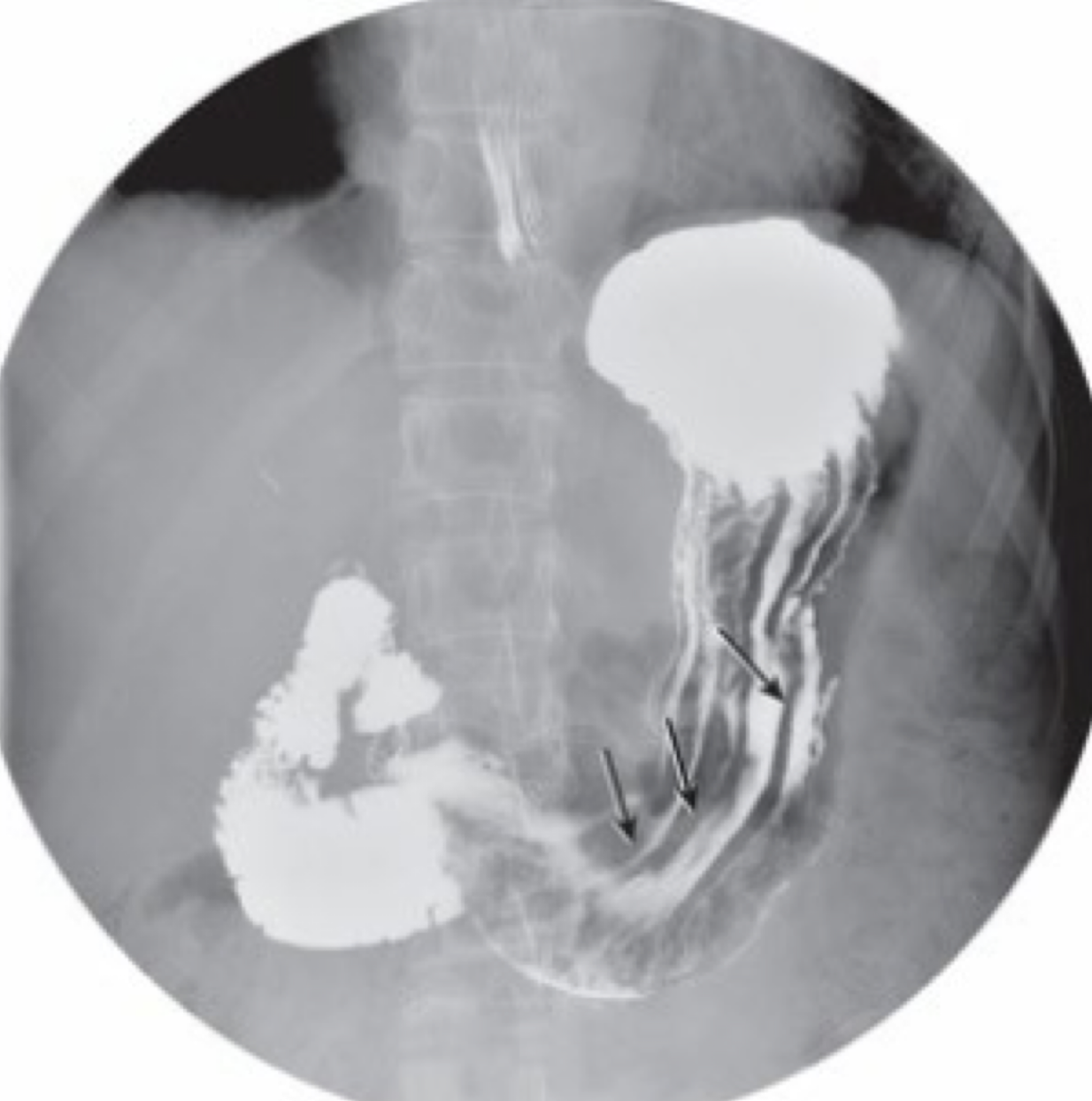
Placing the PT in a recumbent right LAT position demonstrates what anatomy, and is best for what clinical indication(s)?
Demonstrates: retrogastric space, pylorus, C-loop of duodenum (in hypersthenic PTs)
Clinical indications: gastric diverticuli, ulcers and tumors (specifically of retrogastric space)
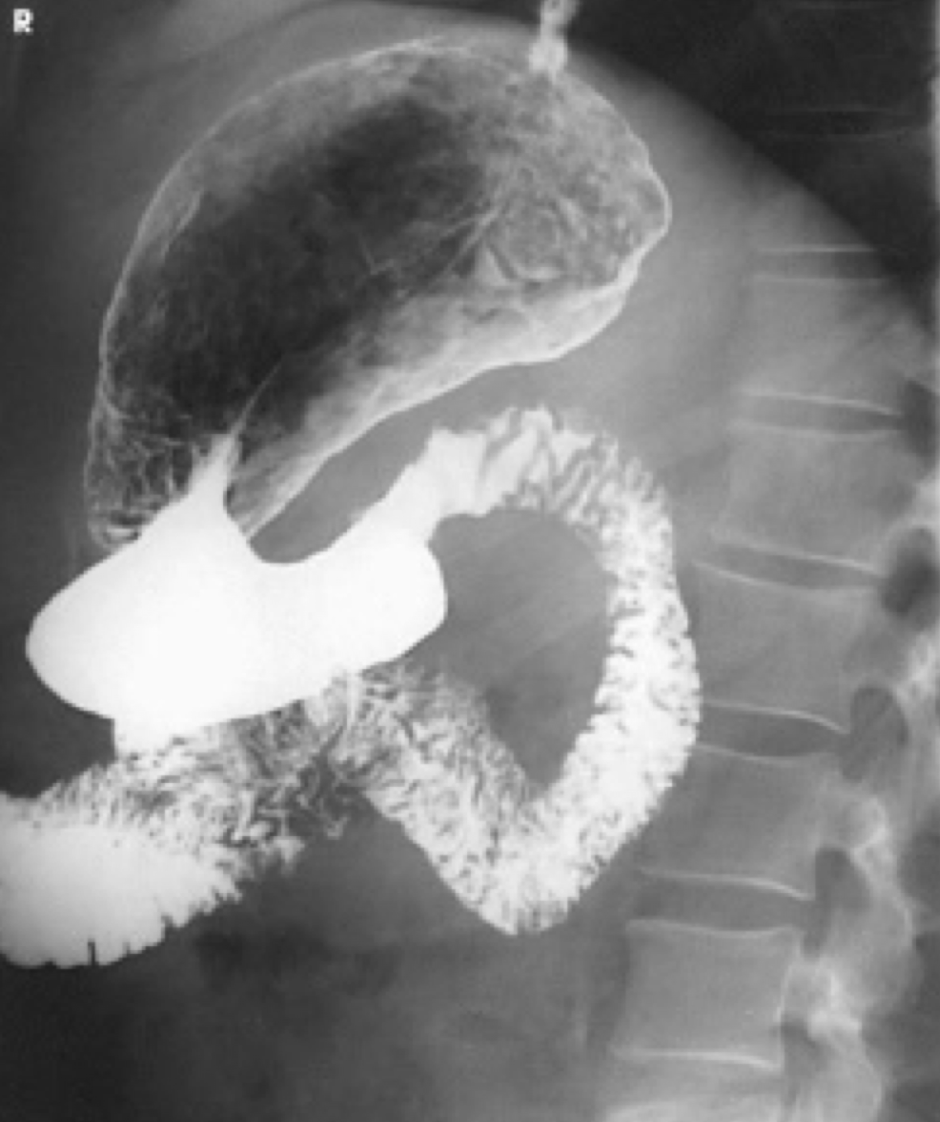
Placing the PT in a 40-70° RAO position for an ES&D demonstrates what anatomy?
Entire stomach and Ba filled duodenal bulb in profile
What PT prep is required for an ES&D?
PT should be NPO for 8 hours prior to study
PT should avoid chewing gum and smoking (otherwise causes gastric secretions preventing Ba from sticking to gastric walls)
A Small Bowel Series is also called what?
SBFT / ES&B
Clinical indications: Small Bowel Series
Used to study form and function of small bowel to detect abnormal conditions
Chron’s
Enteritis
Ileus
Giardiasis (an infection caused by parasite)
Contraindications: small bowel series
Pre-surgical PTs/suspected hollow viscus
Suspected LBO
What PT prep is required for a small bowel series?
Low residue diet 2 days prior to study
PT should be NPO for 12 hours prior to study
PT is to ingest ___ml of ____for a small bowel series
450-900 ml of Ba Sulfate
Small bowel series: how many ml should the PT drink if performing this study after an ES&D?
450 ml
Small bowel series: how many ml of Ba should the PT drink if doing an independent study? (meaning no other Ba study was done prior to this SBFT)
900 ml
Where should the CR be centered for a PA projection 15 minutes into a small bowel series?
Perpendicular to MSP 5 cm above iliac crest
Where should the CR be centered for a PA projection 60 minutes into a small bowel series?
Perpendicular to MSP at level of iliac crest
For a small bowel series, regardless of the time interval being used for the study, an image MUST be taken at the ___ minute mark
60 minute mark, regardless of the time interval being used (eg. every 5, 10, 15 mins etc)
Clinical indications: Barium enema
Colitis
Ulcerative colitis
Polyps
Diverticulosis/itis
Volvulus
Intussusception
Adenocarcinoma
Contraindications: Barium enema
Perforation risk (post-op PT, biopsy, perforated hollow viscus)
Possible LBO
What PT prep is required for a barium enema?
Low residue diet
Laxatives
Cleansing enema
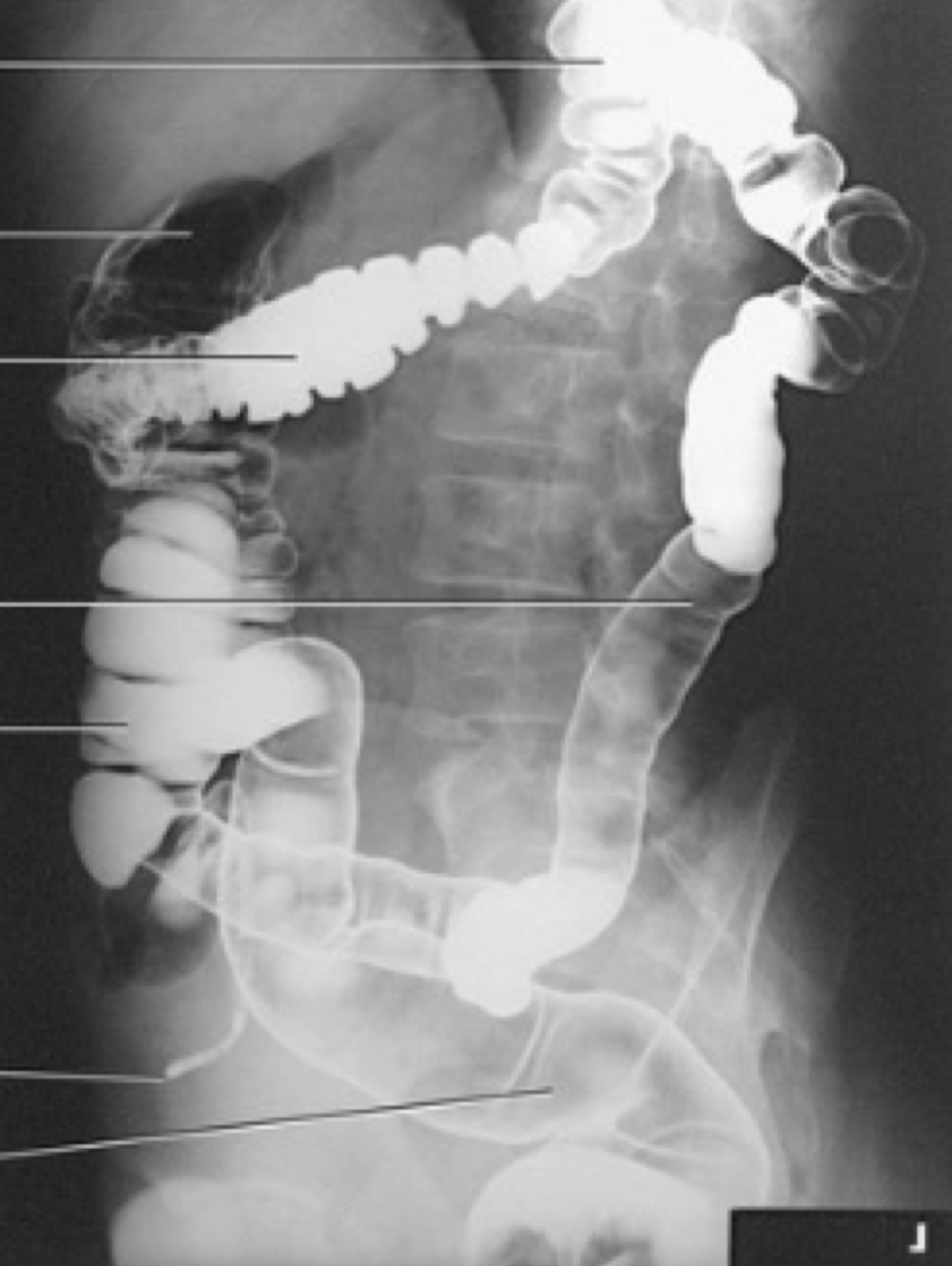
Barium enema: an AP/PA (prone position) demonstrates what anatomy?
Entire large bowel
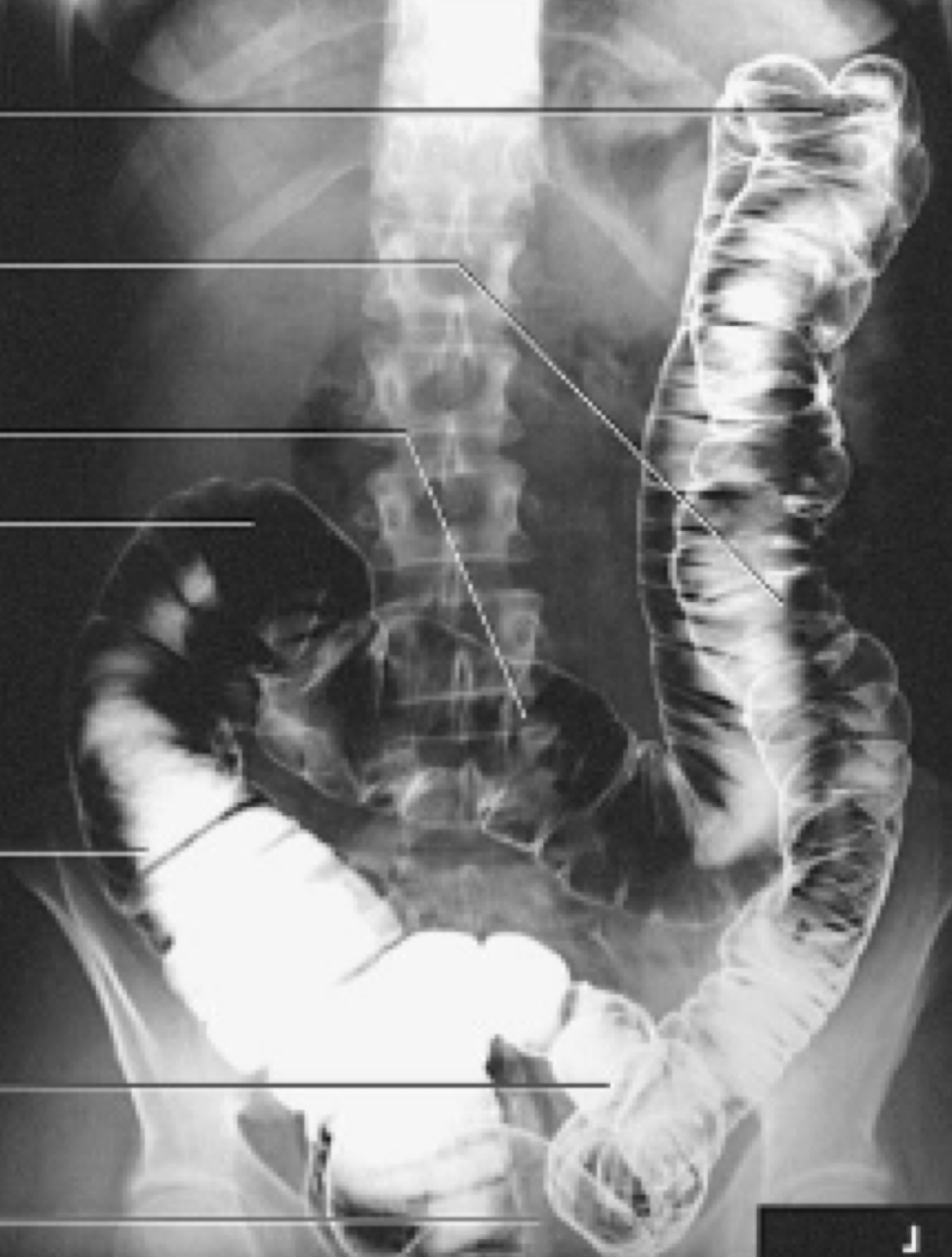
Barium enema: an RAO position (PA OBL projection) best demonstrates what anatomy?
Hepatic (right colic) flexure
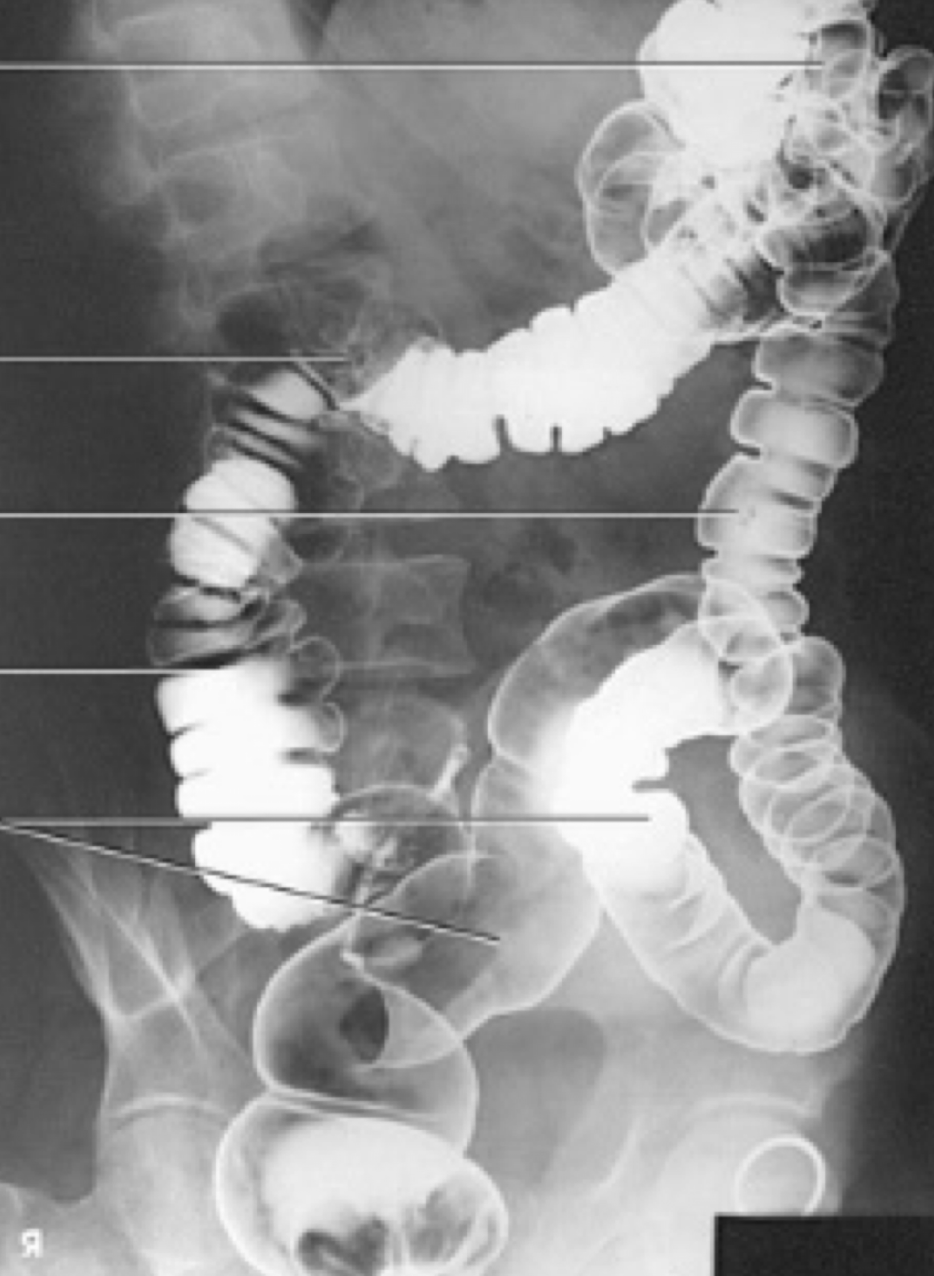
Barium enema: an LAO position (PA OBL projection) best demonstrates what anatomy?
Splenic (left colic) flexure
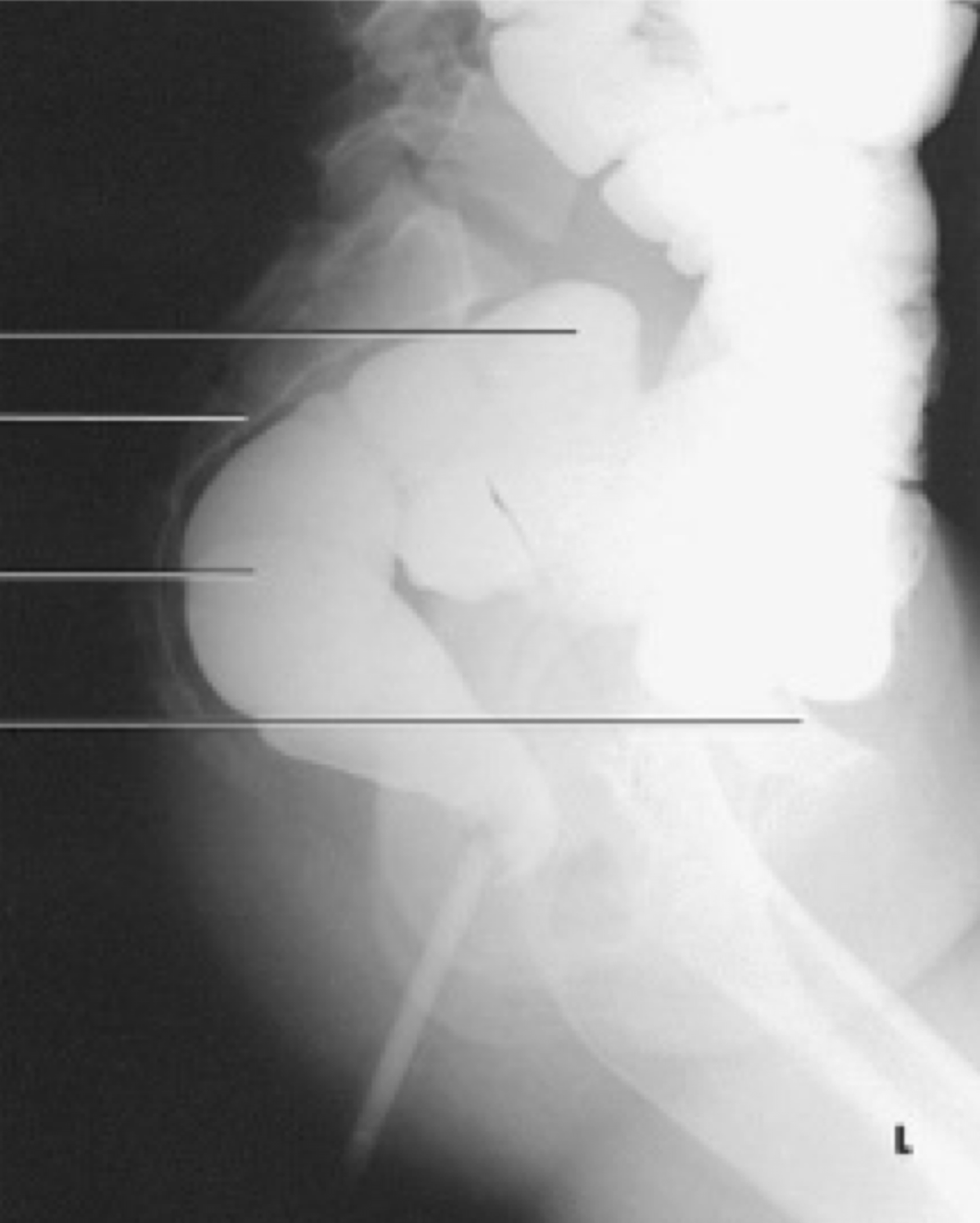
Barium enema: a lateral or ventral decubitus position best demonstrates what anatomy?
Rectum and distal sigmoid
(decubitus shows A/F levels)
Define: therapeutic communication
Techniques used to encourage PTs to express themselves
Define: non-therapeutic communication
Communication that diminishes or dismisses the PT experience
(Judgemental statements, cliches, false reassurance, defending, changing the subject, giving advice, subjective interpretation, agreeing/disagreeing, probing, demanding an explanation)
If a patient is Deaf they have _____
total hearing loss
If a patient is deaf they are ____
unable to hear well enough to process info
Age range for neonates/infants
Birth to 1 year
Age range of toddlers
1-2 years
Age range of pre-schoolers
3-5 years
Age range of school age children
6-12 years
Age range of adolescents
13-18 years
Age range of young adults
19-45 years
Age range of middle age adults
46-64 years
Age range of late adults and old adults
Late: 65-79 years
Old: 80+ years