Enzymes.
 Call Kai
 Learn
Learn Practice Test
 Spaced Repetition
 Match
Match Flashcards
 Knowt Play
1/24

There's no tags or description
Looks like no tags are added yet.
Name | Mastery | Learn | Test | Matching | Spaced | Call with Kai |
|---|
No analytics yet
Send a link to your students to track their progress
25 Terms
Metabolism
Describes all the chemical reactions that occur in an organism.
Metabolic reactions fall into two types:
Anabolic reactions such as photosynthesis use small molecules to make larger ones, usually requiring energy
Catabolic reactions such as respiration break large molecules into smaller ones and release energy.
Enzymes
A biological catalyst that is protein in nature.
Metabolic Functions of Enzymes
Without enzymes, metabolic reactions would occur too slowly for living organisms to function.
Metabolic reactions need to take place under the normal temperature and pH conditions found in the organism’s cells.
In humans, the normal body temp is 37 degrees celsius and the cell cytoplasm has a pH of around 7.2.
Examples of reactions catalysed by enzymes include:
Photosynthesis
Respiration
DNA replication
Pulling chromosomes apart during cell division
Generation of ATP
Catalyst
A chemical which generally speeds up the rate of a chemical reaction but is unchanged in the reaction.
Catalysis
The acceleration of chemical reactions.
Enzyme structure
Enzymes are a form of protein and thus made in the ribosome of a cell.
Proteins are made up of long chains of amino acids.
These chains fold over and take up a very specific shape.
Enzymes have a 3D, globular shape.
Substrate
The chemical with which the enzyme reacts.
Product
The chemical made in the reaction.
Amylase
Location: Mouth and pancreas
Substrate: Starch
Product: Maltose
Optimum pH: 7
Optimum Temp: 37 degrees celsius in humans
Reaction Type: Catabolic
Catalase
Location: Liver and celery
Substrate: Hydrogen peroxide
Product: Water and oxygen
Optimum pH: 7
Optimum Temp: 37 degrees celsius in humans
Reaction Type: Catabolic
DNA polymerase
Location: Every cell
Substrate: Nucleotides → basic unit of DNA
Product: DNA
Optimum pH: 9
Optimum Temp: 75-80 degrees celsius in bacteria
Reaction Type: Anabolic
Features of enzymes
Made of protein, with a particular 3D shape, are produced in living cells.
Specific for a particular substrate. One enzyme per reaction e.g amylase will only work on starch.
Enzymes can work in both directions (reversible).
The activity of the catalyst varies with temperature, pH, enzyme conc., substrate conc., product conc. and enzyme inhibitors.
How does an enzyme work ?
Enzymes work by joining to the substrate molecules.
The position on the enzyme where this happens is called the active site.
An enzyme is specific, i.e it acts like a mould that fits the substrate very closely.
Any other chemicals that do not fit exactly cannot react with the enzyme.
The Induced fit theory then occurs - when the substrate joins the enzyme it will change the shape of the active site slightly to make a better fir for the substrate.
What is the induced fit theory ?
The active site is not a fixed shape.
When the substrate joins the enzyme, it will change the shape of its active site slightly to make a better fit.
These combine to form the enzyme-substrate complex.
The substrate molecules react, the products are released and the unchanged enzyme is the available again.
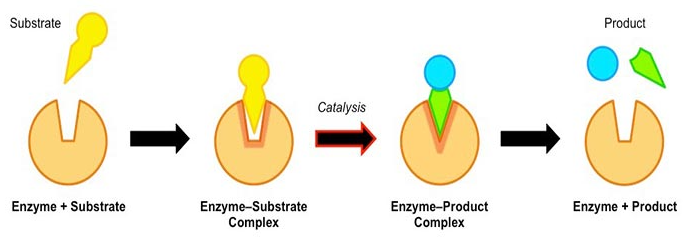
What happens when the enzyme-substrate complex is formed ?
The enzyme will usually work in one of two ways:
Catabolic reaction: It will strain a bond in the substrate so much that the bond breaks and the products will be released.
Anabolic reaction: It will bring two molecules close together at the active site and will encourage the formation of a bond making a new chemical.
Effect of Temperature on Enzyme Action
An increase in temperature increases the rate of reaction up to a maximum or optimum temperature at which the enzyme works best.
Raising the temperature above enzyme’s optimum changes the enzyme’s shape so that the substrate can no longer bind to the active site, lowering the enzyme’s rate of reaction.
If the temperature is too high the enzyme shape is lost permanently and the enzyme no longer functions and is said to be denatured.
Enzymes found in the human body function best at body temperature 37 degrees celsius.
Plant enzymes function best at lower temperatures e.g those in onion cells have an optimum temperature of 25 degrees celsius.
Effect oh pH on enzyme action
Enzyme shape is affected by its environment’s pH.
An enzyme only has the correct shape to attach to its substrate at a particular pH.
pH at which each enzyme works best is called its optimum pH.
Decreases or increases in pH from the optimum pH result in the enzyme changing shape and a decline in its ability to function → i.e enzymes will be denatured.
Extremes of pH denature enzymes.
Effect of substrate concentration
At low substrate concentrations, the reaction rate is low.
The rate of the enzyme reaction increases as the substrate concentration increases. This is because the enzyme has more substrate molecules to bind with.
After a certain substrate concentration, when all the enzyme molecules active sites are occupied by substrates (it is saturated).
Increasing the substrate concentration further will not increase the reaction rate.
Effect of enzyme concentration
Increasing the enzyme concentration increases the rate of reaction: there are more enzyme molecule active sites or substrate molecules to bind with.
If the enzyme concentration exceeds the number of substrate molecules, the reaction rate levels off, as there are not enough substrate molecules to react with the enzyme.
Biochemical reactions
Biochemical reactions are carried out in sterile, stainless-steel vessels called bioreactors.
They can also speed up reactions at much lower temperatures than other catalysts and they can be reused.
Immobilised enzymes
Enzymes can be used in bioreactors either ‘free’ insolution or ‘immobilised’.
Immobilised enzyme is an enzyme attached to itself or an inert material
Immobilised enzymes are ’held in place’ - the enzyme can be:
absorbed on an inert solid surface or
trapped within a gel made from a substance such as alginate.
When an immobilised enzyme is used in a bioreactor, the substrate is passed over the immobilised enzyme and the product is collected.
Advantages using immobilised enzymes over free enzymes
The product is pure and does not need to be separated from the reaction solution.
Immobilised enzymes are easily retrieved for reuse.
Immobilised enzymes are more stable to temperature /pH changes.
Disadvantages using immobilised enzymes
There is a lower reaction rate than with a free enzyme.
When the enzyme is immobilised in a gel, the substrate must diffuse into the gel to react with the enzyme and the product must diffuse out.
There is the cost of immobilising the enzyme.
Lactase
Used to convert lactose into sweeter sugars, glucose & glactose. These sugars are used to replace condensed milk in the manufacture of soft toffee and caramel.