Greek History Artifacts Archaic-Hellenistic
 Call Kai
 Learn
Learn Practice Test
 Spaced Repetition
 Match
Match Flashcards
 Knowt Play
1/53

There's no tags or description
Looks like no tags are added yet.
Name | Mastery | Learn | Test | Matching | Spaced | Call with Kai |
|---|
No analytics yet
Send a link to your students to track their progress
54 Terms
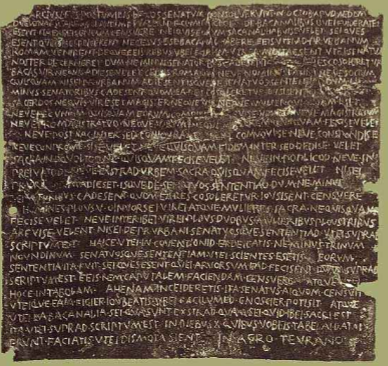
Bacchanalia Senatus Consultum- Hellenistic
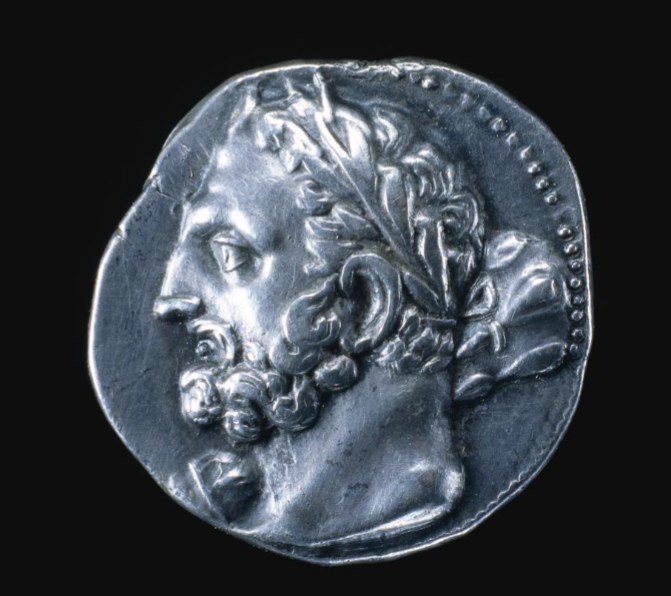
Hannibal Coin from Spain- Hellenistic
“Instantly he shrieked aloud as if smitten by a
violent blow and was conducted by his Friends, who led him by the hand
back to his apartments. His chamberlains put him to bed and attended him
closely, but the pain increased and the physicians were summoned. No one
was able to do anything helpful and Alexander continued in great
discomfort and acute suffering. When he, at length, despaired of life, he
took off his ring and handed it to Perdiccas. His Friends asked: “To whom
do you leave the kingdom?” and he replied: “To the strongest.” He added,
and these were his last words, that all of his leading Friends would stage a
vast contest in honour of his funeral. This was how he died after a reign of
twelve years and seven months. He accomplished greater deeds than any,
not only of the kings who had lived before him but also of those who were
to come later down to our time.”
Diodorus Siculus, - Hellenistic
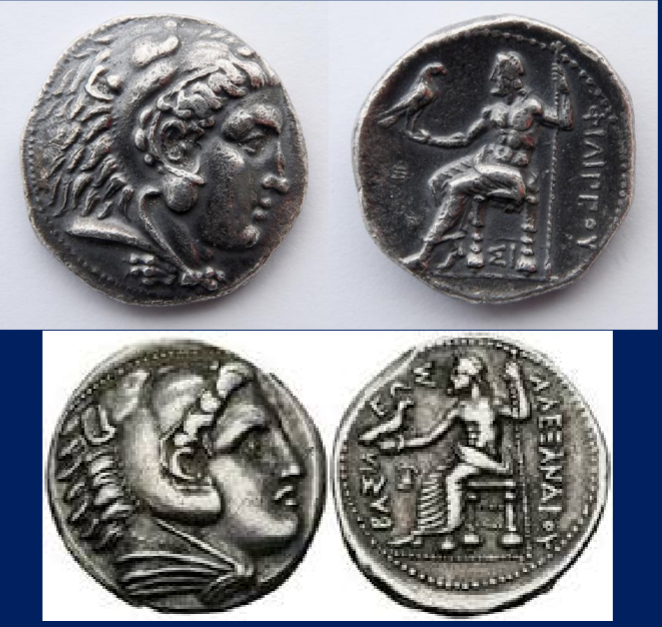
Alexander IV and Phillip Arridaeus coin - Hellenistic
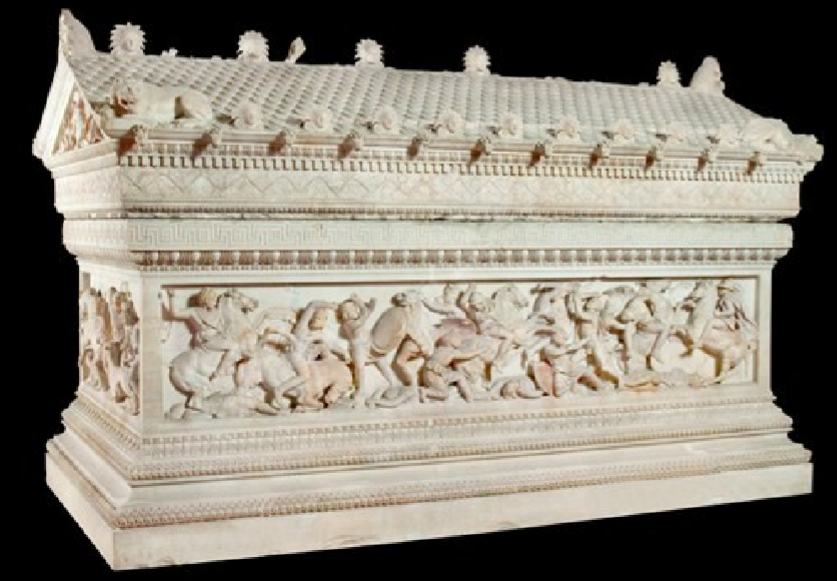
Alexander Sarcophagus (for King Abdalonymos, of Sidon) - Hellenistic
“As quaestor it fell to [Julius Caesar’s] lot to serve in Farther Spain. When he was
there, while making the circuit of the assize-towns, to hold court under commission
from the praetor, he came to Gades, and noticing a statue of Alexander the Great in
the temple of Hercules, he heaved a sigh, and as if out of patience with his own
incapacity in having as yet done nothing noteworthy at a time of life when Alexander
had already brought the world to his feet, he straightway asked for his discharge, to
grasp the first opportunity for greater enterprises at Rome. Furthermore, when he was
dismayed by a dream the following night (for he thought that he had raped his
mother) the soothsayers inspired him with high hopes by their interpretation, which
was: that he was destined to rule the world, since the mother whom he had seen in his
power was none other than the earth, which is regarded as the common parent of all
mankind.”
Suetonius, Life of the Deified Julius Caesar - Hellenistic
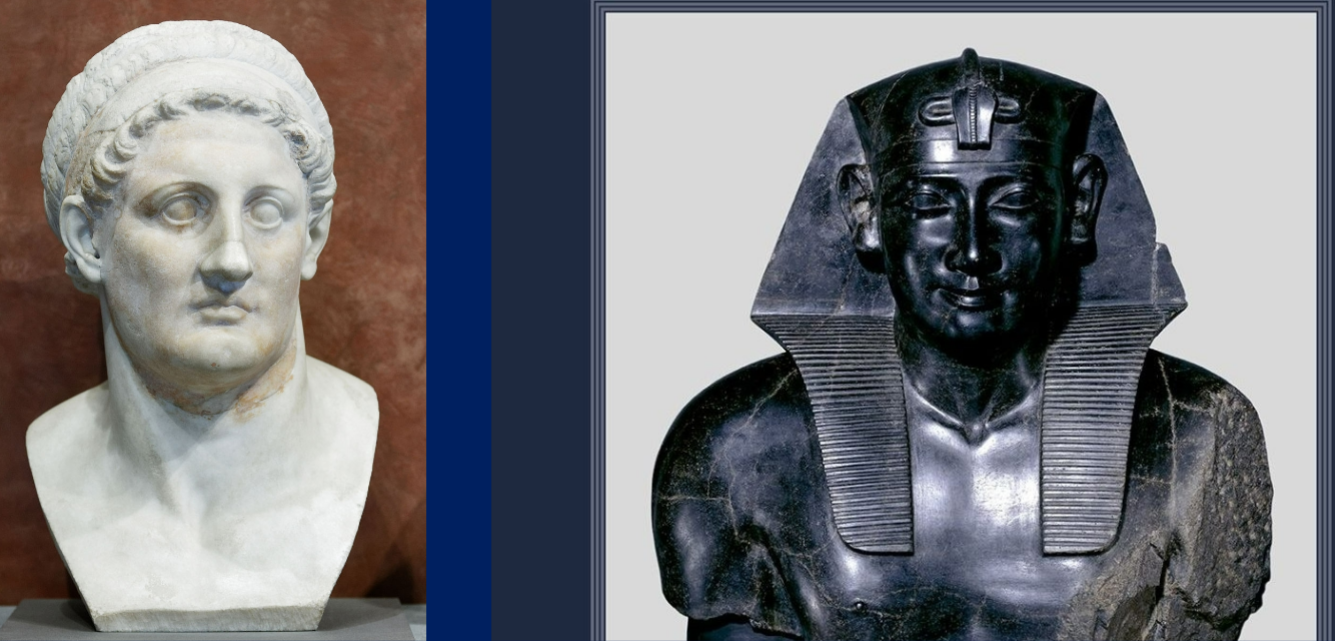
Ptolemy Busts - Hellenistic
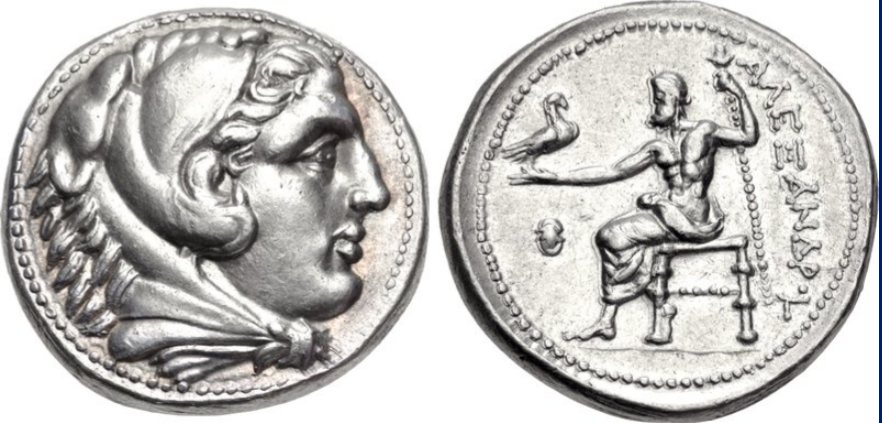
Alexander tetradrachm - Classical
![<p>“Night of the thirtieth: Last part of the night […]</p><p>[That month, the equivalent for 1 shekel of silver was: barley] […] kur; mustard, 3 kur, at the end of the month […]; sesame, 1 pân, 5</p><p>minas.</p><p>At that time, Jupiter was in Scorpio; Venus was in Leo, at the end of the month in Virgo; Saturn was in Pisces; Mercury and Mars,</p><p>which had set, were not visible.</p><p>That month, the river level […].</p><p>That month, the eleventh, panic occurred in the camp before the king [The Macedonians] encamped in front of the king.</p><p>The twenty-fourth,note in the morning, the king of the world [erected his] standard […]. Opposite each other they fought and a heavy</p><p>defeat of the troops [of the king he inflicted]. The king, his troops deserted him and to their cities [they went] They fled to the land of</p><p>the Guti.</p><p>[Month seven, the first of which followed the thirtieth of the preceding month;] sunset to moonset 13º30’ […].</p><p>Night of the second: The moon was above Jupiter […]</p><p>Night of the seventh: Beginning of the night:</p><p>[End of the tablet. On the reverse side, the astronomical observations of the month Tašrîtu are illegible. At the end of the tablet, the</p><p>following can be read:]</p><p>[That month, the equivalent] for 1 shekel of silver was: […]</p><p>That month, from the first to the […], came to Babylon, saying: "Esagila [will be restored] and the Babylonians to the treasury of</p><p>Esagila [their tithe will give."]</p><p>On the eleventh, in Sippar an order of Al[exander to the Babylonians was sent as follow]s: "Into your houses I shall not enter."</p><p>On the thirteenth, [the vanguard advanced to the Sikil]la gate, to the outer gate of Esagila and [the Babylonians prostrated</p><p>themselves].</p><p>On the fourteenth, these Ionians a bull […] short, fatty tissue [lacuna]. Alexander, king of the world, came into Babylon […], horses</p><p>and equipment of […] and the Babylonians and the people of […] a message to</p><p>[end of tablet]</p>](https://assets.knowt.com/user-attachments/0228110b-fbe4-422d-aed8-003603c364f7.png)
“Night of the thirtieth: Last part of the night […]
[That month, the equivalent for 1 shekel of silver was: barley] […] kur; mustard, 3 kur, at the end of the month […]; sesame, 1 pân, 5
minas.
At that time, Jupiter was in Scorpio; Venus was in Leo, at the end of the month in Virgo; Saturn was in Pisces; Mercury and Mars,
which had set, were not visible.
That month, the river level […].
That month, the eleventh, panic occurred in the camp before the king [The Macedonians] encamped in front of the king.
The twenty-fourth,note in the morning, the king of the world [erected his] standard […]. Opposite each other they fought and a heavy
defeat of the troops [of the king he inflicted]. The king, his troops deserted him and to their cities [they went] They fled to the land of
the Guti.
[Month seven, the first of which followed the thirtieth of the preceding month;] sunset to moonset 13º30’ […].
Night of the second: The moon was above Jupiter […]
Night of the seventh: Beginning of the night:
[End of the tablet. On the reverse side, the astronomical observations of the month Tašrîtu are illegible. At the end of the tablet, the
following can be read:]
[That month, the equivalent] for 1 shekel of silver was: […]
That month, from the first to the […], came to Babylon, saying: "Esagila [will be restored] and the Babylonians to the treasury of
Esagila [their tithe will give."]
On the eleventh, in Sippar an order of Al[exander to the Babylonians was sent as follow]s: "Into your houses I shall not enter."
On the thirteenth, [the vanguard advanced to the Sikil]la gate, to the outer gate of Esagila and [the Babylonians prostrated
themselves].
On the fourteenth, these Ionians a bull […] short, fatty tissue [lacuna]. Alexander, king of the world, came into Babylon […], horses
and equipment of […] and the Babylonians and the people of […] a message to
[end of tablet]
Babylonian Astronomical Diaries - Classical
“1. What Herodotus the Halicarnassian has learnt by inquiry is here set forth:
in order that so the memory of the past may not be blotted out from among
men by time, and that great and marvellous deeds done by Greeks and
foreigners and especially the reason why they warred against each other may
not lack renown [aklea]…<abduction of Io and Europa> …3. Then (so the
story runs) in the second generation after this Alexandrus son of Priam, having
heard this tale, was minded to win himself a wife out of Hellas by ravishment;
for he was well persuaded that, as the Greeks had made no reparation, so
neither would he. So he carried off Helen.”
Heroditus, Histories - Classical
“The weakness of the olden times is further proved to me chiefly by this circumstance, that before
the Trojan war, Hellas, as it appears, engaged in no enterprise in common. Indeed, it seems to me
that as a whole it did not yet have this name, either, but that before the time of Hellen, son of
Deucalion, this title did not even exist, and that the several tribes, the Pelasgian most extensively,
gave their own names to the several districts; but when Hellen and his sons became strong in
Phthiotis and were called in to the aid of the other cities, the clans thenceforth came more and
more, by reason of this intercourse, to be called Hellenes, though it was a long time before the
name could prevail among them all. The best evidence of this is given by Homer; for, though his
time was much later even than the Trojan war, he nowhere uses this name of all, or indeed of any
of them except the followers of Achilles of Phthiotis, who were in fact the first Hellenes, but
designates them in his poems as Danaans and Argives and Achaeans. And he has not used the term
Barbarians, either, for the reason, as it seems to me, that the Hellenes on their part had not yet been
separated off so as to acquire one common name by way of contrast. However this may be, those
who then received the name of Hellenes, whether severally and in succession, city by city,
according as they understood one another’s speech, or in a body at a later time, engaged together in
no enterprise before the Trojan war, on account of weakness and lack of intercourse with one
another. And they united even for this expedition only when they were now making considerable
use of the sea.”
Thucydides - Classical
“You two [i.e., Athenians and Spartans] sprinkle altars from the same cup like
kinsmen, at Olympia, at Thermopylae, at Pytho—how many other places could
I mention if I had to extend the list—yet when enemies are available with their
barbarian armies, it’s Greek men and Greek cities you’re determined to
destroy.”
Aristophanes, Lysistrata - Classical
“Again, our fathers condemned many to death for defection to the Medes; in our public
assemblies even to this day, before any other business is transacted, the Athenians call
down curses upon any citizen who proposes friendly overtures to the Persians; and, at the
celebration of the Mysteries, the Eumolpidae and the Kerykes, because of our hatred of
the Persians, give solemn warning to the other barbarians also, even as to men guilty of
murder, that they are for ever banned from the sacred rites. So ingrained in our nature is
our hostility to them that even in the matter of our stories we linger most fondly over
those which tell of the Trojan and the Persian wars, because through them we learn of our
enemies’ misfortunes; and you will find that our warfare against the barbarians has
inspired our hymns, while that against the Hellenes has brought forth our dirges; and that
the former are sung at our festivals, while we recall the latter on occasions of sorrow.
Moreover, I think that even the poetry of Homer has won a greater renown because he has
nobly glorified the men who fought against the barbarians, and that on this account our
ancestors determined to give his art a place of honour in our musical contests and in the
education of our youth, in order that we, hearing his verses over and over again, may
learn by heart the enmity which stands from of old between us and them, and that we,
admiring the valour of those who were in the war against Troy, may conceive a passion
for like deeds.”
Isocrates, Panegyricus - Classical
“Those [ethne] who live in a cold climate and in [northern] Europe are
full of spirit, but wanting in intelligence and skill; and therefore they
keep their freedom but have no political organization and are
incapable of ruling over others. Whereas the [ethne] of Asia are
intelligent and inventive, but they are wanting in spirit, and therefore
they are always in a state of subjection and slavery. But the race of
Greeks, which is situated between them, is intermediate in character,
being high-spirited and also intelligent.”
Aristotle, Politics - Classical
“Now that these descendants of Perdiccas are Greeks, as they
themselves say, I myself chance to know and will prove it in the later
part of my history. Furthermore, the Hellenodicae who manage the
contest at Olympia determined that it is so, for when Alexander (I; r.
498/7-454) chose to contend and entered the lists for that purpose, the
Greeks who were to run against him wanted to bar him from the race,
saying that the contest should be for Greeks and not for foreigners.
Alexander, however, proving himself to be an Argive, was judged to
be a Greek. He accordingly competed in the furlong race and tied step
for first place. This, then, is approximately what happened.”
Heroditus, Histories - Classical
“Then there is a point which some find extraordinary, that they everywhere assign
more to the worst persons, to the poor, and to the popular types than to the good men:
in this very point they will be found manifestly preserving their democracy. For the
poor, the popular, and the base, inasmuch as they are well off and the likes of them
are numerous, will increase the democracy; but if the wealthy, good men are well off,
the men of the people create a strong opposition to themselves. And everywhere on
earth the best element is opposed to democracy. For among the best people there is
minimal wantonness and injustice but a maximum of scrupulous care for what is
good, whereas among the people there is a maximum of ignorance, disorder, and
wickedness; for poverty draws them rather to disgraceful actions, and because of a
lack of money some men are uneducated and ignorant.”
Xenophon, Constitution of the Athenians - Classical
“11. Again, this also was a native custom of theirs, neither to eat
nor drink while on a march, nor yet to be seen doing any of the
necessary consequences of eating or drinking. Even yet that same
abstinence prevails, but they make their journeys so short that no
one would be surprised at their ability to resist those calls of nature.
12. Again, in times past they used to go out hunting so often that
the hunts afforded sufficient exercise for both men and horses, But
since Artaxerxes and his court became the victims of wine, they
have neither gone out themselves in the old way nor taken the
others out hunting; on the contrary, if any one often went hunting
with his friends out of sheer love for physical exertion, the courtiers
would not hide their jealousy and would hate him as presuming to
be a better man than they. 13. Again, it is still the custom for the
boys to be educated at court; but instruction and practice in
horsemanship have died out, because there are no occasions on
which they may give an exhibition and win distinction for skill.
And while anciently the boys used there to hear cases at law justly
decided and so to learn justice, as they believed—that also has been
entirely reversed; for now they see all too clearly that whichever
party gives the larger bribe wins the case.”
Cyropaedia xenophon - classical
“Clearchus, Spartan general, leader of the Ten Thousand, invited to a banquet by
Tissaphernes: “In these things that he said Tissaphernes seemed to Clearchus to be
speaking the truth; and Clearchus said: “Then do not those who are endeavouring by false
charges to make us enemies, when we have such grounds for friendship, deserve to suffer
the uttermost penalty?” “Yes,” said Tissaphernes, “and for my part, if you generals and
captains care to come to me, I will give you, publicly, the names of those who tell me that
you are plotting against me and the army under my command.” “And I,” said Clearchus,
“will bring them all, and in my turn will make known to you whence come the reports
that I hear about you.” After this conversation Tissaphernes showed all kindness, inviting
Clearchus at that time to stay with him and making him his guest at dinner. On the
following day, when Clearchus returned to the Greek camp, he not only made it clear that
he imagined he was on very friendly terms with Tissaphernes and reported the words
which he had used, but he said that those whom Tissaphernes had invited must go to him,
and that whoever among the Greeks should be convicted of making false charges ought to
be punished, as traitors and foes to the Greeks”
Xenophon, Anabasis - Classical
“The Lacedaemonians, however, said that they would not enslave a Greek city
which had done great service amid the greatest perils that had befallen Greece,
and they offered to make peace on these conditions: that the Athenians should
destroy the long walls and the walls of Piraeus, surrender all their ships except
twelve, allow their exiles to return, count the same people friends and enemies
as the Lacedaemonians did, and follow the Lacedaemonians both by land and
by sea wherever they should lead the way.”
Xenophon, Hellenica - Classical
“Theramenes acted as spokesman for the
embassy, and urged that it was best to obey the
Lacedaemonians and tear down the walls. And
while some spoke in opposition to him, a far
greater number supported him, and it was
voted to accept the peace. After this Lysander
sailed into Piraeus, the exiles returned, and the
Peloponnesians with great enthusiasm began to
tear down the walls to the music of flute-girls,
thinking that that day was the beginning of
freedom for Greece.”
Xenophon, Hellenica - Classical
Main source for the post-Pelop war (30 tyrants, Thrasybulus)
Xenophon, Classical period author
“Peisander and Charicles, who were regarded in those days as the most fervent of
democrats, were members of the commission of inquiry. These two maintained that
the outrage was not the work of a small group of criminals, but an organized attempt
to overthrow the popular government: and that therefore inquiries ought still to be
pursued as vigorously as ever.”
Andocides, On the Mysteries - Classical
“Did you, O men of Athens, execute Socrates the sophist because he was shown to have been the teacher of Critias, one of the Thirty who put down the democracy …?”
Aeschines, Against Timarchus, Classical
“So that when Tiribazus ordered those to be present who desired to give ear to the peace which the King had sent down, all speedily presented themselves. And when they had come together, Tiribazus showed them the King’s seal and then read the writing. It ran as follows:
“King Artaxerxes thinks it just that the cities in Asia should belong to him, as well as Clazomenae and Cyprus among the islands, and that the other Greek cities, both small and great, should be left independent [autonomous], except Lemnos, Imbros, and Scyros; and these should belong, as of old, to the Athenians. But whichever of the two parties does not accept this peace, upon them I will make war, in company with those who desire this arrangement, both by land and by sea, with ships and with money.””
Xenophon, Hellenica - Classical
“But if cattle and horses and lions had hands
or could paint with their hands and create works such as men do,
horses like horses and cattle like cattle
also would depict the gods' shapes and make their bodies
of such a sort as the form they themselves have.
...
Ethiopians say that their gods are snub–nosed [σιμούς] and black
Thracians that they are pale and red-haired.”
Xenophanes - Classical?
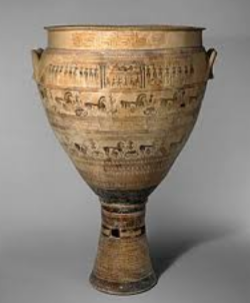
Dipylon Krate - Archaic
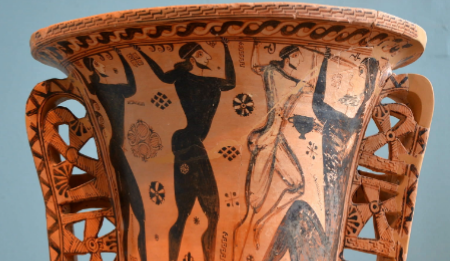
Proto-Attic/Phaleron Ware (?) Polyphemus Painter - Archaic
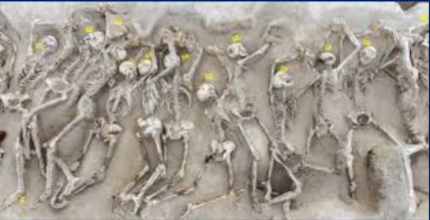
Possible Cylon skeletons - Archaic
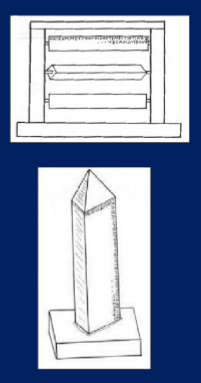
Axones wooden boards and kyrbeis - archaic
Draco’s law” First axon.And or Even if anybody kills anybody not from forethought, he shall be
exiled.The kings shall pronounce responsible for homicide [the one who himself killed or the one?]
whoplanned it; the appeal judges shall decide it. There shall be reconciliation, if there are a fatheror
brother or sons, to be granted by all, or the objector shall prevail. If these do not exist, then as far as
cousinhood and cousin, if they are all willing to grantreconciliation, or the objector shall prevail. If
none of these exists but hekilled unwillingly and the fifty-one appeal judges decide that he
killedunwillingly, let ten members of the phratry allow him to enter if they are willing: let these
bechosen by the fifty-one on the basis of their excellence. And those who killed previously shall be
liable to this ordinance. There shall be a proclamation against thekiller in the agora by those as far
as cousinhood and cousin; there shall join in the prosecutioncousins and cousins’ sons and
brothers-in-law and fathers-in-lawand phratry members . . . is responsiblefor homicide . . . the fifty-
one . . . convictof homicide . . . If anybodykills a killer, or is responsible for his being killed, when
he is keeping away from a frontiermarket and Amphiktyonic contests and rites, he shall be liable to
the same things as forkilling an Athenian; the appeal judges shall decide. . . . . . he is a freeman.
And if he kills a man by defending immediately when the man is forcibly and unjustlytaking and
removing, that man shall have been killed without penalty . . .”
Draco’s law exerpt - Archaic
And he arranged the constitution in the following way: he divided the people by assessment into
four classes, as they had been divided before, Five-hundred-measure man, Horseman, Teamster and
Labourer, …Any man had to be rated as a Five-hundred-measure man the produce from whose
estate was five hundred dry and liquid measures jointly, and at the cavalry-rate those who made
three hundred,—or as some say, those who were able to keep a horse, and they adduce as a proof
the name of the rating as being derived from the fact, and also the votive offerings of the ancients;
for there stands dedicated in the Acropolis a statue of Diphilus on which are inscribed these
lines:Anthemion Diphilus’s son dedicated this statue to the gods
. . . having exchanged the Labourer rating for the Cavalry—
and a horse stands beside him, in evidence that ‘cavalry’ meant the class able to keep a horse.
Nevertheless it is more probable that the cavalry were distinguished by their amounts of produce as
the Five-hundred-measure men were. And men had to be rated in the Teamster class who made two
hundred measures, wet and dry together; while the rest were rated in the Labourer class,
Aristotle, Athenian Constitution - classical
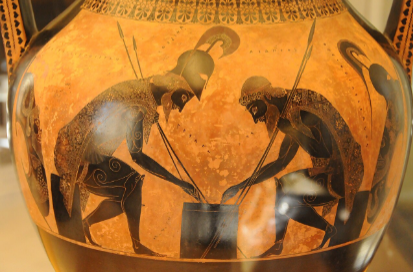
Achilles and Ajax playing game - Archaic
“the standard of justice depends on the
equality of power to compel and that in fact the strong do what they
have the power to do and the weak accept what they have to accept.”
Melian Dialogue, Theucydes - CLassical
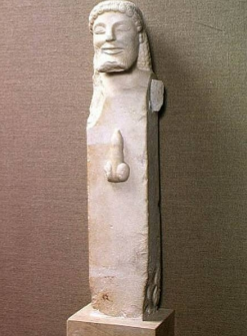
Athenian Herm - Classical