3: refractive surface and vergence .
 Call Kai
 Learn
Learn Practice Test
 Spaced Repetition
 Match
Match Flashcards
 Knowt Play
1/14

There's no tags or description
Looks like no tags are added yet.
Name | Mastery | Learn | Test | Matching | Spaced | Call with Kai |
|---|
No analytics yet
Send a link to your students to track their progress
15 Terms
using model eyes to learn about refractive surface
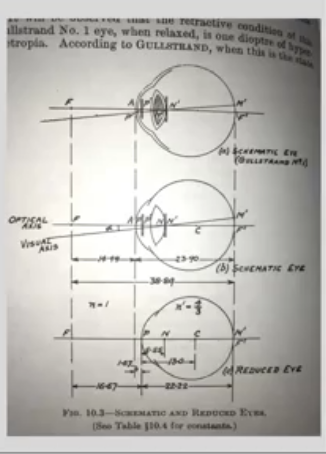
top 2 show 2 surfaces of the cornea
bottom simplified - lenses is taken away and its power is assumed ot be contained within the cornea
power of the eye is around 60 D
40 D contained within the cornea
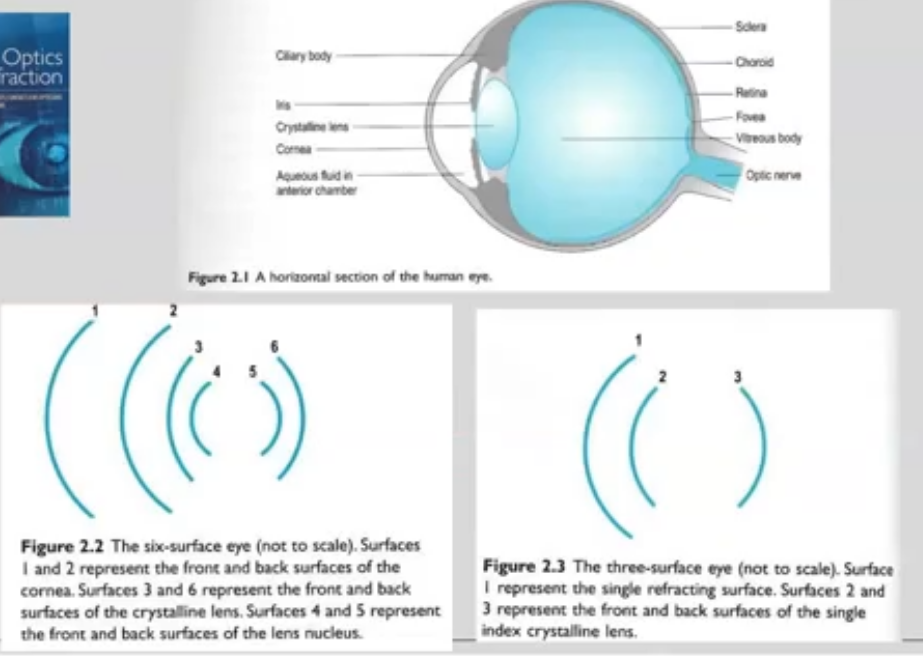
reduced eye
a simpler model eye which has only 1 refracting surface
all dioptric power is contained within conreas as theres no lens
only 4 dimensions - only 4 numbers
radius of curvature of cornea = 5.55mm axial length 22.22mm
if radius of curvature is smaller the power increases
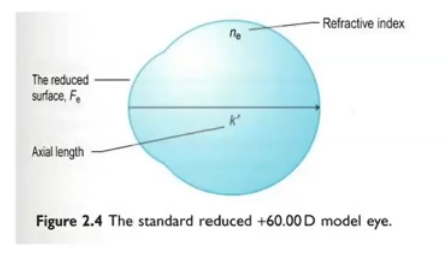
refractive index within : 4/3. power of reduced eye is 60 D
if a patient can read the smallest line on a snellen chart and get it all correct does that mean theyre emmetropic
no, because the might have been accomodating
refractive error equation
4/3 = refractive error ininsde the eye
4/3 - n (1.00) / 5.55mm = 60 D
distance vision, vergence and the dioptre
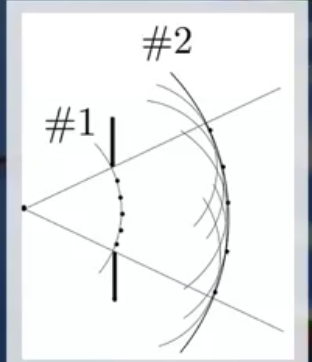
huyens principle for the spreading of light
1 is more curved than the second
gets flatter as it moves away from the source
wavefront curvature reeuces with increased distance from the source
distant vision
wavefront is flat
infinite radius - means 0 curvature
vergence of light is also 1/radium in m
unit for vergeance is the dioptre
when radius is large, ie. infinity it will be 0
1/ infinity is 0
so light from distant target has 0 vergence
vergence
denotes the divergence of light travelling from an object or the convergence of light tracelling to an image
vergence is the recoprocal of an object distance in metres , or image distance multiplied by the refractive index of corresponding medium
e.g when object is in air vergence of light from an object is just 1/ distance from object
minus distance if diverging plus if converging
unit of vergeance is dioptre
what is a dioptre
a unit proposed by monoyer to evaluate the refractive power of a lens or optical system
power of the lens usually denoted by the symbol F - measured in D
Fe is used for the power of the eye + or -
value in dioptres must always have a sign + or -
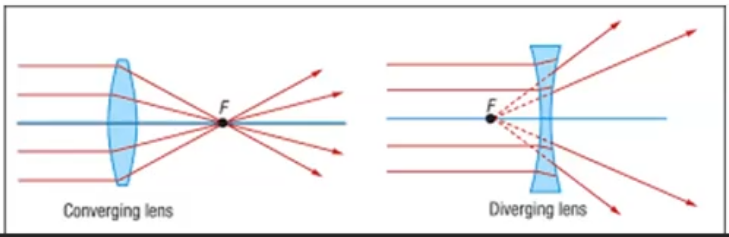
a lens/optical system with a +ve power makes incoming light more convergent
lens with -ve makes incoming light more divergent
paraxial equation
vergence of light after refraction = vergence of light as it meets the lens (or optical system) added to the power of the lens (or optical system)
e.g if divergent light (vergence -3D) strikes a converging lens with power +10 D, after refraction the vergence is +7D
more on vergence
converging rays have a + ve vergence
diverging rays have a -ve vergence
parallel rays of light have 0 vergence as 1/infinity is 0
rays of light are only parallel when they come from a distant target
we use 6m testing distance as its closet to 0
distance vision
from 6m, rays of light are still diverging when they arrive at the eye
but the divergence is low
low enough that the rays can be considered parallel
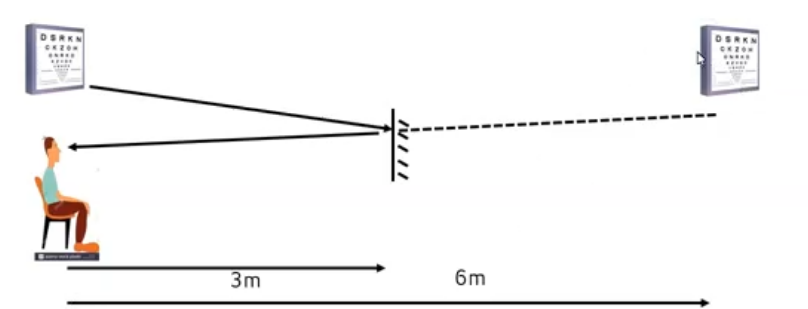
3m room and a mirror
can also be done via a mirror
have patient sat 3m from mirror and test letters above the patient
3m to the mirror and 3m from mirror back which adds to 6m
lateral inversion
issue using a mirror
letters are back to front