Lecture: Plants Diversity (Chapter 30)
 Call Kai
 Learn
Learn Practice Test
 Spaced Repetition
 Match
Match Flashcards
 Knowt Play
1/61

Earn XP
Description and Tags
Gametophyte, Monocot vs. Dicots, Life Reproduction Cycle
Name | Mastery | Learn | Test | Matching | Spaced | Call with Kai |
|---|
No analytics yet
Send a link to your students to track their progress
62 Terms
Fill in the blank
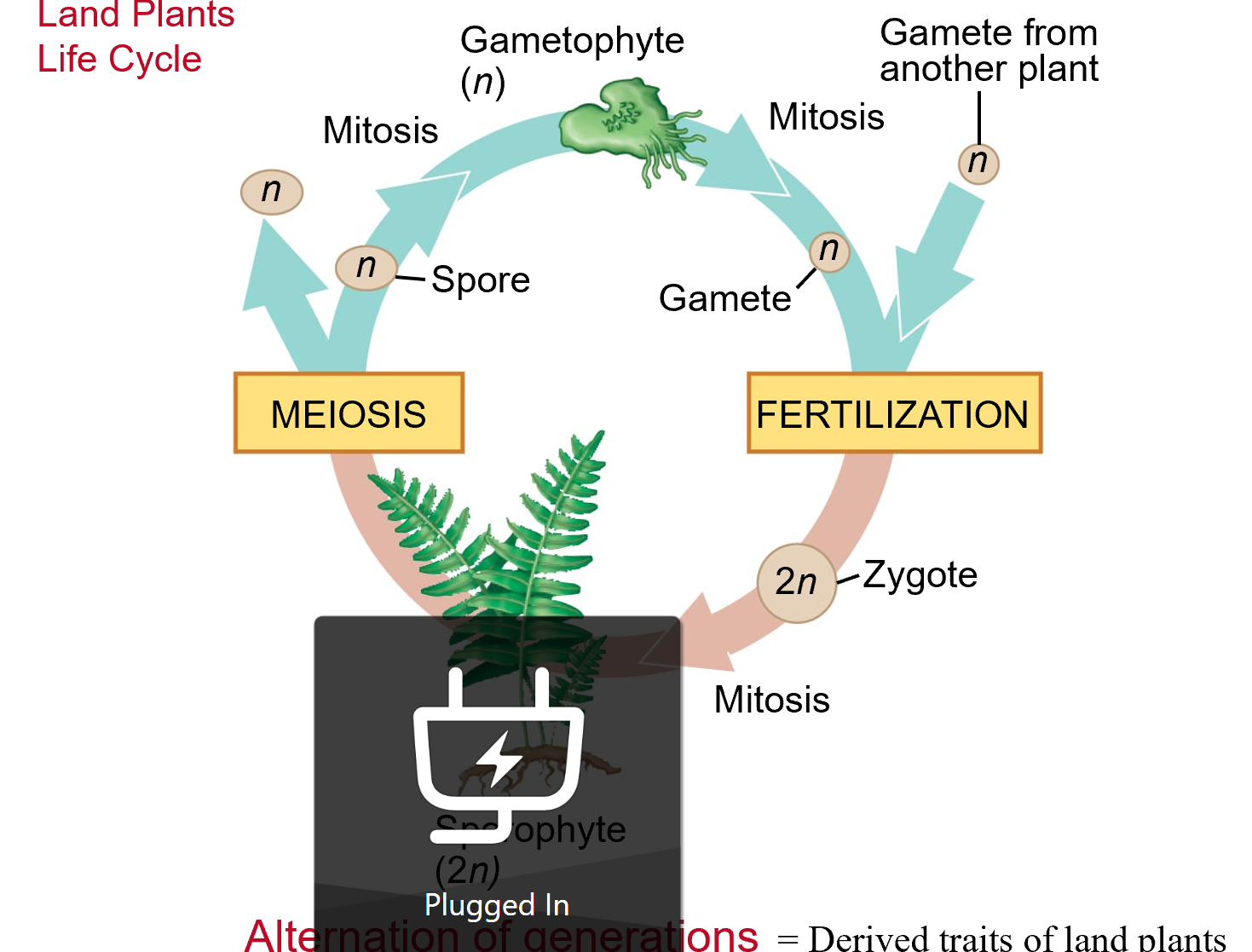
The multicelluar _____ is haploid and produces haploid gametes by ____
gametophyte; mitosis
Fill in the blank
The process of _______ is when male and female gametes fuse together. They form a diploid zygote that will eventually grow into a _______
fertilization; sporophyte
What is a sporophyte?
The sporophyte is the diploid phase of the plant life cycle that develops from the zygote and produces haploid spores through meiosis. It is typically the dominant stage in vascular plants.
By which process do sporophytes produce haploid spores?
Through meiosis.
Study the reproductive cycle
Fill in the blank
Ancestral species gave rise to land plants which can be informally grouped based on the presence or absence of _____ tissue
vascular
Fill in the blank
Nonvascular plants are commonly called _____.
bryophytes a group consisting mainly of mosses and liverworts.
What do vascular plants have that differentiate them form bryophytes?
Vascular tissue
Are vascular plants seedless?
Some vascular plants are seedless, such as ferns.
What is a seed comprised of?
A seed is comprised of an embryo, a supply of nutrients, and a protective seed coat.
What 2 clads are seeded plants divided into?
gymnosperm and angiosperm
Why are gymnosperms called naked seeds?
Gymnosperms are called naked seeds because their seeds are not enclosed in an ovary or fruit, but rather develop on the surface of cone scales. This exposure allows for direct fertilization and dispersal, distinguishing them from angiosperms.
What is the sex organ for a gymnosperm?
The sex organ for a gymnosperm is the cone, which is differentiated into male cones that produce pollen and female cones that develop seeds. The male cones produce pollen, while female cones are responsible for seed development.
What is the sex organ for an angiosperm?
The sex organ for an angiosperm is the flower, which contains stamens (male organs producing pollen) and carpels (female organs containing ovules).
Fill in the blank
Vascular plants have 2 types of vascular tissue:
______ and ______
xylem and phloem
Fill in the blank
______ conducts water and minerals and is made of dead cells called tracheid
Xylem
Fill in the blank
______ are living cells that distribute sugars and amino acids
Phloem are the vascular tissues responsible for transporting nutrients throughout the plant.
What is the function of the roots?
Root anchor vascular tissue of the plant and transports water, nutrients, and carbohydrates between the roots and the rest of the plant.
What is the function of the leaves?
increase surface area for capturing more solar energy used for photosynthesis
Fill in the blank
______ and ______ grains are key adaptation for life on land
Pollen and seed
What does an seed consist of?
embryo and nutrients that are surrounded by a protective coating
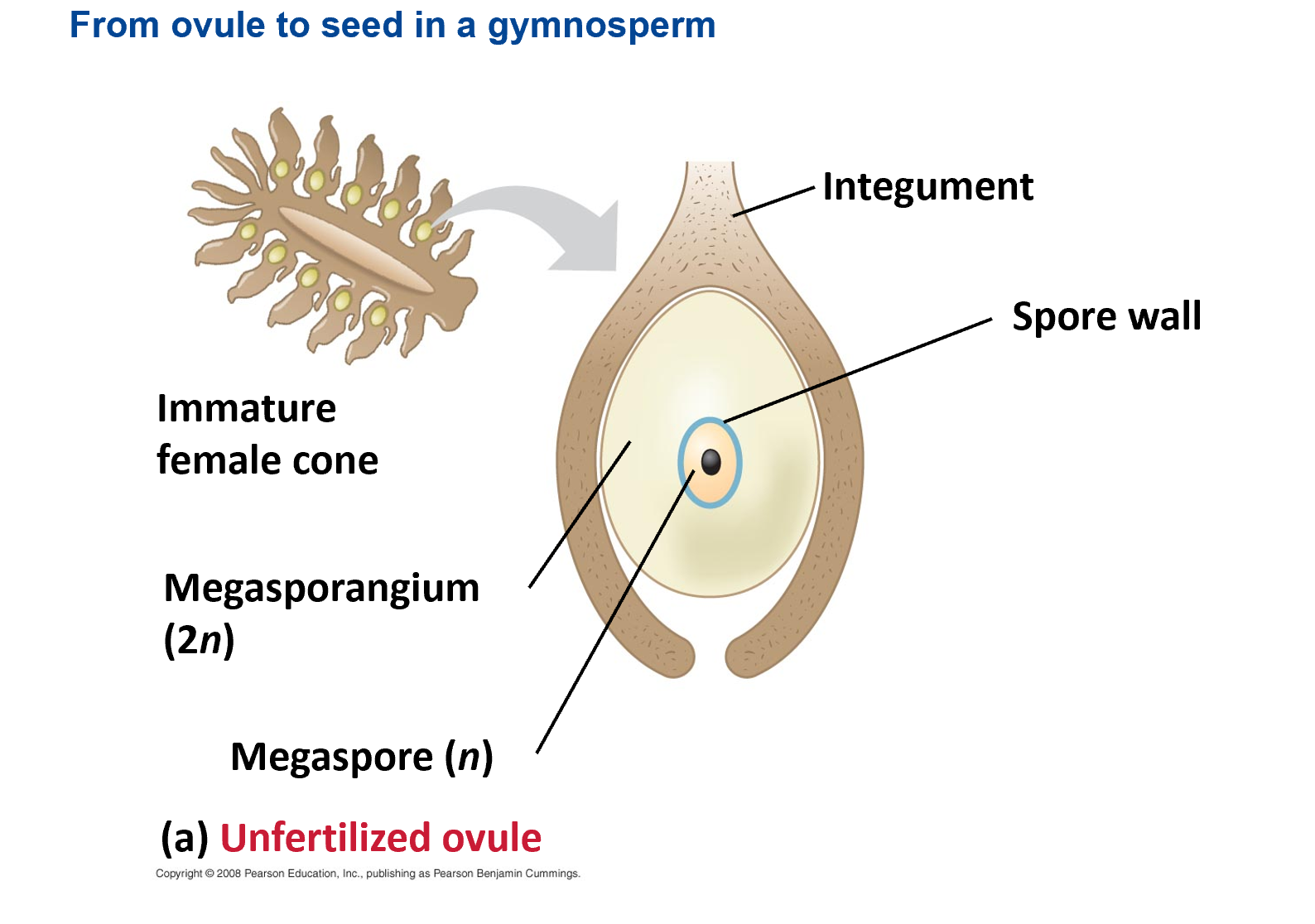
what parts does an ovule consist of?
megasporangium, megaspore, and a protective integument
Fill in the blank
A ___ ovule becomes a seed
fertilized
How many integuments do gymnosperm megaspores have?
Gymnosperm megaspores typically have one integument.
How many integuments do angiosperms megaspores have?
Angiosperm megaspores typically have two integuments.
Fill in the blank
______ develop into pollen grains which contain the male gametophytes
Microspores
What occurs during pollination?
Pollination is the process by which pollen grains are transferred from the male to the female part containing ovules, leading to fertilization.
read
•Pollen eliminates the need for a film of water and can be dispersed great distances by air or animals.
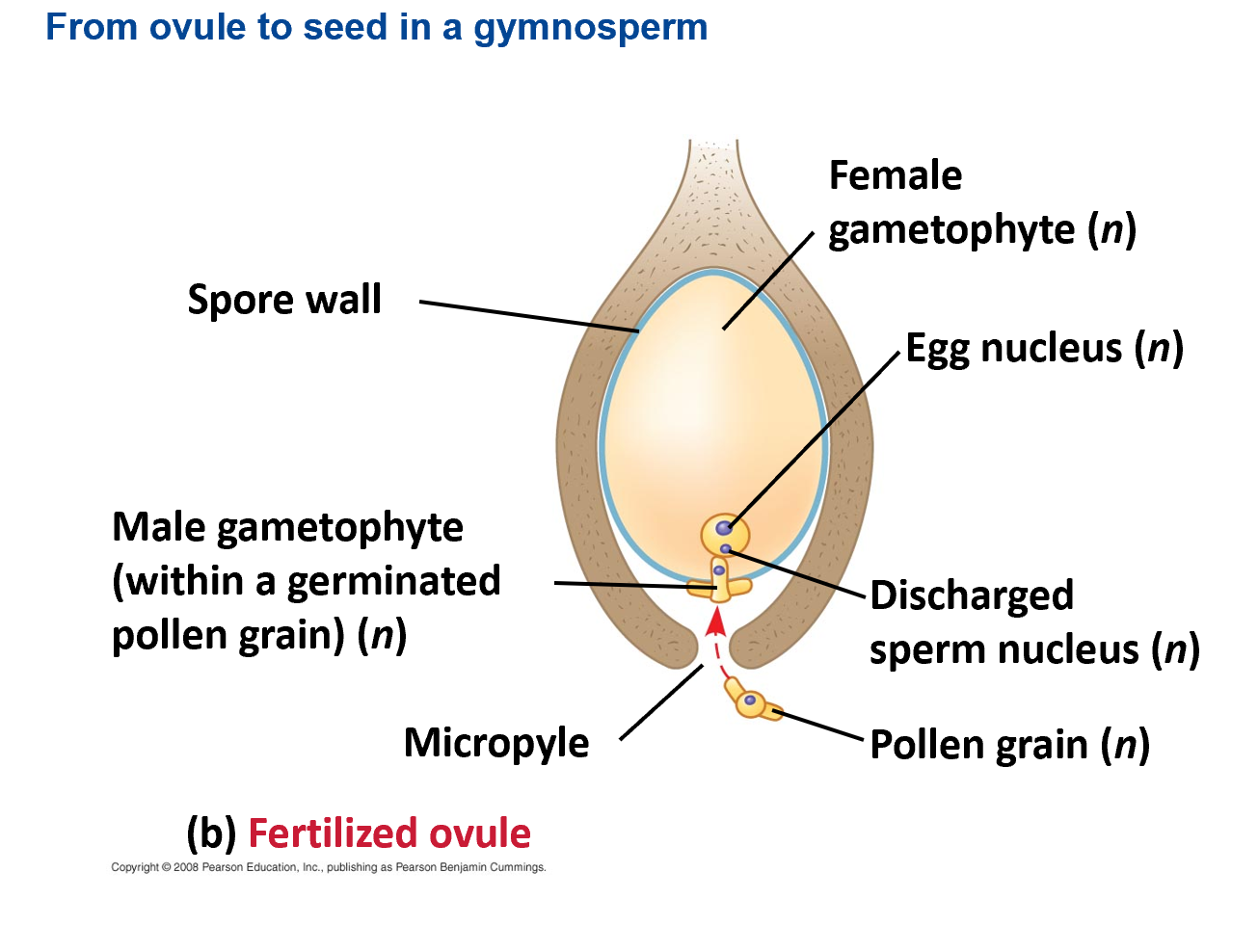
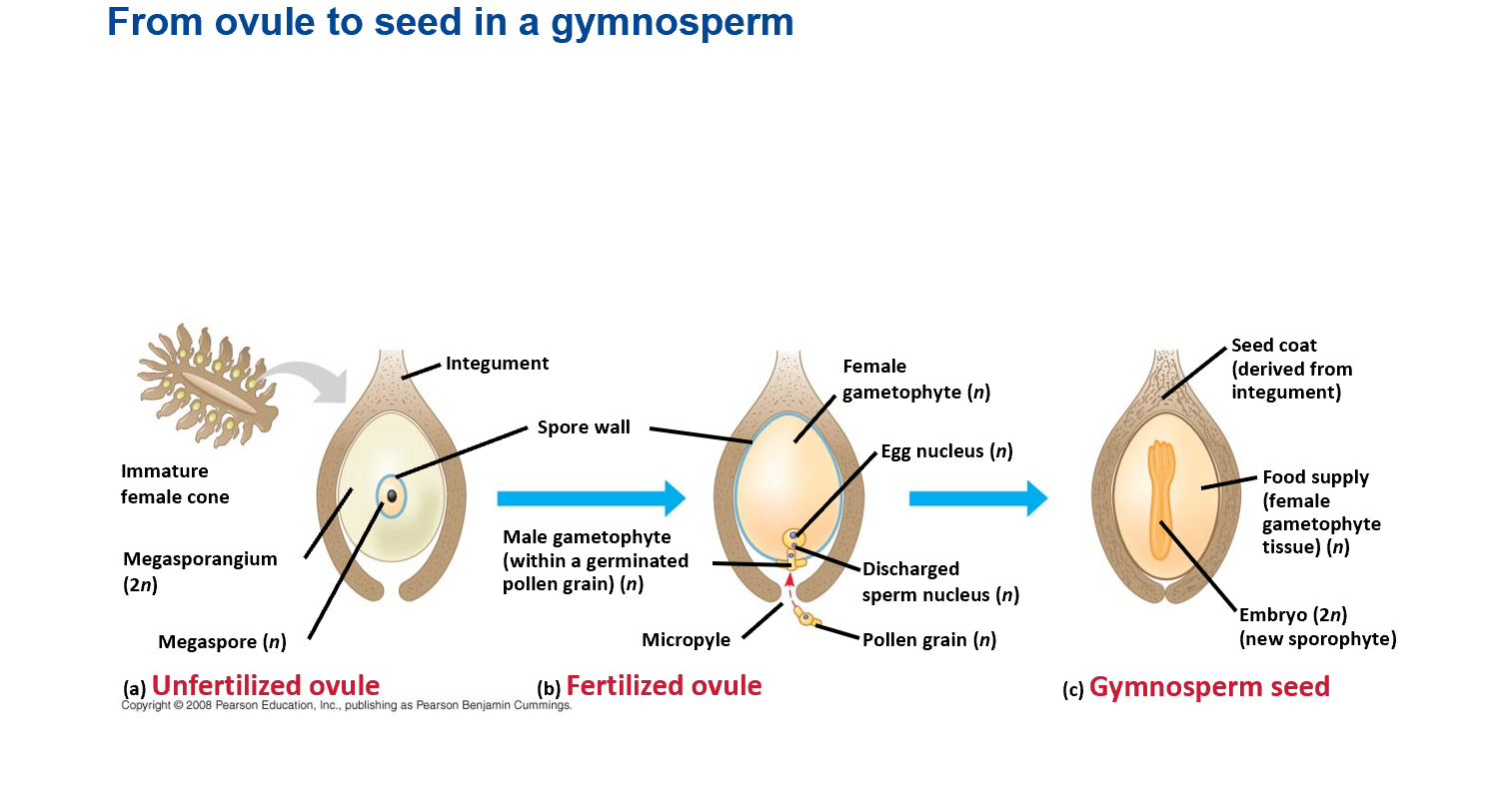
describe the process of gymnosperm fertilization
Gymnosperm fertilization involves the transfer of pollen to the ovule, where sperm nuclei fertilize the egg, leading to the formation of seeds.
look
What are some evolutionary advantages that seeds have in comparison to spores?
they can remain dormant for long periods of time until conditions are favorable for germination. They can also be transported for long distances
True or False
A seed coat comes from a seeds integument once the ovules is fertilized
TrueA seed coat is formed from the integument of the ovule after fertilization, providing protection to the seed.
Read
The gymnosperms have "naked" seeds not enclosed by ovaries and exposed on modified leaves-cones
What are the 4 gymnosperm phyla?
1. Cycadophyta (Cycads)
2. Gingkophyta (Ginkgo bioloba)
3. Gnetophyta ( Gnetum, Ephedra,Welwitschia)
4. Coniferophyta (conifers)
Fill in the blank
Seed plants can divided into 2 clads:
______ and ______
Angiosperms and gymnosperms
What kinds of gymnosperms dominate northern latitudes?
cone-bearing gymnosperms called conifers
What the phylum that consists a single living species of?
Ginkgo biloba
True or False
The Ginkgo biloba has a high tolerance to pollution
True
What is the largest phylum in the gymnosperm phyla?
The largest phylum in gymnosperms is the Coniferophyta, which includes conifers like pine, spruce, and fir.
True or False
Confers are not green yearounds and can only can photosynthesis in the spring
False, conifers are green year-round and can photosynthesize throughout the year.
What are 3 key features of the gymnosperm life cycle?
the sporophyte generate dominates
the transfer pf sperm to ovules by pollen
development of seeds form fertilized ovules
Fill in the blank
Angiosperms are seed plants with reproductive structures called ______ and ______
flowers and fruits
What is the phylum for the flowering plants?
Anthophyta
Read
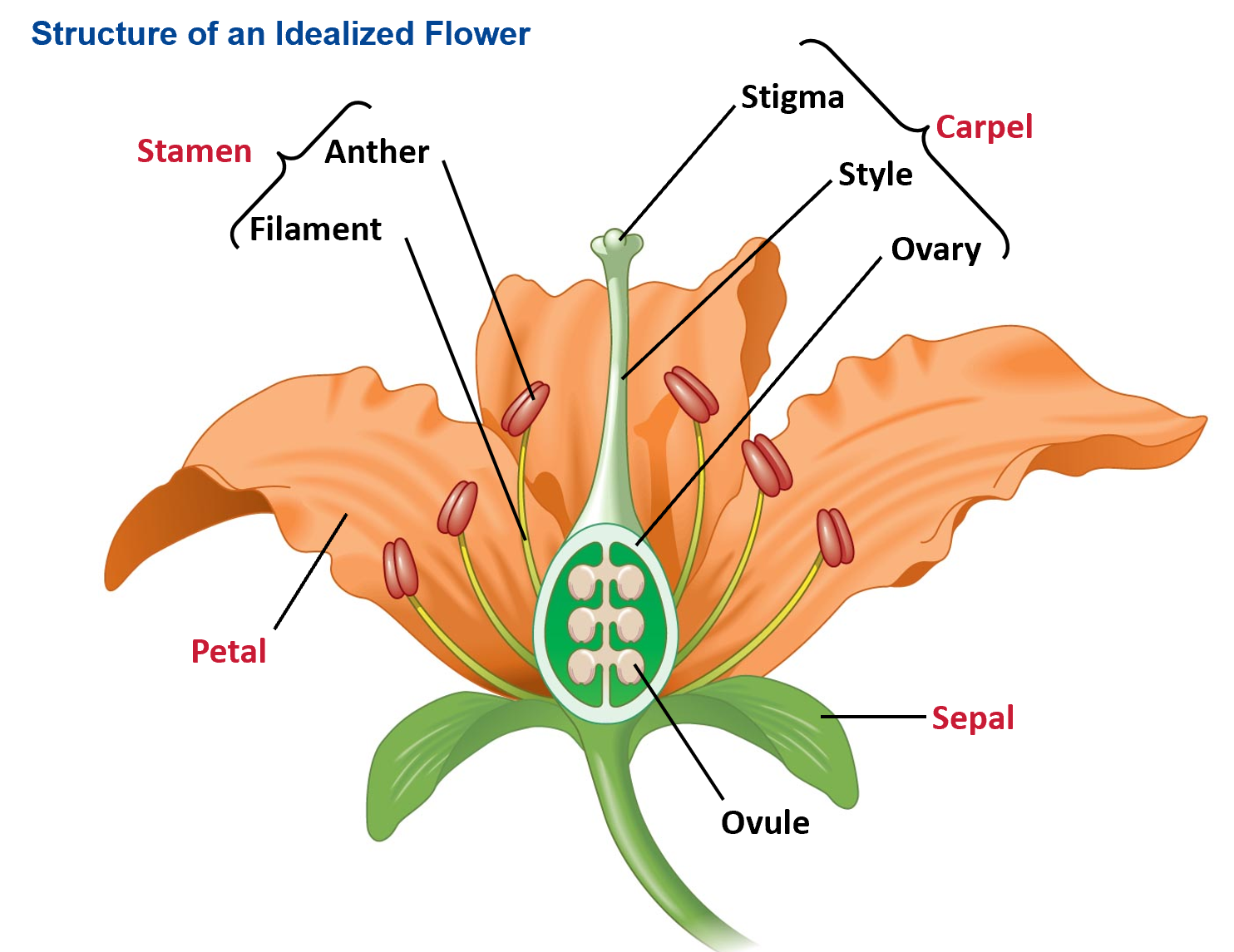
The flower is an angiosperm structure specialized for sexual reporduction. It is a specialized shoot w/ up to 4 types of modified leaves
sepals (enclose the flower)
petals (brightly colored and attract pollinators)
stamen (produce pollen on their terminal anthers)
carpels (consist of an ovary containing ovules at the base and a style holding p a stigma where pollen is received
True or false
Fruit typically consists of a mature ovary
True
True or false
Fruits do not aid seeds in any way
False fruit protects seeds and aid in seed dispersal
Read
Fruit adaptation help disperse seeds by wind, water, or animals
True or false
The flower of the sporophyte is composed of both male and female structures
True, as flowers contain stamens (male) and carpels (female) for reproduction. This allows for pollination and fertilization.
Fill in the blank
Male ______ are contained w/in ______ grains produced by the microsporangia of anthers
gametes; pollen
Read
•The female gametophyte = embryo sac, develops within an ovule contained within an ovary at the base of a stigma.
How do flowers ensure cross-pollination between flowers from different plants of the same species?
Flowers often have mechanisms such as varying flowering times, distinct morphological traits, or attracting different pollinators to promote cross-pollination between flowers from different plants of the same species. This genetic exchange enhances biodiversity and plant health.
Explain the fertilization process
pollen grain lands on the stigma and germinates and the pollen tube of the male gametophyte grows down to the ovary.
Sperm enters the ovule through a pore called the micropyle.
What is double fertilization? What occurs?
In double fertilization, The pollen tube discharges 2 sperm into the female gametophyte w/in an ovule . one sperm fertilizes the egg to form a zygote, while the other sperm fuses with two polar nuclei to form the triploid endosperm, which nourishes the developing embryo.
Is the megasporangium the endosperm?
No, the megasporangium is not the endosperm; it is a structure within the ovule that produces megaspores, which develop into the female gametophyte. The endosperm, formed during double fertilization, serves as a nutrient source for the developing embryo.
What is the purpose of the endosperm?
The endosperm serves as a nutrient reservoir for the developing embryo, providing essential sustenance during early seed development.
Read
•Within a seed, the embryo consists of a root and one or two seed leaves called cotyledon
What are the 2 main groups of angiosperms?
The two main groups of angiosperms are monocots and dicots. Monocots have one cotyledon, while dicots have two.
True or False
there are more monocots than dicots
False
What are ways to differentiate monocots and dicots by the follwoing structures, cotyledon, leaf venation, roots, and flower petals
Monocots have one cotyledon, parallel leaf venation, fibrous root systems, and flower petals in multiples of three, while dicots have two cotyledons, net-like leaf venation, taproot systems, and flower petals in multiples of four or five.
Read
The Evolutionary Links Between Angiosperms and Animals
the Pollution and transport of seeds by animals are 2 important relationships in terrestrial ecosystems
What kind of plants do humans greatly rely on? Why?
Humans greatly rely on flowering plants, or angiosperms, for food, medicinal resources, and ecological services such as oxygen production and habitat provision. They play a crucial role in agriculture and sustain human diets.
What is artificial selection?
Artificial selection is the process by which humans breed plants and animals for specific traits, enhancing desirable characteristics over generations. It is a key method in agriculture and horticulture to improve crop yields and quality.