C214 Financial Management (PRE-ASSESSMENT) questions and answers + detailed rationales
 Call Kai
 Learn
Learn Practice Test
 Spaced Repetition
 Match
Match Flashcards
1/67

There's no tags or description
Looks like no tags are added yet.
Name | Mastery | Learn | Test | Matching | Spaced | Call with Kai |
|---|
No analytics yet
Send a link to your students to track their progress
68 Terms
How can a private firm appropriately maximize shareholder value?
By making decisions that keep the control of the business with the owners
Why are American regulators focused on international investing in a global marketplace?
Because international investing in a global marketplace is the concern of American investors
What is one of the two basic types of financial instruments?
Bonds
What are the likeliest outcomes if a company outsources the manufacturing of its products to a foreign country? (2)
Consumer prices will decrease
Domestic employment will decrease.
What do the content and structure of a balance sheet report?
The assets, liabilities, and equity at a point in time
A company reported an increase in accounts receivable of $5,000 during the recent period. Half of this amount is expected to be collected next period. How will this change in accounts receivable affect the cash flows from the operating activities section?
The change will decrease cash flows from operations by $5,000.
Which statement accurately explains the recognition of revenues and expenses under accounting income and income for tax purposes?
Revenues and expenses may be recognized in one period for accounting income purposes and in a different period for income tax purposes.
Selected Data for 20x2 for ABD Inc.
Net Income $ 1,000
Depreciation Expense $ 300
Change in Operating Assets $ 600
Change in Net Property, Plant, and Equipment $ 5,000
Changes in Long-Term Liabilities$ 1,000
Dividends Paid$ 200
What is this firm's cash flow from investments, using the data above and assuming no asset disposals?
$5,300 outflow
What is the basic equation for a balance sheet?
Assets = Liabilities + Equity
What do cash flows from investing activities generally relate to?
A firm's purchase and sale of long-term assets
Which transaction is reflected in cash flow from operating activities?
Cash sales to customers
What does free cash flow represent?
Cash available for distribution after funding required reinvestment
An analyst is comparing the ratios of two firms and needs to address timing differences.
What is an example of a timing difference between these two firms?
The firms have different fiscal years.
A company's year-end balance sheet for 2013 shows the following:
Accounts Receivable: $900
Inventory: $1,200
Fixed Assets: $1,000
Accounts Payable: $1,300
Sales: $4,000
Salaries Expense: $275
What is its fixed asset turnover ratio?
4.0
A firm has a ROE (return on equity) of 0.27, and the industry average ROE is 0.24.
Which conclusion should an analyst draw when comparing this firm to the industry?
The firm is generating higher returns to owners than the industry.
What must have taken place for a firm to recognize revenue, in order for the firm to comply with the accrual accounting rules?
The product must have been delivered.
A teacher won $100,000 and invests this money for five years at an interest rate of 4% (compounded annually).
How much will this teacher have in principal and interest at the end of the five years?
$121,665
An accountant is 40 years old and has an anticipated retirement age of 70 years old. The accountant plans to save $6,000 per year at the end of the next 30 years to fund retirement.
How much will this accountant have upon retirement, if the accountant is able to earn 4% annually on this investment
$336,510
An investor deposits $2,000 per year (beginning today) for 10 years in a 4% interest-bearing account. The last cash flow is received one year prior to the end of the tenth year.
What is this investor's future balance after 10 years?
$24,973
What is the par value (face value) of a bond?
The sum of money that the corporation promises to pay upon expiration of the bond
A broker is considering purchasing common stock in a company that has average but consistent operating performance.
Which factor should lead this broker to purchase shares in this company?
The current price of the stock is 25% below its intrinsic value.
A broker is considering buying a dividend-paying stock. The dividend will be paid at the end of the year. The analyst consensus is the stock will be worth $36 in one year. The company pays a $2.25 annual dividend. (The ex-dividend date is not a consideration; the broker will receive the full $2.25.) The broker expects a 12% rate of return.
What is the highest price this broker should be willing to pay for this stock?
$34.15
A person buys shares of a company at $45 and recently paid a $2 annual dividend that is expected to grow by 10% per year.
What is the expected return per year?
14.9%
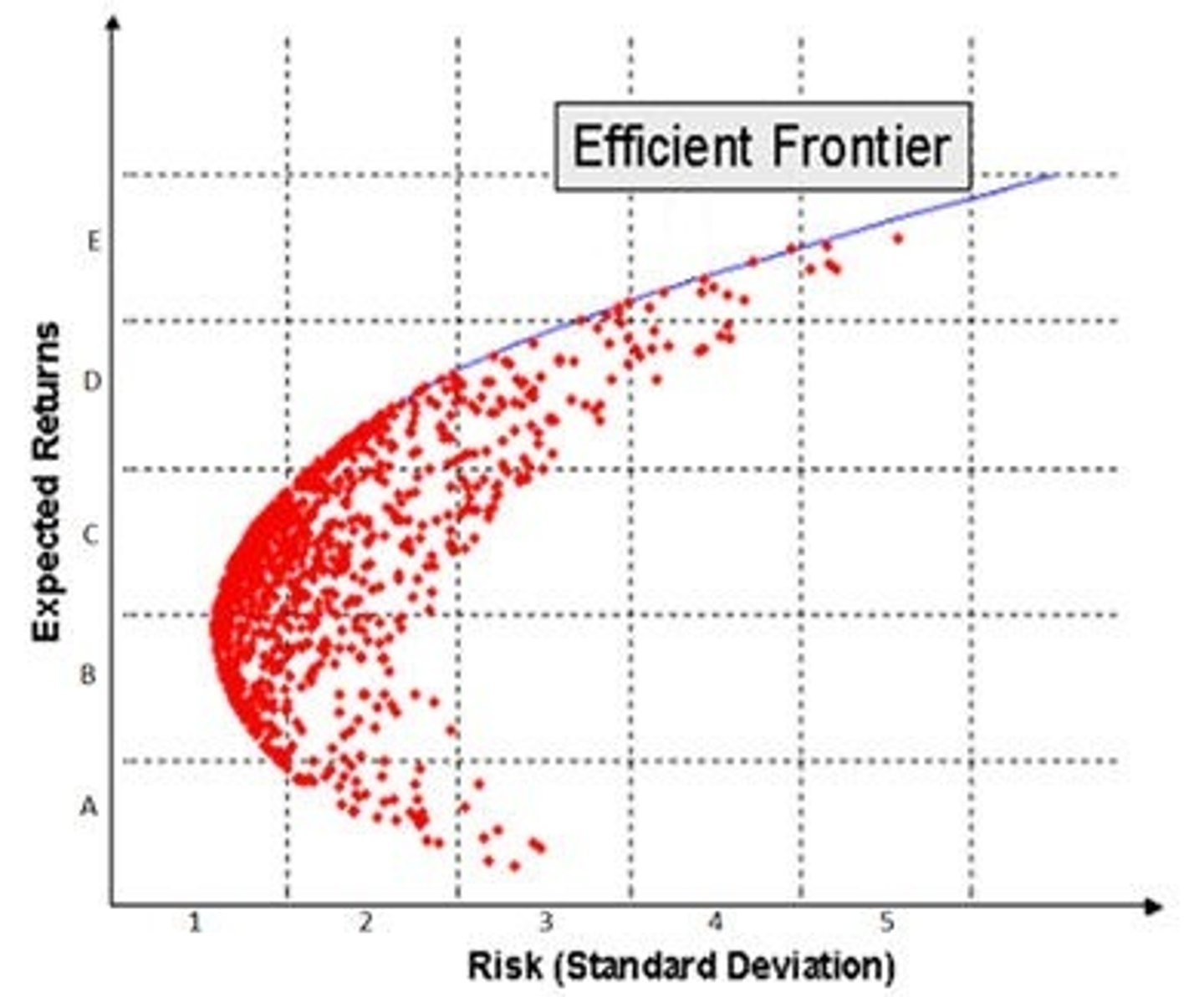
The figure below represents the levels of market efficiency:
Which investment option is less desirable for a prudent investor?
E
The market rate of return is 9%. The face value of a bond is $1,000, the coupon rate is 9% with annual compounding, and the bond matures in 10 years.
What is the value of this bond?
$1,000
Which statement is true about fluctuations in bond prices?
When market interest rates fluctuate, the bond coupon rate is unchanged.
A company issues bonds at a market price of $925. The face value is $1,000. The bonds mature in 10 years, and the coupon rate is 6% compounded semiannually.
What is the yield to maturity (YTM) on this company's bonds?
7.06%
Which securities are issued by local governments and are usually tax exempt at the federal level?
Municipal bonds
A $1,000 bond pays $27.50 every six months, matures in nine years, and is currently priced at $1,090.
What is the yield to maturity for this bond?
4.28%
A bond that matures in 30 months is sold at a premium.
What is the yield to maturity (YTM)?
Lower than the coupon rate
Why does a long-term bond resemble an interest-only loan?
None of the principal is repaid until the bond matures.
Under which circumstances will annual percentage yield (APY) be greater than the annual percentage rate (APR)?
Any time the number of compounding periods is greater than annual.
What is the difference between a common stock and a preferred stock?
Skipping a declared preferred stock dividend results in dividends in arrears.
Which happens to the risk level in a portfolio as the number of assets in the portfolio increases?
Risk decreases at a slower rate.
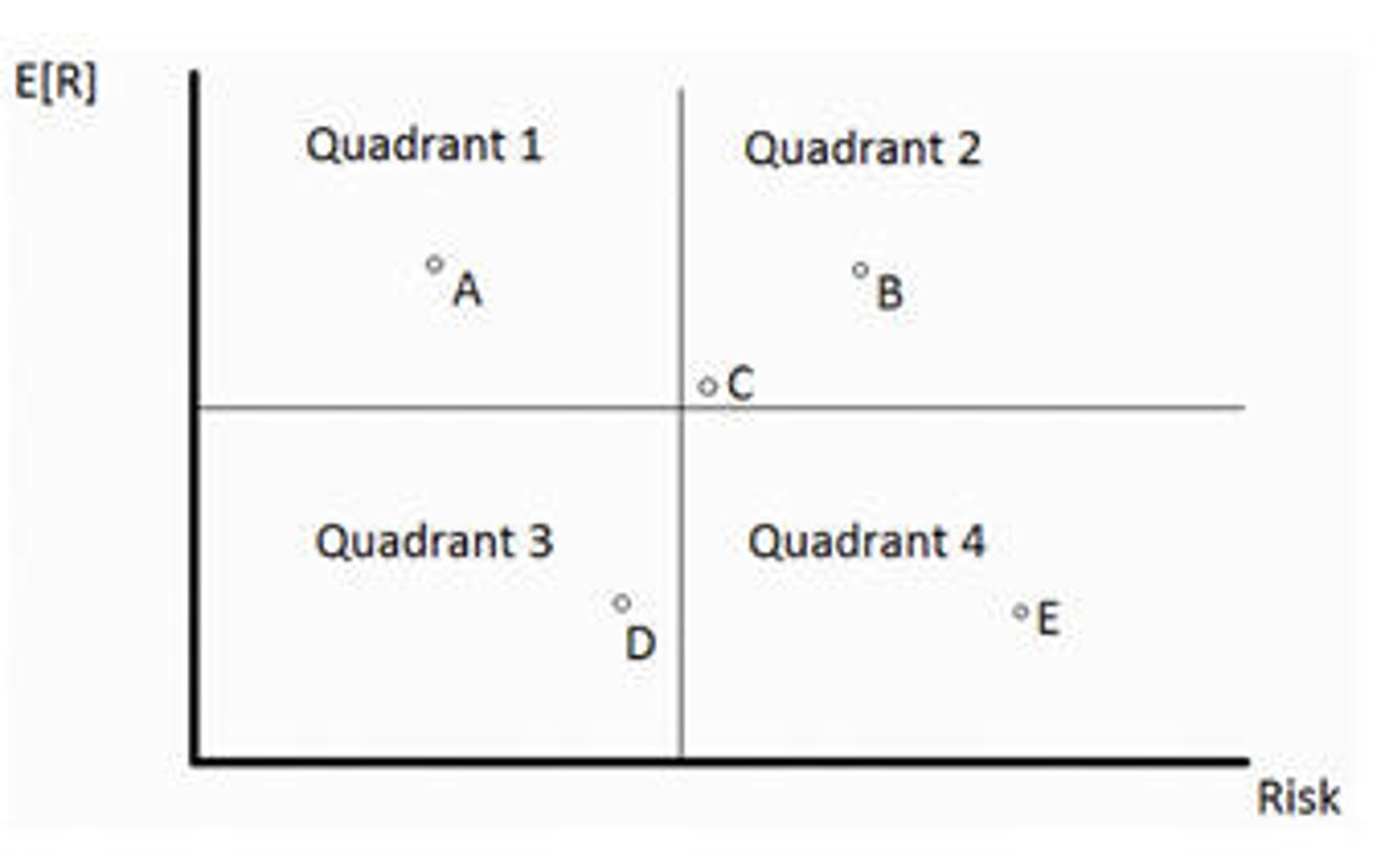
The figure below represents a portfolio that plots the expected return against the risk of each investment:
Where along this line will a highly risk-averse investor likely be?
C1
What are two primary benefits of the capital asset pricing model (CAPM)?
Choose 2 answers.
CAPM provides a way to determine the expected return for stocks.
CAPM provides a way to estimate the required return.
A company has a before-tax cost of common equity of 14%, a pre-tax cost of debt of 6%, a cost of preferred equity of 8%, and a marginal tax rate of 34%. The current market value of the company is $150 million, with $75 million common equity, $50 million debt, and $25 million preferred equity.
What is this company's weighted average cost of capital?
9.7%
Which two techniques are effective ways to manage the growth of a firm, if additional financing is not available?
Choose 2 answers.
Increasing sales prices
Altering capacity
Partial financial data for a company is as follows:
Assets: $10,000,000
Liabilities: $4,000,000
Equity: $6,000,000
Sales: $25,000,000
Net Income: $5,000,000
Profit Margin: 20%
Dividends: $500,000
Dividend Payout Ratio: 10%
ROA: 50%
ROE: 83%
What is the sustainable growth rate for this company?
75%
A machine will reach the end of its useful life in year 5. The realizable salvage value is expected to be $50,000 with a book value of zero. The company's marginal tax rate is 34%.
What is the tax implication on the sale of this new machine at year 5?
Tax liabilities of $17,000
What is the acceptance criteria when using internal rate of return to evaluate a project?
Accept when the project return is greater than the required return
A company has a market value of $500 million. It has a market value of equity of $200 million, a market value of long-term debt of $150 million, and a market value of short-term debt of $150 million.
The cost of equity is 12%, the cost of long-term debt is 8%, and the cost of short-term debt is 6%. The marginal tax rate is 35%.
What is the weighted average pre-tax cost of capital (WACC) for this company?
9.00%
Which advantage does the capital asset pricing model (CAPM) have over the Gordon growth model?
CAPM considers risk of a stock relative to the market to determine expected return.
Why do companies strive for a lower cost of capital?
Less money dedicated to financing means more money is available for production and operations.
A corporation established its projected sales at $210 million. It is using its current year balance sheet as a basis for creating a pro forma balance sheet. It estimates cash will be 7% of projected sales, accounts receivable will be 19% of projected sales, and property, plant, and equipment (PP&E) will be 55% of projected sales. Accounts payable are estimated to be 12% of projected sales. Owners' equity is $34 million. Long-term debt is $90 million. Additionally, the firm raised $12.9 million of equity capital.
What is the amount of discretionary financing needed
$8 million
Year 2010 ending retained earnings were $2 million. Year 2011 forecasted sales are $100,000 with a 25% net margin and 20% dividend payout ratio.
What are the forecasted retained earnings for year 2011?
$2,020,000
How is the amount of discretionary financing that is needed by a firm determined?
Projected total assets − projected total liabilities − projected owner's equity
A company would like to invest in a capital budget project. In 40 years, the project will be worth $500,000 in today's dollars.
How much should this company invest today, assuming an average inflation rate of 2% and a 10% annual return?
$1.2 million
Which three pieces of data are needed to perform a capital budget analysis?
Choose 3 answers.
Annual cash flows for the life of the new project
Cash flow when the firm terminates the project
The initial cost of the new project
What are two examples of sunk costs?
Choose 2 answers.
The cost of a market study conducted prior to the decision
The cost of feasibility consulting incurred before the decision point
Company A has a degree of operating leverage of 1.85, and Company B has a degree of operating leverage of 6.5.
What does the degree of operating leverage say about these two companies
Company A has lower risk than Company B.
Which action is an important part of managing accounts receivable?
Setting credit terms
What is the main benefit associated with holding inventory?
It makes it possible to meet the demands of customers.
A person needs to determine the cost to replace a company's property, plant, and equipment using the replacement cost method.
Which value does this person need to consider in order to make this determination?
Market value
Which type of investment will a risk-averse investor most likely invest in?
Index funds
Company Y has a greater degree of financial risk than Company Z.
What would be a result of a 1% decrease in EBIT for both companies?
A greater percentage decrease in Company Y's pre-tax profit
How does the anticipation of bankruptcy affect a firm's capital structure?
A firm facing bankruptcy will reduce debt to avoid associated high levels of bankruptcy costs.
Why would a company prefer to raise capital by issuing debt instead of issuing new equity?
Debt financing provides interest tax benefits.
Which hybrid security has special claims on a corporation's profits or, in case of liquidation, corporate assets?
Preferred stock
How will an increase in corporate tax rates affect a firm's cost of capital?
The cost of debt will decrease.
Which financial ratio is used to measure a company's effectiveness in extending credit as well as collecting debts?
Accounts receivable turnover
What is the reason for holding cash and cash equivalents?
To provide liquidity
Which term describes the amount of cash a firm needs in order to pay its immediate bill
Operating balance
How does the Securities Exchange Commission (SEC) regulate the financial industry?
By requiring public disclosure of information about entities that sell public equity or debt
Which company control is required by the Sarbanes-Oxley Act?
Disclosure of off-balance sheet debts
Which document is required to be made available prior to a firm going public, according to the Securities Act of 1933?
Prospectus
What does the Financial Industry Regulatory Authority (FINRA) examine to determine if a firm is in compliance with rules of FINRA and the SEC?
Sales practices
What did the Dodd-Frank Act seek to prevent?
Financial institutions becoming too big to fail