Biosynthesis of Neurotransmitters

0.0(0)
Studied by 0 people
call kaiCall Kai
learnLearn
examPractice Test
spaced repetitionSpaced Repetition
heart puzzleMatch
flashcardsFlashcards
GameKnowt Play
Card Sorting

1/27

encourage image

There's no tags or description

Looks like no tags are added yet.

Last updated 9:28 PM on 4/28/26
Name
Mastery
Learn
Test
Matching
Spaced
Call with Kai

No analytics yet

Send a link to your students to track their progress

28 Terms
1
New cards
<p></p>

knowt flashcard image
2
New cards

abnormal things found

Homovanillate is a metabolite of dopamine.

Vanillylmandelate is a metabolite of (epi/norepi)
3
New cards
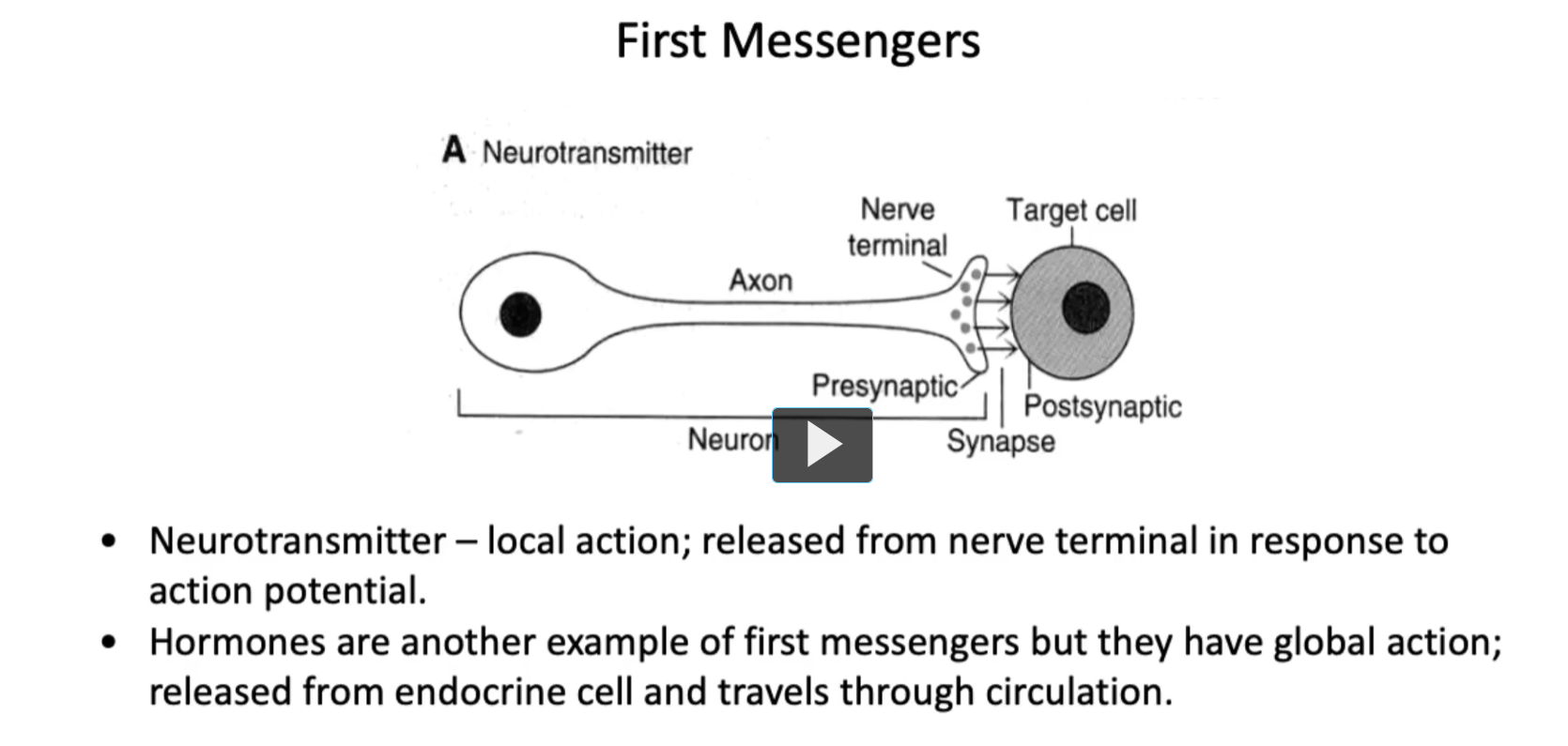
<p><strong>First Messengers</strong></p><p><strong>neurotransmitters</strong> are considered the <strong>local first messengers </strong>in the <strong>nervous system</strong>. </p><p><u>A Neurotransmitter</u></p><p>(A diagram labeling: Neuron, Axon, Nerve terminal, Presynaptic, Synapse, Postsynaptic, Target cell)</p><p>• <strong>Neurotransmitter</strong> – local action; <strong>released</strong> from <strong>nerve terminal</strong> <strong>in response</strong> to <strong>action potential.</strong></p><p>Neurotransmitters specifically act at <strong>synaptic junctions</strong>. Therefore, understanding this distinction is key when evaluating drug targets and the neurophysiology. <br>• <strong>Hormones</strong> <strong>are another example of first messengers</strong> but <strong>they have global action</strong>; <strong>released</strong> <strong>from endocrine cell</strong> and<strong> travels through circulation</strong>.</p>

First Messengers

neurotransmitters are considered the local first messengers in the nervous system.

A Neurotransmitter

(A diagram labeling: Neuron, Axon, Nerve terminal, Presynaptic, Synapse, Postsynaptic, Target cell)

Neurotransmitter – local action; released from nerve terminal in response to action potential.

Neurotransmitters specifically act at synaptic junctions. Therefore, understanding this distinction is key when evaluating drug targets and the neurophysiology.
Hormones are another example of first messengers but they have global action; released from endocrine cell and travels through circulation.

Three types of neurons

  1. sensory neuron (afferent):

  2. motor neuron (efferent)

  3. Interneurons

Each of these play a unique role in signal transmission and many produce different neurotransmitters based on their function and target structure.
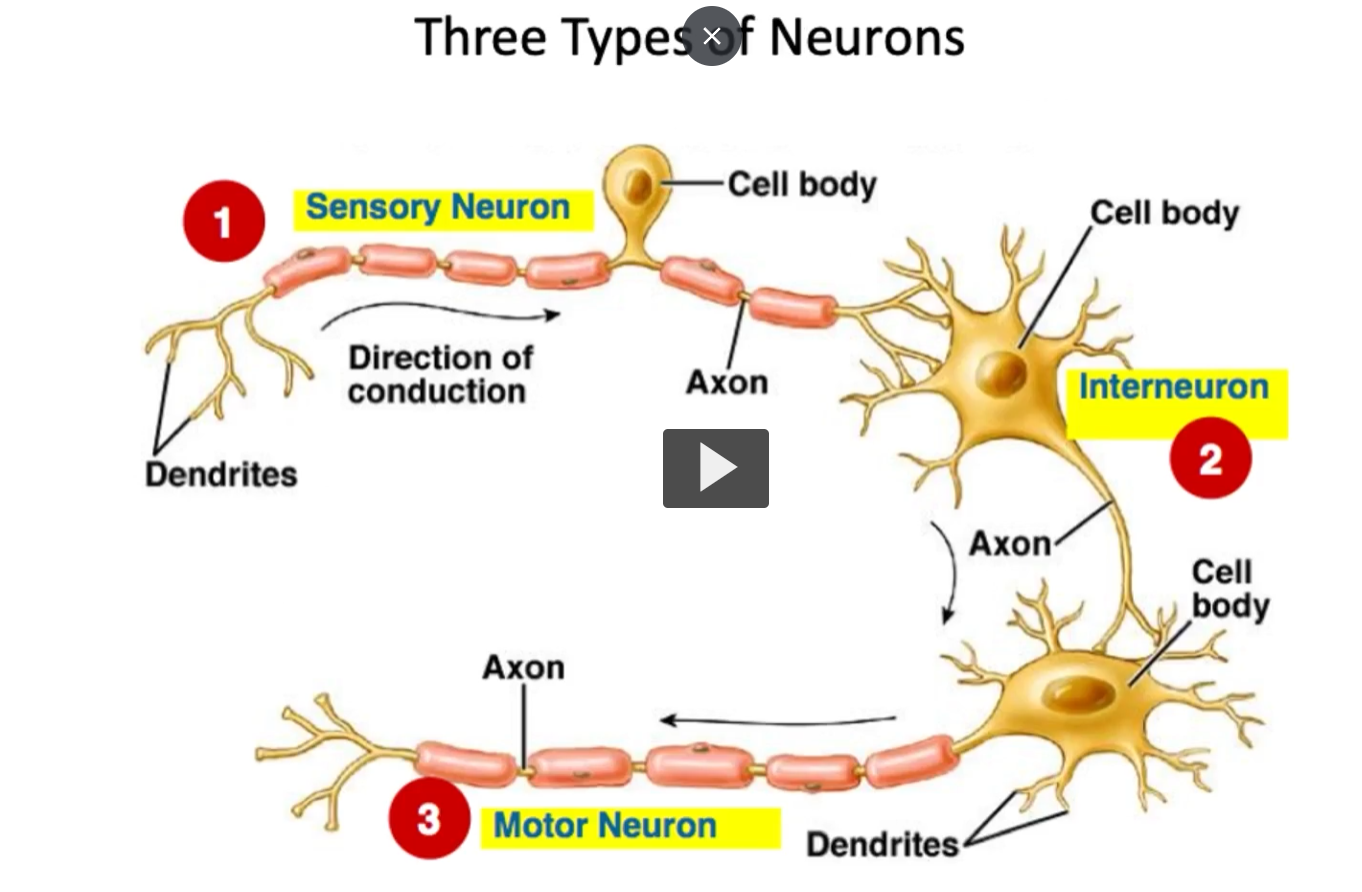
<p><u>Three types of neurons</u></p><ol><li><p>sensory neuron (afferent): </p></li><li><p>motor neuron (efferent)</p></li><li><p>Interneurons</p></li></ol><p><strong>Each of these</strong> <strong>play</strong> a <strong>unique role</strong> in <strong>signal transmission</strong> and<strong> many produce</strong> <strong>different neurotransmitters based on their function</strong> and <strong>target structure.</strong> </p><p></p>
4
New cards
<p><u>Basic types of Receptors</u></p><p>There are<strong> two types of receptors</strong> that we will be discussing. First, there is <strong>ionotropic</strong>, and second, <strong>metabotropic.</strong></p><p>First, <strong>ionotropic receptors</strong>, such as those for <strong>glutamate </strong>or <strong>GABA<sub>a</sub> directly open ion channels</strong> “ionotropic”. Ionotropic are also known as <strong>ligand-activated ion gates</strong>. </p><p>• <strong>Ligand activated ion gates. (</strong>steps)<br>1.<strong> Sodium</strong> or <strong>calcium entry</strong> <strong>depolarizes</strong> (promotes action potential).<br>2. <strong>Chloride influx hyperpolarize</strong>s (leading to inhibition of action potential).</p><p>• <strong>Metabotropic receptors.</strong></p><p><strong>Some examples</strong> <strong>are</strong> the <strong>muscarinic acetyl-choline receptors</strong>.</p><p>-<strong>Metabotropic receptors</strong> work through <strong>second-messengers</strong> and <strong>influence</strong> <strong>gene expression</strong> or <strong>metabolism. </strong> <br>– <strong>Metabotropic receptors</strong> also <strong>alter</strong> the <strong>enzyme activities inside cells</strong>. Like the <strong>kinases.</strong></p>

Basic types of Receptors

There are two types of receptors that we will be discussing. First, there is ionotropic, and second, metabotropic.

First, ionotropic receptors, such as those for glutamate or GABAa directly open ion channels “ionotropic”. Ionotropic are also known as ligand-activated ion gates.

Ligand activated ion gates. (steps)
1. Sodium or calcium entry depolarizes (promotes action potential).
2. Chloride influx hyperpolarizes (leading to inhibition of action potential).

Metabotropic receptors.

Some examples are the muscarinic acetyl-choline receptors.

-Metabotropic receptors work through second-messengers and influence gene expression or metabolism.
Metabotropic receptors also alter the enzyme activities inside cells. Like the kinases.

General Principles of neurotransmitter biosynthesis

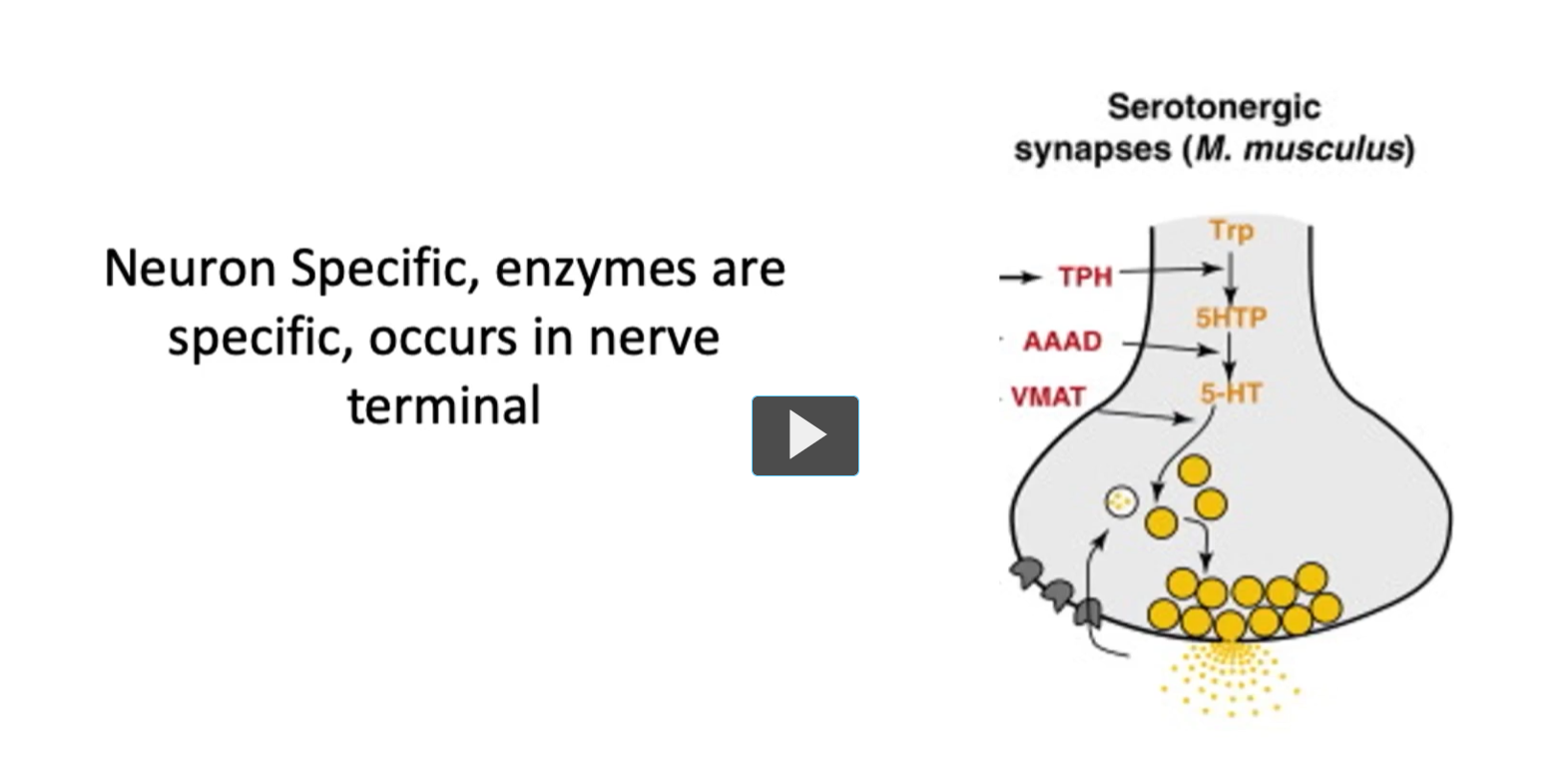
• The process of neurotransmitter synthesis is Neuron specific (through genes) – neurons express gene products for biosynthesis.
Each neuron expresses the relevant enzymes are synthesized and transported to nerve terminal
Raw materials (amino acids) are transported to or taken into nerve terminal by transporter proteins
Occurs in presynaptic terminals
Pool of neurotransmitter loaded into synaptic vesicles by specific transport proteins, to be exported through the process of exocytosis.

It is important to remember that peptide neurotransmitters made like any other protein

Peptide neurotransmitters are made using the normal protein synthesis machinery of the cell, just like any other protein (enzymes, receptors, etc.).

Here’s what that means step-by-step:

1. Made in the cell body (not the nerve terminal)

  • DNA → mRNA (in the nucleus)

  • mRNA → protein (on ribosomes in the rough ER)

2. Synthesized as a “prepropeptide”

  • They start as a large inactive precursor protein called a prepropeptide

  • Then it gets cut and modified → becomes the active neurotransmitter

3. Processed in Golgi and packaged

  • Modified in the Golgi apparatus

  • Packaged into vesicles

4. Transported down the axon

  • Vesicles travel from the cell body → nerve terminal (via axonal transport)
<p><u>General Principles of neurotransmitter biosynthesis</u></p><p>• The <strong>process of neurotransmitter synthesis</strong> is <strong>Neuron specific </strong>(through genes) – <strong>neurons express gene products</strong> for <strong>biosynthesis. </strong><br>• <strong>Each neuron</strong> <strong>expresses</strong> the <strong>relevant enzymes</strong> are <strong>synthesized</strong> and <strong>transported </strong>to <strong>nerve terminal</strong><br>• <strong>Raw materials (amino acids)</strong> are<strong> transported to</strong> or <strong>taken into nerv</strong>e <strong>terminal</strong> by <strong>transporter proteins</strong><br>• <strong>Occurs</strong> in<strong> presynaptic terminals</strong><br>• <strong>Pool of neurotransmitter loaded</strong> into <strong>synaptic vesicles</strong> by <strong>specific transport proteins, </strong>to be exported through the process of <strong>exocytosis</strong>. </p><p><em><u>It is important to remember that peptide neurotransmitters made like any other protein</u></em></p><p><strong>Peptide neurotransmitters are made using the normal protein synthesis machinery of the cell</strong>, just like any other protein (enzymes, receptors, etc.).</p><p>Here’s what that means step-by-step:</p><p> 1. Made in the cell body (not the nerve terminal) </p><ul><li><p>DNA → mRNA (in the nucleus)</p></li><li><p>mRNA → protein (on ribosomes in the rough ER)</p></li></ul><p> 2. Synthesized as a “prepropeptide” </p><ul><li><p>They start as a <strong>large inactive precursor protein</strong> called a <strong>prepropeptide</strong></p></li><li><p>Then it gets <strong>cut and modified</strong> → becomes the active neurotransmitter</p></li></ul><p> 3. Processed in Golgi and packaged </p><ul><li><p>Modified in the <strong>Golgi apparatus</strong></p></li><li><p>Packaged into <strong>vesicles</strong></p></li></ul><p> 4. Transported down the axon </p><ul><li><p>Vesicles travel from the <strong>cell body → nerve terminal</strong> (via axonal transport)</p></li></ul><p></p>
5
New cards
<p>This <strong>concept</strong> of <strong>neural specific enzymes</strong> <strong>reinforces</strong> <strong>the fact tha</strong>t <strong>biosynthesis </strong>(of neurotransmitters) <strong>occurs</strong> <strong>locally within the pre-synaptic termina</strong>l, as we can see in this figure. </p><p><strong>Enzymes </strong>(involved in neurotransmitter production) are <strong>synthesized in the soma</strong> and <strong>transported down to the</strong> <strong>axon of the neuron</strong>. </p><p><strong>This compartmentalization</strong> will <strong>ensure</strong> that <strong>each neurotransmitter</strong> are <strong>made</strong> and <strong>released precisely when</strong> and <strong>where they are needed</strong>. </p>

This concept of neural specific enzymes reinforces the fact that biosynthesis (of neurotransmitters) occurs locally within the pre-synaptic terminal, as we can see in this figure.

Enzymes (involved in neurotransmitter production) are synthesized in the soma and transported down to the axon of the neuron.

This compartmentalization will ensure that each neurotransmitter are made and released precisely when and where they are needed.

Biogenic Amines

Biogenic amines are small neurotransmitters derived from amino acids. The word breaks down as:

  • Bio = life

  • Genic = produced

  • Amine = contains an amino group (–NH₂)

So: “biologically produced amine neurotransmitters.”

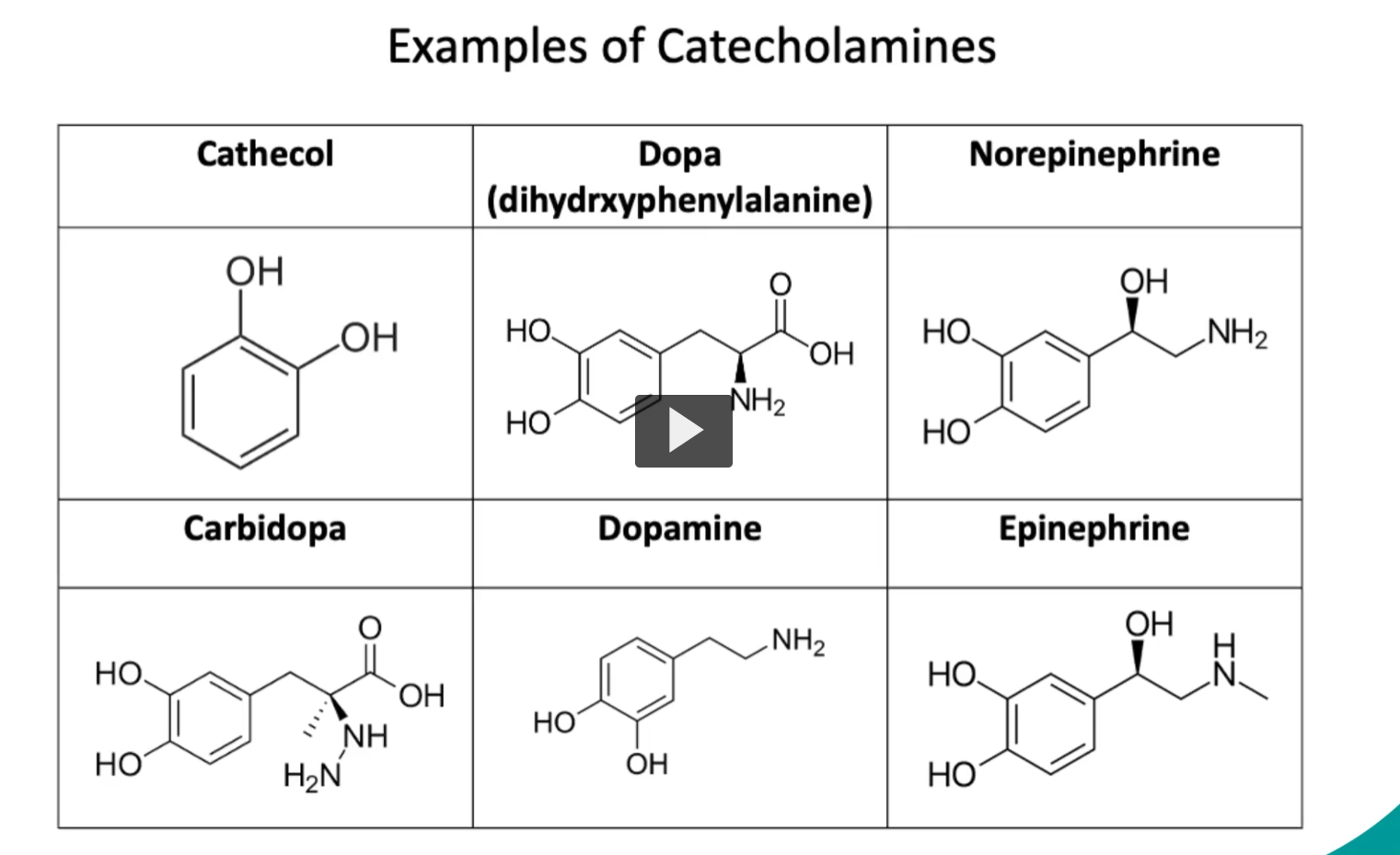
• Five serve as neurotransmitters.
– Catecholamines (from tyrosine) (examples of catecholamines: dopamine, epinephrine, norepinephrine)
– Histamine (from Histidine)
– Serotonin (from tryptophan)

• Derived from tyrosine, histidine, or tryptophan

• Biogenic amines are important in a wide range of behaviors. Many drugs target synthesis, receptor binding/action, or catabolism.

Many psychiatric and neurological medications target the either the synthesis or degradation of these neurotransmitters.
<p><u>Biogenic Amines</u></p><p>Biogenic amines are <strong>small neurotransmitters derived from amino acids</strong>. The word breaks down as:</p><ul><li><p><strong>Bio</strong> = life</p></li><li><p><strong>Genic</strong> = produced</p></li><li><p><strong>Amine</strong> = contains an amino group (–NH₂)</p></li></ul><p>So: <strong>“biologically produced amine neurotransmitters.”</strong></p><p>• Five serve as neurotransmitters.<br>– Catecholamines (from <strong>tyrosine</strong>) (examples of catecholamines: dopamine, epinephrine, norepinephrine)<br>– Histamine (from <strong>Histidine</strong>) <br>– Serotonin (from <strong>tryptophan</strong>) </p><p>• Derived from tyrosine, histidine, or tryptophan</p><p>• Biogenic amines are important in a wide range of behaviors. Many drugs target synthesis, receptor binding/action, or catabolism.</p><p>Many psychiatric and neurological medications target the either the synthesis or degradation of these neurotransmitters. </p>
6
New cards
<p></p>

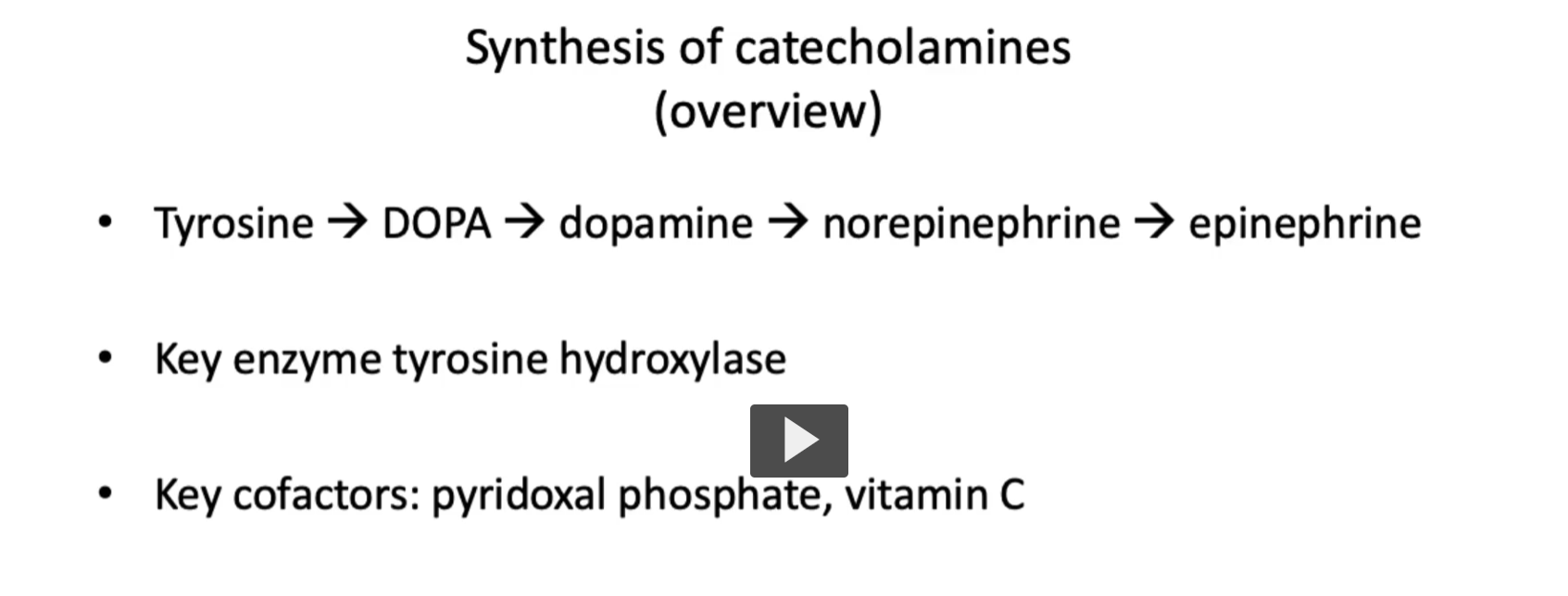
Synthesis of catecholamines (overview)

• Tyrosine → DOPA → dopamine → norepinephrine → epinephrine

-These neurotransmitters share a common synthetic pathway, from the amino acid Tyrosine.

• Key enzyme: tyrosine hydroxylase

Tyrosine hydroxylase catalyzes the conversion of tyrosine → DOPA (L-DOPA).

It adds a hydroxyl group (–OH) to tyrosine:

Tyrosine→ (tyrosine hydroxylase) L-DOPA

  • Uses O₂ (oxygen)

  • Requires a cofactor (tetrahydrobiopterin, BH₄ — high-yield detail)

• Key cofactors: pyridoxal phosphate (vitamin B6) for, vitamin C
<p><u>Synthesis of catecholamines (overview)</u></p><p>• Tyrosine → DOPA → dopamine → norepinephrine → epinephrine</p><p>-These neurotransmitters share a common synthetic pathway, from the amino acid Tyrosine. </p><p>• Key enzyme:<strong> tyrosine hydroxylase</strong></p><p><strong>Tyrosine hydroxylase catalyzes the conversion of tyrosine → DOPA (L-DOPA).</strong></p><p>It adds a <strong>hydroxyl group (–OH)</strong> to tyrosine:</p><p>Tyrosine→ (tyrosine&nbsp;hydroxylase) L-DOPA</p><ul><li><p>Uses <strong>O₂ (oxygen)</strong></p></li><li><p>Requires a cofactor (<strong>tetrahydrobiopterin, BH₄</strong> — high-yield detail)</p></li></ul><p>• Key cofactors: pyridoxal phosphate (vitamin B6) for, vitamin C</p>
7
New cards
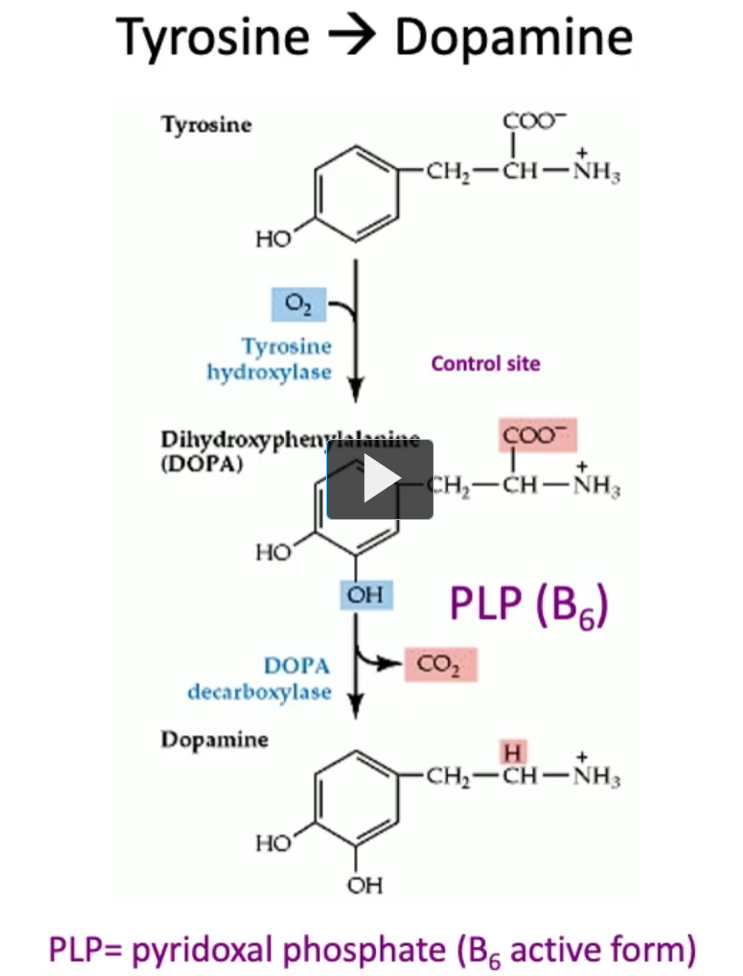
<p><u>Tyrosine → Dopamine</u></p><ol><li><p>Tyrosine (Tyrosine hydroxylase adds OH to tyrosine)→<strong> Dihydroxyphenylalanine (DOPA)</strong></p></li></ol><ul><li><p>Uses <strong>O₂ (oxygen)</strong></p></li><li><p>Requires a cofactor (<strong>tetrahydrobiopterin, BH₄</strong> — high-yield detail)</p></li></ul><ol start="2"><li><p>DOPA (DOPA decarboxylase takes a CO2 from DOPA, uses PLP or B6) → <strong>dopamine</strong></p></li></ol><p>The <strong>function of DOPA decarboxylase is to take a carbon away “decarboxylase”</strong> from <strong>DOPA</strong>, the<strong> function of PLP (B₆) is to stabilize</strong> <strong>intermediates</strong> during <strong>decarboxylation</strong>), which is what DOPA decarboxylase is doing. </p>

Tyrosine → Dopamine

  1. Tyrosine (Tyrosine hydroxylase adds OH to tyrosine)→ Dihydroxyphenylalanine (DOPA)

  • Uses O₂ (oxygen)

  • Requires a cofactor (tetrahydrobiopterin, BH₄ — high-yield detail)

  1. DOPA (DOPA decarboxylase takes a CO2 from DOPA, uses PLP or B6) → dopamine

The function of DOPA decarboxylase is to take a carbon away “decarboxylase” from DOPA, the function of PLP (B₆) is to stabilize intermediates during decarboxylation), which is what DOPA decarboxylase is doing.

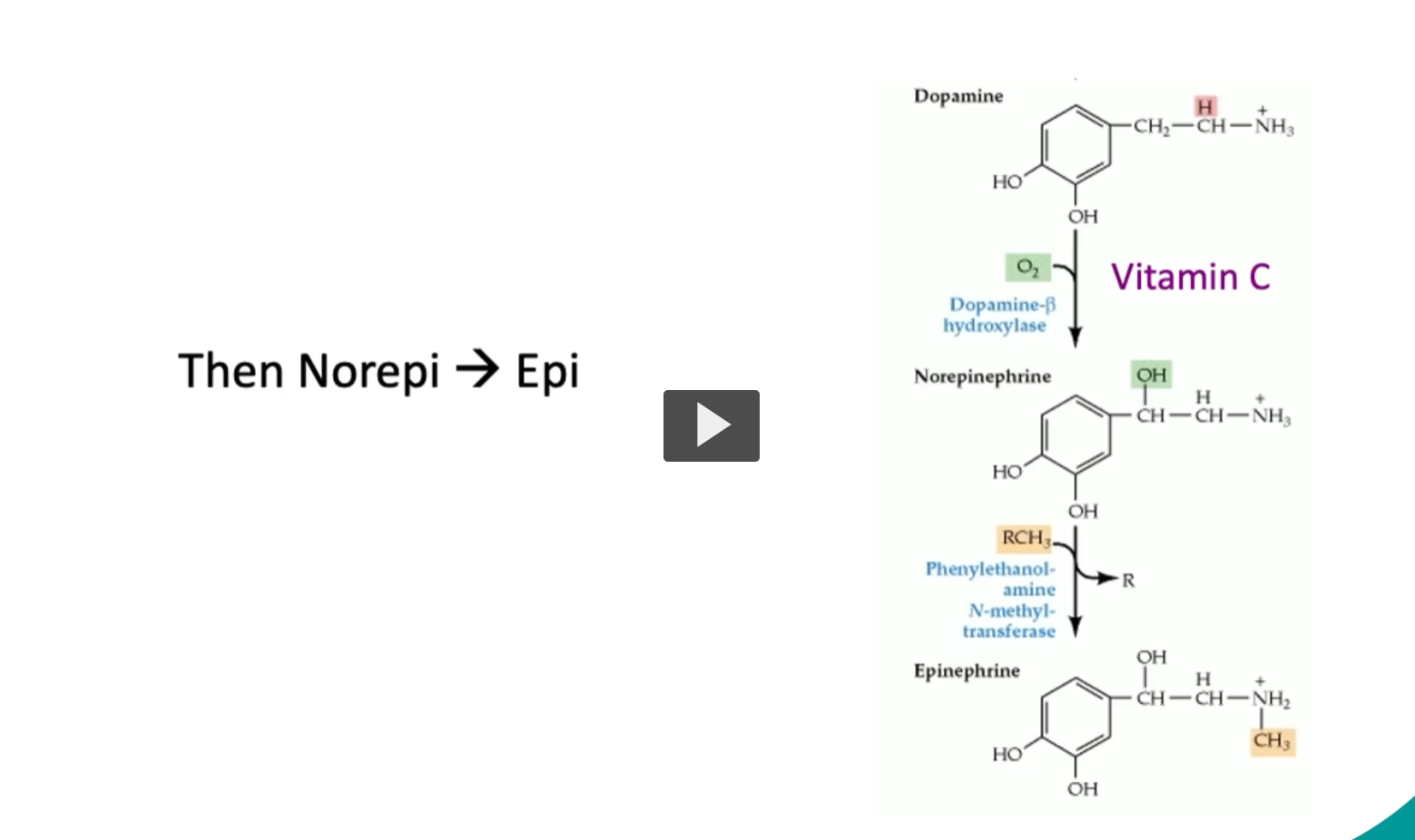
Then Norepi → Epi

  1. Dopamine (Dopamine-β hydroxylase adds OH to Dopamine) → Norepinephrine
    Vitamin C (ascorbic acid) is a water-soluble antioxidant that also acts as an enzyme cofactor.

Therefore, without adequate Vitamin C, noepinephrine production is impaired.

Works by maintaining the proper redox (electron) state of the enzyme.

  1. Norepinephrine (Phenylethanolamine N-methyl-transferase It adds a methyl group (–CH₃) to norepinephrine) → Epinephrine

Methyl donor: SAM (S-adenosylmethionine)

Location: Mainly in the adrenal medulla

RCH₃ (this is the methyl group added)
<p><u>Then Norepi → Epi</u></p><ol><li><p>Dopamine (Dopamine-β hydroxylase adds OH to Dopamine) → <strong>Norepinephrine </strong><br><strong>Vitamin C (ascorbic acid)</strong> is a <strong>water-soluble antioxidant</strong> that also acts as an <strong>enzyme cofactor. </strong></p></li></ol><p>Therefore, without adequate Vitamin C, noepinephrine production is impaired. </p><p><strong>Works</strong> by <strong>maintaining </strong>the proper <strong>redox (electron) state</strong> of the enzyme.</p><ol start="2"><li><p>Norepinephrine (Phenylethanolamine N-methyl-transferase It <strong>adds a methyl group (–CH₃)</strong> to norepinephrine) → Epinephrine</p></li></ol><p><strong>Methyl donor:</strong> <strong>SAM (S-adenosylmethionine)</strong></p><p><strong>Location: Mainly</strong> in the <strong>adrenal medulla</strong></p><p>RCH₃ (this is the methyl group added) </p>
8
New cards

locations

Step

Location in cell

Where in body

Tyrosine → DOPA

Cytosol

Neurons + adrenal medulla

DOPA → Dopamine

Cytosol

Neurons + adrenal medulla

Dopamine → NE

Vesicles

Neurons + adrenal medulla

NE → Epi

Cytosol

Adrenal medulla only

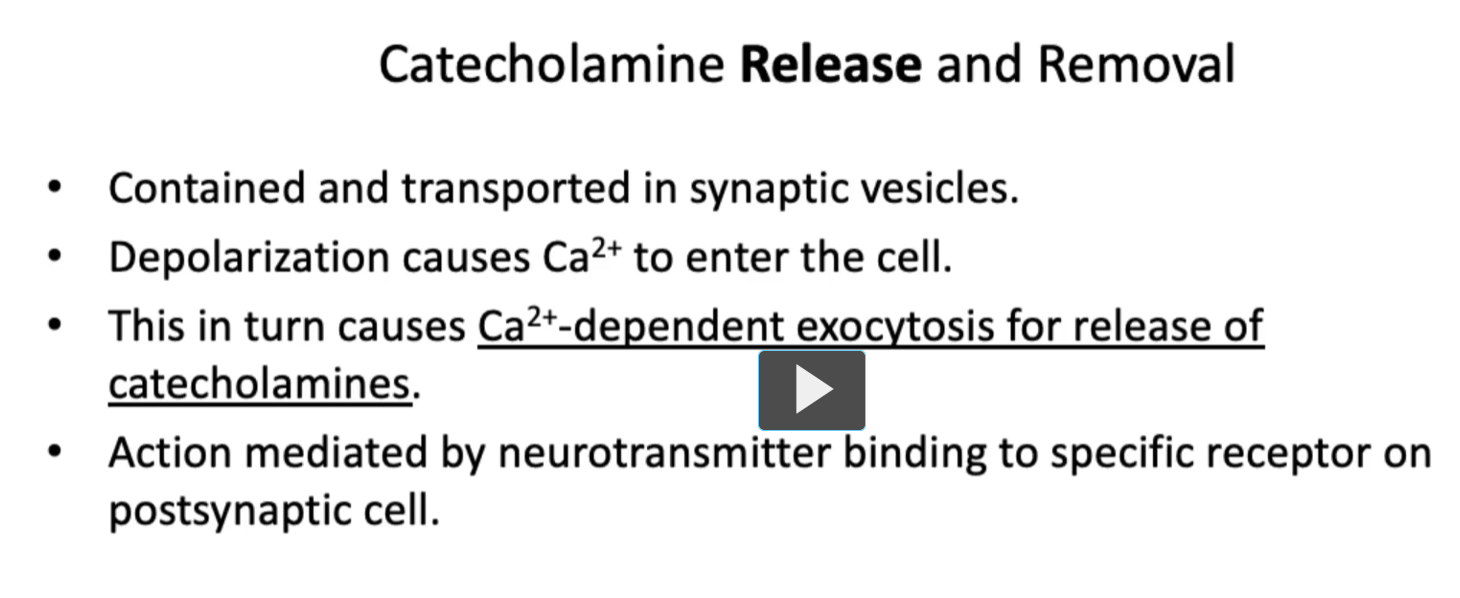
Catecholamine Release and Removal

• Once synthesized, catecholamines are stored, contained, transported in synaptic vesicles.
Depolarization causes Ca²⁺ to enter the cell.
• This in turn causes Ca²⁺-dependent exocytosis for release of catecholamines.
• Action mediated by neurotransmitter binding to specific receptor on postsynaptic cell.
<p><u>Catecholamine Release and Removal</u></p><p>• Once synthesized, catecholamines are stored, contained, transported in <strong>synaptic vesicles</strong>.<br>• <strong>Depolarization causes</strong> <strong>Ca²⁺ to enter the cell.</strong><br>• This in turn causes<u> Ca²⁺-dependent exocytosis for release of catecholamines</u>.<br>• Action mediated by neurotransmitter binding to specific receptor on postsynaptic cell.</p>
9
New cards
<p><u>Catecholamine Release and Removal</u></p><p><strong>Excess neurotransmitter</strong> is<strong> either taken back</strong> by a <strong>pre-synaptic neuron</strong> by a <strong>sodium-dependent transporter</strong> OR the excess neurotransmitter will be <strong>metabolized</strong> by <strong>enzymes</strong> such as<strong> Monoamine oxidase (MAO)</strong>, and <strong>catechol-o-methyl-transferase (COMT). </strong></p><p>This mechanism will terminate the signal and <strong>prevent overstimulation</strong>. </p><ul><li><p>Remaining is cleared from synapse by Na⁺-dependent transporter on presynaptic neuron.</p></li><li><p>Most is reused, some destroyed (<strong>MAO, COMT</strong>).</p></li></ul><p><u>Monoamine Oxidase (MAO) </u></p><p><strong>Definition:</strong><br><strong>Monoamine oxidase (MAO)</strong> is an <strong>enzyme</strong> that <strong>breaks down monoamine neurotransmitters "</strong>“monoamine oxidase” after they’ve done their job in the synapse.</p><p> What does MAO do? </p><p>It <strong>inactivates neurotransmitters</strong> like:</p><ul><li><p>Dopamine</p></li><li><p>Norepinephrine</p></li><li><p>Epinephrine</p></li><li><p>Serotonin</p></li></ul><p>This helps <strong>terminate the signal</strong> and prevents overstimulation.</p><p>Catechol-O-Methyltransferase (COMT) </p><p><strong>Definition:</strong><br>COMT is an enzyme that <strong>inactivates catecholamines</strong> by adding a methyl group (–CH₃).</p><p> What does COMT act on? </p><p>Mainly <strong>catecholamines</strong>:</p><ul><li><p>Dopamine</p></li><li><p>Norepinephrine</p></li><li><p>Epinephrine</p></li></ul><p><span style="color: rgb(39, 42, 151);">(<em>Unlike MAO, it does NOT significantly act on serotonin</em>)</span></p>

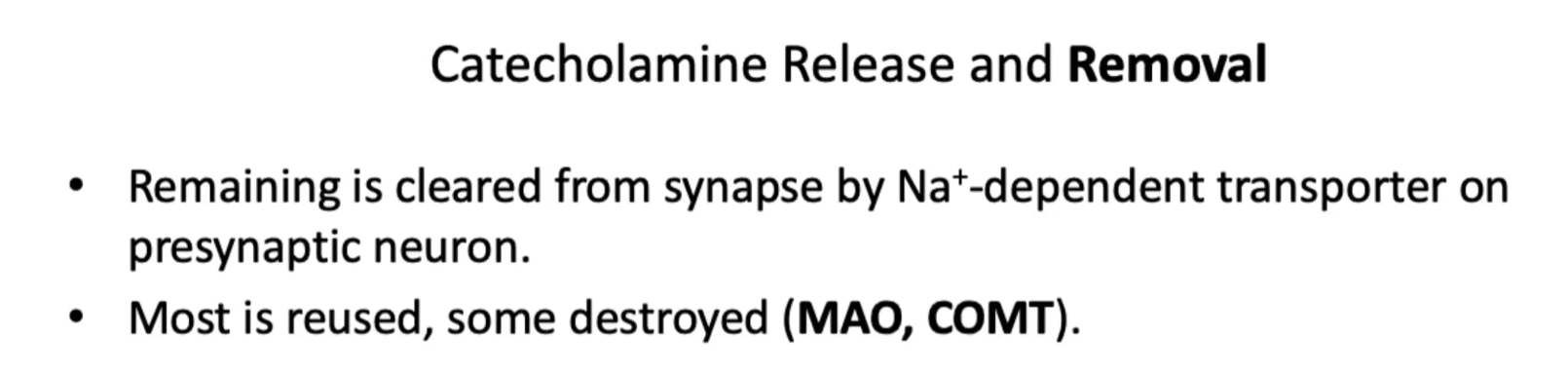
Catecholamine Release and Removal

Excess neurotransmitter is either taken back by a pre-synaptic neuron by a sodium-dependent transporter OR the excess neurotransmitter will be metabolized by enzymes such as Monoamine oxidase (MAO), and catechol-o-methyl-transferase (COMT).

This mechanism will terminate the signal and prevent overstimulation.

  • Remaining is cleared from synapse by Na⁺-dependent transporter on presynaptic neuron.

  • Most is reused, some destroyed (MAO, COMT).

Monoamine Oxidase (MAO)

Definition:
Monoamine oxidase (MAO) is an enzyme that breaks down monoamine neurotransmitters "“monoamine oxidase” after they’ve done their job in the synapse.

What does MAO do?

It inactivates neurotransmitters like:

  • Dopamine

  • Norepinephrine

  • Epinephrine

  • Serotonin

This helps terminate the signal and prevents overstimulation.

Catechol-O-Methyltransferase (COMT)

Definition:
COMT is an enzyme that inactivates catecholamines by adding a methyl group (–CH₃).

What does COMT act on?

Mainly catecholamines:

  • Dopamine

  • Norepinephrine

  • Epinephrine

(Unlike MAO, it does NOT significantly act on serotonin)

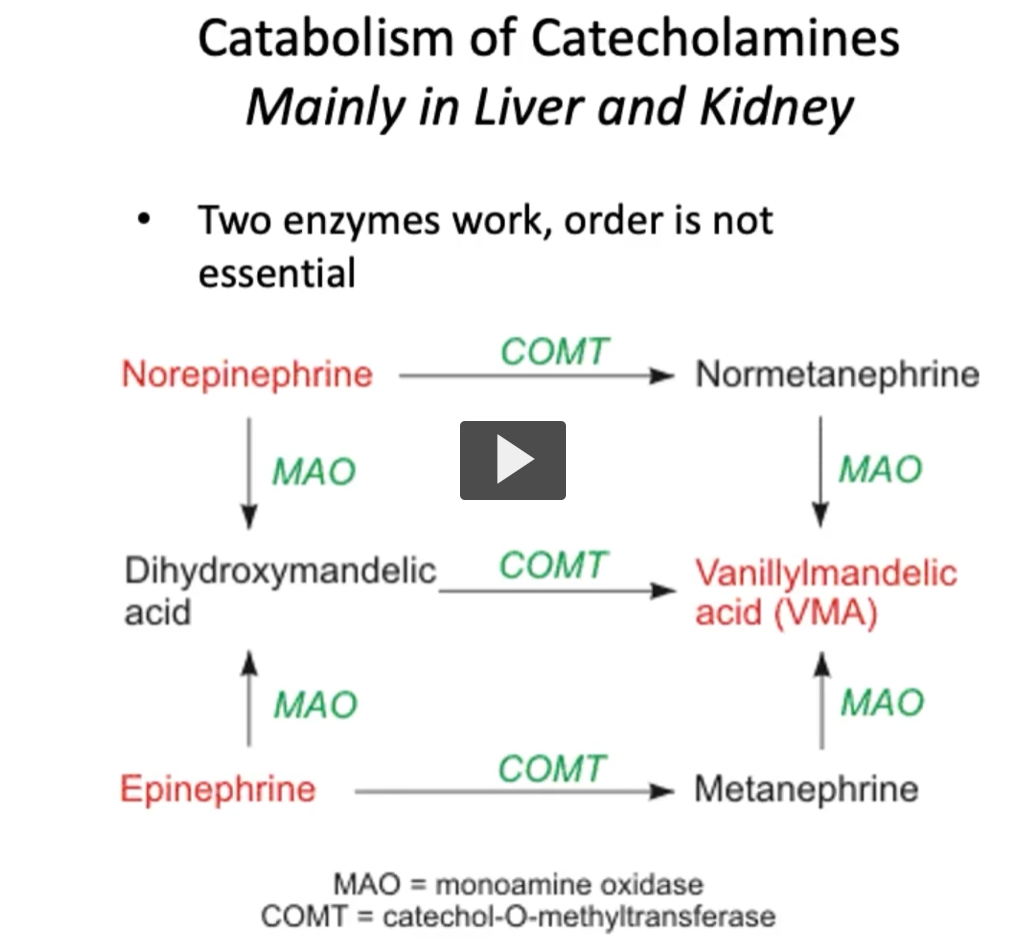
catabolism of catecholamines (mainly in liver and kidney)

Why are they located in the liver? They’re in the liver and kidneys for one main reason:
to detoxify and eliminate circulating monoamines (like catecholamines) from the body. (Chatgpt), the rest of the stuff is what the instructor said)

The primary sites of excess catecholamines breakdown is the liver and kidney. Both MAO and COMT degrade catecholamines through the process of oxidative deamination and as well as methylation.

The sequence of these enzymatic reactions is flexible and is not strictly linear, it does not follow a specific order, but it’s important to remember both processes.

It’s also important to remember the fact that both MAO and COMT enzymes are required for the full inactivation of these excess catecholamines.

Although the exact order of action may vary, both are crucial in maintaining neurotransmitter homeostasis.

A clinical relevant fact is that inhibitors of these enzymes are used therapeutically in Parkinson’s disease and depression.

Vanillylmandelic Acid (VMA)
VMA is the final breakdown product of catecholamines, specifically:

  • Norepinephrine

  • Epinephrine

How is VMA formed?

Catecholamines are degraded by MAO and COMT in sequence → ultimately producing VMA, which is excreted in urine.

Simplified pathway:

  • Norepinephrine / Epinephrine
    → (MAO + COMT)
    VMA

Where is it found? Urine (measured clinically)

Clinical significance

High-yield test point:

  • VMA levels → suggests excess catecholamine production
<p><u>catabolism of catecholamines (mainly in liver and kidney)</u></p><p>Why are they located in the liver? They’re in the <strong>liver and kidneys</strong> for one main reason:<br><strong>to detoxify and eliminate circulating monoamines (like catecholamines) from the body. (</strong>Chatgpt), the rest of the stuff is what the instructor said)</p><p>The <strong>primary sites of excess catecholamines breakdown </strong>is the <strong>liver </strong>and <strong>kidney</strong>. <strong>Both</strong> <strong>MAO</strong> and <strong>COMT</strong> <strong>degrade catecholamines </strong>through the process of <strong>oxidative deamination </strong>and as well as <strong>methylation. </strong></p><p>The <strong>sequence of these enzymatic reactions</strong> is <strong>flexible</strong> and is <strong>not strictly linear</strong>,<strong> it does not follow a specific order</strong>, but it’s important to remember both processes. </p><p>It’s also important to remember the fact that <strong>both MAO </strong>and <strong>COMT enzymes are required </strong>for the <strong>full inactivation </strong>of these <strong>excess catecholamines</strong>. </p><p>Although the exact order of action may vary, both are crucial in maintaining neurotransmitter homeostasis. </p><p>A <strong>clinical relevant fact</strong> is that<strong> inhibitors of these enzymes</strong> are used <strong>therapeutically</strong> in <strong>Parkinson’s disease</strong> and<strong> depression</strong>. </p><p>Vanillylmandelic Acid (VMA) <br><strong>VMA </strong>is the <strong>final breakdown product of catecholamines</strong>, specifically:</p><ul><li><p>Norepinephrine</p></li><li><p>Epinephrine</p></li></ul><p>How is VMA formed? </p><p>Catecholamines are degraded by <strong>MAO</strong> and <strong>COMT</strong> in sequence → ultimately producing <strong>VMA</strong>, which is excreted in urine.</p><p><strong>Simplified pathway:</strong></p><ul><li><p>Norepinephrine / Epinephrine<br>→ (MAO + COMT)<br>→ <strong>VMA</strong></p></li></ul><p>Where is it found? <strong>Urine</strong> (measured clinically)</p><p>Clinical significance </p><p><strong>High-yield test point:</strong></p><ul><li><p>↑ <strong>VMA levels</strong> → suggests excess catecholamine production</p></li></ul><p></p>
10
New cards
<p><u>Clinical significance of metabolites</u></p><ul><li><p>Metabolites such as <strong>Homovanillate</strong> (from dopamine) and <strong>vanillylmandelate </strong>(from epi/norepi) are <strong>secreted</strong> <strong>in urine</strong>.</p></li><li><p><strong>High amounts of degradation products</strong> in <strong>urine</strong> may signal <strong>pheochromocytoma</strong> (catecholamine-secreting tumor) or <strong>neuroblastoma.</strong></p></li><li><p><strong>CSF levels of homovanillate</strong> may <strong>reflect</strong> <strong>dopamine activity</strong> and <strong>oxidative stress</strong>. </p></li><li><p><strong>Levels of homovanillate in CSF</strong> reflect <strong>oxidative or metabolic stress</strong> <strong>as well as levels of dopamine</strong>.</p></li></ul><p></p>

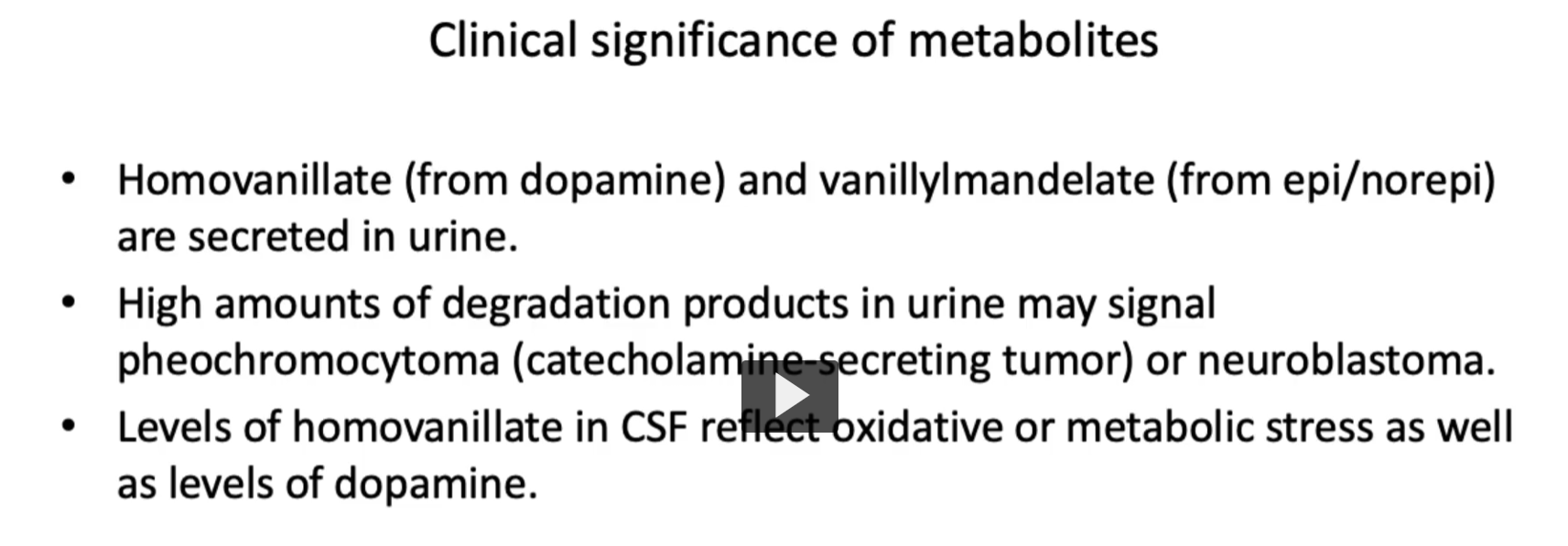
Clinical significance of metabolites

  • Metabolites such as Homovanillate (from dopamine) and vanillylmandelate (from epi/norepi) are secreted in urine.

  • High amounts of degradation products in urine may signal pheochromocytoma (catecholamine-secreting tumor) or neuroblastoma.

  • CSF levels of homovanillate may reflect dopamine activity and oxidative stress.

  • Levels of homovanillate in CSF reflect oxidative or metabolic stress as well as levels of dopamine.

Histamine Synthesis

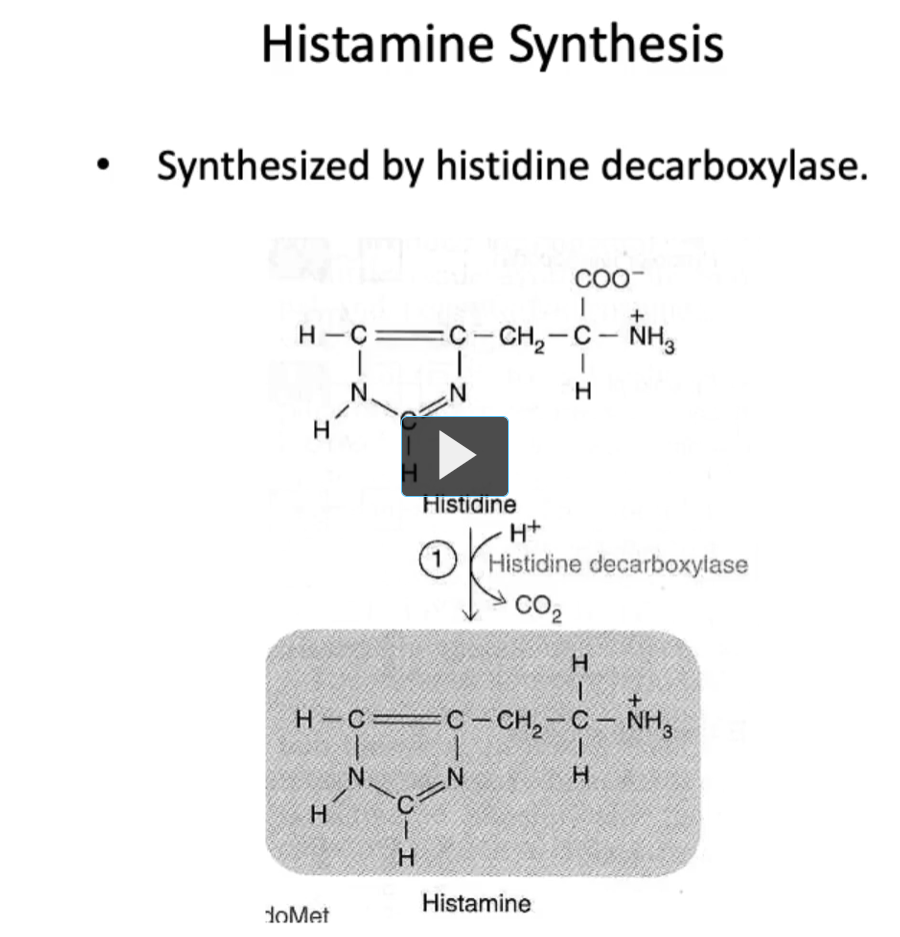
In the case of histamine, it is synthesized from the amino acid histidine by the enzyme histidine decarboxylase.

It plays a role in allergic reactions, gastric acid secretion, and neurotransmission.

Unlike the catecholamines, histamine is not recycled. It is metabolized after its release.

Histamine is not recycled because there is no efficient reuptake system and it is safer for the body to rapidly inactivate it than to reuse it.

In this figure, we can see the structure of histamine.
<p><u>Histamine Synthesis</u></p><p>In the case of<strong> histamine</strong>, it is <strong>synthesized</strong> from the <strong>amino acid histidine</strong> by the enzyme <strong>histidine decarboxylase. </strong></p><p>It plays a role in allergic reactions, gastric acid secretion, and neurotransmission. </p><p>Unlike the catecholamines, histamine is <strong>not </strong>recycled. It is metabolized after its release. </p><p><strong>Histamine</strong> is<strong> not recycled</strong> <strong>because there is no efficient reuptake system</strong> and it is<strong> safer for the body to rapidly inactivate it than to reuse it.</strong></p><p>In this figure, we can see the structure of histamine. </p>
11
New cards
<p><u>Histamine Degradation</u></p><p><strong>Histamine</strong> is <strong>inactivated</strong> <strong>by</strong> <strong>methylation</strong> and <strong>oxidation</strong> via the enzyme <strong>Histamine N-Methyltransferase (HNMT) </strong>(intracellular) as well as <strong>diamine oxidase (DAO) </strong>(extra-cellular). These enzymes degrade histamine in a non-sequential manner. Primarily outside the brain. </p><p><strong>Deficiencies</strong> in <strong>these pathways </strong>can <strong>lead to clinical examples</strong> of <strong>histamine intolerance</strong> or<strong> exaggerrated allergic responses</strong>. </p><ul><li><p>Removed from synapse by transporter.</p></li><li><p>Histamine is metabolized rather than recycled.</p></li><li><p>Metabolized by action of methyltransferase and diamine oxidase (DAO); order independent.</p></li></ul><p></p>

Histamine Degradation

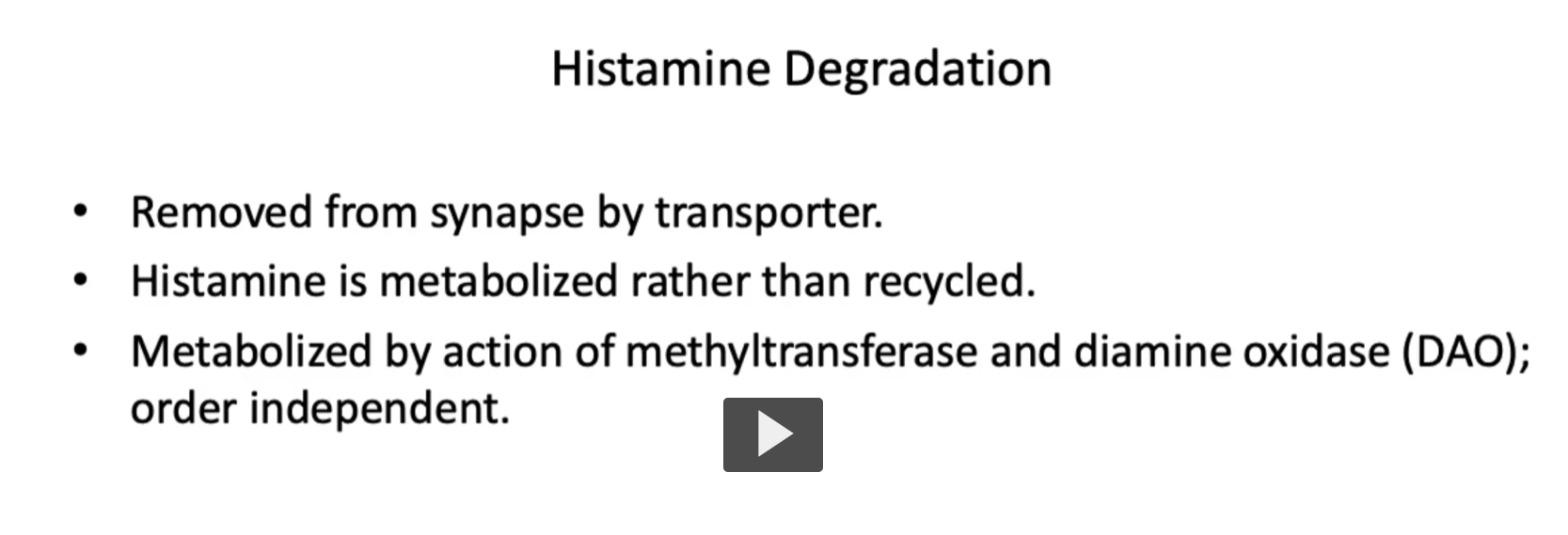
Histamine is inactivated by methylation and oxidation via the enzyme Histamine N-Methyltransferase (HNMT) (intracellular) as well as diamine oxidase (DAO) (extra-cellular). These enzymes degrade histamine in a non-sequential manner. Primarily outside the brain.

Deficiencies in these pathways can lead to clinical examples of histamine intolerance or exaggerrated allergic responses.

  • Removed from synapse by transporter.

  • Histamine is metabolized rather than recycled.

  • Metabolized by action of methyltransferase and diamine oxidase (DAO); order independent.

Histamine Degradation

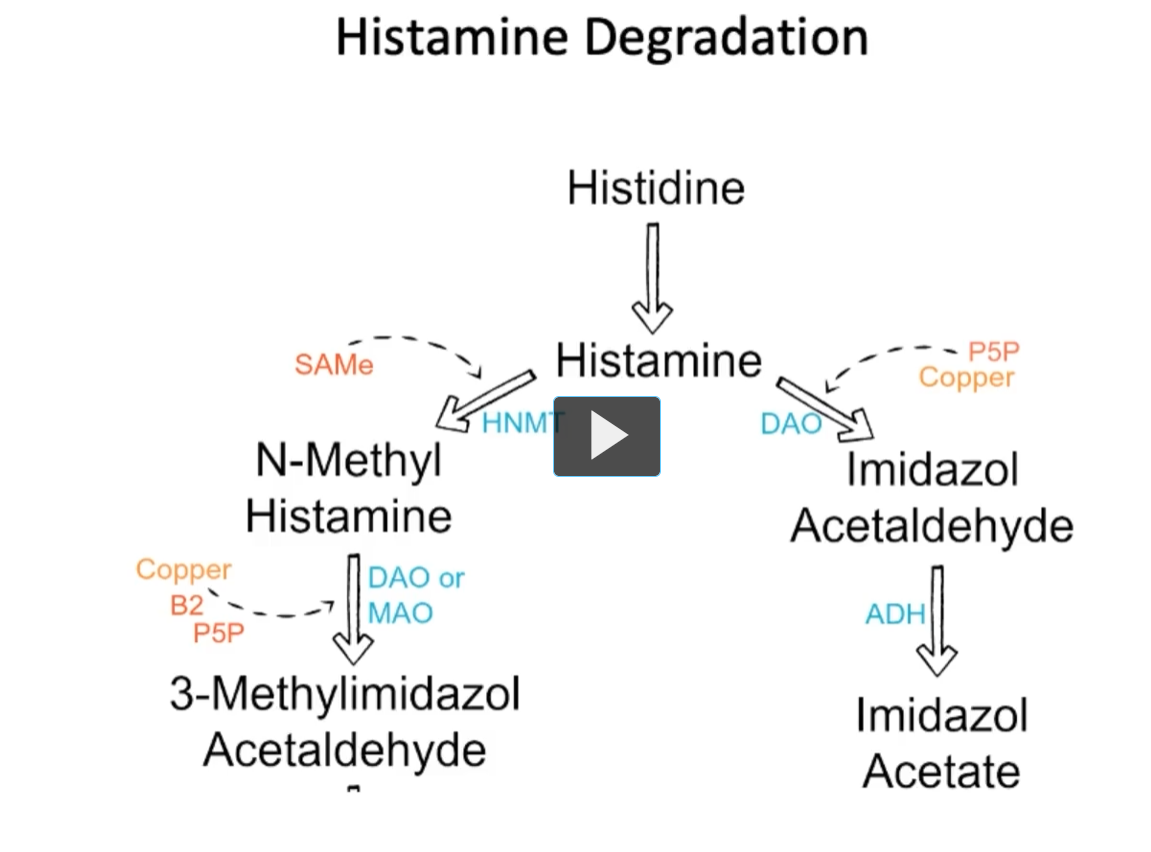
Looking at this figure, we can see that Histamine is inactivated by methylation (Histamine N-Methyltransferase (HNMT) and oxidation (diamine oxidase (DAO), via

Histidine (Histine decarboxylase)

Histamine

Left pathway:

(Histamine N-Methyltransferase (HNMT) inactivates Histamine (using SAMe as a methyl donor) → N-methyl histamine.

N-methyl histamine (DAO or MAO, Copper, B2, P5P) → 3-Methylimidazol Acetaldehyde

Right pathway:

HIstamine (DAO, P5P, Copper) → Imidazol Acetaldehyde

Imidazol Acetaldehyde (ADH) → Imidazol Acetate
<p><u>Histamine Degradation</u></p><p>Looking at this figure, we can see that <strong>Histamine</strong> is <strong>inactivated</strong> by <strong>methylation </strong>(<strong>Histamine N-Methyltransferase (HNMT)</strong> and <strong>oxidation (diamine oxidase (DAO)</strong>, via </p><p>Histidine (Histine decarboxylase)<br>↓<br>Histamine</p><p><strong>Left pathway:</strong></p><p>(<strong>Histamine N-Methyltransferase (HNMT)</strong>  inactivates Histamine (using SAMe as a methyl donor) → N-methyl histamine. </p><p>N-methyl histamine (DAO <u>or</u> MAO, Copper, B2, P5P) →  3-Methylimidazol Acetaldehyde</p><p><strong>Right pathway:</strong></p><p>HIstamine (<strong>DAO</strong>, P5P, Copper) → Imidazol Acetaldehyde</p><p>Imidazol Acetaldehyde (ADH) → Imidazol Acetate</p><p></p>
12
New cards
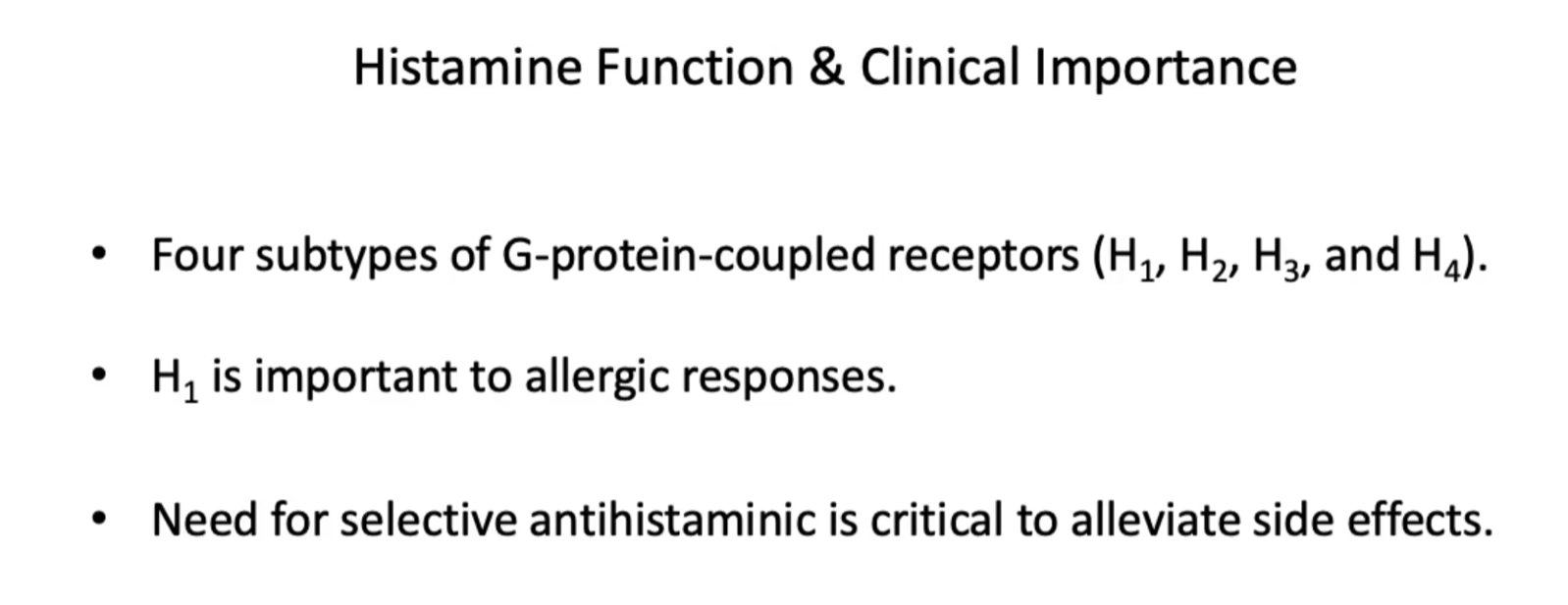
<p><u>Histamine Function &amp; Clinical Importance</u></p><ul><li><p><strong>Four subtypes</strong> of <strong>G-protein-coupled receptors</strong> (H₁, H₂, H₃, and H₄).</p></li><li><p><strong>H₁</strong> is <strong>important</strong> to <strong>allergic responses</strong>.</p></li></ul><p>why? </p><p><strong>H₁ receptor</strong> </p><ul><li><p><strong>Location:</strong> Smooth muscle, endothelium, brain</p></li><li><p><strong>Function:</strong></p><ul><li><p><strong>Allergic responses (most important!)</strong></p></li><li><p>Vasodilation</p></li><li><p>↑ vascular permeability → edema</p></li><li><p>Bronchoconstriction</p></li></ul></li><li><p><strong>Clinical:</strong></p><ul><li><p>Target of <strong>antihistamines</strong> (e.g., diphenhydramine)</p></li></ul></li></ul><p>Think: <strong>H₁ = “Allergy receptor”</strong></p><ul><li><p>Pharmocologically, or in terms of neurophysiology, there is a need for <strong>selective antihistaminic</strong> is <strong>critical</strong> to <strong>alleviate side effects.</strong></p></li></ul><p>Antihistaminics (Antihistamines) </p><p><strong>What they are:</strong><br>Drugs that <strong>block histamine receptors</strong>, mainly <strong>H₁ or H₂</strong>, to reduce histamine’s effects.</p>

Histamine Function & Clinical Importance

  • Four subtypes of G-protein-coupled receptors (H₁, H₂, H₃, and H₄).

  • H₁ is important to allergic responses.

why?

H₁ receptor

  • Location: Smooth muscle, endothelium, brain

  • Function:

    • Allergic responses (most important!)

    • Vasodilation

    • ↑ vascular permeability → edema

    • Bronchoconstriction

  • Clinical:

    • Target of antihistamines (e.g., diphenhydramine)

Think: H₁ = “Allergy receptor”

  • Pharmocologically, or in terms of neurophysiology, there is a need for selective antihistaminic is critical to alleviate side effects.

Antihistaminics (Antihistamines)

What they are:
Drugs that block histamine receptors, mainly H₁ or H₂, to reduce histamine’s effects.

Histamine Function and Clinical Importance

  • The hypothalamus is rich in histaminergic neurons (the hypothalamus contains many neurons that release histamine) that project throughout brain/spinal column.

project: the axons of the histaminergic neurons of the hypothalamus travel long distances through the brain/spinal column.

  • Histaminergic neurons in the hypothalamus regulate arousal and wakefullness.

Histamine = direct “wake-up signal”

Serotonin = modulator of wakefulness + sleep cycles + mood

  • Antihistamines with CNS penetration (crossing of Blood Brain Barrier) can reduce alertness, have side effect of reduced arousal.

Anti-histamines reduce alertness because histamine promotes alertness.

  • Drug-drug interaction with monoamine oxidase inhibitors and antihistamines can exacerbate these effects.

Antihistamines (H₁ blockers) Block histamine in the brain Histamine normally promotes: Wakefulness Alertness. So blocking it → sedation / drowsiness

Monoamine oxidase inhibitors (MAOIs) Prevent breakdown of: Serotonin Dopamine, Norepinephrine These neurotransmitters affect: Mood Arousal Sleep–wake balance.

  • Therefore, it is important to be aware of the mechanism of action of histamine in the CNS.
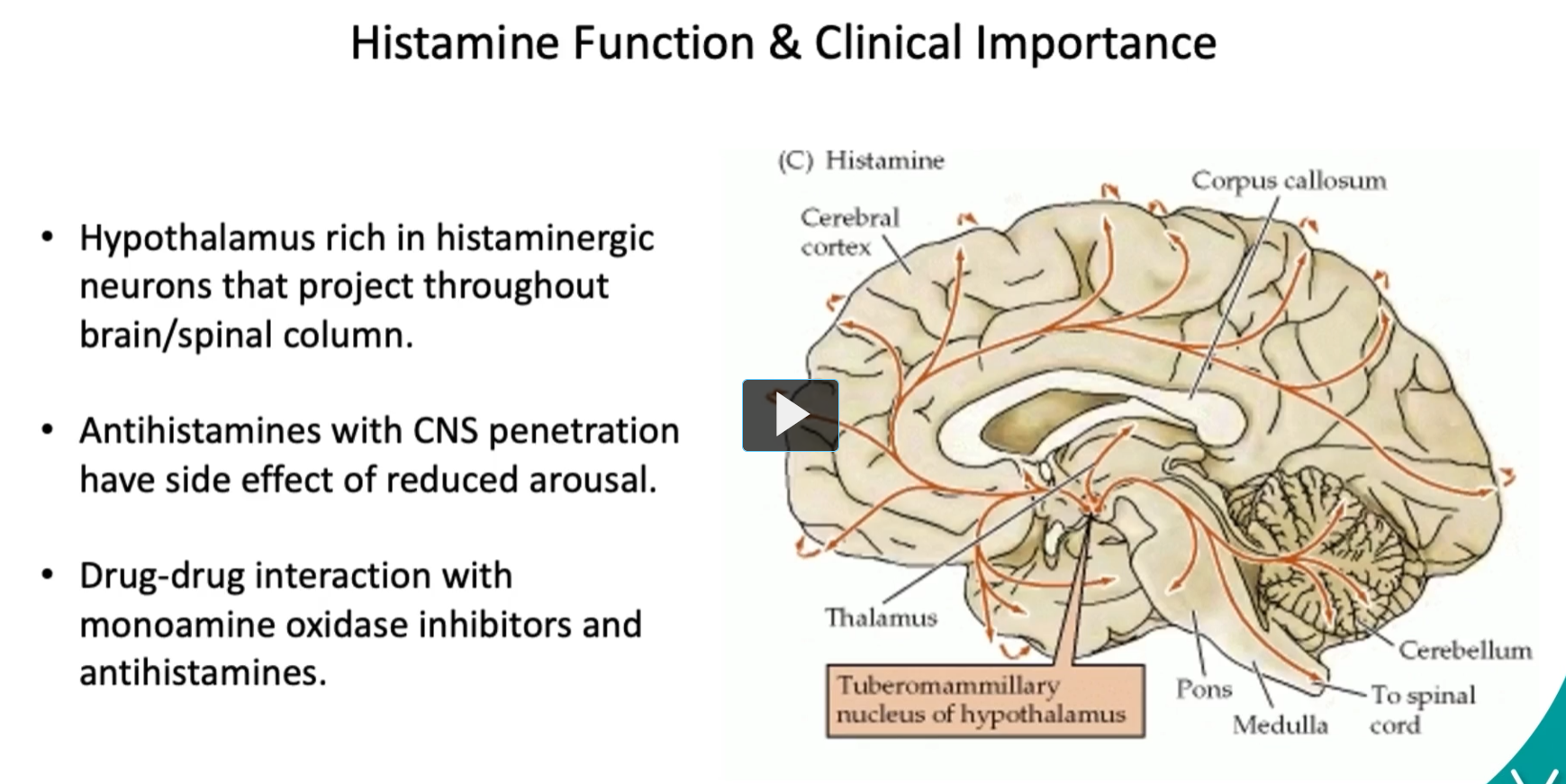
<p><u>Histamine Function and Clinical Importance</u></p><ul><li><p><strong>The hypothalamus </strong>is <strong>rich</strong> in <strong>histaminergic neurons (</strong>the hypothalamus contains many neurons that release histamine) that <strong>project</strong> throughout brain/spinal column.</p></li></ul><p>project: the axons of the histaminergic neurons of the hypothalamus travel long distances through the brain/spinal column. </p><ul><li><p><strong>Histaminergic neurons</strong> in the<strong> hypothalamus regulate</strong> <strong>arousal </strong>and <strong>wakefullness</strong>. </p></li></ul><p><strong>Histamine = direct “wake-up signal”</strong></p><p><strong>Serotonin = modulator of wakefulness + sleep cycles + mood</strong></p><ul><li><p><strong>Antihistamines</strong> with <strong>CNS penetration</strong> (crossing of Blood Brain Barrier) can <u>reduce</u> alertness, have side effect of reduced arousal.</p></li></ul><p>Anti-histamines reduce alertness because histamine promotes alertness. </p><ul><li><p>Drug-drug interaction with monoamine oxidase inhibitors and antihistamines can exacerbate these effects. </p></li></ul><p><strong>Antihistamines (H₁ blockers)</strong> Block <strong>histamine in the brain </strong>Histamine normally promotes: <strong>Wakefulness Alertness. </strong>So blocking it → <strong>sedation / drowsiness</strong></p><p><strong>Monoamine oxidase inhibitors (MAOIs)</strong> Prevent breakdown of: <strong>Serotonin Dopamine, Norepinephrine </strong>These neurotransmitters affect: Mood Arousal Sleep–wake balance. </p><ul><li><p>Therefore, it is important to be aware of the mechanism of action of histamine in the CNS. </p></li></ul><p></p>
13
New cards
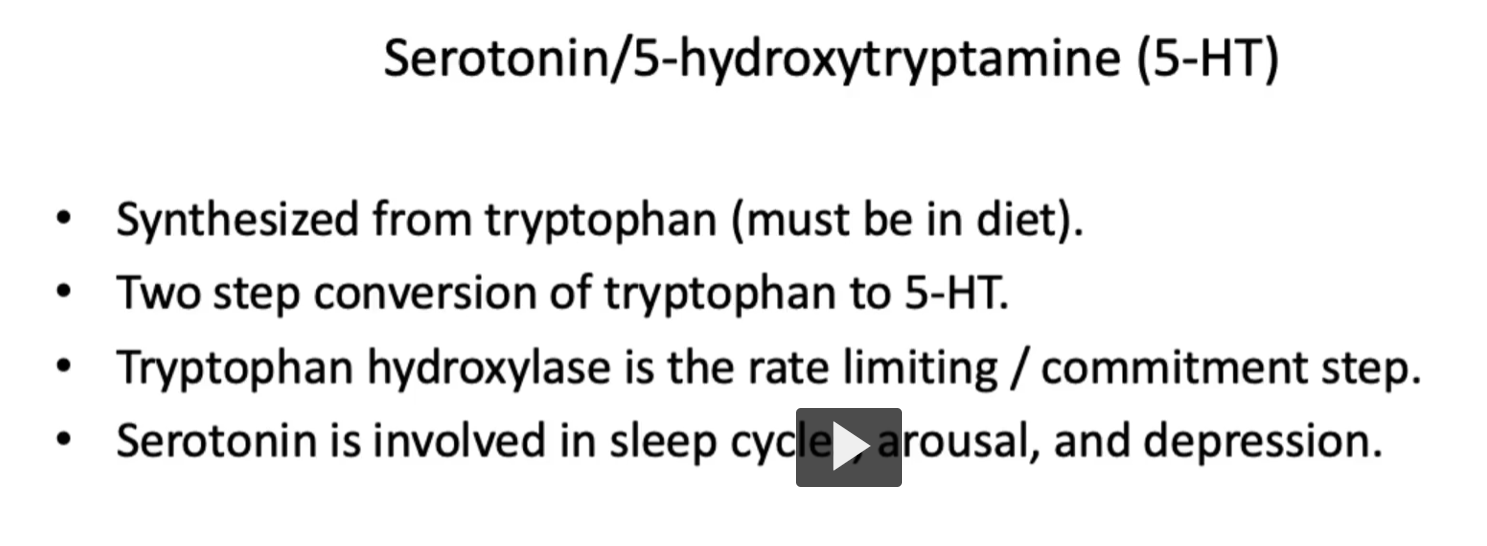
<p><u>Serotonin/5-hydroxytryptamine (5-HT)</u></p><ul><li><p><strong>Serotonin</strong> is <strong>synthesized</strong> from <strong>tryptophan</strong> (tryptophan must be in diet, meaning <strong>tryptophan</strong> <strong>is an essential amino acid</strong>).</p></li><li><p>Two step conversion of tryptophan to 5-HT.</p></li><li><p><strong>Tryptophan hydroxylase</strong> is the<strong> rate limiting</strong> / <strong>commitment step</strong> for the <strong>conversion</strong> of <strong>tryptophan</strong> to <strong>serotonin</strong>. </p></li><li><p>Serotonin is involved in <strong>mood</strong>, <strong>sleep cycle</strong>, <strong>arousal</strong>, and <strong>depression</strong>.</p></li></ul><p></p>

Serotonin/5-hydroxytryptamine (5-HT)

  • Serotonin is synthesized from tryptophan (tryptophan must be in diet, meaning tryptophan is an essential amino acid).

  • Two step conversion of tryptophan to 5-HT.

  • Tryptophan hydroxylase is the rate limiting / commitment step for the conversion of tryptophan to serotonin.

  • Serotonin is involved in mood, sleep cycle, arousal, and depression.

Serotonin Synthesis

In this figure, we can see the two-step process in the synthesis of serotonin.

  1. tryptophan (tyrptophan-5-hydroxylase, adds a hydroxyl to tryptophan) → 5-hydroxy-tryptophan

OH is added.

  1. 5-hydroxytryptophan (aromatic L-amino acid decarboxylase) → Serotonin (5-HT)

Tryptophan is an aromatic amino acid.

CO2 is lost.
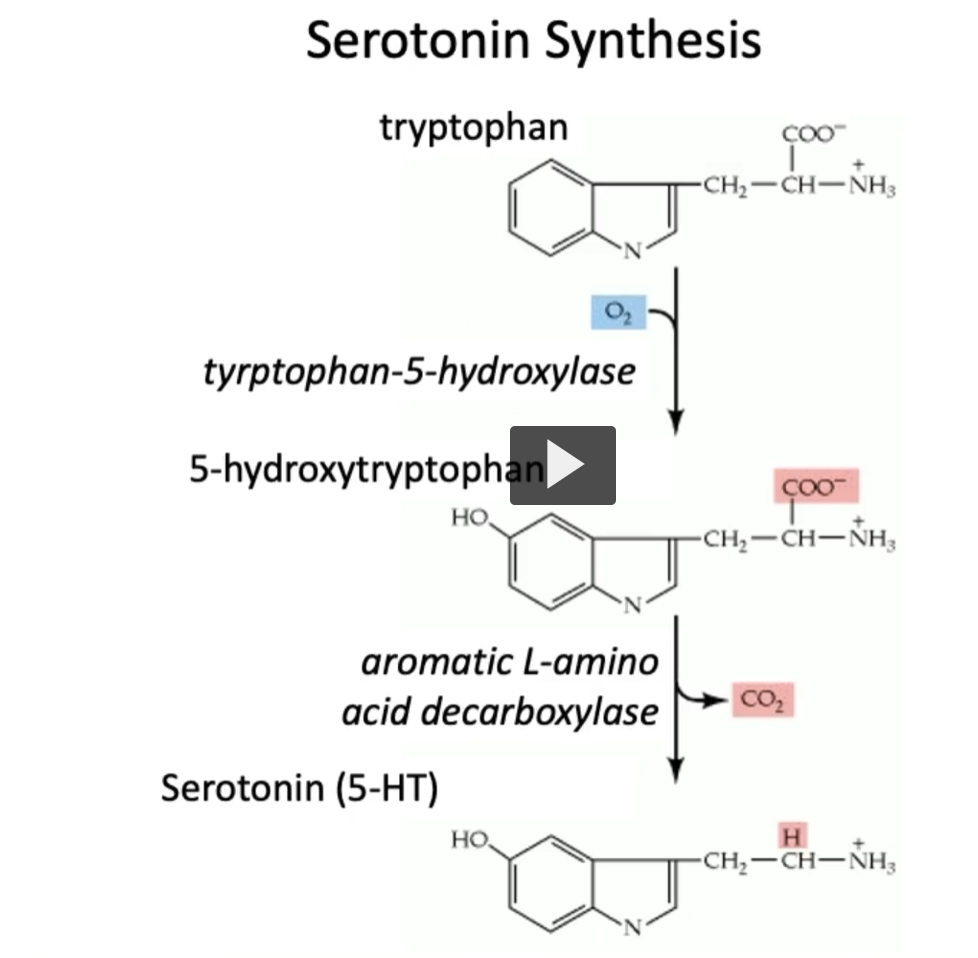
<p><u>Serotonin Synthesis</u></p><p>In this figure, we can see the two-step process in the synthesis of serotonin. </p><ol><li><p>tryptophan (tyrptophan-5-hydroxylase, adds a hydroxyl to tryptophan) → 5-hydroxy-tryptophan</p></li></ol><p>OH is added. </p><ol start="2"><li><p>5-hydroxytryptophan (aromatic L-amino acid decarboxylase) → Serotonin (5-HT)</p></li></ol><p>Tryptophan is an aromatic amino acid. </p><p>CO2 is lost. </p>
14
New cards
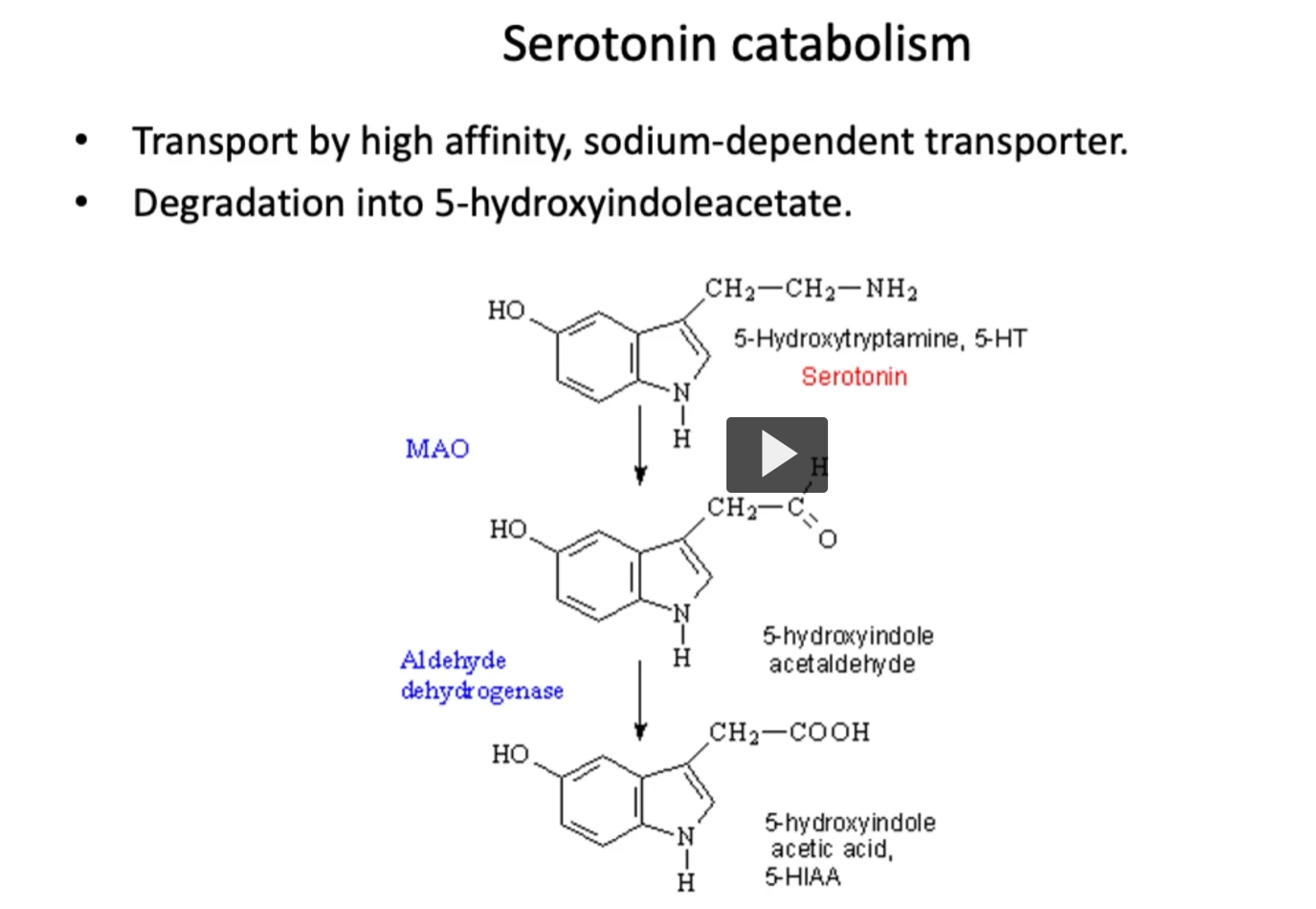
<p><u>Serotonin catabolism</u></p><p>On the other hand, the process of catabolism of serotonin. </p><ol><li><p><strong>Serotonin</strong> will be <strong>re-absorbed</strong> by <strong>high affinity</strong>,<strong> sodium-dependent transporter</strong>.</p></li><li><p><strong>Serotonin</strong> is <strong>degraded (by MAO)</strong> into <strong>5-hydroxyindole acetaldehyde</strong> </p></li><li><p><strong>5-hydroxyindole acetaldehyde</strong> is degraded (by aldehyde dehydrogenase) into <strong>5-hydroxyindole acetic acid (5-HIAA). </strong></p></li></ol><p><strong>5-hydroxyindole acetic acid (5-HIAA) </strong>will be <strong>excreted</strong> in the <strong>urine</strong>. Measurement of 5-HIAA is clinically useful for diagnosing any serotonin producing tumors such as seen in the <strong>carcinoid syndrome</strong>. </p>

Serotonin catabolism

On the other hand, the process of catabolism of serotonin.

  1. Serotonin will be re-absorbed by high affinity, sodium-dependent transporter.

  2. Serotonin is degraded (by MAO) into 5-hydroxyindole acetaldehyde

  3. 5-hydroxyindole acetaldehyde is degraded (by aldehyde dehydrogenase) into 5-hydroxyindole acetic acid (5-HIAA).

5-hydroxyindole acetic acid (5-HIAA) will be excreted in the urine. Measurement of 5-HIAA is clinically useful for diagnosing any serotonin producing tumors such as seen in the carcinoid syndrome.

Serotonin roles and dysfunction

  • In CNS, serotonin controls mood, appetite and sleep.

  • In gut (enterochromaffin cells), serotonin modulates peristalsis, regulating intestinal movements

  • Excess serotonin may lead to adverse effects:

    • cardiomyocyte growth – right heart disease

    • tryptophan depletion and niacin deficiency (leading to the clinical condition of pellagra = dermatitis, dementia, diarrhea)

  • Defects in proper regulation of serotonin receptors cause psychotic disorders.

  • Too much serotonin can be caused by a carcinoid tumor detectable by excess 5-hydroxyindoleacetate (5-HIAA) in urine.
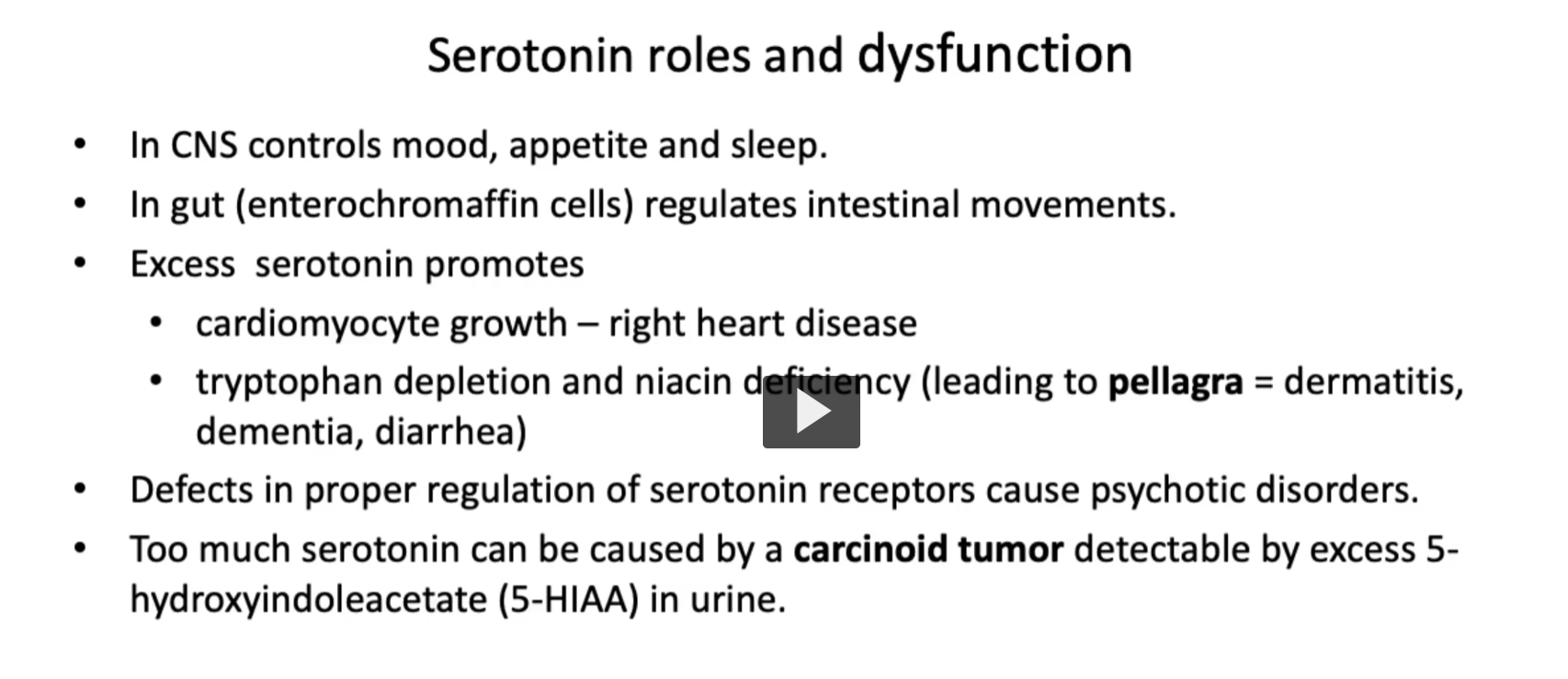
<p><u>Serotonin roles and dysfunction</u></p><ul><li><p>In <strong>CNS</strong>, <strong>serotonin</strong> controls<strong> mood</strong>, <strong>appetite</strong> and <strong>sleep</strong>.</p></li><li><p>In <strong>gut (enterochromaffin cells)</strong>, <strong>serotonin modulates peristalsi</strong>s, <strong>regulating intestinal movements</strong></p></li><li><p><strong>Excess serotonin</strong> <strong>may lead to adverse effects</strong>:</p><ul><li><p>cardiomyocyte growth – <strong>right heart disease</strong></p></li><li><p><strong>tryptophan depletion</strong> and <strong>niacin deficiency</strong> (leading to the clinical condition of pellagra = dermatitis, dementia, diarrhea)</p></li></ul></li><li><p>Defects in proper regulation of serotonin receptors cause psychotic disorders.</p></li><li><p><strong>Too much serotonin</strong> can be <strong>caused</strong> <strong>by</strong> a <strong>carcinoid tumor</strong> detectable by <strong>excess 5-hydroxyindoleacetate (5-HIAA) in urine</strong>.</p></li></ul><p></p>
15
New cards
  • Excess serotonin may lead to adverse effects:

    • cardiomyocyte growth – right heart disease

Right Heart Disease (in the context of serotonin)

This refers to damage to the right side of the heart, especially the tricuspid and pulmonary valves, most classically seen in carcinoid syndrome

Why serotonin causes right heart disease

In carcinoid tumors:

  • Tumor releases large amounts of serotonin (5-HT) into the bloodstream

Serotonin effects:

  • Stimulates fibroblast and smooth muscle proliferation

  • Leads to fibrosis (scar-like tissue) on heart valves

What specifically happens

  • Thickening and stiffening of:

    • Tricuspid valve

    • Pulmonary valve

Results in:

  • Tricuspid regurgitation (most common)

  • Pulmonary stenosis

Why ONLY the RIGHT side?

This is very high-yield:

  • Blood from GI tumors → goes to liver first

  • Normally, the liver breaks down serotonin (via MAO)

BUT:

  • If tumor metastasizes to liver, serotonin enters systemic circulation

Still:

  • Lungs contain MAO → break down serotonin

So:

  • Right heart gets exposed first

  • Left heart is protected by lungs

Summary flow:

Carcinoid tumor → ↑ serotonin → fibrosis of right heart valves → right heart disease

  • Excess serotonin may lead to adverse effects:

  • tryptophan depletion and niacin deficiency (leading to the clinical condition of pellagra = dermatitis, dementia, diarrhea)

Niacin (Vitamin B₃)
A water-soluble vitamin essential for making NAD⁺ and NADP⁺, which are critical for energy metabolism.

Where it comes from

  • Diet (meat, grains, etc.)

  • Synthesized from tryptophan

Key connection (VERY HIGH-YIELD)

Tryptophan can go two ways:

  1. Serotonin production

  2. Niacin (B₃) production

If too much tryptophan is used to make serotonin:

  • ↓ tryptophan available for niacin

  • niacin deficiency

Niacin deficiency = Pellagra Classic 3 D’s

  • Dermatitis

  • Diarrhea

  • Dementia

(+ 4th D = Death if severe)

  • “Pellagra” comes from Italian:

    • “pelle” = skin

    • “agra” = rough, harsh, or sour

So pellagra literally means “rough skin.”

Why that name makes sense

  • One of the hallmark features is dermatitis

  • The skin becomes:

    • Rough

    • Thickened

    • Hyperpigmented (especially in sun-exposed areas)

16
New cards

carcinoid tumor

A slow-growing neuroendocrine tumor that most commonly arises from enterochromaffin cells in the gastrointestinal (GI) tract.

  • “carcino-” = cancer

  • “-oid” = resembling

“Carcinoid” = “cancer-like”
(Originally named because it seemed less aggressive than typical cancers)

What they produce

  • Serotonin (5-HT) (most important)

  • Other vasoactive substances (e.g., bradykinin, histamine)

Carcinoid Syndrome

Occurs when tumor products reach systemic circulation (often after liver metastasis)

Symptoms:

  • Flushing

  • Diarrhea

  • Wheezing (bronchospasm)

  • Right-sided heart disease

Why right heart disease happens

  • Serotonin → fibrosis of heart valves

  • Affects:

    • Tricuspid valve (on right side of the heart)

    • Pulmonary valve (on right side of the heart)

Left heart is protected because lungs break down serotonin

Diagnosis

  • 5-HIAA in urine

    • 5-HIAA = serotonin breakdown product

Melatonin

Serotonin is a precursor for melatonin.

Melatonin is synthesized from serotonin in the pineal gland.

  • Precursor is serotonin.

  • Role in circadian rhythms.

  • Production of melatonin will increase in darkness, thus promoting sleep

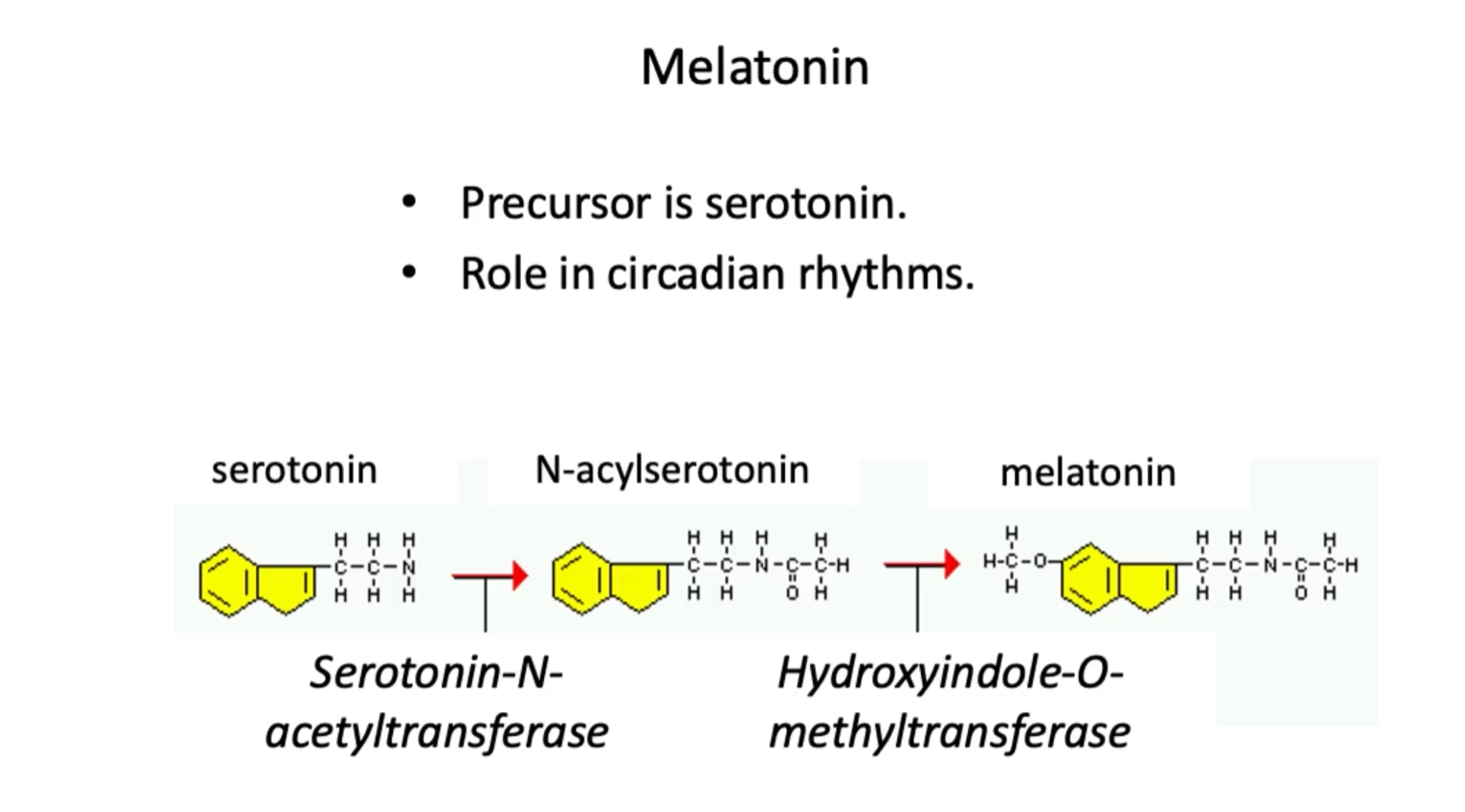
  • In this figure we can see the chain of reactions that lead to the conversion of melatonin from serotonin.

Pathway:
1. serotonin (Serotonin-N-acetyltransferase) → N-acylserotonin

Serotonin-N-acetyltransferase transfers an acetyl group TO serotonin.

2. N-acylserotonin (Hydroxyindole-O-methyltransferase) → melatonin

Hydroxyindole-O-methyltransferase transfers a methyl group to N-acylserotonin to get melatonin.

Hydroxyindole-O-methyltransferase =
An enzyme that transfers a methyl (–CH₃) group to the oxygen (O) of a hydroxyl group on an indole compound
<p><u>Melatonin</u></p><p>Serotonin is a precursor for melatonin.</p><p>Melatonin is synthesized from serotonin in the pineal gland.</p><ul><li><p>Precursor is serotonin.</p></li><li><p>Role in circadian rhythms.</p></li><li><p>Production of melatonin will increase in darkness, thus promoting sleep</p></li><li><p>In this figure we can see the chain of reactions that lead to the conversion of melatonin from serotonin.</p></li></ul><p><strong>Pathway:</strong><br>1. serotonin (Serotonin-N-acetyltransferase) → N-acylserotonin</p><p>Serotonin-N-acetyltransferase transfers an acetyl group TO serotonin.</p><p>2. N-acylserotonin (Hydroxyindole-O-methyltransferase) → melatonin</p><p>Hydroxyindole-O-methyltransferase transfers a methyl group to N-acylserotonin to get melatonin.</p><p><strong>Hydroxyindole-O-methyltransferase</strong> =<br><em>An enzyme that transfers a methyl (–CH₃) group to the oxygen (O) of a hydroxyl group on an indole compound</em></p>
17
New cards
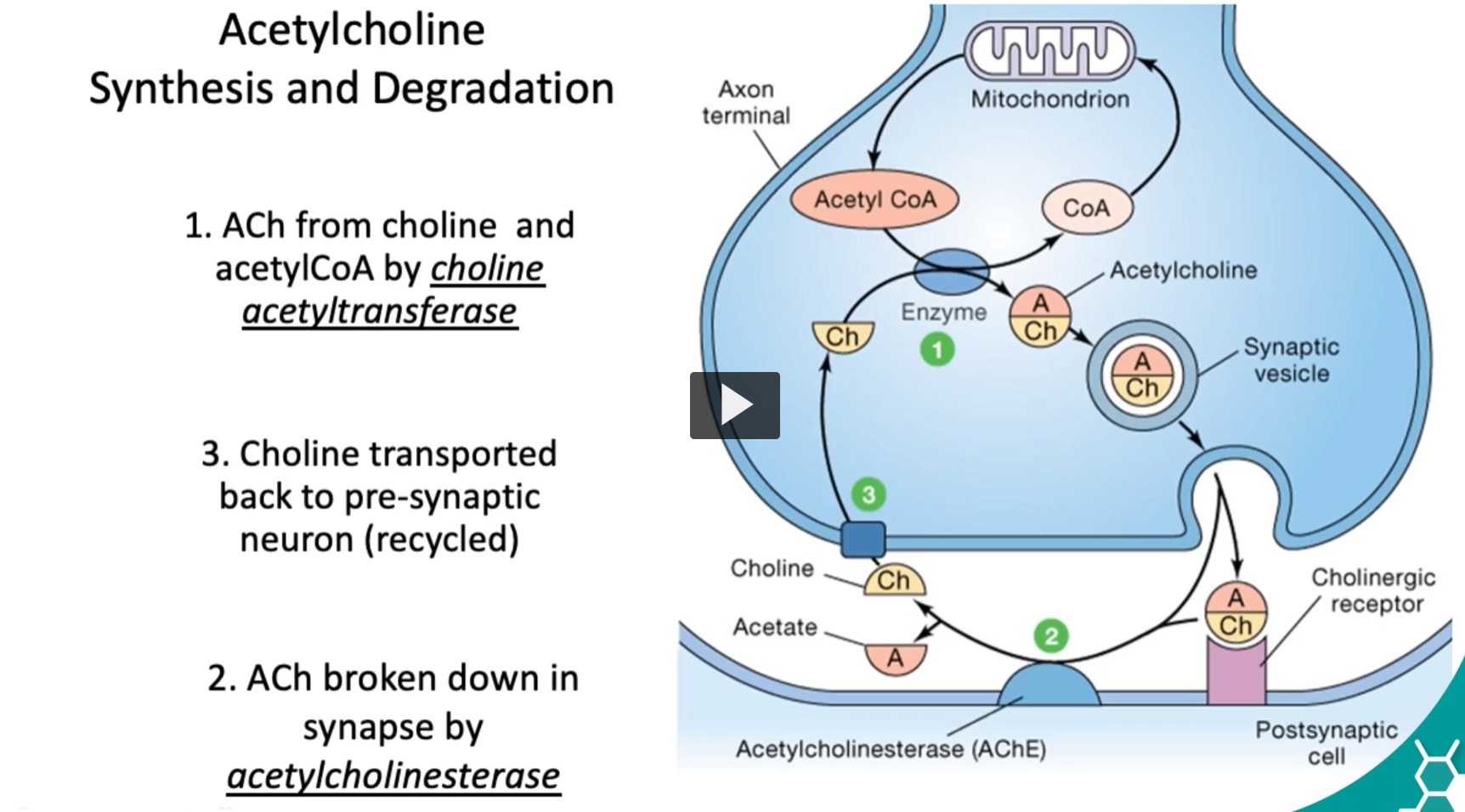
<p><u>Acetylcholine Synthesis and Degradation</u></p><p>Now to discuss <strong>acetylcholine</strong>, it’s important to discuss the <strong>synthesis</strong>, and then we will discuss <strong>degradation</strong>. </p><ol><li><p><strong>ACh</strong> from <strong>choline</strong> and <strong>acetylCoA</strong> by <em><u>choline acetyltransferase</u></em></p></li></ol><p><strong>Choline acetyltransferase (ChAT)</strong><br><em>An enzyme that transfers an acetyl group (–COCH₃) from acetyl-CoA TO choline </em>→ acetylcholine. </p><ol><li><p>ACh broken down in synapse by <em>acetylcholinesterase</em></p></li><li><p>Choline transported back to pre-synaptic neuron (recycled)</p></li></ol><p>This <strong>fast breakdown</strong> makes <strong>acetylcholine ideal </strong>for <strong>rapid, synaptic transmission</strong>. </p><p>We can remember that <strong>acetylcholine</strong> is <strong>one of the main messenger</strong> in <strong>neuromuscular-skeletal pathways</strong> for <strong>muscle contraction</strong>, leading to r<strong>apid access</strong>,<strong> release</strong> and<strong> degradation.</strong> </p>

Acetylcholine Synthesis and Degradation

Now to discuss acetylcholine, it’s important to discuss the synthesis, and then we will discuss degradation.

  1. ACh from choline and acetylCoA by choline acetyltransferase

Choline acetyltransferase (ChAT)
An enzyme that transfers an acetyl group (–COCH₃) from acetyl-CoA TO choline → acetylcholine.

  1. ACh broken down in synapse by acetylcholinesterase

  2. Choline transported back to pre-synaptic neuron (recycled)

This fast breakdown makes acetylcholine ideal for rapid, synaptic transmission.

We can remember that acetylcholine is one of the main messenger in neuromuscular-skeletal pathways for muscle contraction, leading to rapid access, release and degradation.

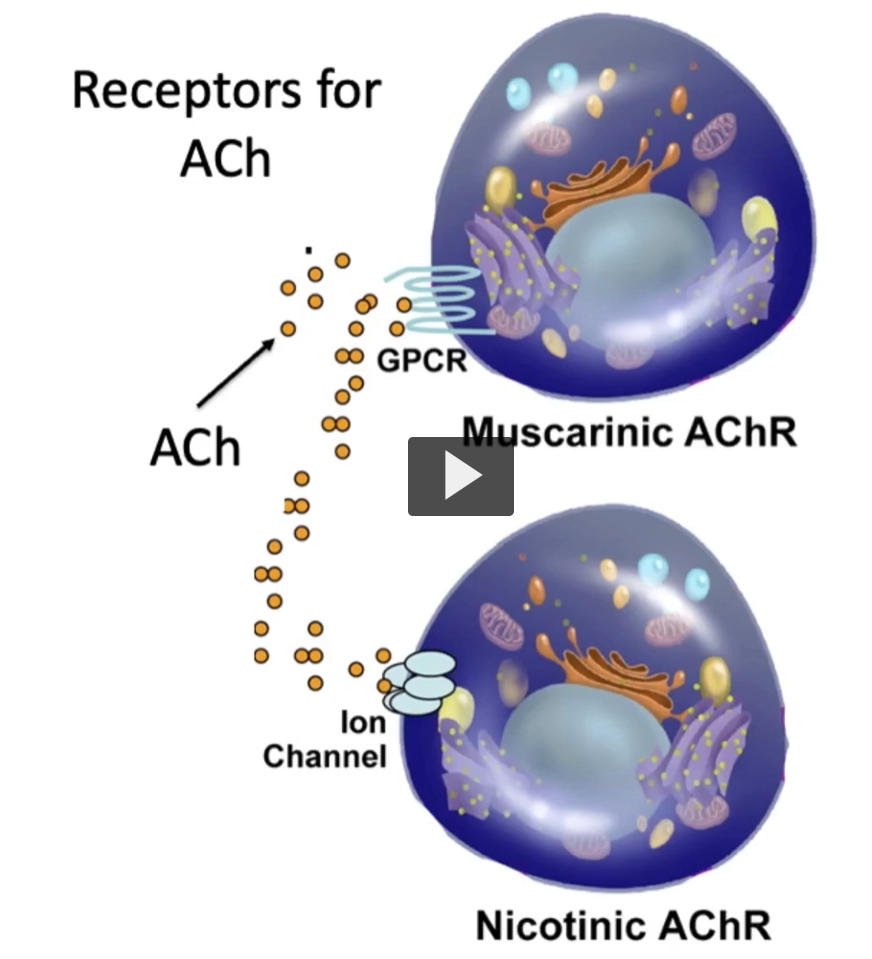
Receptors for ACh

There are two main acetyl-choline receptor types.

  1. muscarinic acetyl-choline receptors, which are metabotropic and G-protein. The muscarinic acetyl-choline receptors mediate para-sympathetic effects.

-muscarine does NOT mean muscle, it means muscarine (a mushroom)

  1. On the other hand, there are Nicotinic acetyl-choline receptors, which are ionotropic, regulating ion channels, facilitating skeletal muscle contraction.

Both muscarinic and nicotinic acetyl-choline receptors play roles in the autonomic and central nervous system function.

Scientists named receptor types based on which plant toxins activated them:

  • Muscarinic → muscarine (mushroom)

  • Nicotinic → nicotine (tobacco)

<p><u>Receptors for ACh</u></p><p>There are<strong> two</strong> <strong>main</strong> <strong>acetyl-choline receptor types</strong>. </p><ol><li><p><strong>muscarinic acetyl-choline receptors</strong>, which are <strong>metabotropic</strong> and <strong>G-protein</strong>. The <strong>muscarinic acetyl-choline receptors mediate para-sympathetic effects. </strong></p></li></ol><p>-muscarine does NOT mean muscle, it means muscarine (a mushroom)</p><ol start="2"><li><p>On the other hand, there are <strong>Nicotinic acetyl-choline receptors</strong>, which are <strong>ionotropic</strong>, <strong>regulating ion channels</strong>, <strong>facilitating skeletal muscle contraction. </strong></p></li></ol><p>Both muscarinic and nicotinic acetyl-choline receptors play roles in the autonomic and central nervous system function. </p><p>Scientists named receptor types based on <strong>which plant toxins activated them</strong>:</p><ul><li><p><strong>Muscarinic → muscarine (mushroom)</strong></p></li><li><p><strong>Nicotinic → nicotine (tobacco)</strong></p></li></ul><p></p>
18
New cards
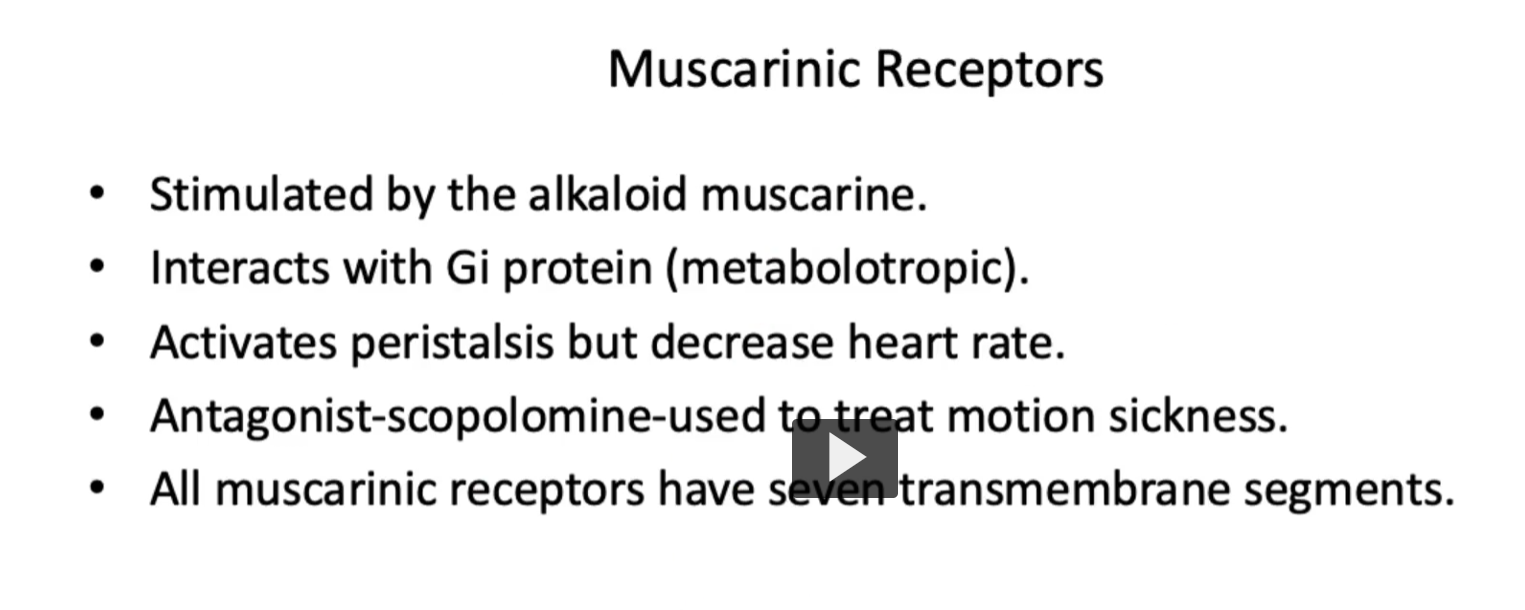
<p><u>Muscarinic Receptors</u></p><ul><li><p><strong>Stimulated</strong> by the <strong>alkaloid muscarine</strong> and mediate <strong>slower, more modulatory effects </strong>via <strong>G protein</strong>. </p></li><li><p>Interacts with Gi protein (metabotropic).</p></li><li><p>Activates peristalsis but decrease heart rate. (parasympathetic)</p></li><li><p>Antagonist-scopolomine-used to treat motion sickness.<strong>Scopol-”</strong> → from the plant genus <em>Scopolia</em></p></li></ul><p><strong>“-amine”</strong> → indicates a nitrogen-containing compound (alkaloid)</p><p>So <strong>scopolamine</strong> = <em>an amine derived from Scopolia plants</em></p><p>Mechanism </p><ul><li><p><strong>Muscarinic receptor antagonist</strong></p></li><li><p>Blocks <strong>acetylcholine (ACh)</strong> at <strong>muscarinic receptors</strong></p></li></ul><p>Clinical use of scopolomine</p><p><strong>Motion sickness </strong></p><p>Prevents nausea/vomiting by: Blocking signals from inner ear → brain</p><ul><li><p>It is important to remember that<strong> All muscarinic receptors</strong> have <strong>seven transmembrane segments. </strong></p></li></ul><p>why seven transmembrane segments? Because <strong>all muscarinic receptors are G-protein–coupled receptors (GPCRs)</strong>—and GPCRs are built with a very specific architecture: Muscarinic receptors (M1–M5) belong to the <strong>GPCR family</strong></p><ul><li><p><strong>All GPCRs have 7 transmembrane α-helices</strong><br>That’s a defining structural feature of the entire receptor class. </p></li></ul><p></p>

Muscarinic Receptors

  • Stimulated by the alkaloid muscarine and mediate slower, more modulatory effects via G protein.

  • Interacts with Gi protein (metabotropic).

  • Activates peristalsis but decrease heart rate. (parasympathetic)

  • Antagonist-scopolomine-used to treat motion sickness.Scopol-” → from the plant genus Scopolia

“-amine” → indicates a nitrogen-containing compound (alkaloid)

So scopolamine = an amine derived from Scopolia plants

Mechanism

  • Muscarinic receptor antagonist

  • Blocks acetylcholine (ACh) at muscarinic receptors

Clinical use of scopolomine

Motion sickness

Prevents nausea/vomiting by: Blocking signals from inner ear → brain

  • It is important to remember that All muscarinic receptors have seven transmembrane segments.

why seven transmembrane segments? Because all muscarinic receptors are G-protein–coupled receptors (GPCRs)—and GPCRs are built with a very specific architecture: Muscarinic receptors (M1–M5) belong to the GPCR family

  • All GPCRs have 7 transmembrane α-helices
    That’s a defining structural feature of the entire receptor class.

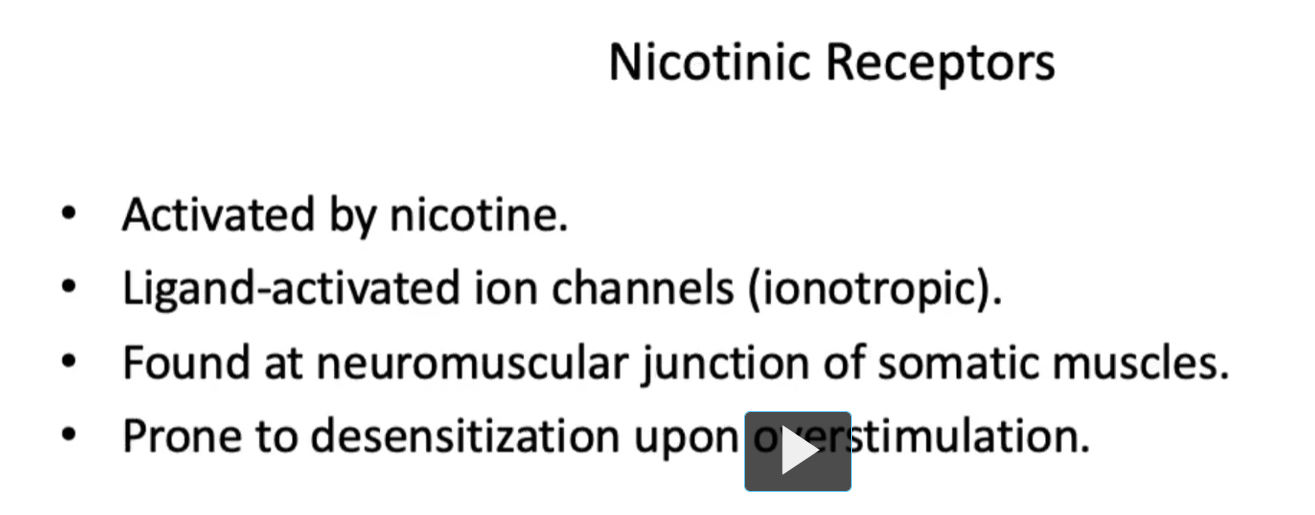
Nicotinic Receptors

  • nicotinic receptors are activated by nicotine.

  • Ligand-activated ion channels (ionotropic).

  • Found at neuromuscular junction of somatic muscles.

  • Prone to desensitization upon overstimulation.

If nicotinic receptors are stimulated continuously or too strongly, they stop responding, even though the ligand (ACh or nicotine) is still present.

But people who smoke don’t get paralysis because

1. Dose and duration are very different

  • Paralysis (like with succinylcholine) happens when receptors are:

    • continuously flooded with agonist

    • at high concentrations

  • Smoking delivers lower, intermittent doses of nicotine
    Not enough to keep receptors constantly activated
<p><u>Nicotinic Receptors</u></p><ul><li><p>nicotinic receptors are activated by nicotine.</p></li><li><p>Ligand-activated ion channels (ionotropic).</p></li><li><p>Found at neuromuscular junction of somatic muscles.</p></li><li><p>Prone to desensitization upon overstimulation.</p></li></ul><p>If <strong>nicotinic receptors are stimulated continuously or too strongly</strong>, they <strong>stop responding</strong>, even though the<strong> ligand (ACh or nicotine)</strong> is <strong>still present.</strong></p><p>But people who smoke don’t get paralysis because </p><p>1<strong>. Dose</strong> and<strong> duration</strong> are <strong>very different </strong></p><ul><li><p><strong>Paralysis (like with succinylcholine)</strong> happens when<strong> receptors</strong> are:</p><ul><li><p><strong><u>continuously</u> flooded</strong> with<strong> agonist</strong></p></li><li><p>at <strong>high concentrations</strong></p></li></ul></li><li><p>Smoking delivers <strong>lower, intermittent doses</strong> of nicotine<br>Not enough to keep receptors constantly activated</p></li></ul><p></p>
19
New cards
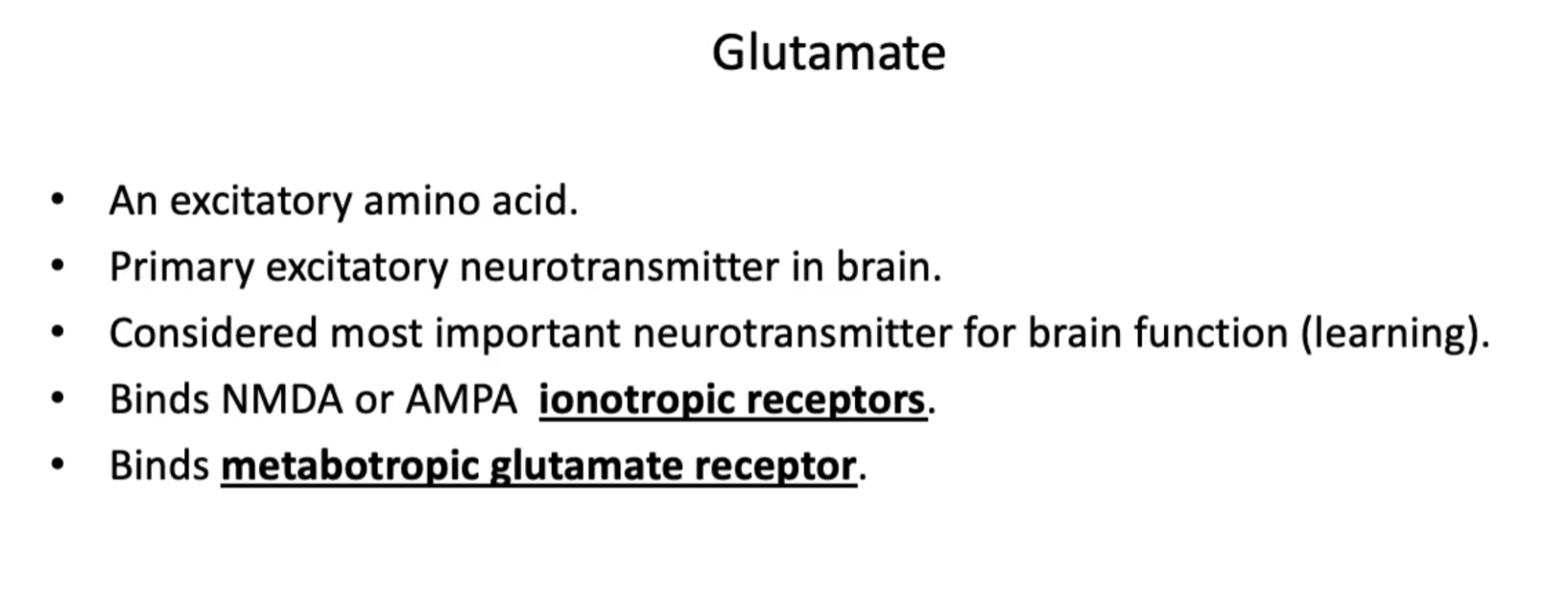
<p><u>Glutamate</u></p><ul><li><p>An excitatory amino acid.</p></li><li><p>Primary excitatory neurotransmitter in brain.</p></li><li><p>Considered most important neurotransmitter for brain function (learning).</p></li><li><p>Binds NMDA or AMPA <em>ionotropic receptors</em>.</p></li><li><p>Binds <em>metabotropic glutamate receptor</em>.</p></li><li><p>Glutamate plays an <strong>essential role</strong> in <strong>synaptic plasticity</strong> and this regulation is <strong>associated</strong> with <strong>excitotoxicity</strong> and in some cases, <strong>neurodegeneration</strong>.</p></li></ul><p></p>

Glutamate

  • An excitatory amino acid.

  • Primary excitatory neurotransmitter in brain.

  • Considered most important neurotransmitter for brain function (learning).

  • Binds NMDA or AMPA ionotropic receptors.

  • Binds metabotropic glutamate receptor.

  • Glutamate plays an essential role in synaptic plasticity and this regulation is associated with excitotoxicity and in some cases, neurodegeneration.

NMDA receptor

NMDA = N-methyl-D-aspartate

A methyl group attached to nitrogen

“aspartate” = an amino acid (from asparagus, where it was first isolated)

“D” = specific stereoisomer (mirror-image form)

What is the NMDA receptor?

  • A type of glutamate receptor

  • Specifically an ionotropic receptor (ligand-gated ion channel)

Unique features (high-yield)

  1. Requires 2 ligands

    • Glutamate + glycine (co-agonist)

  2. Voltage-dependent

    • At rest → blocked by Mg²⁺

    • Needs depolarization to remove Mg²⁺ block

  3. Lets Ca²⁺ in

    • Also Na⁺ in, K⁺ out

    • Calcium entry = key for learning

Why it matters

  • Central to long-term potentiation (LTP)
    → basis of learning and memory

Clinical relevance

  • Overactivation → excitotoxicity (neuronal damage)

  • Involved in:

    • Stroke

    • Neurodegeneration

20
New cards

AMPA Receptor

AMPA = α-amino-3-hydroxy-5-methyl-4-isoxazolepropionic acid

Like NMDA, this is a synthetic agonist used to define the receptor.

What is the AMPA receptor?

  • A glutamate receptor

  • Specifically an ionotropic (ligand-gated ion channel)

What does it do?

When glutamate binds:

  • Channel opens immediately

  • Na⁺ flows in (mainly)

  • Some K⁺ flows out

Result = rapid depolarization (fast excitatory signal)

Key features (high-yield)

  • Fastest excitatory transmission in the brain

  • Responsible for EPSPs (excitatory postsynaptic potentials)

  • Does NOT require depolarization to activate (unlike NMDA)

  • Usually no Mg²⁺ block

  • Limited Ca²⁺ permeability (unless modified subunits

AMPA Relationship to NMDA (important!)

Think of them as a team:

  • AMPA fires first → depolarizes the cell

  • This removes Mg²⁺ block from NMDA

  • Then NMDA opens → Ca²⁺ enters → learning (LTP)

21
New cards

“glutamate binds metabotropic glutamate receptor.”

“Binds metabotropic glutamate receptor” — what does that mean?

It means glutamate can activate receptors that are NOT ion channels, but instead work through G-proteins and signaling pathways.

What are metabotropic glutamate receptors (mGluRs)?

  • Metabotropic = “changing metabolism”

  • These are G-protein–coupled receptors (GPCRs)

  • Unlike AMPA/NMDA, they do NOT directly let ions flow

How they work

  1. Glutamate binds the receptor

  2. The receptor activates a G protein

  3. This triggers second messengers inside the cell (like cAMP, IP₃, DAG)

  4. These signals:

    • Open/close ion channels indirectly

    • Change enzyme activity

    • Modify gene expression

Effects are slower but longer-lasting

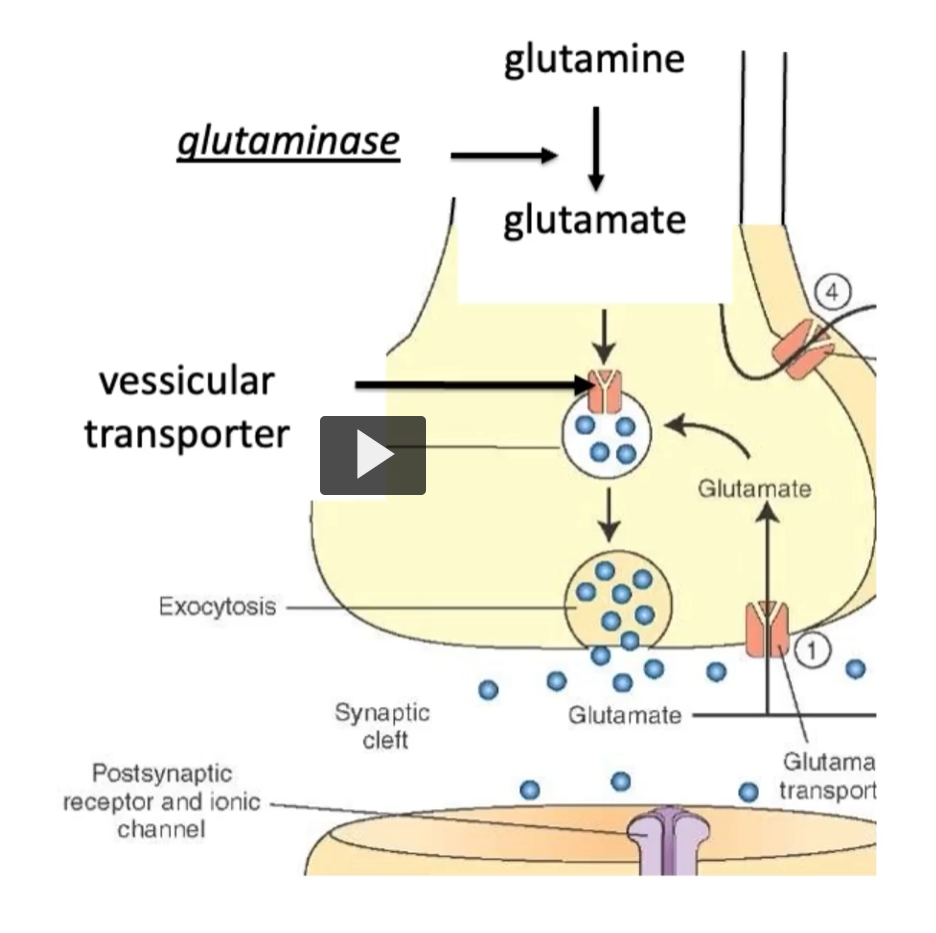
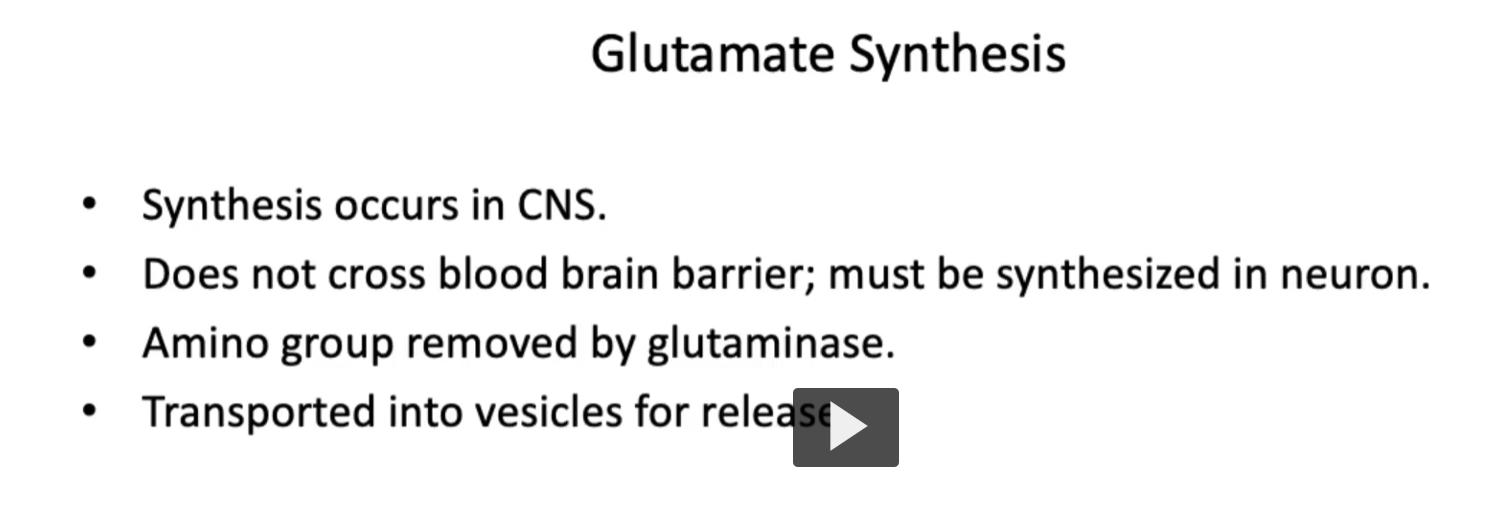
Glutamate Synthesis

Glutamate is synthesized in neurons from glutamine via the enzyme glutaminASE.

GlutMINEASE removes an amine from glutamine to get glutamate.

  • Glutamate synthesis occurs in CNS.

  • Because glutamate cannot cross blood brain barrier; glutamate must be synthesized in neuron. (glutamate has COO- and NH3+ positive charges, at physiological pH, it exists as a polar, charged molecule, and therefore charged molecules CANNOT diffuse through the lipid membrane of the BBB)

  • Amino group removed by glutaminase.

  • Glutamate is stored in synaptic vesicles and released upon depolarization.

  • Transported into vesicles for release.
<p><u>Glutamate Synthesis</u></p><p><strong>Gluta<u>mate</u></strong> is <strong>synthesized</strong> in <strong>neurons</strong> from <strong>gluta<u>mine</u></strong> via the enzyme <strong>glutaminASE. </strong></p><p>GlutMINEASE removes an amine from glutamine to get glutamate. </p><ul><li><p>Glutamate synthesis occurs in CNS.</p></li><li><p>Because glutamate cannot cross blood brain barrier; glutamate must be synthesized in neuron. (glutamate has COO- and NH3+ positive charges, at physiological pH, it exists as a <strong>polar, charged molecule</strong>, and therefore <strong>charged molecules</strong> CANNOT diffuse through the <strong>lipid membrane</strong> of the BBB)</p></li></ul><ul><li><p>Amino group removed by glutaminase.</p></li><li><p>Glutamate is stored in synaptic vesicles and released upon depolarization. </p></li><li><p>Transported into vesicles for release.</p></li></ul><p></p>
22
New cards
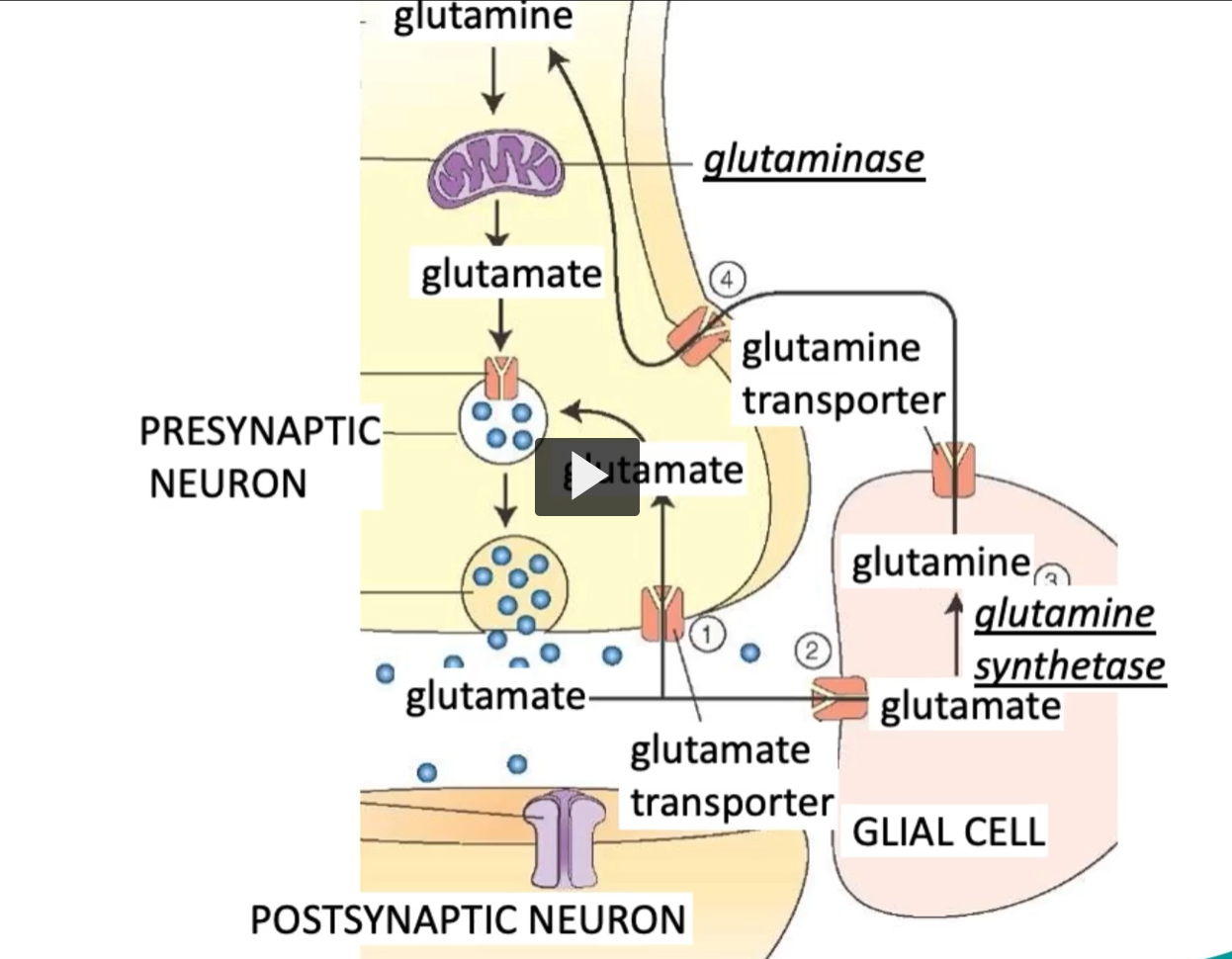
<p><u>Glutamate</u></p><p><strong>Excess glutamate</strong> <strong>must</strong> <strong>be rapidly cleared </strong></p><p><strong>Glial cells absorb glutamate</strong> <strong>via transporters</strong> and <strong>convert it back to glutaMINE</strong>, which is then <strong>recycled back to neurons</strong>. </p><p>In pair, <strong>glutamate clearance</strong> is <strong>implicated</strong> in <strong>diseases</strong> like<strong> ALS</strong> and <strong>Alzheimer’s disease</strong>.  </p><p>In this picture, we can see the <strong>process of glutamine synthesis</strong> and <strong>clearance. </strong></p>

Glutamate

Excess glutamate must be rapidly cleared

Glial cells absorb glutamate via transporters and convert it back to glutaMINE, which is then recycled back to neurons.

In pair, glutamate clearance is implicated in diseases like ALS and Alzheimer’s disease.

In this picture, we can see the process of glutamine synthesis and clearance.

ALS — Amyotrophic Lateral Sclerosis

Etymology (helps you remember)

  • A- = without

  • Myo- = muscle

  • -trophic = nourishment

  • “Amyotrophic” = muscle wasting

  • Lateral = sides of the spinal cord

  • Sclerosis = hardening/scarring

“ALS” = degeneration (hardening) of lateral spinal cord pathways → muscle wasting

What it is

  • A neurodegenerative disease

  • Affects:

    • Upper motor neurons (UMN) → brain

    • Lower motor neurons (LMN) → spinal cord

What happens: Motor neurons die → muscles lose innervation → progressive weakness and atrophy.

Why glutamate matters (connect to your slide)

  • ALS is associated with excess glutamate → excitotoxicity

  • Too much stimulationCa²⁺ influx → neuron death

23
New cards

Alzheimer’s disease (AD)

Etymology

  • Named after Alois Alzheimer, who first described it (1906)

What it is

  • A progressive neurodegenerative disorder

  • Most common cause of dementia

  • Primarily affects:

    • Hippocampus → memory

    • Cerebral cortex → thinking, behavior

Core pathology (high-yield)

  1. Amyloid-β plaques (extracellular)

    • Derived from APP (amyloid precursor protein)

    • “Sticky” deposits between neurons

  2. Neurofibrillary tangles (intracellular)

    • Made of hyperphosphorylated tau protein

    • Disrupt microtubules

  3. Loss of cholinergic neurons

    • Especially in basal nucleus of Meynert

    • ↓ acetylcholine → memory impairment

Neurotransmitter changes

  • acetylcholine (major)

  • ↑ glutamate toxicity (excitotoxicity contributes to damage)

Glutamate removal/recycling

  • Excess glutamate is neurotoxic.

  • glutamate is rapidly removed by action of glutamate transporters on neurons and glia.

  • In glia, glutamate is converted to glutamine and recycled back into neurons.
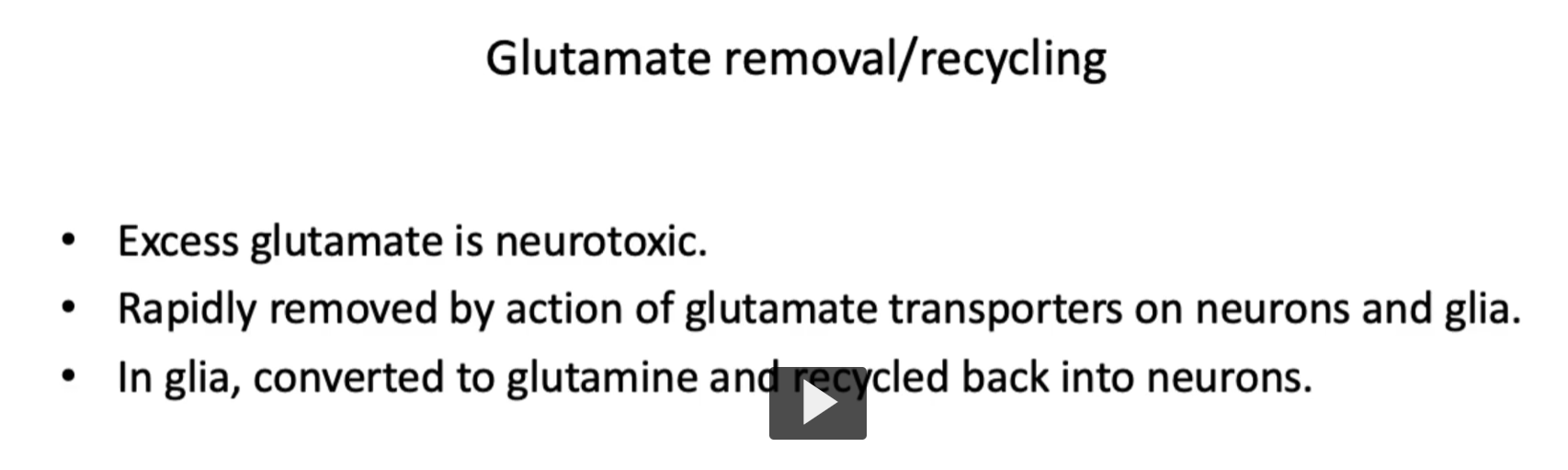
<p><u>Glutamate removal/recycling</u></p><ul><li><p><strong>Excess glutamate</strong> <strong>is neurotoxic</strong>.</p></li><li><p><strong>glutamate is rapidly removed by action of glutamate transporters</strong> <strong>on</strong> <strong>neurons</strong> and<strong> glia</strong>.</p></li><li><p><strong>In glia</strong>, <strong>glutamate</strong> <strong>is converted</strong> <strong>to glutamine</strong> and<strong> recycled back into neurons.</strong></p></li></ul><p></p>
24
New cards
<p>GlutaMINase: converts glutaMINE to glutaMATE</p><p>Glutamine Synthase: synthesizes glutamine</p>

GlutaMINase: converts glutaMINE to glutaMATE

Glutamine Synthase: synthesizes glutamine

GABA and Glycine

On the other hand, there is GABA and Glycine, which are the main inhibitory neurotransmitters.

  • Main inhibitory neurotransmitters.

  • GABA is derived by decarboxylation of glutamate.

  • Two types of GABA receptors are GABAₐ and GABAᵦ.

  • GABA effects on GABAₐ receptors are allosterically increased by diazepam and barbiturates.

  • GABAₐ is a ionotropic ligand gated chloride channel.

  • GABAᵦ is a metabotropic receptor.

Glycine

Glycine plays a role in inhibiting signaling, Glycine is especially important in reflex pathways and spinal inhibition.
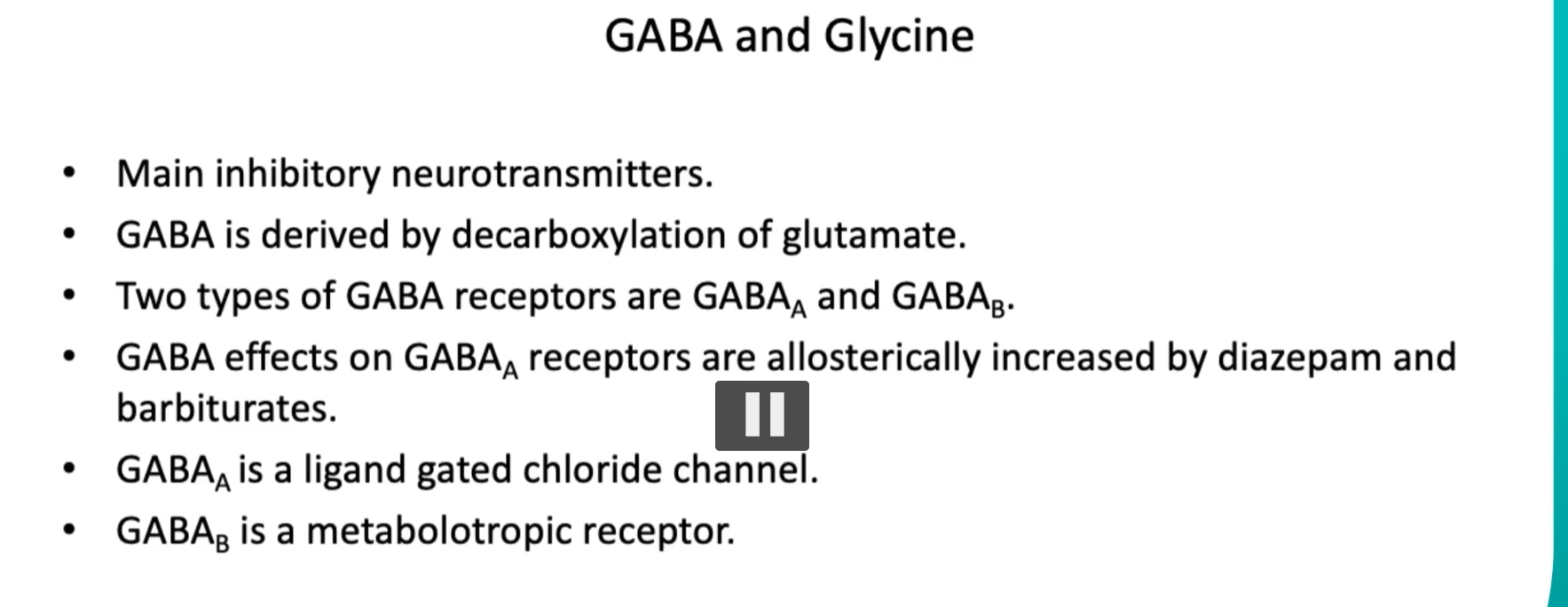
<p><u>GABA and Glycine</u></p><p>On the other hand, there is<strong> GABA</strong> and <strong>Glycine</strong>, which are the <strong>main inhibitory neurotransmitters</strong>.</p><ul><li><p>Main inhibitory neurotransmitters.</p></li><li><p><strong>GABA</strong> is <strong>derived</strong> by <strong><u>decarboxylation</u></strong> of <strong>glutamate</strong>.</p></li><li><p><strong>Two types of</strong> <strong>GABA receptors</strong> are <strong>GABAₐ</strong> and <strong>GABAᵦ</strong>.</p></li><li><p>GABA effects on GABAₐ receptors are allosterically increased by <strong>diazepam</strong> and <strong>barbiturates.</strong></p></li><li><p>GABAₐ is a <strong>ionotropic ligand gated chloride channe</strong>l.</p></li><li><p>GABAᵦ is a <strong>metabotropic receptor. </strong></p></li></ul><p><u>Glycine</u></p><p><strong>Glycine</strong> plays a role in <strong>inhibiting signaling</strong>, Glycine is especially important in reflex pathways and spinal inhibition.</p><p></p>
25
New cards

GABAₐ receptor

What it is

  • A GABA receptor subtype

  • Ionotropic (ligand-gated ion channel)

Mechanism

  • GABA binds → channel opens → Cl⁻ (chloride) enters the cell

  • This makes the inside more negative (hyperpolarization)

Result: inhibition (neuron less likely to fire)

Key features (high-yield)

  • Fast inhibitory signaling

  • Located throughout the brain (CNS)

  • Opposes excitatory neurotransmitters like glutamate

Pharmacology

GABAₐ receptors are enhanced by:

  • Benzodiazepines (e.g., Diazepam)

    • frequency of Cl⁻ channel opening

  • Barbiturates

    • duration of Cl⁻ channel opening

  • Alcohol

    • Also enhances GABAₐ activity

All lead to sedation, anxiolysis, anticonvulsant effects

GABAᵦ receptors

What it is:

  • A GABA receptor subtype

  • Metabotropic (G-protein–coupled receptor, GPCR)

Mechanism

  • Couples to Gi protein

  • Effects:

    • cAMP

    • Opens K⁺ channels → K⁺ leaves cell → hyperpolarization

    • Closes Ca²⁺ channels → ↓ neurotransmitter release

Result: slow, prolonged inhibition

Key features (high-yield)

  • Slower than GABAₐ

  • Produces long-lasting inhibitory effects

  • Often:

    • Postsynaptic → hyperpolarization (via K⁺)

    • Presynaptic → ↓ neurotransmitter release (via Ca²⁺ inhibition)
26
New cards
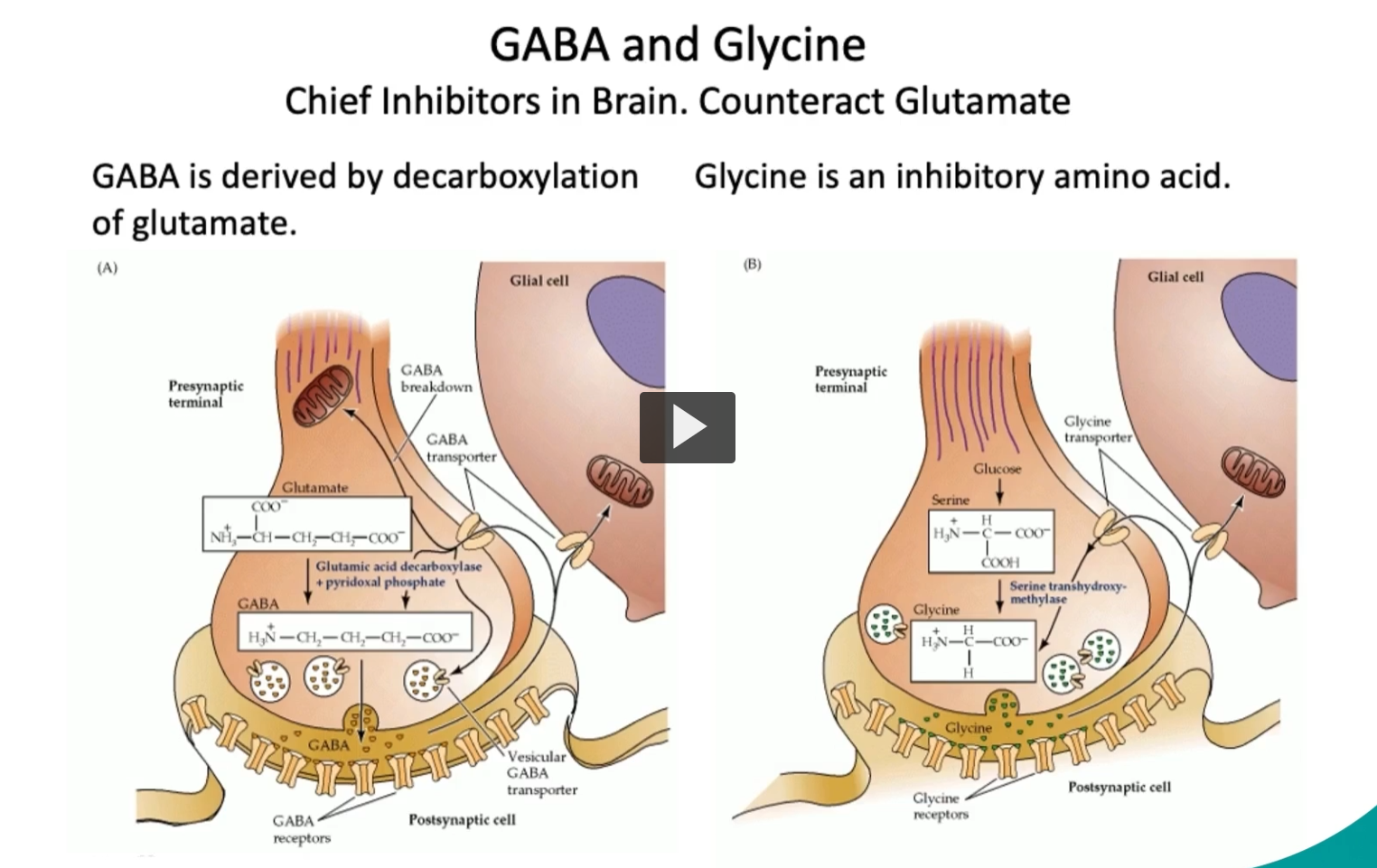
<p><u>GABA and Glycine</u><br><u>Chief Inhibitors in Brain.</u> <u>Counteract Glutamate</u></p><p>In this slide, we can see both GABA and Glycine, which are the chief inhibitors in the brain, and they counteract glutamate activity.</p><ul><li><p>On the left, we can see that <strong>GABA</strong> is <strong>derived by decarboxylation</strong> of <strong>glutamate.</strong></p></li><li><p>On the right, we can see that<strong> Glycine</strong> is an<strong> inhibitory amino acid</strong>, important in<strong> reflex pathways and spinal inhibition.</strong></p></li></ul><p></p>

GABA and Glycine
Chief Inhibitors in Brain. Counteract Glutamate

In this slide, we can see both GABA and Glycine, which are the chief inhibitors in the brain, and they counteract glutamate activity.

  • On the left, we can see that GABA is derived by decarboxylation of glutamate.

  • On the right, we can see that Glycine is an inhibitory amino acid, important in reflex pathways and spinal inhibition.

Opioid Peptides

  • “Opium” → from Greek opion = juice of the poppy

  • “-oid” = “resembling”

Opioid = “opium-like substance”

  • Opioid peptides are endogenous, short peptides that bind to opioid receptors.

  • Opioids play important roles in motivation, pain, stress, food intake, reward system.

  • Opioids are derived from 3 homologous genes (All endogenous opioid peptides come from 3 precursor proteins (genes) that are later cut into smaller active peptides)

    • Proopiomelanocortin (POMC), POMC is cleaved to produce the beta-endorphins.

    • Enkephalins (Derived from proenkephalin, produce Met-enkephalin, Leu-enkephalin, function: Modulate pain (especially in spinal cord)

    • Dynorphins (Derived from prodynorphin, produce Dynorphin A, B, Function:

      • Act mainly on κ (kappa) receptors

      • Involved in pain and stress responses)

  • These peptides are produced through proteolytic cleavage of precursor proteins.
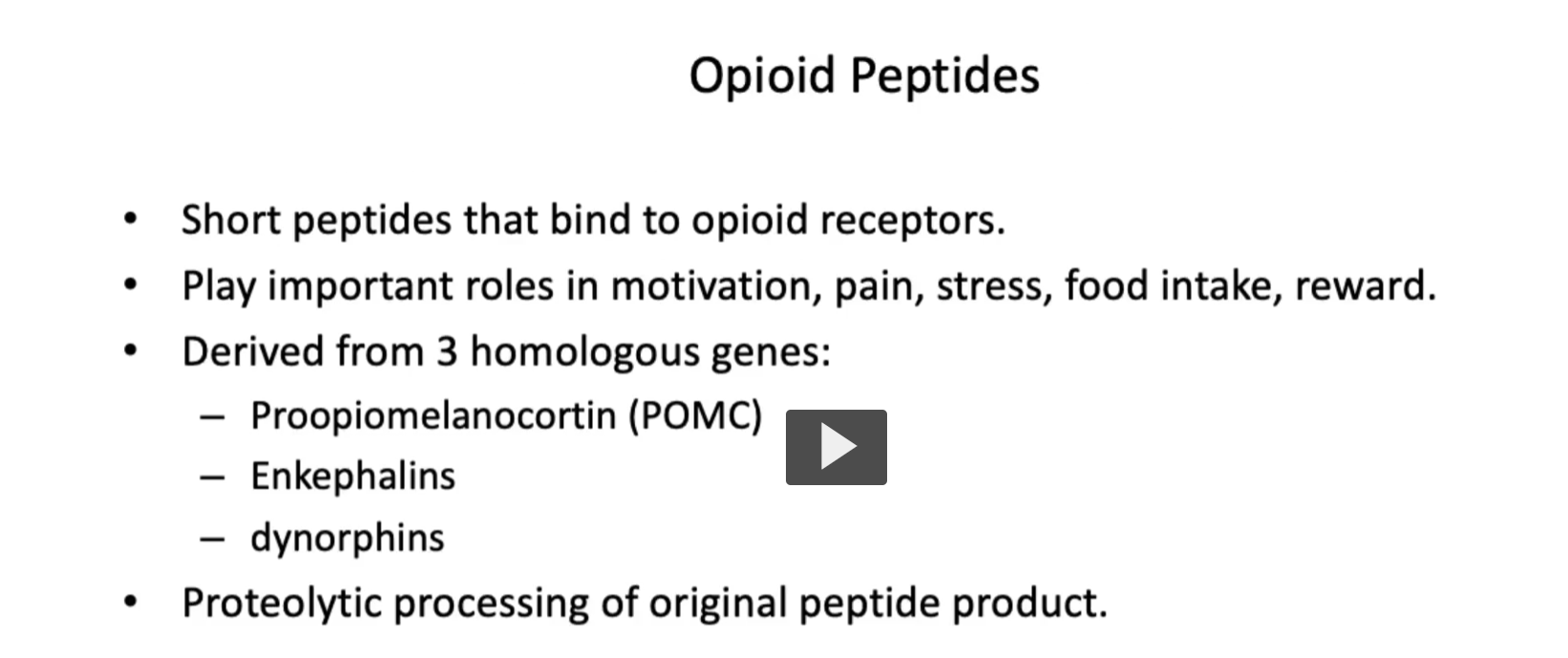
<p><u>Opioid Peptides</u></p><ul><li><p><strong>“Opium”</strong> → from Greek <em>opion</em> = juice of the poppy</p></li><li><p><strong>“-oid”</strong> = “resembling”</p></li></ul><p><strong>Opioid = “opium-like substance”</strong></p><ul><li><p><strong>Opioid peptides</strong> are<strong> endogenous</strong>, <strong>short peptides</strong> that <strong>bind</strong> to <strong>opioid receptors</strong>.</p></li><li><p><strong>Opioids</strong> play<strong> important roles</strong> in <strong>motivation</strong>, <strong>pain</strong>, <strong>stress</strong>, <strong>food intake</strong>, <strong>reward system</strong>.</p></li><li><p>Opioids are derived from 3 homologous genes (All endogenous opioid peptides come from <strong>3 precursor proteins (genes)</strong> that are later <strong>cut into smaller active peptides</strong>)</p><ul><li><p><strong>Proopiomelanocortin (POMC)</strong>, POMC is cleaved to produce the <strong>beta-endorphins.</strong></p></li><li><p><strong>Enkephalins </strong>(Derived from <strong>proenkephalin, </strong>produce <strong>Met-enkephalin</strong>, <strong>Leu-enkephali</strong>n, function: <strong>Modulate pain </strong>(especially in spinal cord)</p></li><li><p><strong>Dynorphins </strong>(Derived from <strong>prodynorphin, </strong>produce Dynorphin A, B, Function:</p><ul><li><p>Act mainly on <strong>κ (kappa) receptors</strong></p></li><li><p>Involved in <strong>pain and stress responses) </strong></p></li></ul></li></ul></li><li><p><strong>These peptides</strong> are <strong>produced through proteolytic cleavage</strong> of <strong>precursor proteins.</strong></p></li></ul><p></p>
27
New cards
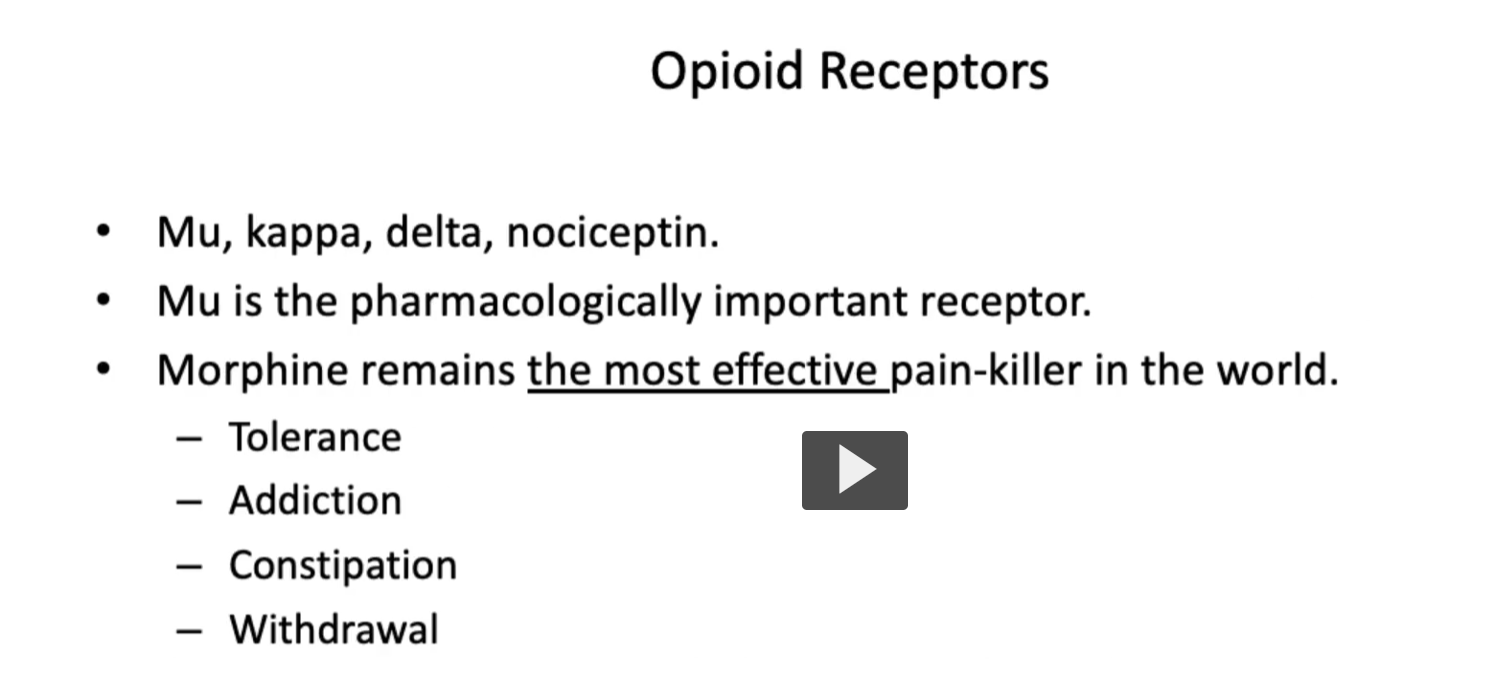
<p><u>Opioid Receptors</u></p><ul><li><p>The <strong>opioid receptors</strong> <strong>include</strong> the <strong>Mu</strong>,<strong> kappa</strong>, <strong>delta</strong>, <strong>nociceptin.</strong></p></li><li><p><strong>Mu</strong> is the <strong>pharmacologically important receptor</strong>. This is because the <strong>Mu receptor</strong> is the <strong>main pharmacological target of drugs </strong>like <strong>morphine.</strong></p></li><li><p>The <strong>activation of the Mu receptor reduces pain perception</strong></p></li><li><p><strong>Morphine</strong> remains <em>the most effective</em> pain-killer in the world.</p></li><li><p>But prolonged use can lead to:</p><ul><li><p>Tolerance</p></li><li><p>Addiction</p></li><li><p>Constipation</p></li><li><p>Withdrawal</p></li></ul></li></ul><p>Understanding receptor subtypes, can guide pain-management strategies.</p>

Opioid Receptors

  • The opioid receptors include the Mu, kappa, delta, nociceptin.

  • Mu is the pharmacologically important receptor. This is because the Mu receptor is the main pharmacological target of drugs like morphine.

  • The activation of the Mu receptor reduces pain perception

  • Morphine remains the most effective pain-killer in the world.

  • But prolonged use can lead to:

    • Tolerance

    • Addiction

    • Constipation

    • Withdrawal

Understanding receptor subtypes, can guide pain-management strategies.

Nitric Oxide

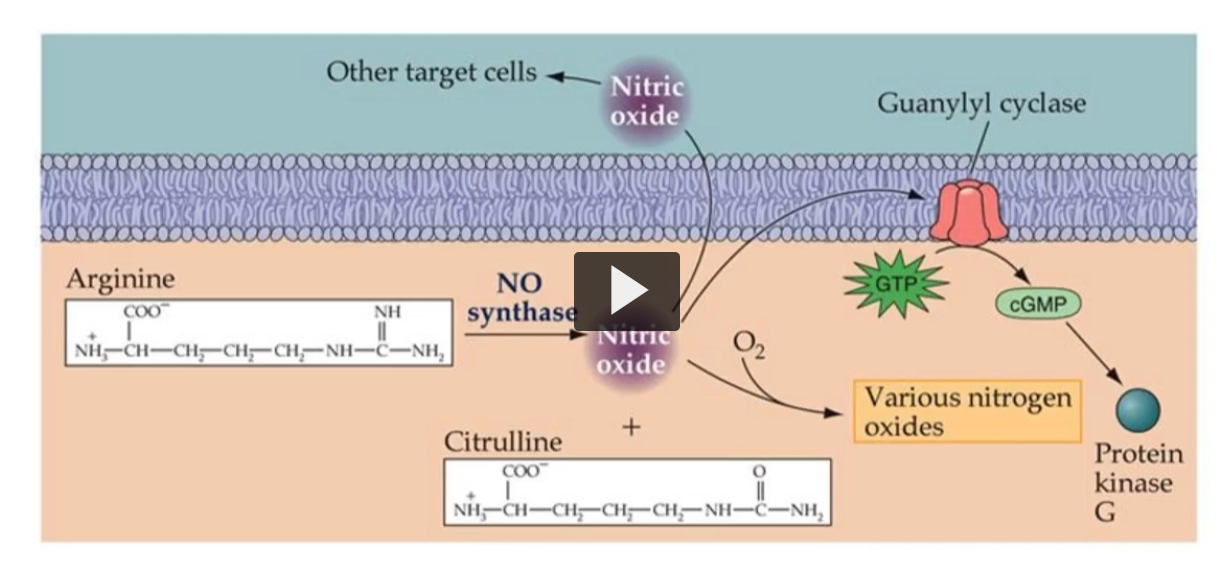
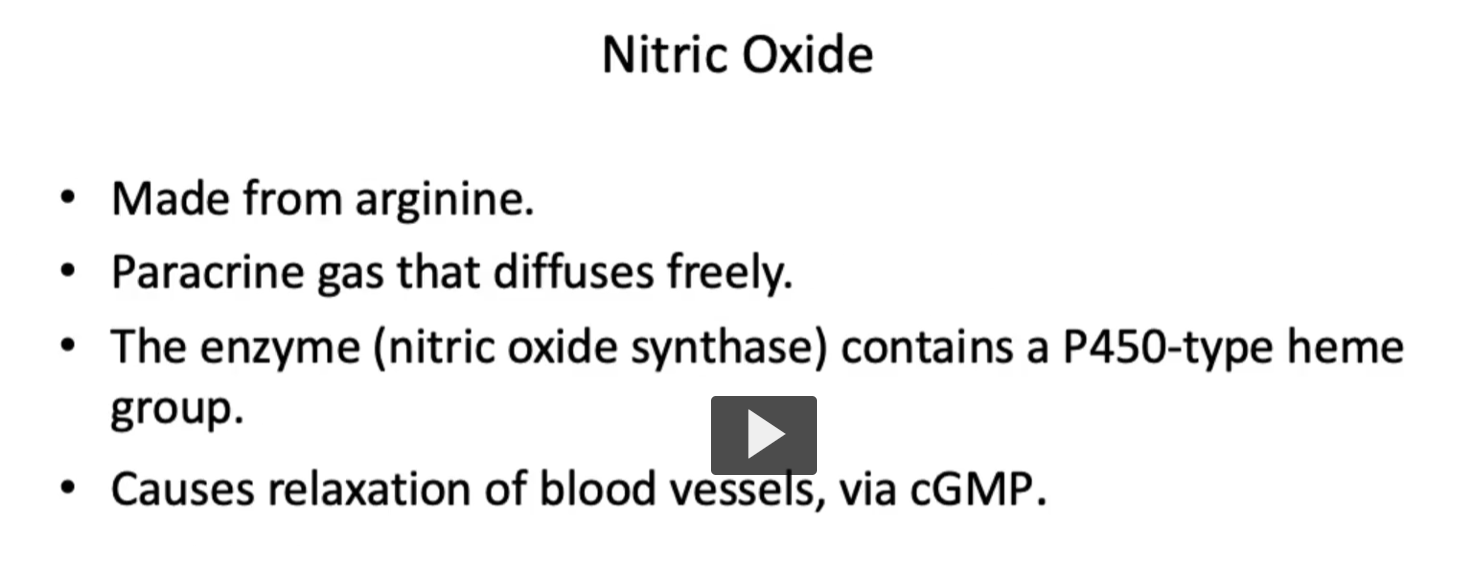
  • Nitric Oxide is a unique neurotransmitter made from arginine by the enzyme nitric oxide synthase.

  • Unlike other neurotransmitters, nitric oxide is a gas, a paracrine gas that diffuses freely.

  • The enzyme (nitric oxide synthase) contains a P450-type heme group.

  • Nitric oxide activates guanylate cyclaseincreasing cGMP → activation of Protein Kinase G, and causing smooth muscle relaxation, especially in blood vessels.

  • Causes relaxation of blood vessels, via cGMP.
<p><u>Nitric Oxide</u></p><ul><li><p><strong>Nitric Oxide</strong> is a<strong> unique neurotransmitter</strong> made from<strong> arginine</strong> by the enzyme <strong>nitric oxide synthase.</strong></p></li><li><p><strong>Unlike other neurotransmitters</strong>,<strong> nitric oxide</strong> is a <strong>gas</strong>, a <strong>paracrine gas</strong> that <strong>diffuses freely</strong>.</p></li><li><p>The enzyme (<strong>nitric oxide synthase</strong>) contains a<strong> P450-type heme group.</strong></p></li><li><p><strong>Nitric oxide activates guanylate cyclase</strong> → <strong>increasing cGMP </strong>→ activation of <strong>Protein Kinase G</strong>, and <strong>causing smooth muscle relaxation</strong>,<strong> especially in blood vessels</strong>.</p></li><li><p>Causes relaxation of blood vessels, via cGMP.</p></li></ul><p></p>
28
New cards
<p>In this figure, we can see the production and its mechanism of action on Guanylyl Cyclase. </p>

In this figure, we can see the production and its mechanism of action on Guanylyl Cyclase.

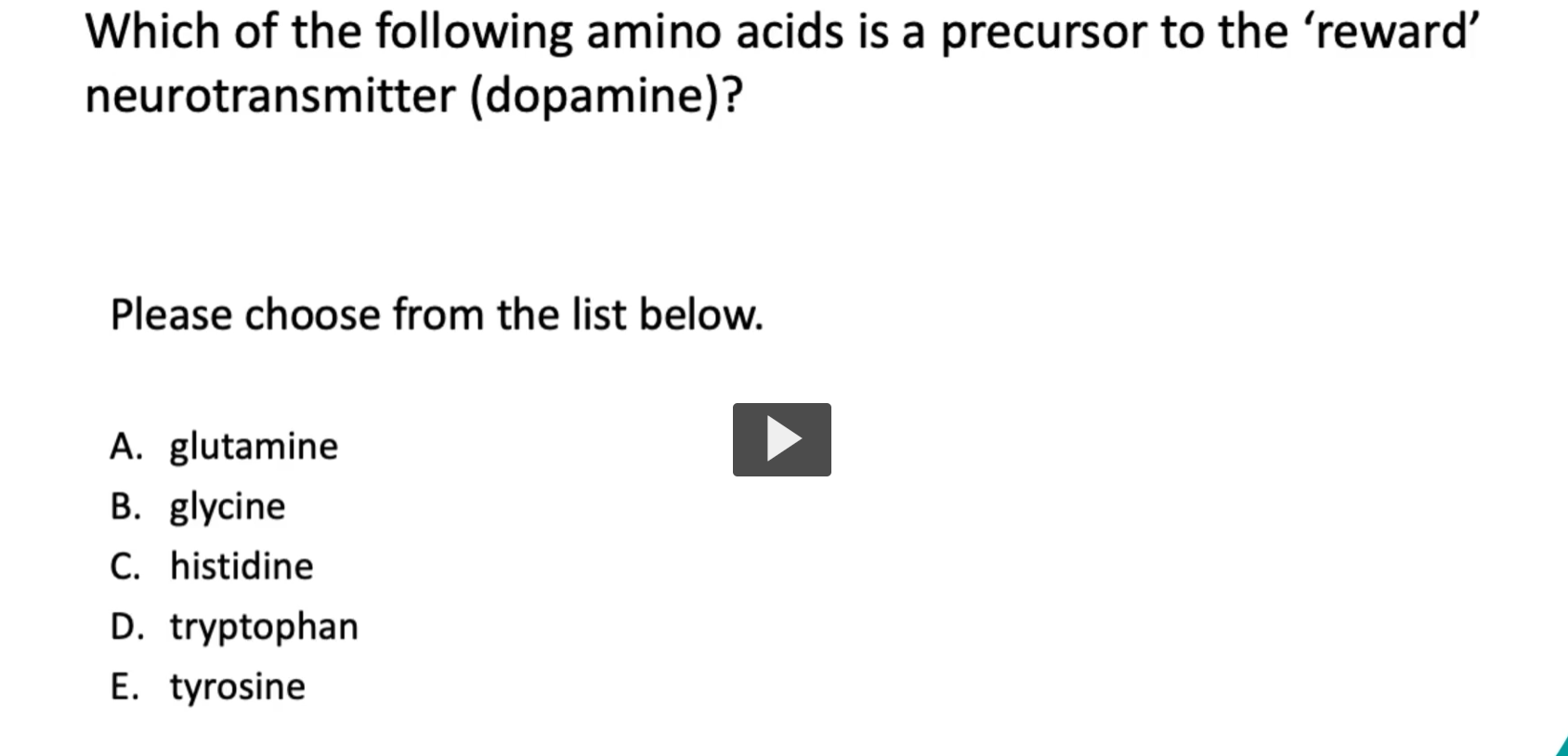
Which of the following amino acids is a precursor to the ‘reward’ neurotransmitter (dopamine)?

Please choose from the list below.

A. glutamine
B. glycine
C. histidine
D. tryptophan
E. tyrosine
<p><strong>Which of the following amino acids is a precursor to the ‘reward’ neurotransmitter (dopamine)?</strong></p><p>Please choose from the list below.</p><p>A. glutamine<br>B. glycine<br>C. histidine<br>D. tryptophan<br><strong>E. tyrosine</strong></p>