Insurance part 16
 Call Kai
 Learn
Learn Practice Test
 Spaced Repetition
 Match
Match Flashcards
 Knowt Play
1/82

There's no tags or description
Looks like no tags are added yet.
Name | Mastery | Learn | Test | Matching | Spaced | Call with Kai |
|---|
No analytics yet
Send a link to your students to track their progress
83 Terms
Business Overhead Expense
LO1: Purpose and importance of disability income insurance
Key Concepts:
Disability income insurance protects against loss of income when covered perils make it impossible to work
Often called "living death insurance" because the financial impact can be worse than death
Provides a specified income benefit for a defined period of time
Transfers potentially catastrophic financial risk to the insurer for predictable premium payments
Important Terms:
Accidental bodily injury: Unintended consequence of an action the insured takes
Morbidity: Measures the risk of becoming disabled based on personal and occupational factors
Covered perils: Accidents and illnesses that cause disability
LO2: differentiate between various definitinos of disability used in insurance policies
Total Disability Definitions:
Own occupation: Cannot perform material and substantial duties of insured's own occupation
Any occupation: Cannot perform duties of own occupation or any occupation for which reasonably suited by education, training, or experience
Substantial gainful activity (SGA): Social Security definition requiring the inability to engage in any substantial gainful work
Other Disability Definitions:
Partial disability: Inability to perform one or more key duties or inability to work full-time
Residual disability: Working less than full-time with income loss of at least 20%
Presumptive disability: Specific severe conditions like loss of limbs, sight, hearing, or speech
Concurrent disability: Multiple events causing the same disability period
Delayed disability: Total disability developing after an accident
Confined disability: Requires the insured to remain indoors
LO3: Identify how individuals qulaify for disability benefits under different policy types
Qualifying Requirements:
Must be under a physician's care
Must meet the policy's definition of disability
Must satisfy the elimination (waiting) period
Must have loss of income (presumed or actual)
Recurrent Disability:
Relapse within six months is considered a continuation of initial disability
No new elimination period needed
No new benefit period begins
Relapse after six months is treated as a new claim
At-Work Benefits:
Partial disability: 50% of the total disability benefit
Residual disability: Percentage of total disability benefit based on income loss
LO4: Compare government disability programs with private disability insurance options
Government Programs:
Social Security Disability Insurance (SSDI):
Requires sufficient FICA tax payments (40 quarters for permanent status)
Uses the substantial gainful activity definition
Has a five-month waiting period
Benefit equals 100% of primary insurance amount (PIA)
Workers' Compensation:
Covers work-related accidents or occupational diseases
Provides medical, disability, and survivor benefits
Classifies disabilities as temporary or permanent
Primary coverage for work-related disability
Private Insurance Advantages:
More flexible definitions of disability
Shorter elimination periods
Higher benefit amounts
Customizable with riders
Coverage for both occupational and non-occupational disabilities
LO5: Distinguish between individual and group disability income insurance features
Individual Disability Insurance:
Occupational contract providing 24/7 coverage
Uses a flat amount approach for benefits
Typically limits coverage to 60% of gross income or 80% of net income
Features a probationary period at policy inception
Offers non-cancelable or guaranteed renewable options
Underwritten based on occupation and personal characteristics
Group Disability Insurance:
Often non-occupational coverage
Uses percentage-of-earnings approach
Coordinates benefits with other sources
No probationary period once coverage begins
Requires minimum participation to avoid adverse selection
Premiums based on the group's aggregate risk level
Short-Term vs. Long-Term Disability:
Short-term disability:
Weekly benefit payments
Minimal waiting periods
Maximum benefit period of two years
Often pays benefits for up to 180 days
Long-term disability:
Monthly benefit payments
Longer elimination periods
Benefit periods range from two years to age 65
Addresses more serious injuries or illnesses
LO6: analyze business applications of disability insurance
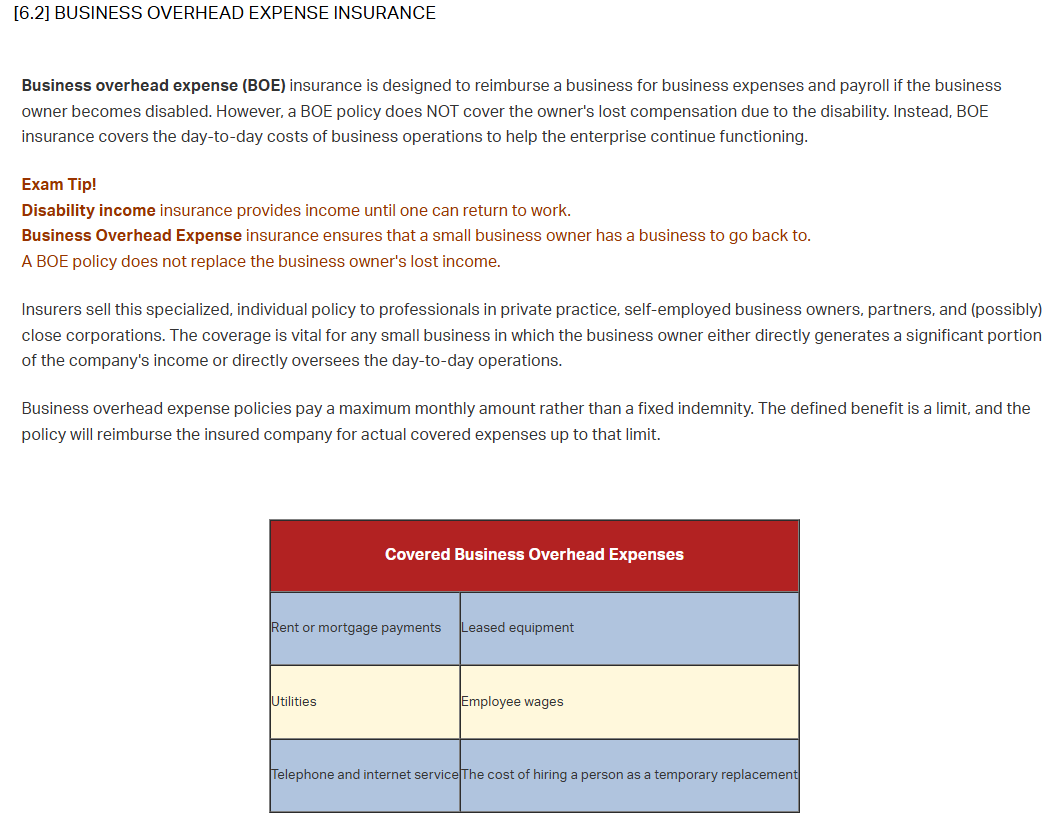
Business Overhead Expense (BOE) Insurance:
Reimburses business expenses if the owner becomes disabled
Does NOT cover the owner's lost compensation
Covers rent, utilities, employee wages, and equipment leases
Pays the actual expenses up to the maximum monthly amount
Vital for small businesses where the owner generates significant income
Disability Buy-Out Policies:
Fund disability buy-sell agreements
Allow remaining owners to buy the disabled partner's share
Available as cross-purchase or entity plans
Often have lengthy elimination periods (up to two years)
May offer lump-sum or periodic payment options
Key Person Disability Insurance:
Indemnifies the business for the loss of services of an essential person
Covers expenses for additional help or outside services
Benefit based on the key person's economic value to the business
Typically has a 30-90 day elimination period
The benefit period is usually one to two years
LO7: How disability insurance benefits are taxed based on premium payment sources
Taxation Principle:
IRS generally taxes money only once (either premiums or benefits)
Individual Disability Insurance:
Premiums are not tax-deductible (paid with after-tax dollars)
Benefits not taxable (premiums already taxed)
Group Disability Insurance:
Employer-paid premiums:
Tax-deductible business expense for the employer
Benefits are fully taxable to the employee
Employee-paid premiums:
Pre-tax contributions: Benefits are fully taxable
After-tax contributions: Benefits are tax-free
Shared premium payments:
Portion paid by employer: Benefits taxable
Portion paid by employee after-tax: Benefits are tax-free
Government Disability Benefits:
SSDI: Partially taxable if income exceeds threshold
Workers' compensation: Generally, not taxable
Exam Tips:
Exam Tips:
Know the differences between disability definitions
Understand the elimination period vs. the probationary period
Remember that individual policies are occupational, while group policies are often non-occupational
Know that disability benefits can never exceed pre-disability income
Understand the taxation principle: money is taxed only once
Remember the key differences between business disability products
Disability Income Policy Question
Non-occupational disability coverage
Waiting period for lowest premium
Own occupation disability income insurance
Elimination Period
Guarenteed insurability Rider
Elimination Period 2
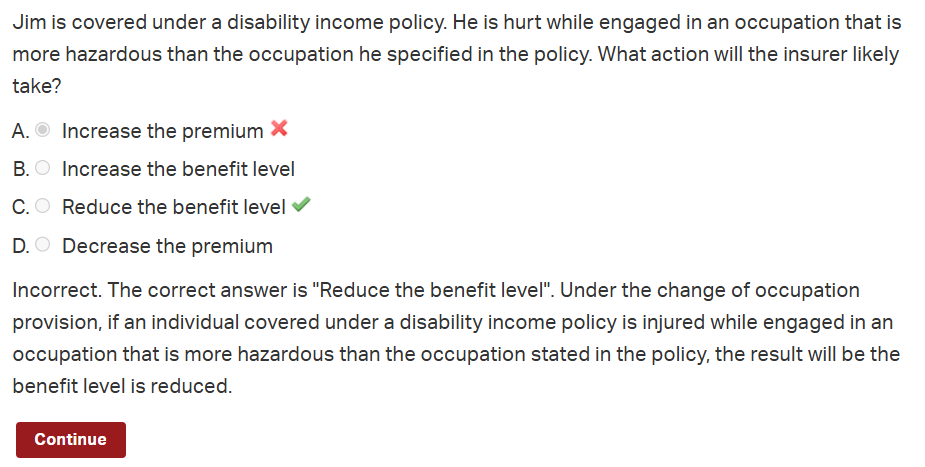
Reducing benefit
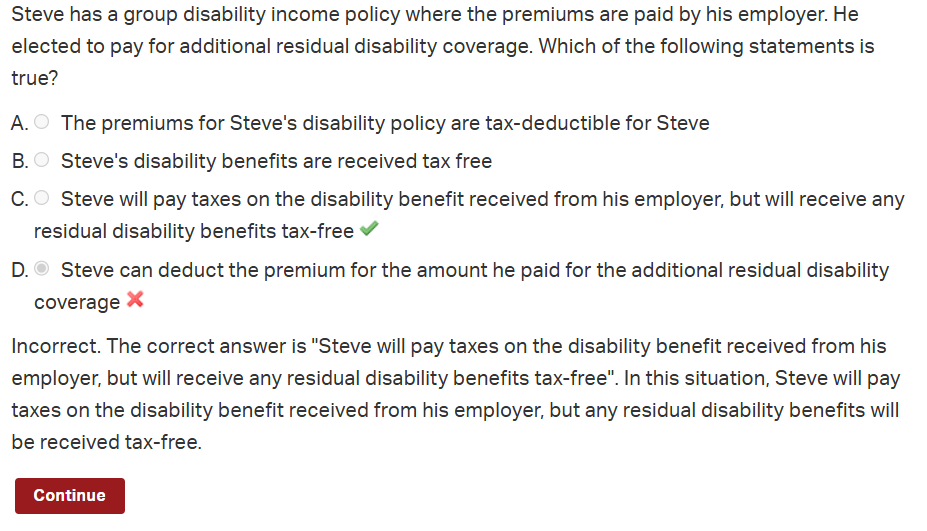
Group Disability income policy
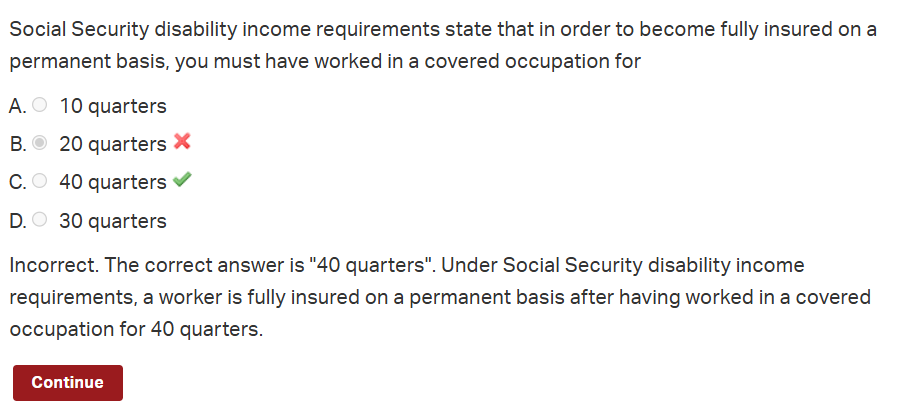
SS disability income requirements
Occupational vs non occupational
No coverage if the insured can also collect workers’ compensation or other work like things is called non-occupational. If a policy gives weekly/monthly benefits of job like disabilities, along with non-occupational losses, its a occupational coverage
EX; group disability insurance: non-occupational, but individual disability insurance: occupational
Short Termdisability Plans
Short term: quickly
1a percentage of the insured income while they recover from a temporary illness. they:
Offered with a LTD beenfit, pays biweekly, minimal waiting period, provide coverage for childbirth, benefits up to 180 days, but max benefit period of 2 years
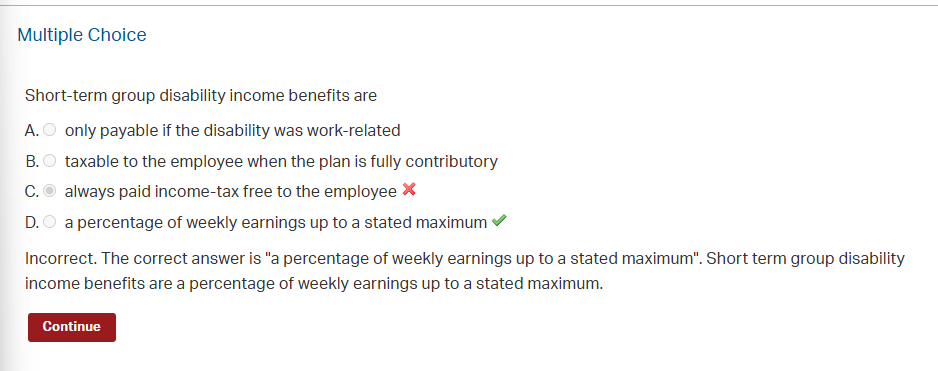
SHort term disability insruance income benefits
Long term disability Insurance PLans (LTD) Insurance
Provides longer benefit periods and can oftern address needs stemming from a more serious injury or sickness. SInce longer, the cost is higher, but longer elimination can reduce costs. The length depends on
- if they applied for group or individual coverage
- the risk of injury or illness with ones occupation
- Traits of gender, age, and medical history
Total disability
A loss of income, ability to work, or both. Insueres add the “gainful employment” or “in any occupation for wages or a profit” to make sure that those collecting benefits were indemnified and not using insurance to profit from any injury.
Inability to perform duties/ material duties/ substantial duties
Refers to the actual tasks/ activites the person has to do for the job, while the other is for the persons “key duties” and essential capabilities that makes them work
Example: surgeon holding a scalpel (MD) cannot keep their hand steady (SD)
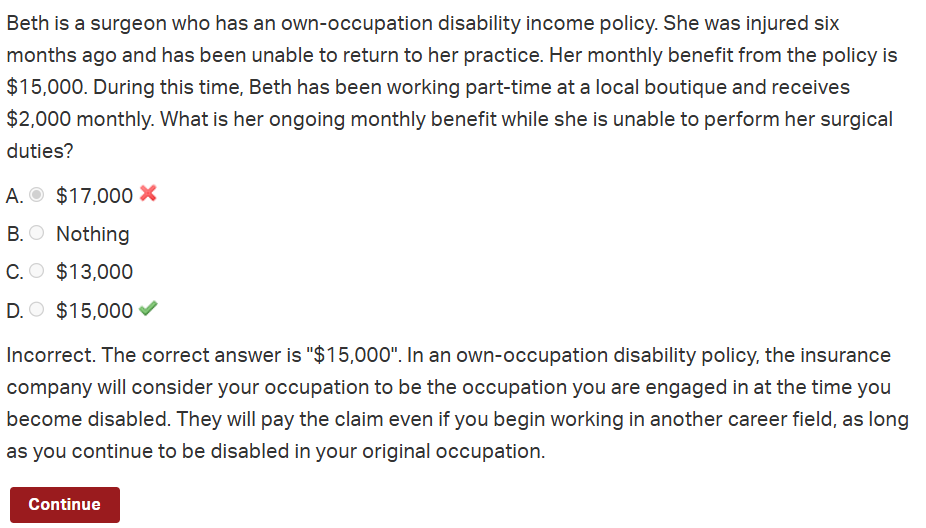
Own occupation
Used in commericla insurance, it considers the insured to be disabled if they "cannot perform the material and substantial duties of their own occupation." Its also very beneficial for the policy owner as its less restrictive and an “any occupation” and can take alternative sources of income
Any occupation
Disabled if they “cannot perform the MD and SD dutie, or any for which they can be reasonably suited by knowledge, training, and experience. If youre a surgeon, and you have a shaky hand, youre disabiled as you cannot perform surgeries anymore
Substanyial gainful activities
The definition to get Social Security Disability Insurance, or ANY GAINFUL WORK. They must be unable to engage in any activities because of a mental or physical activity that is
-expected to be a death
-Has lasted 12 months
- Is supposed to last for 12 more months
and its definition of “gainful” activities include
- Performed for poy or profit
- Generally performed for pay or profit
- Intended for profit, where or not a profit is there
- Perforned part time
Loss of earnings/ Pure loss of income
Loss of wages, salary, commissions, and fees for services, but does not cover rental income form real estate, interest on savings, and investment dividends. PLOI is that a earned income must decrease by 20% for any disability benefit
Recurrent disability
Standard Clause included in a disability insurance policy and applies when the insured suffers a disability
the relapse is considered a recurrence of the initial disability if it occurs within six months after the insured returns to work.
If they have a 5 year benefit and disabled 6 months before work, they would have 4 and a half years of the benefit period remianing
For example, let's assume that Bob owns a disability income policy that pays $1,000 per month with a 30-day waiting period. Bob becomes totally disabled and is out of work for five months. He then returns to work for three months but suffers a relapse of the same disability and is out of work for another four months. How many months of benefits will be paid?
In this case, eight months. He receives benefits four months after the initial elimination period and then another four months during the recurrence because there's no elimination period.
If Bob had gone back to work for seven months and then suffered a relapse, he would have collected seven months of benefits because he would have needed to satisfy a waiting period for each separate disability.
Presumtive disability
Medical definition fo disability. It counts for Double dismemberments, complete loss of sight, hearing, and speech. When the injury falls to severe, it goe sinto this category, and the insurance company waives its other criteria of benefits such as occupational duties, and they ensure the for the physical loss, independent of the financial consequences. Disability is defined by the medical condition, not the financial loss
Concurrent Disability
When disability events occur somuntaneouly and its one period of disability. The insured collects only one benefit as there is only one loss even with multiple causes
Delayed Disability
a total disability that does not occur immediately after an accident; rather, it develops later, and remain eligible for benefits due to theeffects of an accident for an extended period
Confining Versus Non-Confining Disability
first requires the insured to be in doors, while the other is not required to remain indoors
At work benefits
Encourages beneficiaries to return to work by paying a portion of the total disabillity benefit to those who ease back into the workforce.
Partial Disability
The inability to perform one or more of th eimportant orkey duties of ones own occupation, or the inability to work at ones regular occupation full time. Based on insured’s loss of income and the beenfit is paid regardless of if it comes from an illness or accident. I t also allows a partialluuy impaired person to maintain pert-time beenfits while still working part time
The amount of a policy's partial disability benefits payable is dependent on whether the policy stipulates a flat amount or a residual amount. For purposes of this course and exam, the assumption should be that the standard partial disability benefit is 50% of the policy's total disability benefit.
For example, let's assume that an individual earns $4,000 per month and owns a policy with a total disability benefit equal to 60% of their income. Therefore, their total disability benefit is $2,400 per month. The monthly partial disability benefit is 50% of $2,400, which equals $1,200.
Residual Disability
Proportional disability benefit that a person collects when working less than full-time due to a covered disability and suffers an income loss of at least 20%
Credit Disability insurance
CAn be purchased to help make loan payments if the insured becomes disabled. It pays the monthly installment, and since the policy pays off a specific debt, the benefit is typically decreases as the debt is paid down
Premium rider waiver and the disability income rider
PRW waives the premium if the insured becomes disabled, but DIR provides beenfits such as 1% payable if they become disabled
GOVERNMENT (SOCIAL) DISABILITY INSURANCE
Gov. programs that provide a safety net for people with injuring ocnditions. Provides it with someone with a work history at some point
SOCIAL SECURITY DISABILITY INSURANCE
Social Security Administration (SSA) provides disability-related benefits through the SS OASDI program for fully funded payroll taxes paid by empoyees, employers, and self employed employees. 10 years of fully paid taxes earns the person with a pernament fully insured status. Their diability ounts as expected to die or has lasted or is expected to a disabled for at least 12 months and has been for at least 12 motnsh
Waiting period
5 month time before qualified for benefits, where the benefits themseves can accrue during the 6th month and paid at the end of the month
benefits of a worker
A workers SSDI beenfit equals 100% of their primary insurance amount (PIA)
Primary Insurance Amount (PIA)
An individuals benefit level based on their incomes history and FICA taxes from that time
WORKERS' COMPENSATION
A form of liability that provides medical disability and survivor benefits to workers in work related accidents. They have a temporary and pernament disability, very similar to earlier
PROBATIONARY PERIOD
Not an elimination period as now it happens only once at the policy’s inception. In a disability insurance policy defines the period that must pass before it covers illness claims and acts for 15, 30, or 60 days
THE BENEFIT PERIOD
The maximum length of timer per disability claim that an insurer will provide benefits to a covered individual suffering a loss of incomes. Underwriting determinations are based on job categories and one’s health. Shorter beenfit periods are standard with higher risk.
Individual short-term DI policies have benefits of few to 24 months
Individual LT DI are from 2 years to a lifetime if still disabled
DISABILITY BENEFIT AMOUNTS
Issue individual policies that limit coverage to a percentage of the insured’s incme. LTD Policies pay beenfits monthly Insurers use the percent-of-earnings approach or the flat amount method.
THE PERCENT-OF-EARNINGS APPROACH
For example, if an insured's policy provides a 60% benefit based on a monthly gross income of $3,000, the monthly benefit equals $1,800 (60% × $3,000). If the insured's income increases to $3,200, the 60% benefit will increase to $1,920 (60% of $3,200).
THE FLAT AMOUNT APPROACH
For example, if Barry, the policyholder, has $3,000 in gross earned income per month, an insurer could issue a policy with a monthly benefit equal to 60% of the insured's monthly income, or $1,800. Unlike our previous example, a policy using this approach defines the benefit as $1,800 in the contract language, NOT 60%. Because the benefit is defined as $1,800, it would not change in reaction to changes in Barry's income. If Barry's income rose to $3,300, the policy benefit remains $1,800.
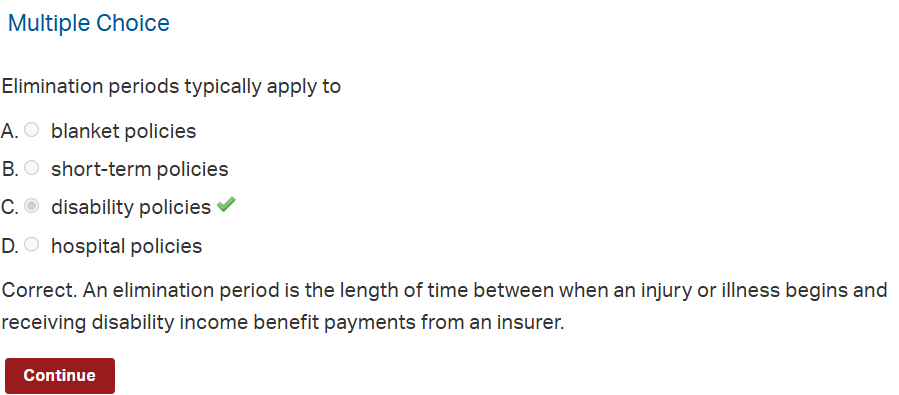
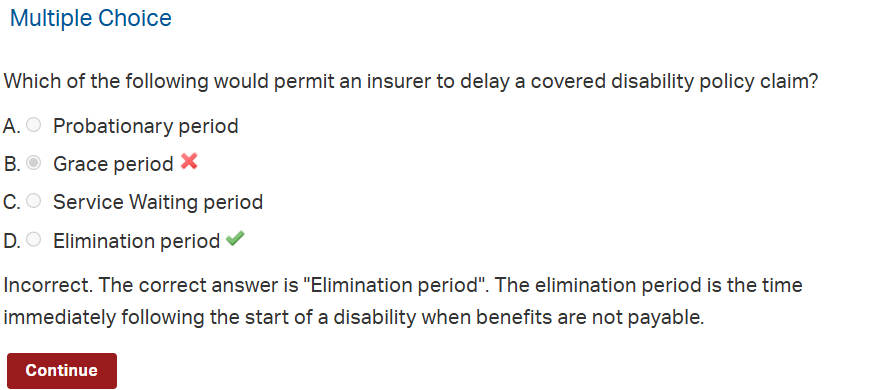
Elimination Period
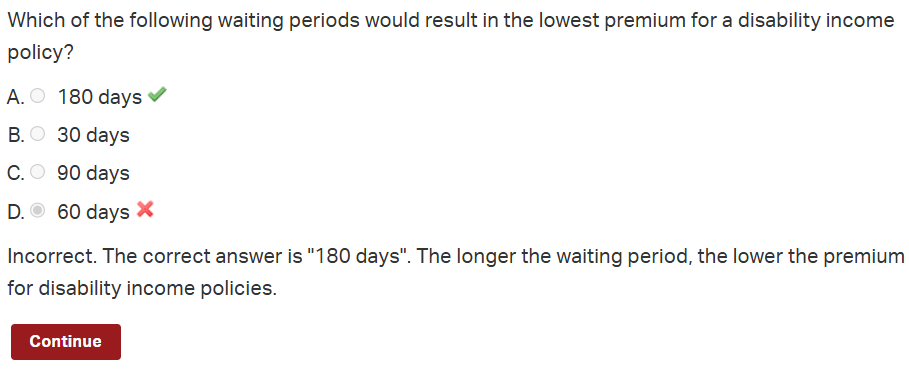
The waiting period and the period immeidately after the onset of disability which beenfits are NOT payable. The longer the waiting period, the lower the policy premium. Same goes for an elimination premium and allows the insurer to reduce coverage costs
Premiums for DI
Length of the waiting period
Monthly income benefit amount
Length of the benefit period
Age, (gender), income, and health of the applicant
Insured's occupation
Whether the insured owns other disability income insurance
Most IDP are sold with premium that doesnt change with age.
Annually REnewable Disability Insurance
Companies that offer policies with age-sensitive premiums. Costs strat lower than a comparable level premium policy but increase above average.
Exclusions
War (declared or undeclared)
Intentionally self-inflicted injuries
Aviation-related claims of a pilot or crew member, unless a commercial aircraft or pilot is involved (which is covered)
Military service
Losses that result from engaging in any illegal occupation
Change of Occupation provision
If a person is covered under a DIP and is injured whiie engaged in an occuation more dangerous that theoccupation that is stated in the policy, the beenfit level is reduced.
RElation of earning to the insurance
Addresses situations where more than one policy covers the same disability claim, so the total beenfits will not exceed the insured’s pre-disability income.
Impairment rider/ Exlcusion rider
This rider ensured certain losses from coverage, and the excluded risk stems from an occupation
Rehabilitation beenfits
Encourages people to actively participate in their recovery and help then return to work in at least a year. It facilitates coational training to help the person for the new occupation
Non-cancelable and guarenteed renewable
The inusrer guarantees the premium charge at the time the policy was issued and the carrier cannot raise the rate during the life of the policy
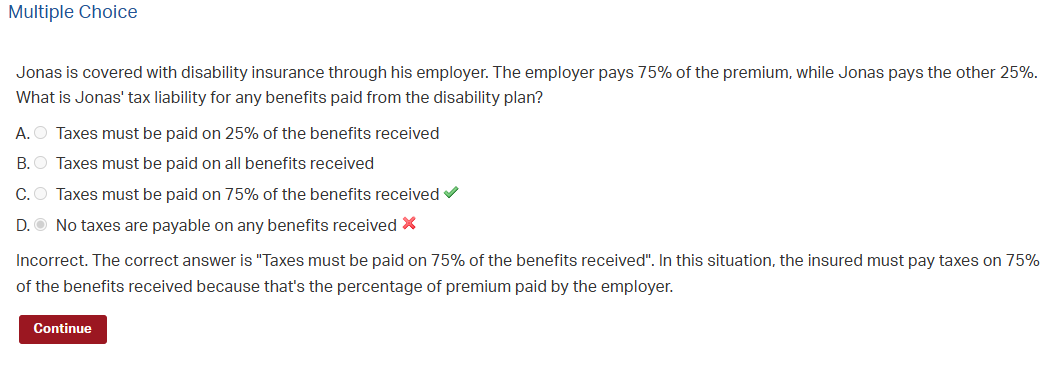
Tax liability for any benefits paid
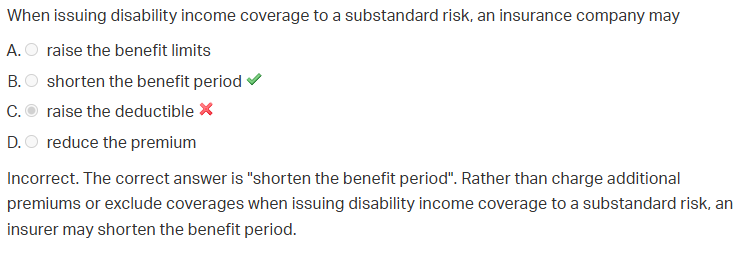
What a company should do
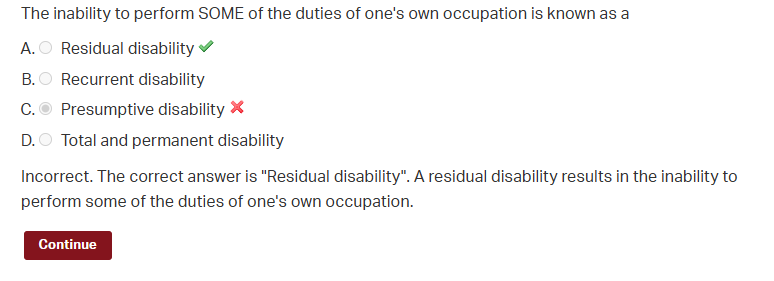
residual Disability
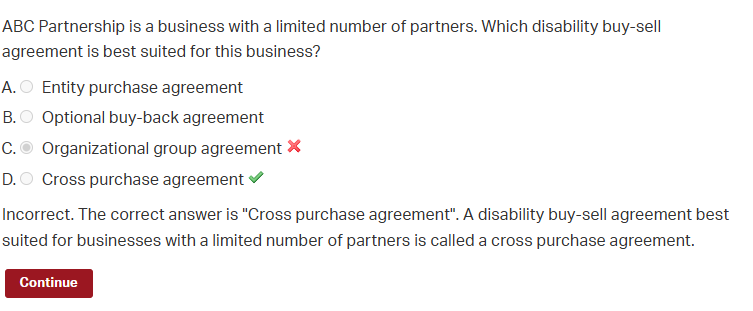
cross purchase agreementf