Bio 1002 Animal Diversity Intro
 Call Kai
 Learn
Learn Practice Test
 Spaced Repetition
 Match
Match Flashcards
 Knowt Play
1/66

There's no tags or description
Looks like no tags are added yet.
Name | Mastery | Learn | Test | Matching | Spaced | Call with Kai |
|---|
No analytics yet
Send a link to your students to track their progress
67 Terms
how many animal species have been found
1.3 million
Estimates of total species approach 8 million
what makes up most of the animal species
Morethan1,000,000 arthropod species
• Most of theseare insects
Animals are __cellular, _trophic _otes with tissues that develop from _ layers
multi, hetero, eukar, embryonic
*characteristics that define the Kingdom Animalia
• Nutritional mode
• Cell structure and specialization
• Reproduction and development
Nutritional Mode
• Animals are heterotrophs
:– They cannot construct all their own organic molecules
– They obtain organic molecules from their food, that they ingest and use enzymes to digest the food within their bodies
secrete enzymes, absorb nutrients
Cell Structure and Specialization
• Animals are multicellular eukaryotes
• They lack cell walls*** (movement)**
• Instead, proteins external to cell membrane provide structural support to animal cells and connect them to one another
• Most abundant is collagen, only in animals
Cells of most animals organized into tissues
tissues
groups of similar cells that act as a functional unit
• Muscle tissues (movement), and nervous tissue (conducting nervous impulses) are unique, defining characteristics of animals
Reproduction and Development
• Most animals reproduce sexually, and the diploid stage dominates the life cycle
• Meiotic division produces haploid sperm and egg cells
• Most species: small flagellated sperm fertilizes larger nonmotile egg forming a diploid zygote
what has the biggest sperm
side: Drosphila bifurca has the longest sperm of any organism, measuring 6cm which is 20 times the size of the male's body
Early embryonic development in animals
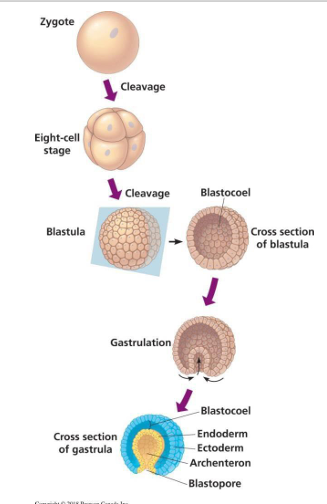
1) After a spermfertilizes an egg, the zygote undergoes a series of mitotic cell divisions called cleavage
2) Eight-cell embryo formed by 3 rounds of cell division
3) Cleavage produces a multicellular stage called a blastula
4) Following blastula stage is process of gastrulation
5) Pouch formed by gastrulation called archenteron. Opens to outside via blastopore
6) Endoderm of archenteron develops into tissue lining animal’s digestive tract
Blastula
a hollow ball of cells surrounding a cavity called the blastocoel
gastrulation
One end folds inward
• Producing layers of embryonic tissues
• Ectoderm (outer layer) • Endoderm (inner layer)
• Resulting developmental stage is called a gastrula
• Most animals have at least one ___ stage
larval
A larva is:
– sexually immature– and morphologically distinct from the adult– different food– maybe different habitat than adu
Animal larvae eventually undergo ___ to become a juvenile
metamorphosis
A juvenile:
– resembles an adult
– but is not yet sexually mature
Hox genes
• Most animals, and only animals, have Hox genes regulating development of body form
• Although the Hox family of genes is highly conserved, it can produce a wide diversity of animal morphology
a subset of homeobox genes, are a group of related genes that specify regions of the body plan of an embryo along the head-tail axis of animals
body plans
A body plan is a particular set of morphological and developmental traits integrated into a functional whole – the living animal
• Body plans are a way to compareand contrast animal features
• Animal body plans have evolved overtime
• Some body plans have been conserved,while others have changed multiple times over the course of evolution– The molecular control of gastrulation has remained unchanged for more than 500 million years
• Similar body forms may have evolved independently in different lineages
• Body features can be lost over the course of evolution causing some closely related species to look very different from one another
bees
suborder Apocrita (superfamily Apoidea) entirely dependent on flowers for food (pollen and nectar) Most of the Apoidea are solitary, or nonsocial, and do not 20,000 species colonies
Symmetry
• A basic feature of animal bodies is their type of symmetry or absence of symmetry
• Many sponges lack symmetry altogether
• Some animals have radial symmetry
• Like a flower pot
• Any imaginary slice through the central axis divides the animal into mirror images
• Example: sea anemones (phylum Cnidaria)
• Have oral and aboral sides
• Do not have a left side or a right side, no front or back
• Two-sided symmetry is called bilateral symmetry • Bilaterally symmetrical animals have:
• A dorsal (top) side and a ventral (bottom) side
• A right and left side
• Anterior (front) and posterior (back) ends
• Many also have sensory “equipment” concentrated at the anterior end, including brain (development of a head), which is called cephalization
• End with sense organs and brain encounters environment first: advantage detecting prey, predators
Symmetry And Lifestyle
• Radial animals are often sessile (living attached to substrate) or planktonic (drifting or weakly swimming)
• Their symmetry allows them to meet environment equally well from all sides
• Bilateral animals often move actively from place to place and have a central nervous system
• Allows them to coordinate complex movementsinvolved in crawling, burrowing, flying, swimming
Tissues
• Animal body plans also vary according to the organization of the animal’s tissues
• In animals, true tissues are collections of specialized cells isolated from other tissues by membranous layers
• Sponges and a few other groups lack true tissues
• In all other animals, the embryo becomes layered through the process of gastrulation
• As development progresses, these layers, called germ layers, form the various tissues and organs of the body
Ectoderm, Endoderm, Diploblastic, Triploblastic
Ectoderm
the germ layer covering the embryo’s surface; gives rise to outer covering of the animal, and in some phyla to the central nervous system
Endoderm
the innermost germ layer and lines the developing digestive tube, called archenteron; also gives rise to lining of digestive tract and organs such as liver and lungs of vertebrates
*Diploblastic
animals have only 2 germ layers: ectoderm and endoderm– Includes cnidarians and a few other groups
Triploblastic
animals also have a third germ layer, the mesoderm layer between ectoderm and endoderm
• These have bilateral symmetry– Includes flatworms, arthropods, vertebrates– Mesoderm forms muscles and most other organs between the digestive tract and the outer covering of the animal
Body Cavities
• Most triploblastic animals possess a body cavity
• A true body cavity is called a coelom
• A fluid or air-filled space between the digestive tract and the outer body wall
• A true coelom is derived from mesoderm
• Coelomates, such as earthworms, are animals that posses a true coelom
• A body cavity completely lined by tissue derived from mesoderm
Body cavities of triploblastic animals
• A pseudocoelom isa body cavity derived from mesoderm and endoderm
• Is fully functional
• Triploblastic animals possessing a pseudocoelom are called pseudocoelomates
• Example, roundworms
• Triploblastic animals that lack a body cavity are called acoelomates
• Example: planarians
Functions of a body cavity
1) Its fluid cushions the suspendedorgans– helps prevent internal injury
2) In soft-bodied animals e.g. earthworms the coelom contains noncompressible fluid that acts like a skeleton
3) Cavity enables internal organs to grow and move independently of outer body wall
*Protostome and Deuterostome Development
• Based on early development, many animals can be categorized as having one of two developmental modes
• protostome development or deuterostome development
• Distinguished by differences in
• Cleavage
• Coelom formation
• Fate of the blastopore
Cleavage
• Many animals with protostome development undergo spiral cleavage
• The planes of cell division are diagonal to the vertical axis of the embryo
• Eight-cell stage, smaller cells centered over grooves between larger underlying cells
• Determinate cleavage rigidly casts or determines the developmental fate of each embryonic cell very early
• In deuterostome development, radial cleavage: cleavage planes are either parallel or perpendicular to vertical axis of embryo
• Eight-cell stage tiers aligned
• Indeterminate cleavage each cell produced by early cleavage divisions retains capacity to develop into a complete embryo
Coelom Formation
• In protostome development, splitting of solid masses of mesoderm forms the coelom
• In deuterostome development, mesoderm buds from the wall of the archenteron to form the coelom
Fate of the Blastopore
• The blastopore forms during gastrulation and connects the archenteron to the exterior of the gastrula
• In most animals a second opening forms at opposite end of gastrula
• In protostome development, the blastopore becomes the mouth: “first mouth”
• In deuterostome development, the blastopore becomes the anus; mouth is formed from second opening “second mouth”
Invertebrates
Invertebrates account for 95% of known animal species
• Occupy almost every habitat– scalding water released from deep-sea hydrothermal vents– frozen ground of Antarctica
• Adaptation to varied environments has produced huge diversity of forms and features: a flat bilayer of cells, silk-spinning glands, tentacles covered with suction cups
• and sizes:– microscopic to 18 m long
All animals except sponges and a few other groups belong to the clade __
Eumetazoa
*Eumetazoa
animals with truetissues
Phylum Cnidaria
Phylum Cnidaria Have diversified into a wide range of both sessile and motile forms including jellies (“jellyfish”), corals, and hydras
• Hydra: an animal model
Cnidarians
• Diploblastic, radial body plan
• A sac with a central digestive compartment, the gastrovascular cavity
• A single opening to the gastrovascular cavity functions as mouth and anus
• The body wall has 2 layers of cells
• Outer layer of epidermis (derived from ectoderm)
• Inner layer of gastrodermis (derived from endoderm)
• Mesoglea is a gelatinous layer between epidermis and gastrodermis
Two variations on body plan: the sessile polyp and the motile medusa
• Polyps are cylindrical, adhere to substrate by the aboral end of body (end opposite the mouth)
• Extend tentacles waiting for prey
• Polyp examples include hydras and sea anemones
• Cnidarians are carnivores that use tentacles around mouth to capture prey and push food into gastrovascular cavity where digestion begins
• Tentacles are armed with cnidocytes, unique cells that function in defence and prey capture
Hydra
– a freshwater cnidarian
– exists only in polyp form
– and reproduces asexually by budding
Medusa
flattened, mouth-down version of polyp
• Moves freely in water by passive drifting and contractions of bell-shaped body
• Medusae include free-swimming jellies
• Tentacles dangle from oral, downward-pointing surface
• Some cnidarians only exist as polyps, some only as medusae
• Others have both polyp and medusa stage in life cycle
cnidocytes
unique cells that function in defence and prey capture
Some cnidocytes contain nematocysts
nematocysts
organelles that contain and eject a stinging thread that can penetrate the body wall of prey
When a “trigger” is stimulated by touch or certain chemicals, the thread shoots out puncturing and injecting toxins into prey
Cnidarian digestion
Tentacles push food into gastrovascular cavity
• Enzymes secreted into cavity to digest prey
• Cells lining cavity absorb nutrients and complete digestion
• Undigested remains expelled through mouth/anus
*Cnidarian movement
• Movements coordinated by nerve net
• No brain, has nerve net associated with sensory structures around body
• Can detect and respond to stimuli from all directions
Majority of animals belong to clade ___, and have-
Bilateria
• Have bilateral symmetry and triploblastic development
• Most have a coelom and a digestive tract with two openings
• The clade Bilateria contains Lophotrochozoa, Ecdysozoa, and Deuterostomia
Lophotrochozoa
• The clade Lophotrochozoa was identified by molecular data
• Some develop a lophophore, a crown of ciliated tentacles for feeding, others pass through a trochophore larval stage, and few have neither feature
• Lophotrochozoa includes 18 phyla
• Lophotrochozoa includes flatworms,rotifers, ectoprocts, brachiopods, molluscs, and annelids
Annelids
• Annelids (“little rings”) are segmented worms
– Segmentation: division of body into nearly identical subunits– bodies composed of a series of fused rings
– rings are distinct segments separated by a partition (septum)
• Live in sea, in most freshwater habitats, and damp soil
• Coelomates; range in length from < 1mm to > 3 m
• Annelids can be divided into two major clades: (lifestyle differences)
– Errantia
– Sedentaria: leeches and earthworms
Segmentation
division of body into nearly identical subunits
Leeches
• Most species of leeches live in fresh water; some are marine or terrestrial (live in moist vegetation)
• 1 –30cm
• Leeches include predators of invertebrates, and parasites that suck blood by temporarily attaching to other animals
• Anterior sucker, bladelike jaws slit skin
• Secretes anaesthetic
• Secretes chemical, (hirudin), that keeps blood from coagulating
• Sucksblood
Earthworms
• Earthworms are one of our invertebrate animal models
• Earthworms eat through soil, extracting nutrients as the soil moves through the alimentary canal
• Undigested material eliminated as fecal castings through anus; till, aerate, improve soil
• Earthworms are hermaphrodites but cross-fertilize– clitellum: role in reproduction
• Some reproduce asexually by fragmentation
Ecdysozoans
Ecdysozoans are the most species-rich animal group
• Ecdysozoans are covered by a tough coat called a cuticle
• The cuticle is shed or moulted through a process called ecdysis
• The two largest phyla are nematodes and arthropods
Phylum Arthropoda bodyplan
• Arthropod body plan:
• A segmented body
• Hard exoskeleton
• Jointed appendages (“jointed feet”)
• Appendages, are jointed and paired
• Some modified for walking, feeding, sensory reception, reproduction, defense
General Characteristics of Arthropods
• Body completely covered by the cuticle
• An exoskeleton made of layers of protein and the polysaccharide chitin
• Arthropods have well developed sensory organs
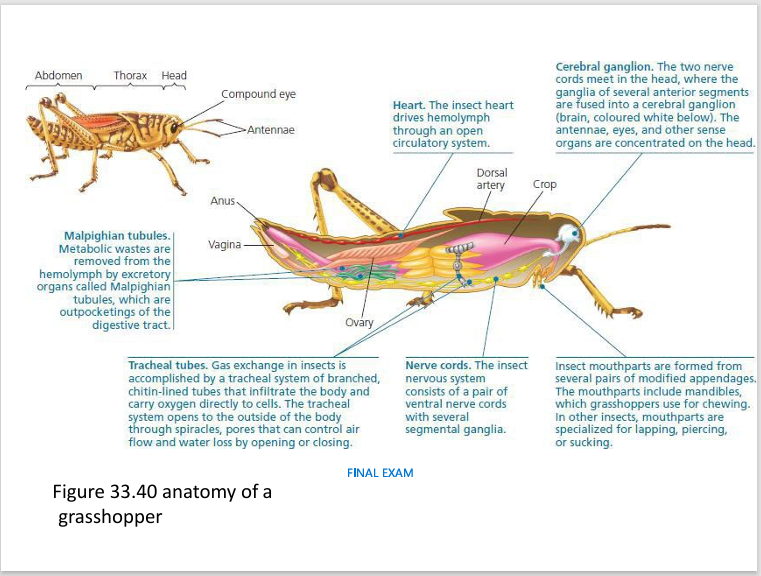
Arthropods have an open circulatory system
Morphological and molecular evidence suggests that arthropods consist of three major lineages that diverged early in phylum’s evolution
Exoskeleton
Exoskeleton protects, and provides points of attachment for muscles that move appendages
• Prevents desiccation
• When an arthropod grows, it moults its exoskeleton
• Energetically expensive
• Vulnerable until new exoskeleton has hardened
arthropod sensory organs
– eyes
– olfactory receptors
– and antennae that function in touch and smell
• Most sensory organs concentrated in anterior end
Arthropods open circulatory system
• Hemolymph fluid propelled by heart through short arteries into spaces (sinuses) surrounding tissues and organs
• Hemolymph reenters heart through pores that have valves
• Hemolymph-filled body sinuses are called the hemocoel • Coelom reduced in adults, hemocoel main body cavity
• A variety of organs specialized for gas exchange have evolved in arthropods
– insects have tracheal systems, branched air ducts leading to interior from pores in cuticle
arthropods three major lineages that diverged early in phylum’s evolution
– Chelicerates (sea spiders, horseshoe crabs, scorpions, ticks, mites, and spiders)
– Myriapods (centipedes and millipedes)
– Pancrustaceans (lobsters, shrimp, and other crustaceans, as well as insects and their relatives)
do we find it easy to eat new foods
We traditionally inherit 200-300 staple foods from our parents
We often find it very difficult to incorporate new foods Due to cultural and/or religious values, many foods are even considered taboo
Entomophagy
The eating of insects
Orthoptera
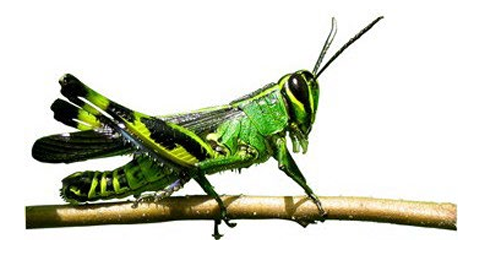
Orthoptera ortho - G, straight; pteron – wing Grasshoppers, crickets, katydids, etc.
Insects
• Insect body has 3 regions
• Head, thorax, abdomen
• Segmentation of thorax and abdomen obvious. segments that form head are fused
• 3 pairs of legs
anatomy of a grasshopper
Flight importance
Flight important to huge success of insects
• Can:
– escape predators
– find food, mates
– disperse to new habitat
• Faster than animals that can only crawl
• Many have one or two pairs of wings that emerge from dorsal side of thorax
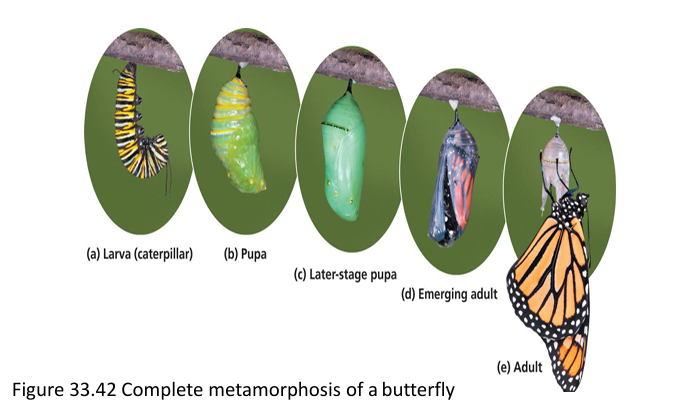
__ undergo metamorphosis
insects
incomplete metamorphosis
the young called nymphs, resemble adults but are smaller and lack wings
complete metamorphosis
Insects with complete metamorphosis have larval stages known by such names as maggot, grub, or caterpillar
Complete metamorphosis of a butterfly
a) Larva (caterpillar) spends time eating, growing, moulting as it grows
b) After several moults, larva develops into pupa
c) Within pupa larval tissues broken down, adult built by division and differentiation of cells quiescent in the larva
d) Eventually adult begins to emerge