Lab 3: Earthquakes
 Call Kai
 Learn
Learn Practice Test
 Spaced Repetition
 Match
Match Flashcards
 Knowt Play
1/35

There's no tags or description
Looks like no tags are added yet.
Name | Mastery | Learn | Test | Matching | Spaced | Call with Kai |
|---|
No analytics yet
Send a link to your students to track their progress
36 Terms
liquifaction
When loose, water-saturated sediment (like sand/fill) loses strength and acts like a liquid during shaking.
Triassic age (200 million years old)
faults leftover from breakup of Pangaea
Hypocenter depths range from…
1 to 8 miles with over 90% deeper than 3 miles
P-wave
The fastest seismic wave; it arrives first at a seismograph station; always start at 0 seconds
S-wave
Arrives second; causes more damage because it has a larger amplitude ("bigger range").
Seismic waves
vibrations of energy caused by the sudden breaking of rock in the Earth's crust (earthquakes), volcanic eruptions, or explosions, propagating through the Earth's interior and along its surface.
transform plate boundaries
friction of plates moving past each other creates earthquakes
convergent plate boundaries
reverse faults
divergent plate boundaries
normal faults
hypocenter
the position where the strain energy stored in the rock is first released, marking the point where the fault begins to rupture
epicenter
The point on Earth's surface directly above where an earthquake starts.
the lithosphere is brittle
it bends until it breaks
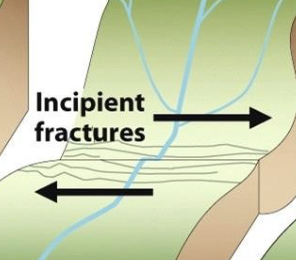
incipient fractures
A joint or fracture which does not continue through the specimen or at least not seen with the naked eye.
no strain
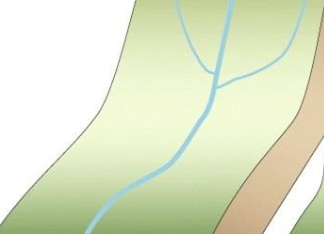
strain build-up
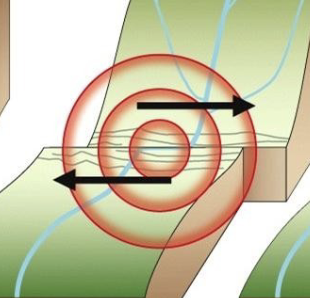
rupture with elastic rebound
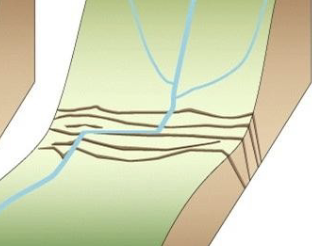
strain released
most earthquakes occur
along plate boundaries
Normal Fault
where the hanging wall moved down relative to the footwall
tensional stress
the type of stress that creates normal faults (pulling apart)
hanging wall
upside down shoe
foot wall
looks like a shoe
the plate boundary most commonly associated with normal faults? FUN
divergent FOOT UP NORMAL
reverse fault
where the hanging wall moves up relative to the footwall
compressional stress
the type of stress that creates reverse faults (pushing together)
the plate boundary most commonly associated with reverse faults
convergent
strike-slip fault
a fault where blocks move horizontally past each other; it has no hanging wall or footwall
Shear stress
type of stress that creates strike-slip faults
the plate boundary most commonly associated with strike-slip faults (San Andreas)
transform
triangulation
The process of using 3 seismograph stations to locate an earthquake's epicenter.
S-P interval
The time difference between P and S waves; it increases the further you are from the epicenter.
Artificial Fill (AF)
Man-made ground material (sand/rocks) that is the least stable and most prone to liquefaction.
wando formation
A dense, clay-rich natural deposit that is more stable during an earthquake than artificial fill.
intraplate earthquake
An earthquake that occurs away from a plate boundary (e.g., the 1886 Charleston Earthquake).
seismic joint
A rubber seam or gap in a building designed to let sections flex and move independently during shaking.
earthquake bolts
metal rods/plates added to old buildings to pull walls back to square and provide structural support