Chapter 9.1 DNA and 9.2 Protein Synthesis
 Call Kai
 Learn
Learn Practice Test
 Spaced Repetition
 Match
Match Flashcards
 Knowt Play
1/37

Earn XP
Name | Mastery | Learn | Test | Matching | Spaced | Call with Kai |
|---|
No analytics yet
Send a link to your students to track their progress
38 Terms
What does DNA stand for and what does it consist of?
Deoxyribonucleic acid (DNA).
DNA consists of two polynucleotide chains that coil around each other to produce a double helix and genetic information.
Where is the majority of DNA found in humans and what is it known as?
In humans, most DNA is found in the nucleus. This DNA is known as nuclear DNA (nDNA).
Where is a small amount of DNA found in every cell and what is it known as?
In every cell, a small amount of DNA is located in the mitochondria. This DNA is known as mitochondrial DNA (mtDNA).
What is the function of DNA?
DNA contains a genetic code that provides instructions to produce proteins.
What are the repeating units in DNA called?
Nucleotides
What are nucleotides composed of?
Nucleotides are composed of a nitrogen base, a sugar molecule (deoxyribose), and a phosphate molecule.
There are four nitrogen bases: Adenine (A), thymine (T), cytosine (C) and guanine (G)
What are the complementary base pairs for DNA?
Adenine (A) always binds to thymine (T). Cytosine (C) always binds to guanine (G)
In DNA describe the backbone structure.
DNA is made up of two (anti-parallel) strands of nucleotides/double stranded structure.
Nucleotides are made up of a phosphate group, a deoxyribose sugar, and a nitrogen base.
The sugar of one nucleotide bonds with the phosphate of another OR there is a long chain of alternating sugar and phosphate molecules for each DNA strand OR sugar-phosphate backbone- Attached to each sugar is a nitrogen base.
Attached to each sugar is a nitrogen base. 4 different nitrogen bases named adenine, thymine, guanine and cytosine.
The bases for each strand are bonded together with weak hydrogen bonds.
In DNA what attracts the specific bases.
Hydrogen bonds
What is the shape of DNA?
The DNA twists into a double helix shape/coiled into a spiral
What is the shape of nDNA and mtDNA?
In the nucleus, nDNA forms in long linear strands (linear chromosomes).
In the mitochondria, mtDNA forms in circular structures (circular chromosomes).
What are chromosomes composed of?
Chromosomes are composed of DNA wrapped in histone proteins.
How are histones arranged and what is DNA coiled around a histone known as?
Histones arrange in ‘octamers’—groups of eight histones. DNA that is coiled around a histone is known as a nucleosome.
How is DNA structured when a cell is not dividing?
In a cell that is not dividing, the coiled DNA forms a tangled network called chromatin.
How is DNA structured when a cell is dividing?
However, when a cell divides the coiled chromatin becomes more tightly coiled, forming structures called chromosomes.
What are genes?
sections of DNA that code for a particular protein. which each chromosome is made up of.
What is a karyotype?
A karyotype is an image of the complete set of chromosomes.
What is the process called when chromatin becomes more tightly coiled?
Supercoiling
What are the differences between nuclear DNA and mitochondrial DNA?
•Nuclear DNA is in the form of very long strands that are bound to proteins, the histones.
•Mitochondrial DNA is in the form of small circular molecules that are not bound to proteins
Describe the structure of mitochondrial DNA in terms of their gene numbers and what the functions of these genes.
There are about 5-10 molecules of mtDNA in each mitochondrion.
It has 37 genes, all of which are essential for the mitochondrion to function normally.
Twenty-four of the genes contain the code for making transfer RNA (tRNA) molecules, which are involved in protein synthesis.
The other 13 genes have instructions for making some of the enzymes necessary for the reactions of cellular respiration
When cells divide they undergo DNA replication. Describe the steps of DNA replication.
Cells divide through the processes of mitosis and meiosis.
1. The first stage of DNA replication is when the two strands of the DNA molecule are separated by the enzyme DNA helicase.
2. Each strand of the separated section contains half the original information.
3. Each strand serves as a template for the nucleotides that will form the new strand.
DNA polymerase adds the new nucleotides to the new strand, and DNA ligase joins short sections of DNA together.
Hydrogen bonding and DNA replication?
(past exam question)
Hydrogen bonding between bases allows for DNA replication to take place.
This is due to hydrogen bonding being relatively weak which allows for base pairs to be separated easily.
Therefore the template allows for the production of new DNA molecule/for nucleotides to bond and form the new DNA strand.
Why structures of DNA allow for DNA replication and steps?
(past exam question)
Hydrogen bonds between bases are relatively weak and easily broken.
This means the nitrogen bases are easily exposed to allow for replication to occur.
DNA can replicate itself because of the way its double strands relate to one another/the complementary nature of the two strands.
Enzyme helicase separates the two strands of DNA.
Each strand of DNA acts as a template to make new complementary strands of DNA.
DNA polymerase adds new free-floating nucleotides to form the new strands of DNA.
DNA ligase combines short sections of DNA.
This creates two new identical molecules of DNA
How are proteins produced? Give an example of a protein.
Proteins are made up of long chains of amino acids bonded together by peptide bonds. The sequence of bases in DNA controls the order of amino acids and, therefore, the type of protein that is produced.
Some proteins you have heard of include hemoglobin, actin and myosin, albumin, fibrin, collagen, insulin, immunoglobulins, and amylase.
State 3 differences between DNA and RNA.
The sugar molecule is ribose, not deoxyribose. Ribose has one more oxygen atom than deoxyribose.
RNA is single stranded, while DNA is double stranded.
RNA has the bases cytosine, guanine, adenine and uracil, while DNA has the bases cytosine, guanine, adenine and thymine.
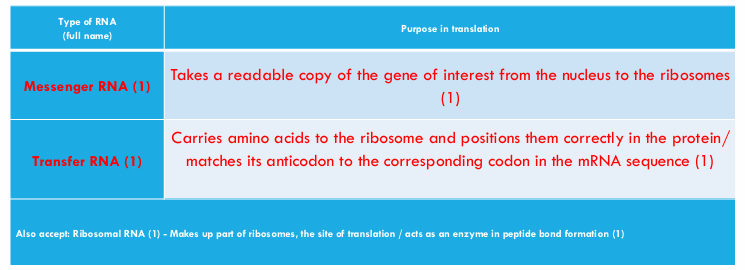
List and describe the functions of the 3 types of RNA.
Messenger RNA (mRNA) is made in the nucleus and takes the genetic code into the cytoplasm.
Ribosomal RNA (rRNA). The rRNA ensures the correct alignment of mRNA, tRNA and ribosome. It also has an enzymatic role in the formation of peptide bonds between amino acids.
Transfer RNA (tRNA) is a small molecule of RNA, containing only 70–90 nucleotides. Each tRNA molecule is able to carry a specific amino acid and therefore plays a vital role in protein synthesis.
Role of the nucleus in protein synthesis
(past exam question)
1. Nucleus controls all cellular activities.
2. DNA makes up chromosomes/DNA is made up of segments called genes.
3. Information in a gene is transcribed into mRNA.
4. Nucleus transmits mRNA to the cytoplasm to attach to ribosomes.
5. Other roles include:
Ribosomes, used for synthesis, are produced in the nucleus. The nucleus has receptors for inducing protein synthesis
What is a triplet?
A sequence of three bases is the code for a particular amino acid
What is transcription?
Transcription is the process by which the genetic instructions are copied (or transcribed) from the DNA to the mRNA molecule.
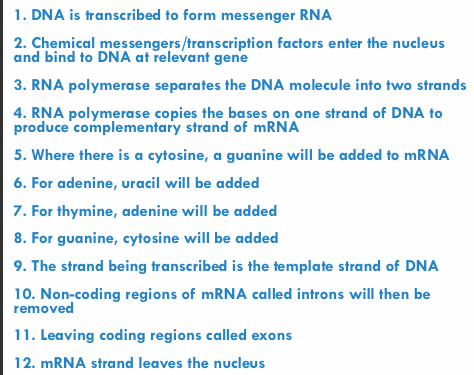
Describe the process of transcription
(past exam question)
First, DNA in the nucleus comes apart due to RNA polymerase/helicase.
Second, RNA polymerase then unzips the DNA and transcribes (copies) the bases on one strand of the DNA to make a complementary molecule of mRNA
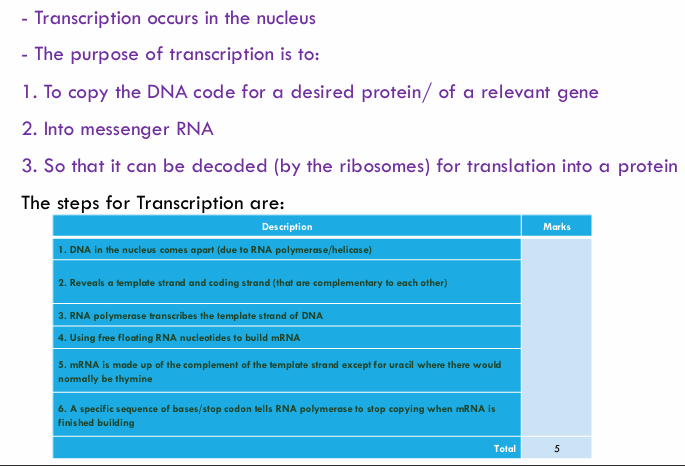
Transcription extended response answer
(past exam question)
What is translation?
Translation is the production of a protein using the information that is coded in the mRNA molecule and occurs in the ribosomes.
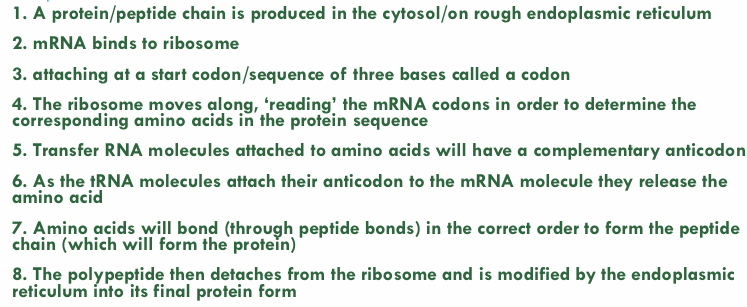
Describe the 5 steps of translation.
1st Step - The mRNA then leaves the nucleus and heads to the cytosol, where a ribosome attaches to one end of the mRNA molecule at a particular sequence of bases (adenine, uracil, and guanine) called the start codon. This ensures that the ribosome attaches to the correct end of the mRNA.
2nd Step - The ribosome then moves along the mRNA three bases at a time.
3rd Step - As the ribosome reads the codons on the mRNA, the tRNA molecules with the complementary bases join to the mRNA.
4th Step - The amino acids carried by the tRNA are joined so that the protein is assembled with the amino acids in the correct sequence.
5th Step - Once the tRNA has delivered its amino acid, it detaches from the ribosome and can then pick up another amino acid from the cytosol.
translation extended response answer
(past exam question)
types of RNA involved in translation
(past exam question)
Role of the Golgi body/apparatus in translation.
(past exam question)
The organelle that receives the products of translation.
Processes that occur in the Golgi body: Modifies proteins / adds phosphate and carbohydrates to proteins / completes folding of proteins / checks structure of proteins.
Sorts and packages proteins into vesicles for secretion.
What is gene expression?
The process of copying information from DNA on to messenger RNA (mRNA) and then translating the message into a series of amino acids to form a protein.
Although your body contains no genes to create lipids or carbohydrates directly. How is protein involved in the synthesis of lipids and carbohydrates?
There are no genes that carry instructions for the manufacture of lipids or carbohydrates.
However, the synthesis of these substances requires enzymes, and enzymes are proteins. The DNA in the genes carries the code for protein manufacture; therefore, the genes indirectly control the synthesis of lipids and carbohydrates.