EEMB 148: Midterm 2.0
 Call Kai
 Learn
Learn Practice Test
 Spaced Repetition
 Match
Match Flashcards
 Knowt Play
1/118

There's no tags or description
Looks like no tags are added yet.
Name | Mastery | Learn | Test | Matching | Spaced | Call with Kai |
|---|
No analytics yet
Send a link to your students to track their progress
119 Terms
what are the two sources of organic phosphorus?
drainage basin
some anthropogenic
what is an additional source of organic phosphorus?
pacific salmon: adults swim into freshwater to breed and bring organic phosphorus with them
some adult salmon die bc of the energy expended swimming upstream → death releases additional nutrients → increases algae → increase insects → more food for juvenile fish
what are the two forms of phosphorus?
dissolved organic phosphorus (ex. SRP)
organic phosphorus
what is the difference in algal versus bacterial uptake and storage of phosphorus?
bacteria: uptake P at low concentrations, cannot store it
algae: uptake P at high concentrations, can store it
what is inorganic turbidity in large lakes?
phosphorus sticks to suspended sediments due to concentration gradient
what does a large turbid river look like?
high sediment; low light; high P; low algal production
what does a large clear river look like?
low sediment; high light; low P; low algal production
what happens at a mixing zone for turbid and clear rivers?
P is able to desorb from the sediment due to change in concentration and becomes SRP → less sediment means more light is available → increased algal production
what is the nutrient spiraling concept?
the process in which nutrients are transported downstream and cycled in the system; helps to measure retentiveness
what is spiraling length?
the average distance traveled by a nutrient atom during one complete cycle
what is the equation for spiraling length? what happens if you increase V or decrease T?
S = V * T
increase V = longer spiraling length
decrease T = shorter spiraling length
what is the decomposition equation?
S = Sw + Sb
what is the in-theory equation for spiraling length in water?
Sw = Vw * Tw
how is the spiraling length in water actually measured?
flux vs. distance of a radioactive tracer
what is Kl?
Kl: slope of decline in flux with distance
larger Kl means greater uptake and shorter spiraling length
what is the rearranged equation for the spiraling length in water?
Sw = Fw / U
how does flux and uptake affect the spiraling length in water?
increase flux rate = longer spiraling length
increase uptake rate = shorter spiraling length
what is the in-theory equation for spiraling length in biota?
Sb = Vb * Tb
how is the spiraling length in biota actually measured?
measure the loss of a label/sample over time
what is Kb?
Kb: slope of decline in flux with distance
larger Kb means greater uptake and shorter spiraling length
what is the rearranged equation for the spiraling length in biota?
Sb = Vb / Kb
increase biota = shorter spiraling length
what value has a larger impact on spiraling length?
spiraling length in water
how does geomorphology affect spiraling length? (steep slope, sediment, sand)
steep slope = increase velocity, less uptake = longer spiraling length
lots of sediment = sinks, retained = shorter spiraling length
sand = smoother, less friction, moves faster = longer spiraling length
how does discharge affect spiraling length?
low flow = less velocity, high uptake = shorter spiraling length
how does algae and bacteria affect spiraling length?
lots of algae = more uptake = shorter spiraling length
lots of bacteria = more uptake = shorter spiraling length
how do sedimentary and mobile consumers affect spiraling length?
sedimentary = absorbs in one place, long life span = shorter spiraling length
mobile = messy eater, push things downstream = longer spiraling length
how is CPOM classified?
>1 mm, slowest downstream velocity
how is FPOM classified?
<1 mm to >0.45 um, intermediate downstream velocity
how is DOM classified?
>0.45 um, fastest downstream velocity
what is labile organic matter?
simple molecules, rapidly degraded, low C:N
what is refractory organic matter?
complex molecules, slowly degraded, high C:N
what is an allochthonous system? when are the pulsed inputs?
carbon fixed OUTSIDE the system
pulsed inputs: fall (plants drop leaves), early spring (melting of snow causes flooding)
what kind of food chain is associated with an allochthonous system?
detrital food chain - donor control
macrophytes enter through this web (toxic and well defended)
what is an autochthonous system? when are the pulsed inputs?
carbon fixed INSIDE the system
pulsed inputs: late fall (leaves fall, more light available), early spring (leaves haven’t grown back yet, more light available)
what kind of food chain is associated with an autochthonous system?
grazing food chain - top down effects
what is the order of the lability index?
periphyton > macrophytes > herbs vegetation > woody vegetation
what are the two assumptions of the RCC?
a gradient of physical characteristics exist from the headwaters to the tailwaters
organism distribution is determined by organic inputs and how they are processed
what are the two predictions of the RCC?
the relative importance of allochthonous, autochthonous, and downstream transport
community composition is based on mechanisms to harvest organic matter
what are the RCC characteristics of a headwater?
physical: small, high canopy, low light, cold, low turbidity, low velocity
energy: allochthonous, P/R < 1
biota: shredders and filter feeding collectors
fish: fusiform (reduce drag, cold adapted, eats insects)
what are the RCC characteristics of a midwater?
physical: intermediate size, intermediate canopy, intermediate light, warmer, intermediate turbidity, intermediate velocity
energy: autochthonous, P/R > 1
biota: grazers and filter & deposit collectors
fish: laterally compressed (increase agility, variable temp. adapted, eats everything)
what are the RCC characteristics of a tailwater?
physical: large, minimal canopy, high light, warm, high turbidity, high velocity
energy: downstream transport, P/R < 1
biota: deposit collectors
fish: dorsal ventrally compressed (stay near the bottom, warm adapted), fusiform (reduce drag, warm adapted, eats FPOM in water column)
what is the dominant carbon input in most rivers?
allochthonous inputs
how are desert streams, springs, slow rivers, and rivers with extensive floodplains exceptions to the carbon budget?
desert streams: no vegetation → auto
springs: clear water, low particulates → auto
slow rivers: sediment sinks, phytoplankton persist (division rate higher than flow rate) → auto
floodplains: shallow, sediment sinks → auto
what are the three limitations of the carbon budget?
no distinction between labile and refractory organic matter
indicates total input and output of organic matter
most organic matter is highly refractory
what are the percentages of the carbon budget?
25% processed in place
25% stored in sediment
50% lost downstream
what are the two ways that organic matter enters the food chain?
organisms (fungi, bacteria)
invertebrates (shredders, gougers)
what is the first step in CPOM break down? what percentage is lost and how long does it take?
leaching: all soluble materials dissolve
lose 25%
24 hours
what is the second step in CPOM break down? what percentage is lost and how long does it take?
mineralization: bacteria and fungi colonize and convert dead organics to living biomass
lose 50%
10 days
what is the third step in CPOM break down? what percentage is lost and how long does it take?
fragmentation: invertebrates process organic matter through maceration, abrasion, and defecation
lose 25%
100-250 days
what biomass is usually lost first?
labile biomass
what biomass takes the longest to lose?
refractory biomass
what did studies originally show about the impact of bugs on decomposition rates?
increase bugs = increase decomposition
what organisms are better at processing thin/flat leaves?
microbes = more surface area for them to colonize
what organisms are better at processing thick/wide leaves?
bugs = able to chop up the leaves
what were the results of the leaf pack experiment on decomposition? are there any possible alternative explanations?
fine mesh leaf pack excluded bugs → saw a decrease in decomposition rate
alternative: fine mesh prevented flow of nutrients, oxygen, and waste which would decrease decomposition
what was changed in the secondary experiment on decomposition? are there any possible alternative explanations?
used insecticide to kill all the bugs → saw a decrease in decomposition rate
alternative: decomposition of bugs increased the availability of nutrients which increased the decomposition rates of microbes
what is periphyton?
benthic algae
what is a biofilm made up of?
bacteria, fungi, algae in a polysaccharide matrix
what is the difference between epilithic, episammic, epipelic, and epiphytic?
lithic = rocks
sammic = sand
pelic = mud
phytic = plants
what are the characteristics of bacillariophyta?
diatoms: silica shell, rapid reproducers via asexual reproduction in constant environment, R-selected
what are the characteristics of chlorophyta?
green algae: absorb red light, rapid reproducers via sexual reproduction, all energy into growth
what are the characteristics of cyanophyta?
cyanobacteria: fix own nutrients, grazing resistant gel coat
what are the characteristics of euglenophyta?
euglenoids/phytoflagellates: part animal/part plant, heterotrophic, mobile with flagella
what are the characteristics of rhodophyta?
red algae: absorbs green light, deep water/shaded conditions, less competition
what are submerged macrophytes?
all photosynthetic parts are underwater
what are floating macrophytes?
all photosynthetic parts are above water
what are emergent macrophytes?
rooted in water, photosynthetic parts can be above or below water
what is the first way to measure biomass? what are the benefits or downsides?
ash free dry mass: weigh and combust
benefit = cheap, easy
downside = inaccurate as it measures ALL biomass
what is the second way to measure biomass? what are the benefits or downsides?
chlorophyll A: separate pigments based on concentration
benefit: more accurate
downside: more work, less effective in low light environments
what is the third way to measure biomass? what are the benefits or downsides?
cell volume: count every algal cell
benefit: extremely accurate
downside: really costly, highly labor intensive
what is the first way to measure productivity? what are the benefits or downsides?
light and dark chambers
benefit: easy, cost effective, less labor intensive
downside: measures community metabolism (underestimates NPP), reduces flow rate
what is the second way to measure productivity? what are the benefits or downsides?
radioactive carbon
benefit: more accurate
downside: expensive, assumes C14 uptake is the same as C12 (its not)
what is the third way to measure productivity? what are the benefits or downsides?
changes in biomass overtime
benefit: works great for macrophytes (more biomass = more productivity)
downside: does NOT work for periphyton (experiences more grazing) (increases secondary production)
how can we measure the biomass change of periphyton?
rate change in biomass = gain - loss
gain = immigration, growth rate
loss = cell death, emigration (sloughing, scouring, grazing)
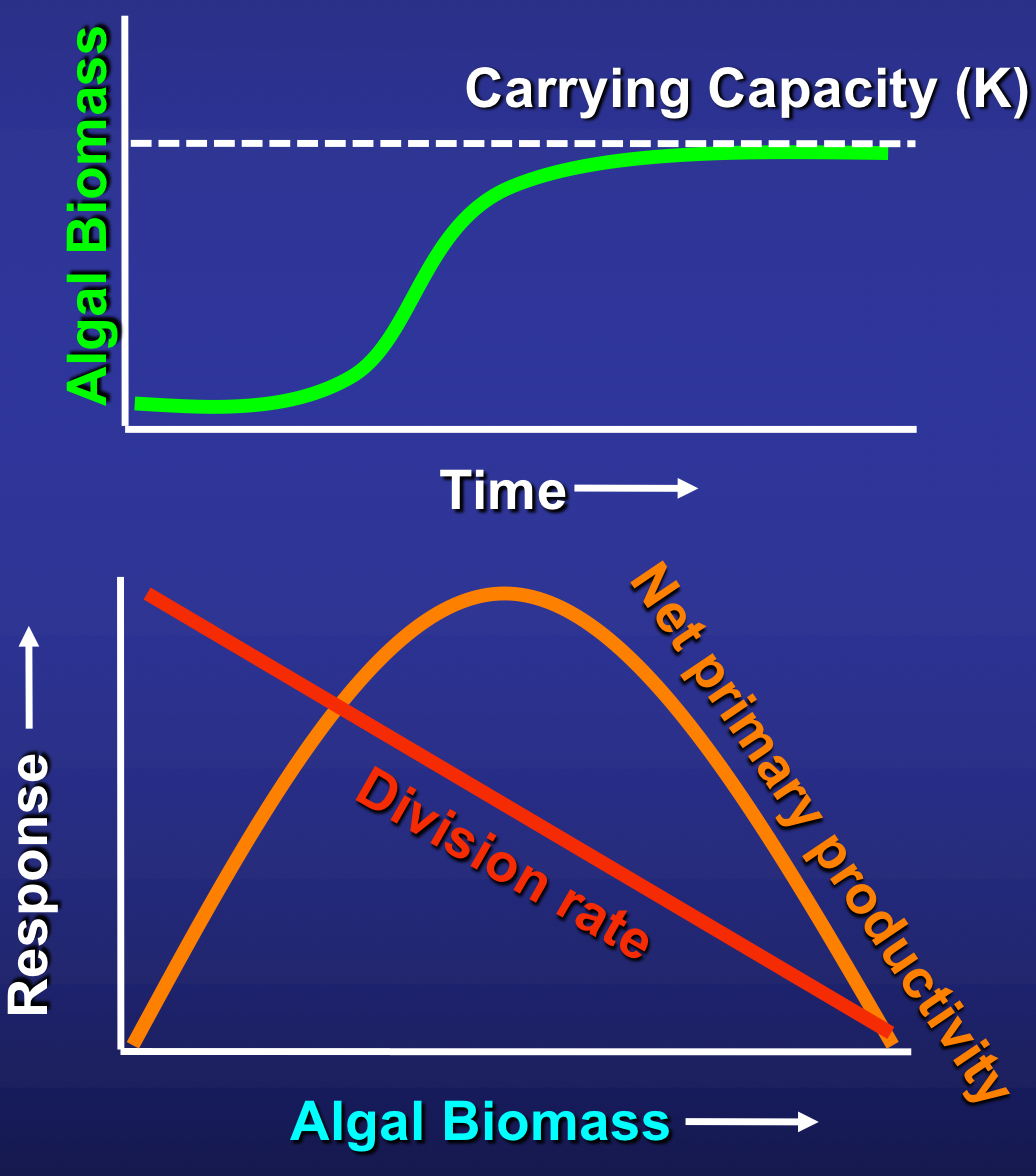
what is the general model of algal biomass accumulation without grazers?
biomass: initially increases due to excess resources, then reaches a carrying capacity
division rate: decreases as algal biomass increases due to the decrease in resources
NPP: initially increases due to excess resources, then drops off as resources decrease
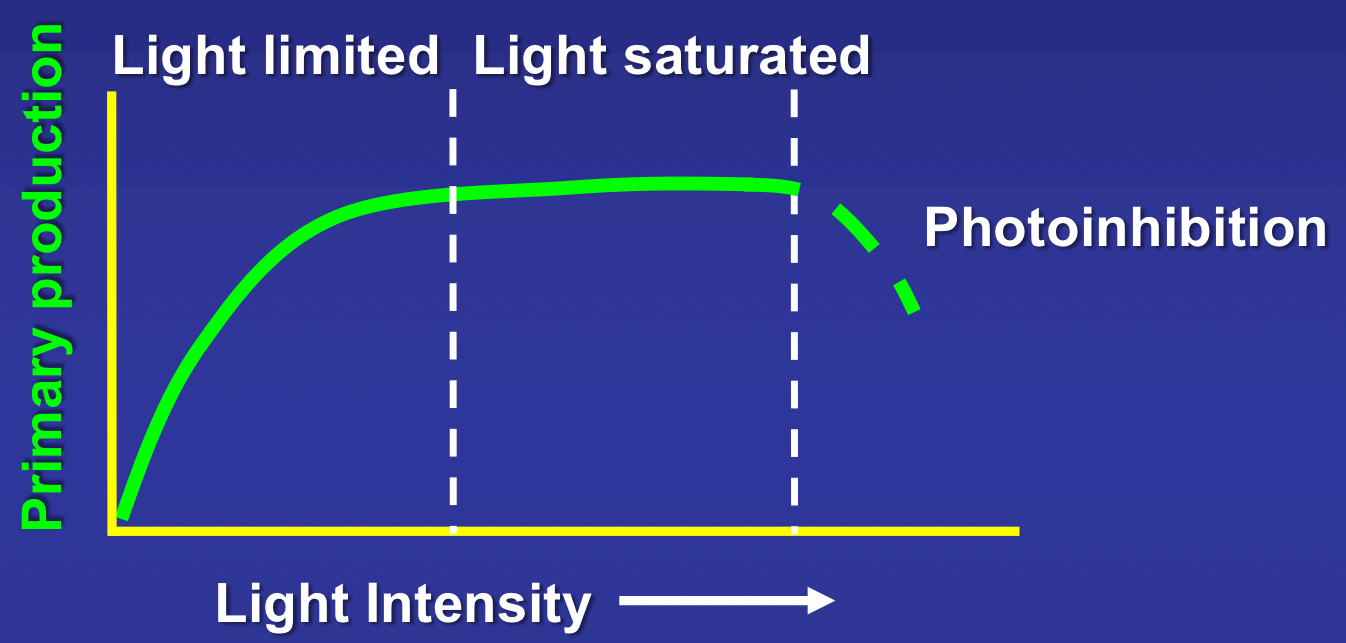
how does light impact productivity?
light limited: low light = critical resource = limits production
light saturated: algae absorbs the maximum amount of light = fueling production
photoinhibition: too much high energy light can damage the algal cells
what were the results for the open canopy stream from the Hill and Knight experiment?
open canopy stream covered with a tarp + added nutrients
results = no increase in biomass
stream is nutrient limited
what were the results for the closed canopy stream from the Hill and Knight experiment?
closed canopy stream had vegetation cut down + added nutrients
results = increased biomass
stream is light limited
what is hypothesis 1 regarding if nutrients limit algal growth?
high delivery rate despite nutrient is low → replaced by upstream sources
never feels the nutrient limitation
what is hypothesis 2 regarding if nutrients limit algal growth?
velocity gradient near the bottom
much slower in boundary layer → decreases delivery rate
means that delivery rate is dependent on the concentration of nutrients
what is the Redfield ratio?
the ratio in which a systen switches from being phosphorus limited to nitrogen limited
below 16:1 = N limited
what does the Redfield ratio look like in natural rivers?
below 10-30:1 = N limited
what are the three ways to manipulate nutrients?
nutrient diffusing substrata
experimental stream channels
whole stream additions
what is Liebig’s Law of the minimum?
growth of an organism is set by substrate in lowest supply relative to the needs of the organism
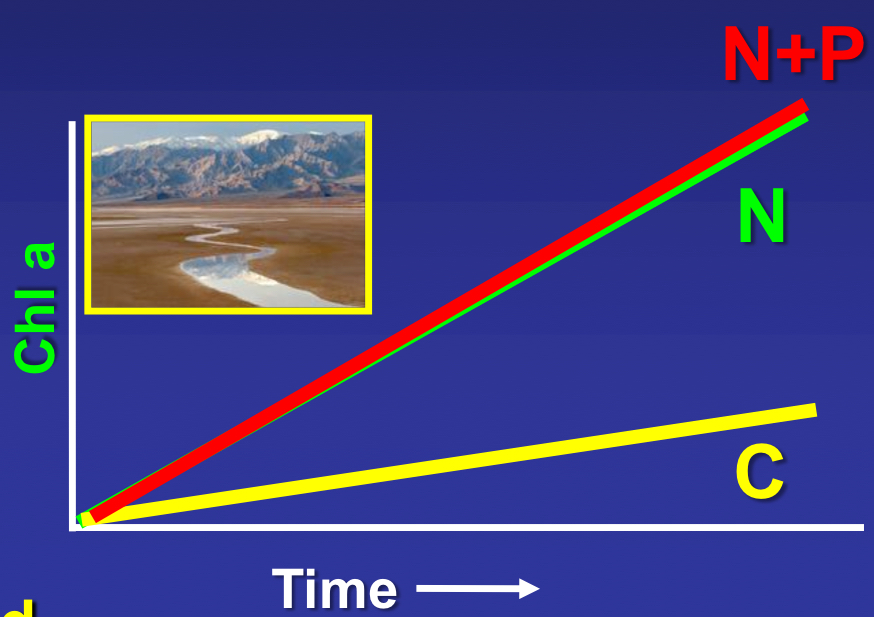
what were the conditions and results of the Grimm and Fisher experiment in desert streams?
desert stream = high P, low N
added only N = increase Chl A
added N+P = no further increase (since there is already P, cannot flip Redfield ratio)
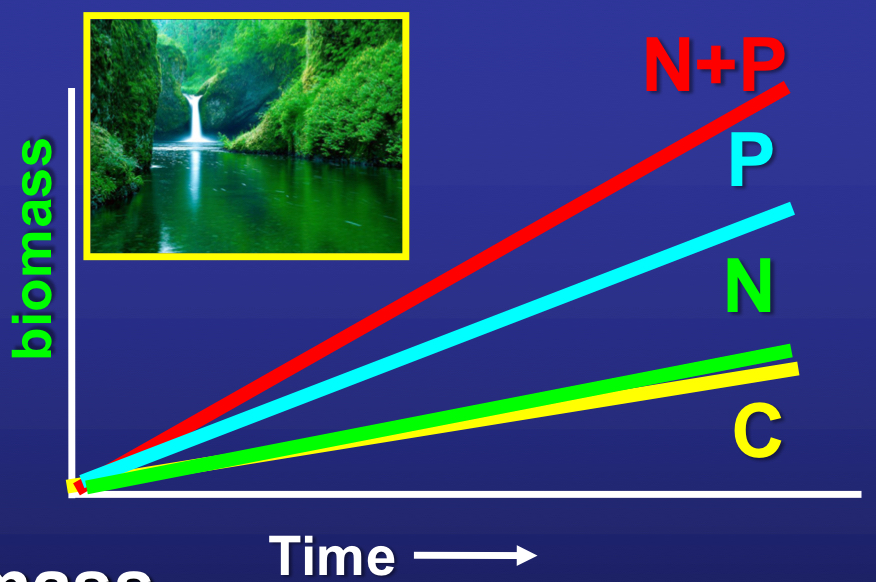
what were the conditions and results of the Stockner and Shortreed experiment in PNW troughs?
PNW troughs = moderate N, low P
added only N = no change from control
added only P = increase Chl A (P was limiting and in most need)
added N+P = further increased Chl A (add P, now N is limiting - flipped Redfield ratio)
what are brushers? what are mobile brushers?
fast moving, takes the top off of algae
mobile brushers: fast resource tracking, removes LESS algae
what are raspers?
intermediate moving, grinds up food more than brushers
what are scrapers? what are sessile scrapers?
slow moving, pulls algae right off the rock
sessile scrapers: slow resource tracking, removes MORE algae
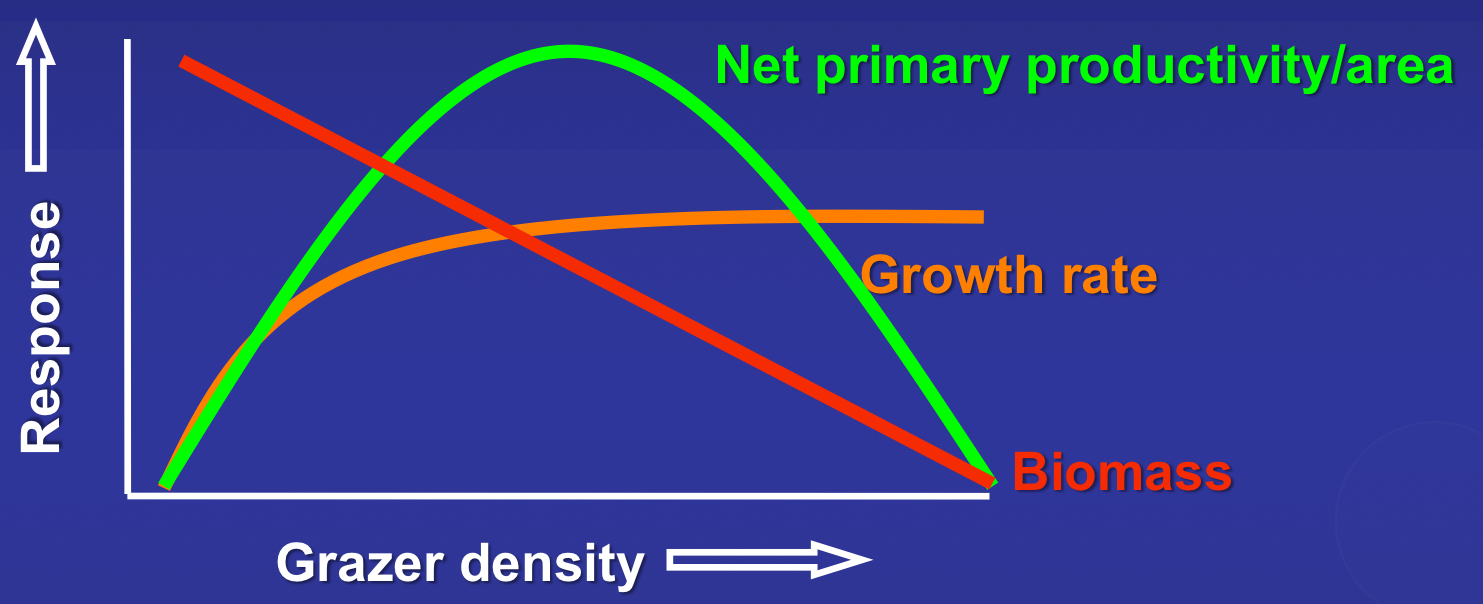
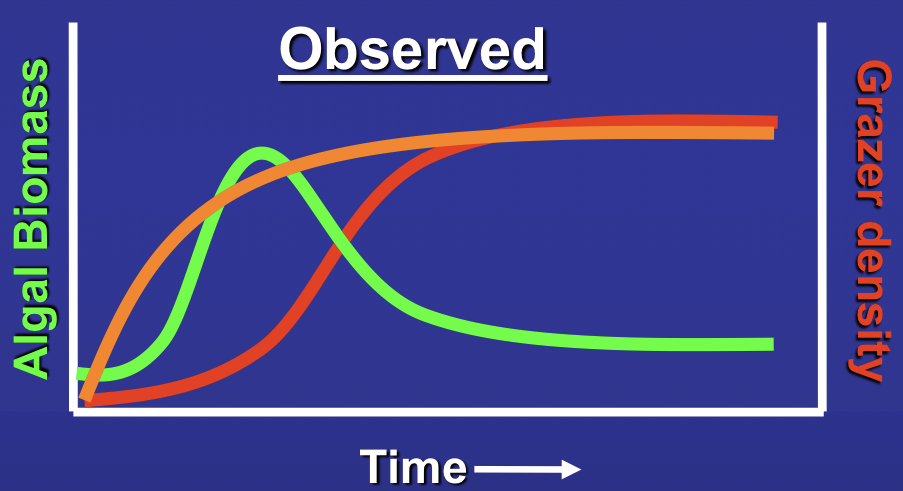
what is the general model for how algae respond to grazing pressure?
biomass: decreases since algae is being consumed by grazers
growth rates: initially there are excess resources per individual allowing for exponential growth → eventually reach peak efficiency and cannot divide anymore
NPP: initially enough resources to stimulate productivity and pack on biomass BUT not enough per unit area so it drops
what are the three experimental techniques used to measure herbivory?
insecticide treatments
artificial substrate
artificial stream channels
what were the Caddisfly results of the Hill and Knight experiment on the direct effects of herbivory?
caddisfly = scraper = bigger impact on algae
decreased Chl A, AFDM, bio volume
match to the model
what were the Mayfly results of the Hill and Knight experiment on the direct effects of herbivory?
mayfly = brusher = less of an impact on algae by only taking the top off
no change in Chl A, AFDM, bio volume
mismatch to the model (why? feeding apparatus)
what were the results of the Lambreti experiment on the effects of multiple grazers (Caddisfly, Snails, Mayfly) on herbivory?
⬆ grazers ⬇ biomass ⬆ growth rate
magnitude of effect: caddisfly > snail > mayfly
match to the model (fails the indirect effects)
what were the results of the Powers experiment on the indirect effects of grazing catfish on herbivory in Panamanian rivers?
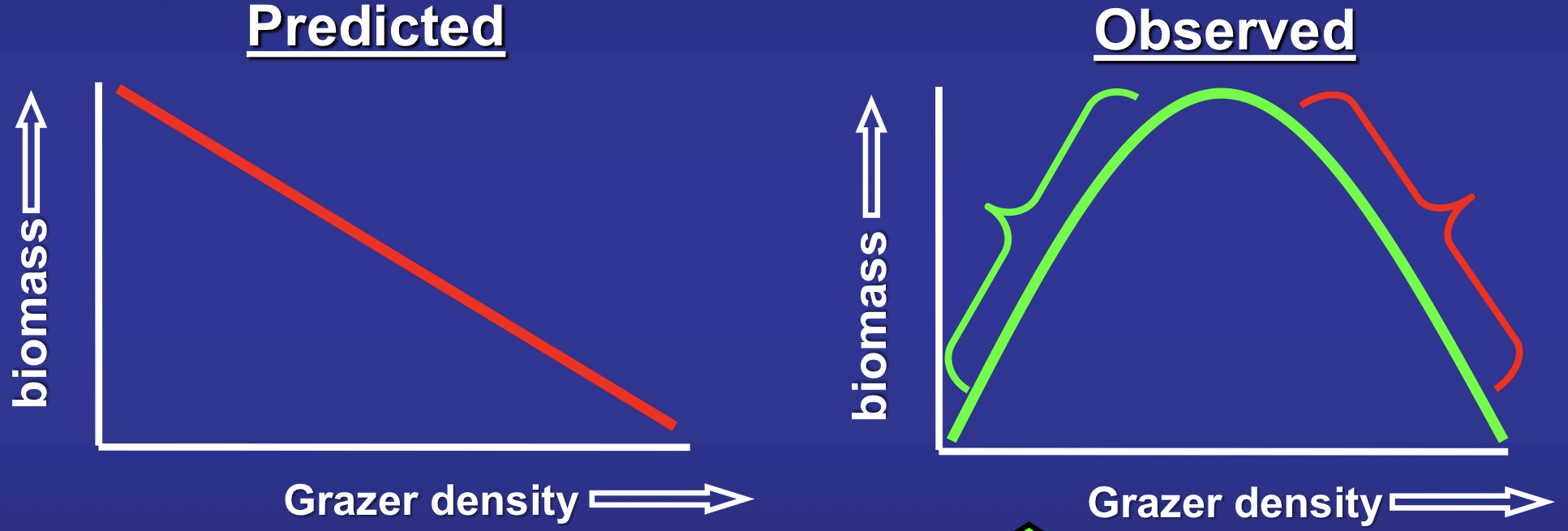
low density of grazers = increased algae biomass (why? grazers bush away sediment allowing for light to reach algae)
high density of grazers = decreased algae biomass (why? grazers are consuming SO much algae that they cannot replenish their biomass)
mismatch to the model
what were the results of the Dudley experiment on the effects of Caddisfly on Cladophora in SPRING?
smooth tile: ⬆ caddisfly = ⬇⬇ cladophora (why? smooth = easier to consume)
rough tile: ⬆ caddisfly = ⬇ cladophora (why? harder to eat the algae due the grooves in the tile)
match to the model
what were the results of the Dudley experiment on the effects of Caddisfly on Cladophora in SUMMER?
⬆ caddisfly = ⬇ epiphytes = ⬆ cladophora (why? missing a trophic level; cladophora grows into a bigger filament making it harder to eat; removal of epiphytes provides more light and nutrients to cladophora)
mismatch to the model
what does adding light and nutrients do to a closed system?
increases algal biomass
what does adding light and nutrients do to a open system?
no effect on algal biomass (why? rapid immigration of grazers)
what were the results of the Steinman experiment adding light to an open system in a SHORT time scale?
match to the model (no change in biomass, increase in grazer density)
increased growth rate due to secondary production by grazers