Wrist Special Tests

0.0(0)
Studied by 0 people
call kaiCall Kai
learnLearn
examPractice Test
spaced repetitionSpaced Repetition
heart puzzleMatch
flashcardsFlashcards
GameKnowt Play
Card Sorting

1/12

encourage image

There's no tags or description

Looks like no tags are added yet.

Last updated 10:43 PM on 5/26/26
Name
Mastery
Learn
Test
Matching
Spaced
Call with Kai

No analytics yet

Send a link to your students to track their progress

13 Terms

1
New cards

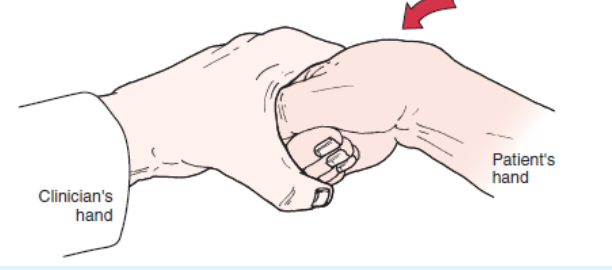
Finkelstein Test

  • PURPOSE- Determine the presence of de Quervain disease, a paratenonitis in the thumb

  • DESCRIPTION- The patient makes a fist with the thumb inside the fingers. The examiner stabilizes the forearm and deviates the wrist toward the ulnar side.

  • RESULT- Pain over the abductor pollicis longus and extensor pollicis brevis tendons at the wrist and is indicative of a paratenonitis of these two tendons.
<ul><li><p><span>PURPOSE- Determine the presence of de Quervain disease, a paratenonitis in the thumb</span></p></li><li><p><span>DESCRIPTION- The patient makes a fist with the thumb inside the fingers. The examiner stabilizes the forearm and deviates the wrist toward the ulnar side.</span></p></li><li><p><span>RESULT- Pain over the abductor pollicis longus and extensor pollicis brevis tendons at the wrist and is indicative of a paratenonitis of these two tendons.</span></p></li></ul><p></p>
2
New cards

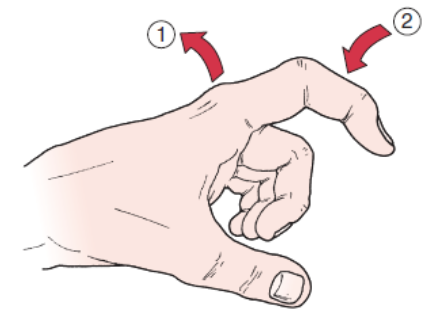
Bunnel- Littler Test

  • PURPOSE- Identifies tightness in structures surrounding the MCP joint

  • DESCRIPTION- The metacarpophalangeal joint is held slightly extended while the examiner moves the proximal interphalangeal joint into flexion, if possible.

  • RESULT- If the test is positive (which is indicated by inability to flex the proximal interphalangeal joint), there is a tight intrinsic muscle or contracture of the joint capsule. If the metacarpophalangeal joints are slightly flexed, the proximal interphalangeal joint flexes fully if the intrinsic muscles are tight, but it does not flex fully if the capsule is tight. The patient remains passive during the test. This test is also called the intrinsic-plus test
<ul><li><p><span>PURPOSE- Identifies tightness in structures surrounding the MCP joint</span></p></li></ul><ul><li><p><span>DESCRIPTION- The metacarpophalangeal joint is held slightly extended while the examiner moves the proximal interphalangeal joint into flexion, if possible.</span></p></li><li><p><span>RESULT- If the test is positive (which is indicated by inability to flex the proximal interphalangeal joint), there is a tight intrinsic muscle or contracture of the joint capsule. If the metacarpophalangeal joints are slightly flexed, the proximal interphalangeal joint flexes fully if the intrinsic muscles are tight, but it does not flex fully if the capsule is tight. The patient remains passive during the test. This test is also called the <em>intrinsic-plus test</em></span></p></li></ul><p></p>
3
New cards

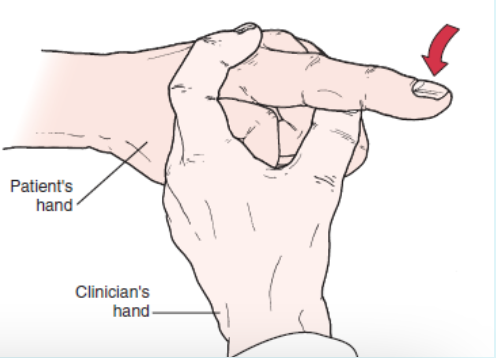
Tight retinacular test

  • PURPOSE- Identify tightness around PIP joint

  • DESCRIPTION- The proximal interphalangeal joint is held in a neutral position while the distal interphalangeal joint is flexed by the examiner.

  • If the distal interphalangeal joint does not flex, the retinacular (collateral) ligaments or proximal interphalangeal capsule are tight.

  • If the proximal interphalangeal joint is flexed and the distal interphalangeal joint flexes easily, the retinacular ligaments are tight and the capsule is normal.
<ul><li><p><span>PURPOSE- Identify tightness around PIP joint</span></p></li><li><p><span>DESCRIPTION- The proximal interphalangeal joint is held in a neutral position while the distal interphalangeal joint is flexed by the examiner. </span></p></li><li><p><span>If the distal interphalangeal joint does not flex, the retinacular (collateral) ligaments or proximal interphalangeal capsule are tight. </span></p></li><li><p><span>If the proximal interphalangeal joint is flexed and the distal interphalangeal joint flexes easily, the retinacular ligaments are tight and the capsule is normal.</span></p></li></ul><p></p>
4
New cards

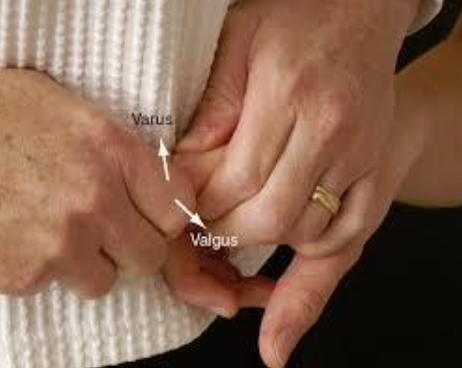
ligament instability test

  • PURPOSE- Identify ligament instability, medial or lateral

  • DESCRIPTION- Fingers are stabilized and supported. Varus or valgus stress applied to the joint (proximal or distal interphalangeal) to test the integrity of the collateral ligaments

  • RESULT- The results are compared for laxity with those of the uninvolved hand, which is tested first.
<ul><li><p><span>PURPOSE- Identify ligament instability, medial or lateral</span></p></li><li><p><span>DESCRIPTION- Fingers are stabilized and supported. Varus or valgus stress applied to the joint (proximal or distal interphalangeal) to test the integrity of the collateral ligaments</span></p></li><li><p><span>RESULT- The results are compared for laxity with those of the uninvolved hand, which is tested first.</span></p></li></ul><p></p>
5
New cards

Froment Sign

  • PURPOSE- Identify ulnar nerve dysfunction

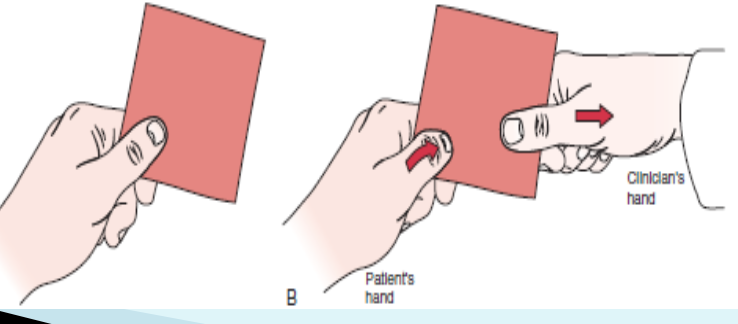
  • DESCRIPTION- The patient attempts to grasp a piece of paper between the thumb

    and index finger

  • RESULT- When the examiner attempts to pull away the paper, the terminal phalanx of the thumb flexes because of paralysis of the adductor pollicis muscle, indicating a positive test.

  • If, at the same time, the metacarpophalangeal joint of the thumb hyperextends, the hyperextension is noted as a positive Jeanne’s sign.

  • Both tests, if positive, are indicative of ulnar nerve paralysis
<ul><li><p><span>PURPOSE- Identify ulnar nerve dysfunction</span></p></li><li><p><span>DESCRIPTION- The patient attempts to grasp a piece of paper between the thumb</span></p><p><span>and index finger</span></p></li><li><p><span>RESULT- When the examiner attempts to pull away the paper, the terminal phalanx of the thumb flexes because of paralysis of the adductor pollicis muscle, indicating a positive test. </span></p></li><li><p><span>If, at the same time, the metacarpophalangeal joint of the thumb hyperextends, the hyperextension is noted as a positive Jeanne’s sign. </span></p></li><li><p><span>Both tests, if positive, are indicative of ulnar nerve paralysis</span></p></li></ul><p></p>
6
New cards

Wartenberg Sign

  • PURPOSE- Identify ulnar nerve neuropathy

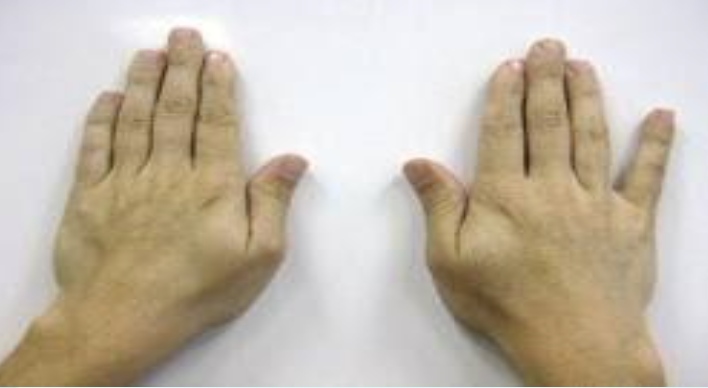
  • DESCRIPTION- The patient sits with his or her hands resting on the table. The examiner passively spreads the fingers apart and asks the patient to bring them together again.

  • RESULT- Inability to squeeze the little finger to the remainder of the hand indicates a positive test for ulnar neuropathy
<ul><li><p><span>PURPOSE- Identify ulnar nerve neuropathy</span></p></li><li><p><span>DESCRIPTION- The patient sits with his or her hands resting on the table. The examiner passively spreads the fingers apart and asks the patient to bring them together again.</span></p></li><li><p><span>RESULT- Inability to squeeze the little finger to the remainder of the hand indicates a positive test for ulnar neuropathy</span></p></li></ul><p></p>
7
New cards

Hoffman Sign

  • PURPOSE- Indicates upper motor neuron dysfunction

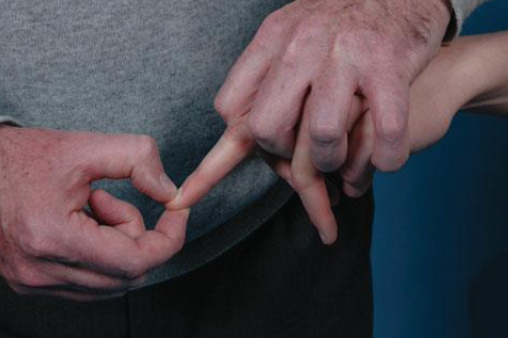
  • DESCRIPTION- The examiner holds the patient’s middle finger and briskly flicks the

    distal phalanx

  • RESULT- A positive sign is noted if the interphalangeal joint of the thumb of the same hand flexes/adducts. The fingers may also flex.
<ul><li><p><span>PURPOSE- Indicates upper motor neuron dysfunction</span></p></li><li><p><span>DESCRIPTION- The examiner holds the patient’s middle finger and briskly flicks the</span></p><p><span>distal phalanx</span></p></li><li><p><span>RESULT- A positive sign is noted if the interphalangeal joint of the thumb of the same hand flexes/adducts. The fingers may also flex.</span></p></li></ul><p></p>
8
New cards

Thumb grind test

  • PURPOSE- Identify degenerative joint disease in the metacarpophalangeal or metacarpotrapezial joint

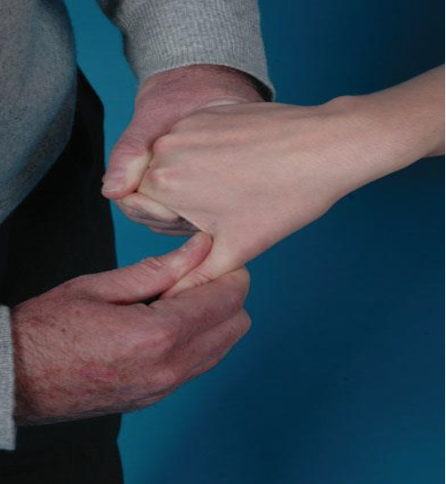
  • DESCRIPTION- The examiner holds the patient’s hand with one hand and grasps the patient’s thumb below the metacarpophalangeal joint with the other hand. The examiner then applies axial compression and rotation to the metacarpophalangeal joint

  • RESULT- If pain is elicited, the test is positive and indicative of degenerative joint disease in the metacarpophalangeal or metacarpotrapezial joint
<ul><li><p><span>PURPOSE- Identify degenerative joint disease in the metacarpophalangeal or metacarpotrapezial joint</span></p></li><li><p><span>DESCRIPTION- The examiner holds the patient’s hand with one hand and grasps the patient’s thumb below the metacarpophalangeal joint with the other hand. The examiner then applies axial compression and rotation to the metacarpophalangeal joint</span></p></li><li><p><span>RESULT- If pain is elicited, the test is positive and indicative of degenerative joint disease in the metacarpophalangeal or metacarpotrapezial joint</span></p></li></ul><p></p>
9
New cards

Murphy Sign

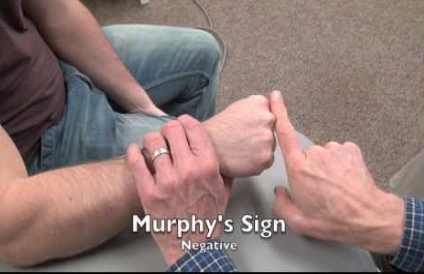
  • PURPOSE- Identify lunate dislocation

  • DESCRIPTION- The patient is asked to make a fist. If the head of the third metacarpal is level with the second and fourth metacarpals, the sign is positive and indicative of a lunate dislocation. Normally, the third metacarpal would project beyond (or further distally) the second and fourth metacarpals.
<ul><li><p><span>PURPOSE- Identify lunate dislocation</span></p></li><li><p><span>DESCRIPTION- The patient is asked to make a fist. If the head of the third metacarpal is level with the second and fourth metacarpals, the sign is positive and indicative of a lunate dislocation. Normally, the third metacarpal would project beyond (or further distally) the second and fourth metacarpals.</span></p></li></ul><p></p>
10
New cards

Tinel Sign

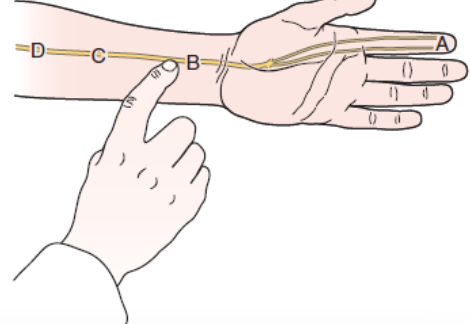
  • PURPOSE-Identify carpal tunnel compression of median nerve

  • DESCRIPTION- The examiner taps over the carpal tunnel at the wrist

  • RESULT- A positive test causes tingling or paresthesia into the thumb, index finger, and middle and lateral half of the ring finger. Tinel sign at the wrist is indicative of a carpal tunnel syndrome.
<ul><li><p><span>PURPOSE-Identify carpal tunnel compression of median nerve</span></p></li><li><p><span>DESCRIPTION- The examiner taps over the carpal tunnel at the wrist</span></p></li><li><p><span>RESULT- A positive test causes tingling or paresthesia into the thumb, index finger, and middle and lateral half of the ring finger. Tinel sign at the wrist is indicative of a carpal tunnel syndrome.</span></p></li></ul><p></p>
11
New cards

Phalen Test

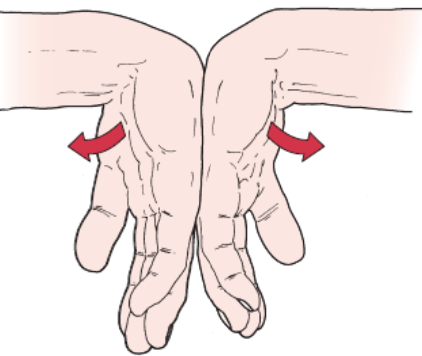
  • PURPOSE- Identify carpal tunnel compression of median nerve

  • DESCRIPTION- The examiner flexes the patient’s wrists maximally and holds this position for 1 minute by pushing the patient’s wrists together.

  • RESULT- Production of the patient’s symptoms is considered to be a positive test for carpal tunnel syndrome. The test may also involve flexing the wrist 60° before applying the pressure and whether symptoms are relieved when the examiner lets go. The wrist flexion is felt to make the test more sensitive
<ul><li><p><span>PURPOSE- Identify carpal tunnel compression of median nerve</span></p></li><li><p><span>DESCRIPTION- The examiner flexes the patient’s wrists maximally and holds this position for 1 minute by pushing the patient’s wrists together.</span></p></li><li><p><span>RESULT- Production of the patient’s symptoms is considered to be a positive test for carpal tunnel syndrome. The test may also involve flexing the wrist 60° before applying the pressure and whether symptoms are relieved when the examiner lets go. The wrist flexion is felt to make the test more sensitive</span></p></li></ul><p></p>
12
New cards

2 pt discrimination test

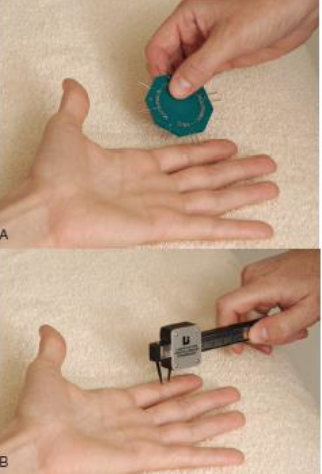
  • PURPOSE-To identify level of sensory innervation in hand

    • DESCRIPTION- The examiner uses a paper clip, two-point discriminator, or calipers to simultaneously apply pressure on two adjacent points in a longitudinal direction or perpendicular to the long axis of the finger; the examiner moves proximal to distal in an attempt to find the minimal distance at which the patient can distinguish between the two stimuli. Only the fingertips need to be tested. Normal discrimination distance recognition is less than 6 mm
<ul><li><p><span>PURPOSE-To identify level of sensory innervation in hand</span></p><ul><li><p><span>DESCRIPTION- The examiner uses a paper clip, two-point discriminator, or calipers to simultaneously apply pressure on two adjacent points in a longitudinal direction or perpendicular to the long axis of the finger; the examiner moves proximal to distal in an attempt to find the minimal distance at which the patient can distinguish between the two stimuli. Only the fingertips need to be tested. <strong>Normal discrimination distance recognition is less than 6 mm</strong></span></p></li></ul></li></ul><p></p>
13
New cards

Allen Test

  • PURPOSE- To identify vascular compromise

  • DESCRIPTION- The patient is asked to open and close the hand several times as quickly as possible and then squeeze the hand tightly. The examiner’s thumb and index finger are placed over the radial and ulnar arteries, compressing them. The patient then opens the hand while pressure is maintained over the arteries. One artery is tested by releasing the pressure over that artery to see if the hand flushes. The other artery is then tested in a similar fashion.
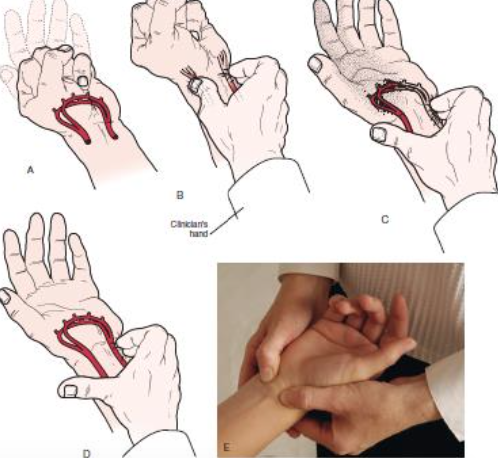
<ul><li><p><span>PURPOSE- To identify vascular compromise</span></p></li><li><p><span>DESCRIPTION- The patient is asked to open and close the hand several times as quickly as possible and then squeeze the hand tightly. The examiner’s thumb and index finger are placed over the radial and ulnar arteries, compressing them. The patient then opens the hand while pressure is maintained over the arteries. One artery is tested by releasing the pressure over that artery to see if the hand flushes. The other artery is then tested in a similar fashion.</span></p></li></ul><p></p>



