5.4 – Supply‑Side Policy
 Call Kai
 Learn
Learn Practice Test
 Spaced Repetition
 Match
Match Flashcards
 Knowt Play
1/25

There's no tags or description
Looks like no tags are added yet.
Name | Mastery | Learn | Test | Matching | Spaced | Call with Kai |
|---|
No analytics yet
Send a link to your students to track their progress
26 Terms
What is ‘supply-side policy’
Government actions aimed at increasing the productive capacity of the economy and improving the efficiency of factors of production, usually shifting LRAS to the right.
- Government policy tools designed to increase aggregate supply by improving the workings of product and factor markets

What are the main objectives of supply-side policy
Increasing productivity
2. Increasing productive capacity
What does ‘increasing productivity’ mean
Making workers and firms more efficient so that more output is produced from the same inputs
What does ‘increasing productive capacity’ mean
Expanding the economy’s potential output so it can produce more without creating inflation.
What supply‑side policy tools can governments use (8)
Supply‑side tools include:
1. Spending on education and training
2. Infrastructure development
3. Support for technological improvement (e.g., subsidies for R&D)
4. Cuts in corporate tax
5. Cuts in income tax
6. Trade union reform
7. Privatisation and deregulation
8. Encouraging immigration of skilled workers
How does improving education and training increase productive capacity
Better quality education and training improve workers’ skills, productivity, flexibility, and mobility, leading to a more efficient labour force. This increases the economy’s productive capacity, boosts output, and supports innovation and entrepreneurship.
How does promoting infrastructure development support supply‑side growth
High‑quality infrastructure (transport, power, telecommunications) reduces costs of firms, prevents production interruptions, improves distribution, and helps firms operate efficiently—leading to higher productivity and output.
How does government support for technological improvement boost output
Technological improvement increases capital efficiency, allowing firms to produce more at lower cost. Governments can subsidise universities and firms to encourage innovation, raising both productivity and output.
How do cuts in corporate tax act as a supply‑side tool
Lower corporate tax increases firms’ retained profits, encouraging investment. More investment boosts aggregate demand and aggregate supply, raising productive capacity.
How do cuts in income tax improve supply‑side performance
Lower income tax encourages workers to increase hours, take promotions, or remain in the labour force longer. It can also attract new workers into employment, increasing the labour supply.
How does trade union reform support supply‑side policy
Reducing union power can increase worker flexibility and mobility, reduce strike days, and make the country more attractive to multinational firms. This may raise productivity and production.
How do privatisation and deregulation improve supply‑side performance
Privatisation encourages efficiency by moving firms to the private sector, while deregulation removes barriers to entry and reduces compliance costs, lowering firms’ production costs and increasing output.
How does encouraging skilled immigration help the economy
Skilled immigration increases both the quantity and quality of labour, improving productivity and expanding the economy’s productive capacity.
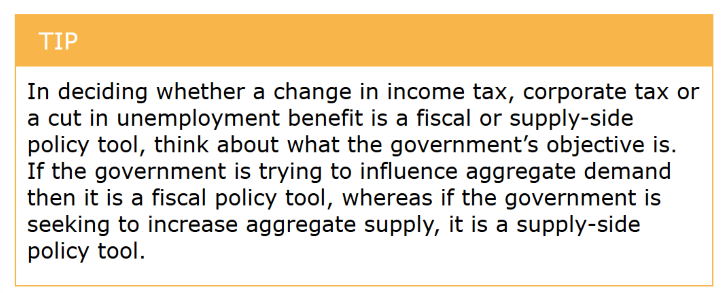
Tip - when deciding whether a tax is fiscal or supply-side consider its effect
Which macroeconomic objectives do supply-side policies help with
All - They can raise economic growth, reduce inflationary pressures and lower unemployment
How do supply‑side policy tools affect national income and real output
By raising the productivity, quality, and quantity of labour and capital, supply‑side tools increase national income and real output.
Better training raises labour productivity, infrastructure increases production capacity, and new technology improves the efficiency of capital goods reducing costs of production and increasing output — leading to higher long‑run growth.
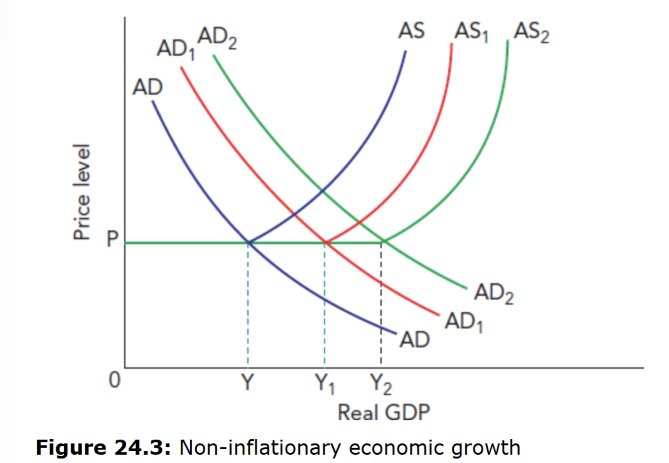
How do supply‑side policies affect the price level (diagram)
If aggregate supply increases in line with rising aggregate demand, output can grow from Y → Y₁ → Y₂ without causing demand‑pull inflation.
Supply‑side tools also help reduce cost‑push inflation by lowering labour and production costs (for example, through improved skills and productivity).
How do supply‑side policy tools affect employment
Supply‑side policies can reduce frictional and structural unemployment by improving education and training, which raises workers’ skills and mobility (geographical and occupational).
Although technological improvement may replace some workers with capital, both technological progress and infrastructure development can increase employment by lowering production costs, boosting sales, and encouraging firms to hire more workers to meet higher output.
What does the effectiveness of supply‑side policies depend on (6)
The effectiveness of supply‑side policies depends on:
1. Time lags – many policies (e.g. education, infrastructure) take years to have an impact.
2. Quality and relevance of measures such as training and skill development.
3. Costs and delays, especially with infrastructure projects.
4. How evenly benefits are distributed (technological change can displace some workers).
5. The strength of aggregate demand – increased productive capacity will not raise output if demand is too low.
6. Adjustment ability of firms and workers to new technologies and job patterns.
Why might education and training be less effective in the short run
It takes a long time for skills to develop, so short‑run effects are small. Increased government spending may also raise aggregate demand, causing inflation before supply increases. Training may also be ineffective if quality is poor or if workers’ new skills are not in future demand.
What are limitations of infrastructure development as a supply‑side policy
Infrastructure projects are expensive, take years to complete, and may be poorly located or outdated by completion. Some projects may also cause environmental harm.
What are the advantages and drawbacks of technological improvement
Technological improvement raises productivity and output, but benefits may be unevenly distributed. It can displace workers, create new job types that not everyone can adapt to, and involve adjustment costs.
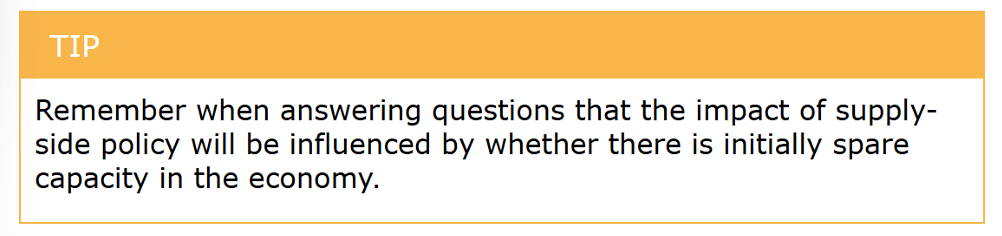
Why might supply‑side policies fail to increase output even if they raise productive potential
If the economy has insufficient aggregate demand, firms will not use the extra capacity. They may be able to produce more, but will not do so if they do not expect sales to rise.
What are ‘labour market reforms’
Policies such as flexible wages, reduced labour taxes, and eased employment regulations that improve employment and efficiency.
Explain the chain of reasoning for supply-side policy.
Improved infrastructure, skills, or incentives → firms produce more efficiently → LRAS shifts right → output rises, employment rises, price level stable → long-term economic growth increases.
What is the difference between supply-side policy and demand-side policies
Supply-side policy focuses on increasing productive capacity and efficiency (long-term growth), whereas fiscal and monetary policies influence aggregate demand (short-term growth and stability).