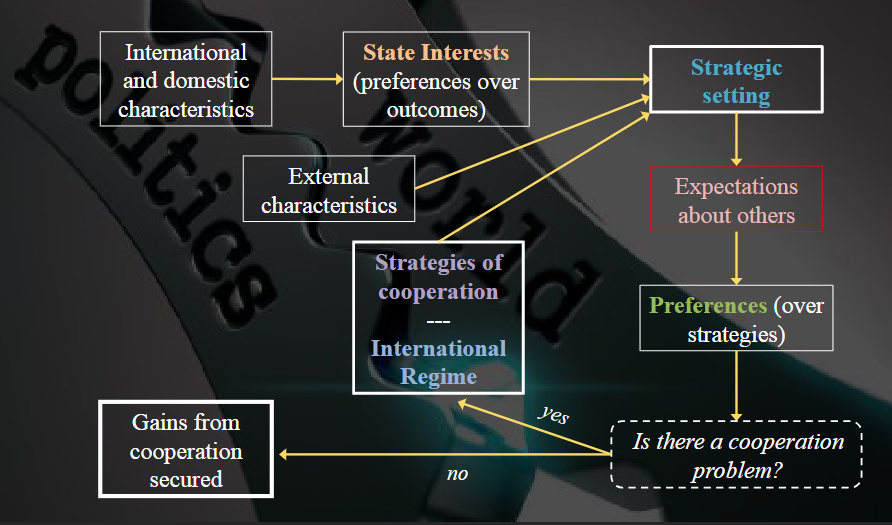
Poli244
 Call Kai
 Learn
Learn Practice Test
 Spaced Repetition
 Match
Match Flashcards
 Knowt Play
1/304

There's no tags or description
Looks like no tags are added yet.
Name | Mastery | Learn | Test | Matching | Spaced | Call with Kai |
|---|
No analytics yet
Send a link to your students to track their progress
305 Terms
International Relations
The study of the interactions among the actors that
participate in international politics (e.g. States,
international organizations, non-governmental organizations,
individuals, etc.).
It is the study of the behaviours of these actors as they
participate individually and together in international
political processes
The social scientific study of world politics
Making sense of a phenomenon by simplifying a complex reality
into a simpler, intelligible one
Paradigm, theory, explaination
Parsimony
The optimal combination of simplicity and explanatory power
Generalizable knowledge
Patterns of behaviour
Causation
Assumptions
Falsifiable
Testable through observation (evidence)
Hypotheses
From variables to observable indicators
The path of social scientific research
1. Identify some phenomenon that needs to be
explained
2. Offer some tentative observable hypotheses
(derived from one or more theories)
3. Test the hypotheses in light of available evidence
State
Political organization that manages the affairs of a
population in a given territory
The modern (Westphalian) State
Territoriality
• Effective control
• Sovereignty ↔ international anarchy
Nationalism and the State
Nationalist expansionism and unification
Nationalist separatism
Other Actors in International relations
States, NGOs & IGOs
State centerism (Prevalent in IR)
Focuses on relationships between governments and between governments and IGOs
Transnational view of world politics
Focuses on interactions that take place between governments and international / domestic nongovernmental actors.
Levels of Analysis in IR
Individual, State & international
One of those 3 analysed via:
Location of explainatory factor, explainatory factor, then international phenominon to be explained
Neorealism/Structural realism
Emphasizes the role of power politics in international relations, sees competition and conflict as enduring features and sees limited potential for cooperation
Constant Anarchy
Makes war possible
Power
Measure of states vulnerability
Anarchy, uncertainty of intentions, and the security dilemma
The ability to influence the behaviour of others to get the
outcomes one wants
International politics
Power politics (Realpolitik) among like units
Can be explained with polarity (materialism)
Behavioural power
“A’s ability to get B to do something that B
would not otherwise do.” (R. Dahl)
Power as influence
The process of exercising influence over others
Power as capabilities
A set of attributes or resources that can be
used to alter the behaviour of others
Power cannot be reduced to capabilities:
Costs of using those capabilities
Beliefs about others’
capabilities
Coercion
The active use of capabilities
Threats & promises
The passive use of capabilities
The structural effect of capabilities
Perceptions
Natural capabilities
Geography, natural resources, land, population
Political & social resources
Internal mobilization
Synthetic capabilities
Economy (size and dynamism), military capability
Compellence
1) A. doing something B. cannot tolerate
2) B. initiates action against A. to stop intolerable actions.
3) Both A. and B. stop actions.
Deterrence
1) A. not presently doing anything B. finds intolerable
2) B. tells A. if A. does something intolerable, B. will punish A.
3) A. continues to not do anything B. finds intolerable
Horizontal nuclear proliferation
Since 1940, avg trend is 1 new state with nuclear weapons every 5 years, until mid 90s when Ukraine, Belarus, Kazakhstan & South Africa became part of NNWS
States with nuclear weapons (Estimated)
United States (5044) -
Russia (5580) +
UK (225) +
France (290) =
China (500) =
Israel (90) =
India (172) +
Pakistan (170) +
North Korea (50) +
Behavioral power
Getting others to do what you want
Hard power
Coercion, threats, promises (Influence over outcomes)
Structural power
The ability of A to influence the
context or environment surrounding B’s decisions (Influence over outcomes)
Soft power
Getting others to want the outcomes that
you want (Influence over preferences)
Neorealism and the Ukraine crisis
• NATO’s enlargement
• EU’s Eastern Partnership initiative
• West-led democratization in post-Soviet states
• “Realpolitik remains relevant – and states that ignore it do so at their own peril.” (J. Mearsheimer)
The Balance of Power
A situation in which
power is distributed
equally
The Balance of Power Theory
Explains a systemic tendency
toward equilibrium.
The mechanisms of Balance of Power Theory
States seek security which leads to both a balanced distribution of power and an unbalanced distribution of power. (Tilted in their favour) The constant teetering leads to a balanced distribution of power over time.
Power-Gap Minimizers
eg. Balanced distribution of power
Power-Gap Maximizers
Eg. Unbalanced distribution of power
Policies that tends to restore balance of power
Internal
Militerization
Policies Intended to restore balance of power
External
Alliances
Different Types of Power Balancing
Hard Balancing:
Military buildups and alliances
• Becoming rare
• Too costly (and dangerous) under unipolarity
• High opportunity costs (econ interdependence, common threats, etc)
Soft balancing:
Limited, attritional balancing
• May refer to hard power or soft power resourcesInstitutional balancing
Using and pooling institutional
resources
Asymmetric balancing: War of attrition by (weak) non-state
Hegemonic orders and War
Robert Gilpin’s theory of systemic change (hegemonic war)
– The stability of an international system is determined by the
relationship between:
• The distribution of material power
• The distribution of prestige
• The rights and rules that set parameters of behavior
Gilpin’s theory
of systemic
change
System in state of equilibrium (consolidated hegemony) leads to differential growth of power which leads to redistribution of power in the
system (declining hegemony) which leads to the rise of a challenger which leads to disequilibrium of the system which leads to bipolarization which leads to Resolution of systemic crisis (hegemonic war) which leads to peace settlements which leads to a system in a state of equilibrium and the cycle repeats.
Status quo vs Revisionist states
Revisionists/Dissatisfied:
North Korea (Small power)
Iran, Russia (Middle Power)
China (Great power)
Status Quo/Satisfied:
Mexico (Small power)
Canada (Middle power)
Japan, Germany (Great power)
USA (Dominant state)
Why would the dominant state’s power decline?
• Exogenous factors
– Technical innovations
– Political organization
– Good (regional) leadership
• Endogenous factors
– Uneven environmental pressures
Preventive wars
During transition period between dominant and challenger state, if both have high capabilities, a war is likely to break out
Re-ordering of international politics after WW2
USA: NATO + Marshall Plan + Bretton Woods - - USSR: Informal empire in Eastern Europe (Warsaw Pact)
The Cold War (1947-1991)
– Balance of Power of US hegemony (unsuccessfully challenged)
– Conflicts: Berlin crisis (1961), Cuban missile crisis (1962)
International stability without cooperation
• Hegemonic systems
• Balance-of-power systems
International stability with cooperation
Concert systems
• Collective-security systems
Balance-of-power systems
• States are stuck in a Pareto-suboptimal equilibrium of mutual defection
(Security dilemma)
• Underlying instability (internal/external balancing)
Concert systems
• Deliberate cooperation among great powers to manage their affairs
through multilateral mechanisms and self-restraint
• Concert of Europe (1815-1853)
The Concert of Europe (1815-1853)
• The Great Powers would govern Europe
• France would become the fifth Great Power
• Strategic territorial divisions would create spheres of influence (with complete disregard for history, nationality, or dynastic right)
• The distribution of territory reflected the bargaining power of each of the Great Powers
• A self-enforcing settlement
• For every potentially contestable territory, there existed some coalition of states that had a clear interest in blocking undesirable changes to the status quo
• The deterrent threat against defection was credible because it was self-interested
• The defenders of the settlement were self-selected by their own selfish interests.
The Concert Turning to War
All Leading To The Great War:
- Memories of the Napoleonic wars faded → unifying fear gone
• Ottoman Empire in decline → power vacuum in SE Europe
• Crimean War (1853-1856) → Russia defeated by GB-F
• Nationalist movements threaten multi-national States
• Italian and German unifications (1860s-1870s)
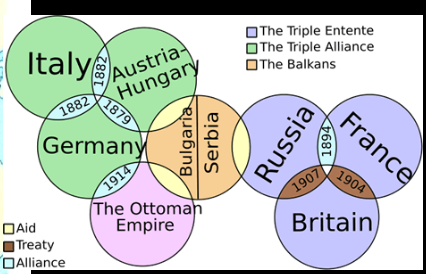
• Bismarckian system of alliances → to keep the BoP in Europe
• Germany: “One of three in a world of five”
• Three Emperors League (G, R, AH) → to deter France
• The Dual Alliance (G, AH) → to deter both R and AH from going against
each other in the Balkans
• The Triple Alliance (G, AH, I) → to deter Italy from attacking Austria
• Entente between Germany and Great Britain → mutual reassurance
• Wilhelm II in Germany + Russian ambitions
• Three Emperors League (G, R, AH) → Franco-Russian Dual Alliance (R, F)
against the Triple Alliance (G, AH, I)
• Germany grows → Triple Entente (R, F, GB)
Pre-WWI system
of alliances
States react to…
Threats, not power (Usually)
Bandwagoning
Allying with the dominant side
For either appeasement (defense)
Or ambition (Offense)
Uncertainty of intentions → the cost of a perception error
In a world of band wagoners…
• Threatening states (aggression) are rewarded
• Demonstrating aggressiveness is best
In a world of balancers…
• Threatening states (aggression) provoke resistance
• Demonstrating self-restraint is best
The emergence of the sovereign State
• War and preparation for war: Finding an efficient way of resource
extraction (men, arms, supplies, money)
• 1000-1350 economic renaissance (burghers)
• 3 institutional outcomes: sovereign states (France), city-states (Italian
city-states), city-leagues (Hanseatic League)
The predominance (selection) of the sovereign State
• War-waging advantage
• Law-enforcement & Transaction costs reduction
• Inter-unit relations: lower commitment problems
The functions of war in the international system
• Redistribution of material power
• Adjustment on the hierarchy of prestige
• War as a marker of power/political authority
• Establishment and enforcement of an international order
The regulation of war in the international system
• State sovereignty, non-intervention, and war
• The regulation of war to protect and enhance State sovereignty
• War in the UN-based system
• Who can fight a war? → the right to kill
• When can we fight a war? → jus ad bellum
- The right to self-defense
- UN Security Council authorization
• How can we fight a war? → jus in bello / laws of war / IHL
• War and criminal (individual) accountability
• Jus ad bellum → The international crime of aggression
• Jus in bello → Genocide, crimes against humanity, war crimes, etc.
Rational Choice Approach
Explaining international politics as the outcome of
individual goal-seeking decisions
Explanations proceed in terms of the relevant actors, the
goals they seek, and their ability to achieve them
Only very general substantive commitments
• Any actor’s choices can be modelled as rational choices.
• Behavior can be oriented to any goals.
• Goal-seeking can be constrained by obstacles internal or
external to the rational actor.
A rational-choice theory will need to make more
substantive commitments:
• Who are the relevant actors? What goals do they pursue? How
constrained is their ability to do so?
• What is rational about the choice is not the goal it
seeks but the relationship between goal and behaviour
• A goal is never rational; an action is rational (in light of a given goal)
• Rational Choice explains behavior (endogenous), not goals
(exogenous)
Rational choice steps
Consider all possible strategies
Rank outcomes
Select best strategy
Rational Actor real vs Ideal
Actor decided rationally vs behaved as if it were rational
Inductive theorizing
Making a model that fits the data
Testing rationalism against its rivals
Testing theories, not meta-theoretical approaches
The impossibility of rational calculations
We cannot process all relevant information about all possible
courses of action (Bounded rationality)
Information processing: Cognitive short-cuts
The (mis-)use of analogies
Cognitive dissonance
Staying within the psychological zone of
comfortDiscounting evidence that is inconsistent with our prior beliefs
Choosing options the anticipated outcomes of which 0are consistent
with prior beliefs
Attribution
Egocentric bias & Fundamental attribution error
Mutual attribution of hostile intentions → conflict escalation, arms
races, etc.
Prospect theory
Subjective (biased) expected utility
• The rational actor’s utility function: Unbiased perception of value
• Actors are often not neutral about risk: Risk aversion when things
are going well; risk acceptance when things are going badly
Endowment effect
Reversing losses; gain/loss focus
• Framing: reference points and risk taking
Reactive devaluation (interpersonal bias)
• Implications for threats vs. promises in negotiations
• The subjective value of concessions in bargaining
Deterrence theory
The more costly wars are, the more
unlikely they are
• Wars happen when: E(benefits) - E(costs) > 0
• Nuclear weapons as the ultimate deterrent (MAD)
• The effectiveness of deterrent threats depends on:
• Retaliatory capacity → second-strike capability, ABMs, target localization, etc.
• Willingness to retaliate (resolve) → political costs, humanitarian considerations, unclear benefits, ect.
The more destructive the retaliatory attack, the less important
credibility is
• E(benefits) > E(costs)
• Nuclear deterrence and the security dilemma
• Nuclear deterrence and soft balancing
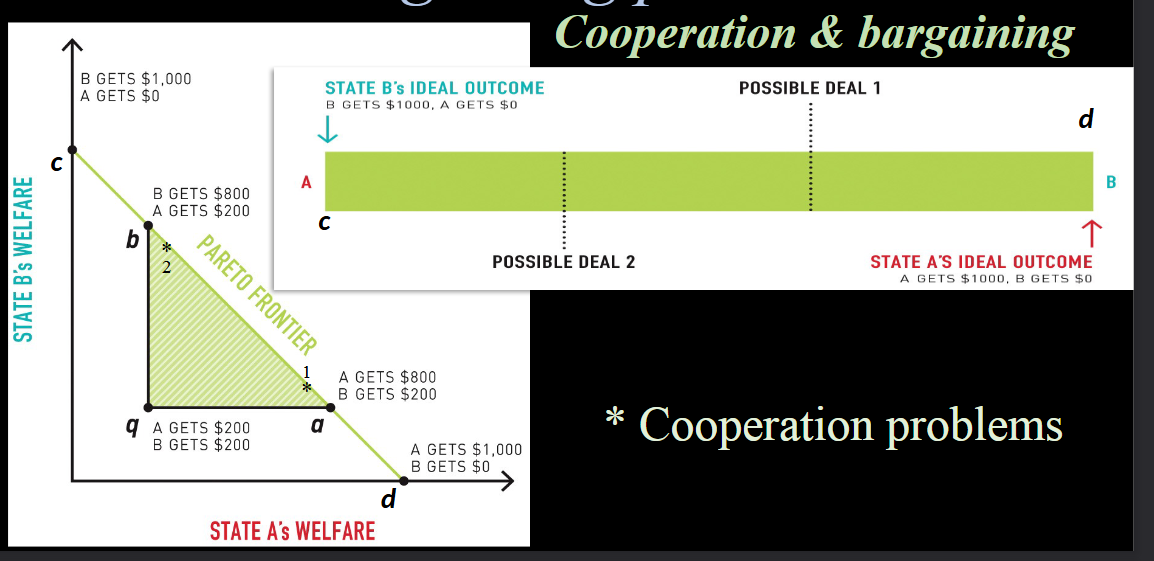
Bargaining Power
Dominant Strategy
A strategy that is the best response to whatever the other
player does.
Strictly Dominant Strategy
A strategy that always provides greater utility to a the player, no matter what the other player’s strategy is.
Weakly Dominant Strategy
A strategy that provides at least the same utility for all the other player’s strategies, and strictly greater for some strategy.
Nash Equilibrium
A combination of strategies (one for each player) each of
which is the best response to each other.
Expected Outcome
The combination of strategies (one for each player) determined
by each player’s maximization of their expected payoff
Pareto-Optimal Outcome
A combination of strategies (one for each player) such
that no other combination of strategies would make at least
one player better off without making anyone worse off.
Extensive form
Can be represented through game trees
The process of foreign policy, international interactions and
cooperation
Strategic interactions
lead to either
Bargaining (Zero sum gain) or Cooperation (Positive sum gain)
Cooperation leads to either
Coordination or Collaboration
Coordination Problems
Dilemmas of common aversions
Main obstacle to cooperation:
miscommunication
Collaboration Problems
Dilemmas of common interests
Main obstacle to cooperation:
cheating
Achieving Cooperation Under Anarchy