Physics Definitions
 Call Kai
 Learn
 Practice Test
 Spaced Repetition
 Match
 Flashcards
 Knowt Play
1/21

Earn XP
Description and Tags
22 Terms
What is temperature?
A measure of the hotness or coldness of an object.
What is temperature related to microscopically?
The motion of the constituent atoms and molecules.
What does temperature measure in an ideal gas?
The average translational kinetic energy of its particles.
What is thermal energy?
The sum of the kinetic energies of the molecules making up a body
What is heat?
The transfer of energy from a hotter body to a colder body in thermal contact.
What is thermal equilibrium?
A state in which bodies are at the same temperature and there is no net heat flow between them.
What is the Zeroth Law of Thermodynamics?
If two systems are each in thermal equilibrium with a third system, they are in thermal equilibrium with each other.
What is a thermometric property?
A measurable property of a body that changes with temperature.
What is calibration?
Comparing measurements with a known reference to establish the correctness of a measuring device.
What is an ideal gas?
A gas whose particles have no volume and experience no inter-particle interactions
Three types of molecular motion
Translational: movement from one position to another.
Vibrational: oscillation of atoms within a molecule.
Rotational: spinning of a molecule about an axis.
For an ideal gas, the average translational kinetic energy per particle is:
Symbol | Meaning | Unit |
|---|---|---|
\(E_k\) | Kinetic energy | J |
\(k_B\) | Boltzmann constant | J K⁻¹ |
\(T\) | Absolute temperature | K |
\(m\) | Mass of a particle | kg |
\(v\) | Particle velocity | m s⁻¹ |
The Boltzmann constant is approximately 1.38×10^-23 J/K

In which direction does heat flow naturally?
From a hotter body to a colder body.
When does net heat flow stop?
When the bodies reach thermal equilibrium.
Must bodies physically touch for thermal contact?
No. Energy can transfer by radiation without direct physical contact.
What is the SI unit of heat?
Joule (J), because heat is transferred energy.
What does the Zeroth Law allow us to do?
Compare temperatures and establish the basis for temperature measurement.
Is heat the same as temperature?
No. Heat is energy transferred; temperature describes the thermal state of a body.
Thermometer types

1. Mercury thermometer
Principle: liquid expands when heated and contracts when cooled.
The liquid level moves along a capillary tube.
A calibrated scale converts the liquid level into temperature.
Limitation: mercury is toxic if released; the thermometer can break.
2. Bimetallic thermometer
Principle: two bonded metals expand by different amounts when heated.
The strip bends as temperature changes.
Common applications include ovens and refrigerators.
Limitation: generally less suitable for very precise measurements than specialised electronic instruments.
3. Infrared (IR) thermometer
Principle: detects infrared radiation emitted by an object.
Allows non-contact temperature measurement.
Useful for measuring hot, moving or inaccessible objects.
Accuracy depends on factors such as surface properties, distance and instrument calibration.
4. Thermocouple
Listed as a thermometer type in Lecture 3.
Uses the electrical response produced by a junction of different metals as temperature changes.
Can be used over a wide range of temperatures.


Thermometer knowledge to memorise
Thermometric property: the property that changes with temperature.
Calibration: establishing the relationship between the instrument's readings and known temperatures.
Precision: how closely repeated measurements agree with one another.
Accuracy: how close a measurement is to the true or accepted value.
Linear response: a property changes in direct proportion to temperature over the calibrated range.
Temperature scales and calibration calculations- relationship between Fahrenheit and Celsius.
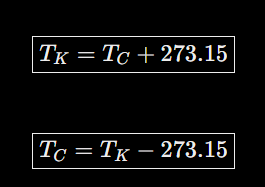
formulas for celcius and kelvin
