Part 2.3.2 - Autonomic Drugs - Parasympatholytics
 Call Kai
 Learn
Learn Practice Test
 Spaced Repetition
 Match
Match Flashcards
 Knowt Play
1/54

There's no tags or description
Looks like no tags are added yet.
Name | Mastery | Learn | Test | Matching | Spaced | Call with Kai |
|---|
No analytics yet
Send a link to your students to track their progress
55 Terms
Parasympatholytics are also known as ________ antagonists.
a. Adrenergic
b. Dopaminergic
c. Cholinergic
d. Histaminergic
c. Cholinergic
Parasympatholytics classifications
a. Antimuscarinics
b. Antinicotinics
c. both
c. both
[ANTIMUSCARINICS]
Antimuscarinics are also known as ________.
a. Adrenergics
b. Anticholinergics
c. Sympathomimetics
d. Cholinomimetics
b. Anticholinergics
[ANTIMUSCARINICS]
Drug that is a prototype antimuscarinic
a. Scopolamine
b. Atropine
c. Benztropine
d. Ipratropium
b. Atropine
[ANTIMUSCARINICS]
Blocking M1 receptors by atropine inhibits ________ secretion.
a. Salivary
b. Gastric
c. Bronchial
d. Lacrimal
b. Gastric
[ANTIMUSCARINICS]
Blocking M2 receptors by atropine causes ________.
a. Bradycardia
b. Tachycardia
c. Bronchodilation
d. Ileus
b. Tachycardia
[ANTIMUSCARINICS]
Blocking M3 receptors by atropine inhibits ________.
a. Secretion
b. Lipolysis
c. Dopamine release
d. Peristalsis only
a. Secretion
Blocks M3: Inhibits secretion & Smooth Muscles
[ANTIMUSCARINICS]
Blocks M3 by atropine: Inhibits secretion may lead to
Salivation / wet mouth or Dry mouth?
Anhidrosis (no sweating) or Sweating / diaphoresis?
Cutaneous vasodilation (widening of skin blood vessels) or Cutaneous vasoconstriction?
Pallor (pale skin) or Erythema (skin redness)?
Dry mouth
Anhidrosis (no sweating)
Cutaneous vasodilation (widening of skin blood vessels)
Erythema (skin redness)
[ANTIMUSCARINICS]
Blocks M3 by atropine: Smooth Muscles may lead to
Miosis or Mydriasis?
Cycloplegia or Accommodation / normal focusing?
Bronchodilation or Bronchoconstriction?
Normal bowel movement / peristalsis or Ileus?
Urination or Urinary retention?
Mydriasis
Cycloplegia
Bronchodilation
Ileus
Urinary retention
[ANTIMUSCARINICS]
CNS Effects of blocking muscarinic receptors by atropine
I. Acute Psychosis
II. Confusion
III. Agitation
IV. Disorientation
All
CNS / mental confusion symptoms
Acute Psychosis → abnormal thinking/perception
Confusion → cannot think clearly
Agitation → restless or disturbed behavior
Disorientation → confused about place, time, or person
[ANTIMUSCARINICS]
Other Anticholinergics for CNS
I. Scopolamine
II. Trihexyphenidyl
III. Benztropine
IV. Biperiden
All

[ANTIMUSCARINICS]
Other Anticholinergics for Eyes
I. Homatropine
II. Anistropine
III. Cyclopentolate
All

[ANTIMUSCARINICS]
Other Anticholinergics for Bronchi
I. Ipratropium
II. Tiotropium
III. Oxytropium
All

[ANTIMUSCARINICS]
Other Anticholinergics for Gastric Gland
I. Pirenzepine
II. Telenzepine
Both

[ANTIMUSCARINICS]
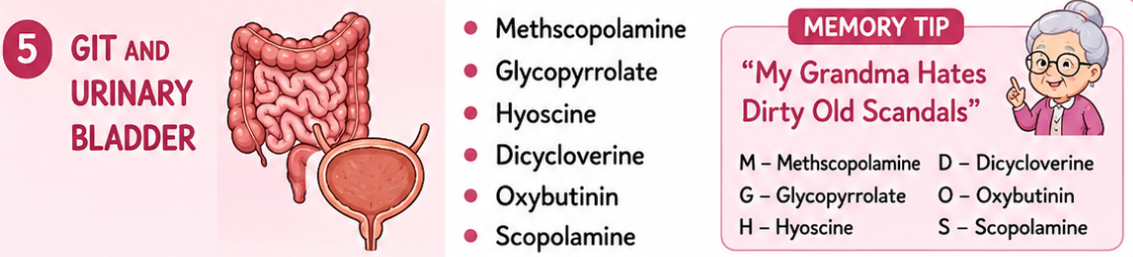
Other Anticholinergics for GIT and Urinary Bladder:
Methscopolamine, Glycopyrrolate, Hyoscine, Dicycloverine, Oxybutinin, Scopolamine
All
[ANTIMUSCARINICS]
For Symptomatic Bradycardia
a. Trihexyphenidyl
b. Scopolamine
c. Biperiden
d. Atropine
d. Atropine
[ANTIMUSCARINICS]
Treatment of Cholinomimetic Poisoning
a. Trihexyphenidyl
b. Scopolamine
c. Biperiden
d. Atropine
d. Atropine
[ANTIMUSCARINICS]
Given with Diphenoxylate to minimize addiction with Diphenoxylate
a. Trihexyphenidyl
b. Scopolamine
c. Biperiden
d. Atropine
d. Atropine
[ANTIMUSCARINICS]
Management of Motion sickness
a. Trihexyphenidyl
b. Scopolamine
c. Biperiden
d. Atropine
b. Scopolamine
[ANTIMUSCARINICS]
Management of EPS and Parkinsonism
I. Scopolamine
II. Trihexyphenidyl
III. Benztropine
IV. Biperiden
II. Trihexyphenidyl
III. Benztropine
IV. Biperiden
[ANTIMUSCARINICS]
For Mydriatic Cycloplegics
I. Homatropine
II. Anistropine
III. Cyclopentolate
IV. Biperiden
I. Homatropine
II. Anistropine
III. Cyclopentolate
[ANTIMUSCARINICS]
For Bronchial and COPD
I. Ipratropium
II. Tiotropium
III. Oxytropium
IV. Cyclopentolate
I. Ipratropium
II. Tiotropium
III. Oxytropium
[ANTIMUSCARINICS]
For Management of hyperacidity
I. Ipratropium
II. Pirenzepine
III. Oxytropium
IV. Telenzepine
II. Pirenzepine
IV. Telenzepine
[ANTIMUSCARINICS]
For Management of hypermotility D/O and urinary incontinence
I. Methscopolamine
II. Glycopyrrolate
III. Hyoscine
IV. Dicycloverine
V. Oxybutinin
VI. Scopolamine
All
[ANTINICOTINIC]
_______ are Nn blockers.
a. Neuromuscular Blockers
b. Ganglionic Blockers
c. Muscarinic agonists
d. Bronchodilators
b. Ganglionic Blockers
[ANTINICOTINIC]
_______ are Neuromuscular blockers.
a. Ganglionic Blockers
b. Skeletal muscle relaxants
c. Bronchodilators
d. Antimuscarinic agents
b. Skeletal muscle relaxants
[ANTINICOTINIC]
Vasodilation and anticholinergic
a. Ganglionic Blockers
b. Neuromuscular Blockers
a. Ganglionic Blockers
[ANTINICOTINIC]
These agents are no longer clinically useful
a. Ganglionic Blockers
b. Neuromuscular Blockers
a. Ganglionic Blockers
[ANTINICOTINIC]
Used for spastic disorders
a. Ganglionic Blockers
b. Neuromuscular Blockers
b. Neuromuscular Blockers
[ANTINICOTINIC]
Anesthetic adjuncts
a. Ganglionic Blockers
b. Neuromuscular Blockers
b. Neuromuscular Blockers
[ANTINICOTINIC]
Hexamethonium
a. Ganglionic Blockers
b. Neuromuscular Blockers
a. Ganglionic Blockers
[ANTINICOTINIC]
Trimethaphan
a. Ganglionic Blockers
b. Neuromuscular Blockers
a. Ganglionic Blockers
[ANTINICOTINIC]
Mecamylamine
a. Ganglionic Blockers
b. Neuromuscular Blockers
a. Ganglionic Blockers
[ANTINICOTINIC]
Classified as Depolarizing or Non-depolarizing
a. Ganglionic Blockers
b. Neuromuscular Blockers
b. Neuromuscular Blockers
[ANTINICOTINIC]
Succinylcholine
a. Depolarizing NMB
b. Non-depolarizing NMB
a. Depolarizing NMB
[ANTINICOTINIC]
Curare derivatives
a. Depolarizing NMB
b. Non-depolarizing NMB
b. Non-depolarizing NMB
[ANTINICOTINIC]
_______ is an anti-nicotinic agonist useful when rapid endotracheal intubation is required during induction of anesthesia.
a. Rocuronium
b. Succinylcholine
c. Atracurium
d. Neostigmine
b. Succinylcholine
[ANTINICOTINIC]
_______ is used during electroconvulsive shock treatment.
a. Succinylcholine
b. Tubocurarine
c. Pancuronium
d. Rocuronium
a. Succinylcholine
[ANTINICOTINIC]
MOA of ________: irreversibly activates Nm receptor.
a. Succinylcholine
b. Atracurium
c. Pancuronium
d. Tubocurarine
a. Succinylcholine
[ANTINICOTINIC]
Initial phase of effect of ________ is skeletal muscle contraction, followed by final relaxation paralysis.
a. Succinylcholine
b. Rocuronium
c. Tubocurarine
d. Atracurium
a. Succinylcholine
[ANTINICOTINIC]
Respiratory paralysis caused by ________ may be treated with Endrophonium or Neostigmine.
a. Succinylcholine
b. Cyclopentolate
c. Pirenzepine
d. Ipratropium
a. Succinylcholine
[ANTINICOTINIC]
Malignant hyperthermia caused by Succinylcholine is treated with ___.
a. Rocuronium
b. Dantrolene
c. Tubocurarine
d. Atracurium
b. Dantrolene
[ANTINICOTINIC]
Adverse effects of Succinylcholine include ________.
a. Myalgia, Myositis, and Rhabdomyolysis
b. Hyperacidity and diarrhea
c. Bronchospasm and cough
d. Mydriasis and cycloplegia
a. Myalgia, Myositis, and Rhabdomyolysis
[ANTINICOTINIC]
MOA of curare derivatives: ________.
a. Irreversibly activate Nm receptor
b. Block Nm receptor causing immediate paralysis
c. Stimulate muscarinic receptor
d. Increase acetylcholine release
b. Block Nm receptor causing immediate paralysis
[ANTINICOTINIC]
At low doses, curare derivatives competitively block ________ at nicotinic receptors, preventing depolarization and muscle contraction.
a. Dopamine
b. Epinephrine
c. Acetylcholine (ACh)
d. Serotonin
c. Acetylcholine (ACh)
[ANTINICOTINIC]
At high doses, curare derivatives block ________ of the motor template, further weakening neuromuscular transmission.
a. Muscarinic receptors
b. Ion channels
c. Sodium pumps
d. Alpha receptors
b. Ion channels
[ANTINICOTINIC]
Isoquinoline (-curium)
a. Type I Non-depolarizing NMB
b. Type II Non-depolarizing NMB
a. Type I Non-depolarizing NMB
[ANTINICOTINIC]
Atracurium
a. Type I Non-depolarizing NMB
b. Type II Non-depolarizing NMB
a. Type I Non-depolarizing NMB
[ANTINICOTINIC]
Tubocurarine
a. Type I Non-depolarizing NMB
b. Type II Non-depolarizing NMB
a. Type I Non-depolarizing NMB
[ANTINICOTINIC]
Steroidal (-curonium)
a. Type I Non-depolarizing NMB
b. Type II Non-depolarizing NMB
b. Type II Non-depolarizing NMB
[ANTINICOTINIC]
Pancuronium
a. Type I Non-depolarizing NMB
b. Type II Non-depolarizing NMB
b. Type II Non-depolarizing NMB
[ANTINICOTINIC]
Rocuronium
a. Type I Non-depolarizing NMB
b. Type II Non-depolarizing NMB
b. Type II Non-depolarizing NMB
[ANTINICOTINIC]
Respiratory/diaphragmatic paralysis caused by non-depolarizing blockers is treated with ________.
a. Dantrolene and Epinephrine
b. Neostigmine and Edrophonium
c. Atropine and Dopamine
d. Tiotropium and Ipratropium
b. Neostigmine and Edrophonium
[ANTINICOTINIC]
Tubocurarine may cause an anaphylactoid reaction treated with ________.
a. Epinephrine
b. Dantrolene
c. Neostigmine
d. Scopolamine
a. Epinephrine
[ANTINICOTINIC]
May cause an anaphylactoid reaction
a. Epinephrine
b. Dantrolene
c. Tubocurarine
d. Scopolamine
c. Tubocurarine