Chapter 5 - Initiating and Planning IS Development Projects
 Call Kai
 Learn
Learn Practice Test
 Spaced Repetition
 Match
Match Flashcards
 Knowt Play
1/19

There's no tags or description
Looks like no tags are added yet.
Name | Mastery | Learn | Test | Matching | Spaced | Call with Kai |
|---|
No analytics yet
Send a link to your students to track their progress
20 Terms
Assessing Project Feasibility
Project Costs and Benefits
Is the project beneficial?
At what point do we expect returns?
Project Planning
Phase where we decide to accept it or reject it
Understand if the project brings value to the company
Would investing in this project bring benefit above others?
Tangible Benefits
Measurable and quantifiable advantages that result from the implementation of a project, action, or investment. Can be directly tied to financial gains (increased revenue, reduced costs leading to savings, productivity improvements)
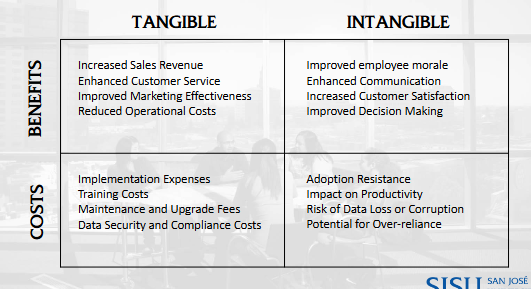
Tangible Costs
Direct expenses that are quantifiable and typically associated with the acquisition or operation of a project, system, or action. Costs include materials, labor, and other resources that have a clear financial value.
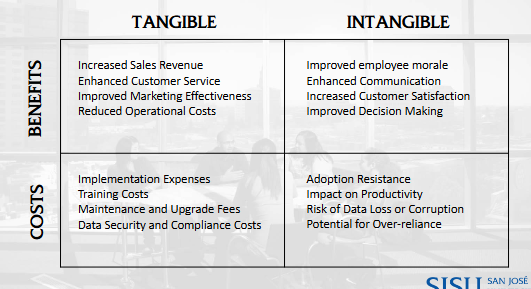
Intangible Benefits
Advantages that are not easily quantified or measured in financial terms. Includes improvements in customer satisfaction, brand reputation, employee morale, or innovation capabilities
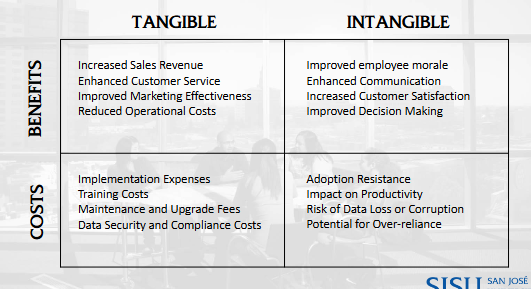
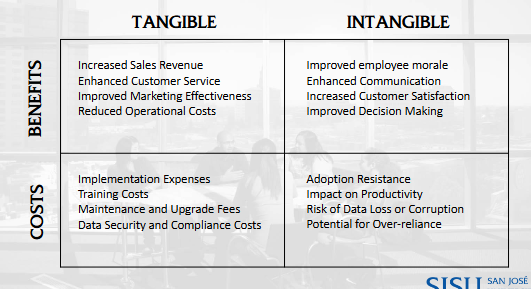
Intangible Costs
Expenses that are not easily quantifiable. Includes impact on employee morale due to increased workload, potential loss of customer trust due to a project, or opportunity cost of not pursuing an alternative action
Time Value of Money (TVM)
Recognizing that the value of money changes over time. Asserts that a specific amount of money today is worth more than the same amount in the future. This concept is crucial for various financial decisions, including investments, loans, and savings.
Discount Rate
Rate of return used to discount future cash flows back to their present value. Reflects the opportunity cost of capital, accounting for the risk and the time value of money
Purpose: The discount rate is used to determine the present value of future cash flows. It serves as a benchmark for comparing the profitability of different investments or financial decisions
Formula: 1 / (1+r) ^ t
r = discount rate given, t = number of years or year #
Present Value
Current value of a future sum, discounted at a specific rate because of interest or returns. Represents the amount that would need to be invested today that is to be received in the future.
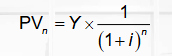
Present Value Formula
PV = Present Value
Y = Future Value (amt of money expected to be received)
i = Discount Rate (OC of capital, risk, and time preference for money. used to discount future cash flows to the present value
n = Number of Years (period of years until future cash flow is received)
Break-Even Ratio Formula
Overall NPV Cash Flow: represents total net present value of all cash inflows - the total NPV of all cash outflows over the project’s lifespan
Yearly NPV Cash Flow: NPV of cash flows for a specific year

Break-Even Ratio
Indicates how many years it will take for the cumulative NPV of the cash inflows to cover the cumulative NPV of the cash outflows.
Ratio of #y: project breaks even within #y of years.
ROI (Return on Investment)
Measures the profitability or efficiency of an investment relative to its cost
Positive ___ = investment earned money
Negative ___ = lost money
(Overall NPV / PV of all costs) x 100 for percentage
Overall NPV
NPV of All Benefits after lifespan - NPV of All Costs after lifespan = ________
The project’s discounted benefits exceed its cost by ______
Yearly Cashflow
Present Value of Benefits - One-time costs - Present Value of Costs
Overall Cashflow
Yearly Cash Flow of that year + Overall cashflow of last year
For year 0, it’s NPV of All Benefits - NPV of All Costs
NPV of All Benefits
PV benefits for that year + NPV benefits from the year before
represents the cumulative NPV of benefits in that year
Present Value of Benefits
Net benefit for that year x discount rate for that year (after formula)
NPV of All Costs
Current yr’s Present Value of Costs + Previous year’s NPV of all costs
Present Value of Costs
Recurring cost for that year x Discount rate for that year