Purdue Bio 110 Final exam practice
 Call Kai
 Learn
Learn Practice Test
 Spaced Repetition
 Match
Match Flashcards
 Knowt Play
1/22

There's no tags or description
Looks like no tags are added yet.
Name | Mastery | Learn | Test | Matching | Spaced | Call with Kai |
|---|
No analytics yet
Send a link to your students to track their progress
23 Terms
Where does the citric acid cycle occur?
In the matrix of a mitochondria
During cellular respiration protons are actively transported
From the matrix into the inner membrane space
What is true of the electron transport chain?
A. it supplies the energy needed to pump protons
B. It directly brings about the reduction of Carbon dioxide
C. it directly brings about the reduction of water
D. It directly brings about the regeneration of RuBP
A. it supplies the energy needed to pump protons
Which of the following best characterizes oxaloacetate?
A. it is a 4-carbon acetyl acceptor molecule
B. it contains high-energy electrons that once were carried by NADPH
C. it is mainly found in the chloroplasts
D. it catalyzes the reaction of carbon dioxide with RuBP
A. it is a 4-carbon acetyl acceptor molecule
What is one possible use of G3P in photosynthesis
the production of glucose
Regenerate the RuBP
Which of the following is an output of glycolysis?
A. RuBP
B. pyruvate
C. glucose
D. oxaloacetate
B. Pyruvate
which of the following is true concerning glycolysis?
A. it occurs in the matrix of the mitochondria.
B. the end product is acetly-CoA
C. Oxyloacetate is regenerated at the end
D. none of the above
D. none of the above
Both substrate level phosphorylation and chemiosmosis generate ATP; how are they different?
one requires electron transport; the other does not
What is the final electron acceptor in cellular respiration
Oxygen
Theoretically cellular respiration could generate 36 ATPs per glucose molecule. Why is the number of ATPs generated usually less that 36 ATPs?
Mitochondrial membranes tend to leak protons
If oxygen levels in a cell are not sufficient, pyruvate will
be oxidized anaerobically in the cytoplasm
which represent an electron carrier in cellular respiration?
A. NADP+
B. NAD+
C. FAD+
D. A and C
E. B and C
E. B and C
Which statement is true about photosystems I and II?
A. photosystem II reduces water molecules but photosystem I does not
B. Photosystem II captures photons but not photosystem I
C. photosystem II sends Electrons to Photosystem I
C. Photosystem II sends electrons to photosystem I
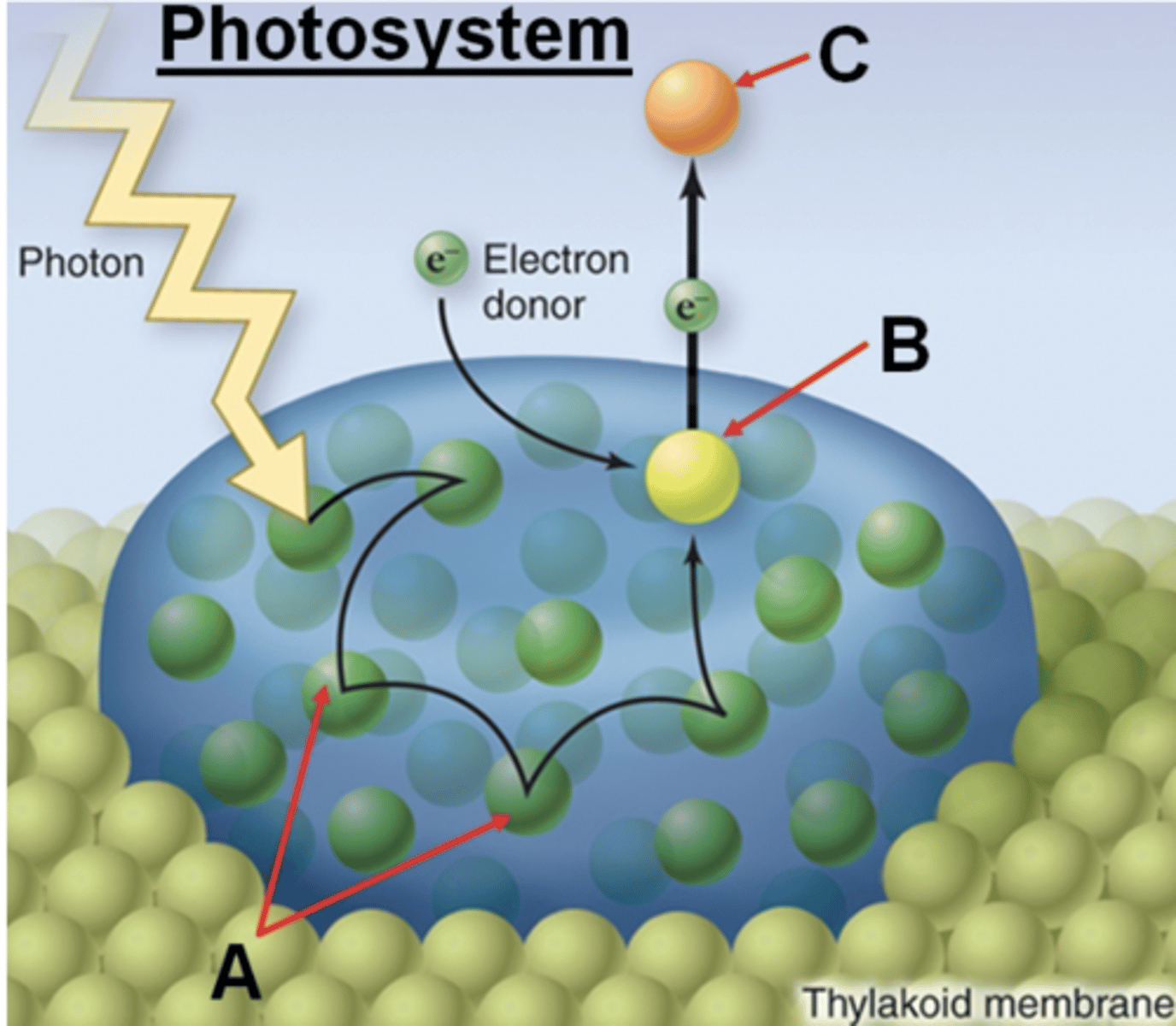
In the figure above, what best describes the structures labeled A?
Antenna chlorophyll
Glucose oxidation is a term that collectively refers to?
glycolysis, oxidation of pyruvate, the citric acid cycle, and electron transport/chemiosmosis
Anatomical similarities between organisms that develop because the organisms are closely related and share a recent common ancestor are known as
homologous similarities
According to the biological species concept, two organisms are the same species if
they can mate and produce offspring that are fertile and that mating would normally occur under natural conditions
Which of the following characterize all organisms in the archaea domain?
A. They have internal membranes.
B. They have cell walls.
C. Their ribosome structures are the same as eukaryotes but different than bacteria.
D. None of the above are true of archaea.
E. B and C are true of all archaea.
B. They have cell walls
Which of the following characterize all organisms in the plant kingdom?
A. They are eukaryotic.
B. They are heterotrophs.
C. The cells of plants lack cell walls.
D. All of the above are true of all plants.
E. Only A and B above are true of all plants.
A. They are eukaryotic
All of the following are pre-zygotic barriers to reproduction except
A. hybrid sterility
B. geographic separation
C. gametic isolation
D. behavioral isolation
A. Hybrid sterility
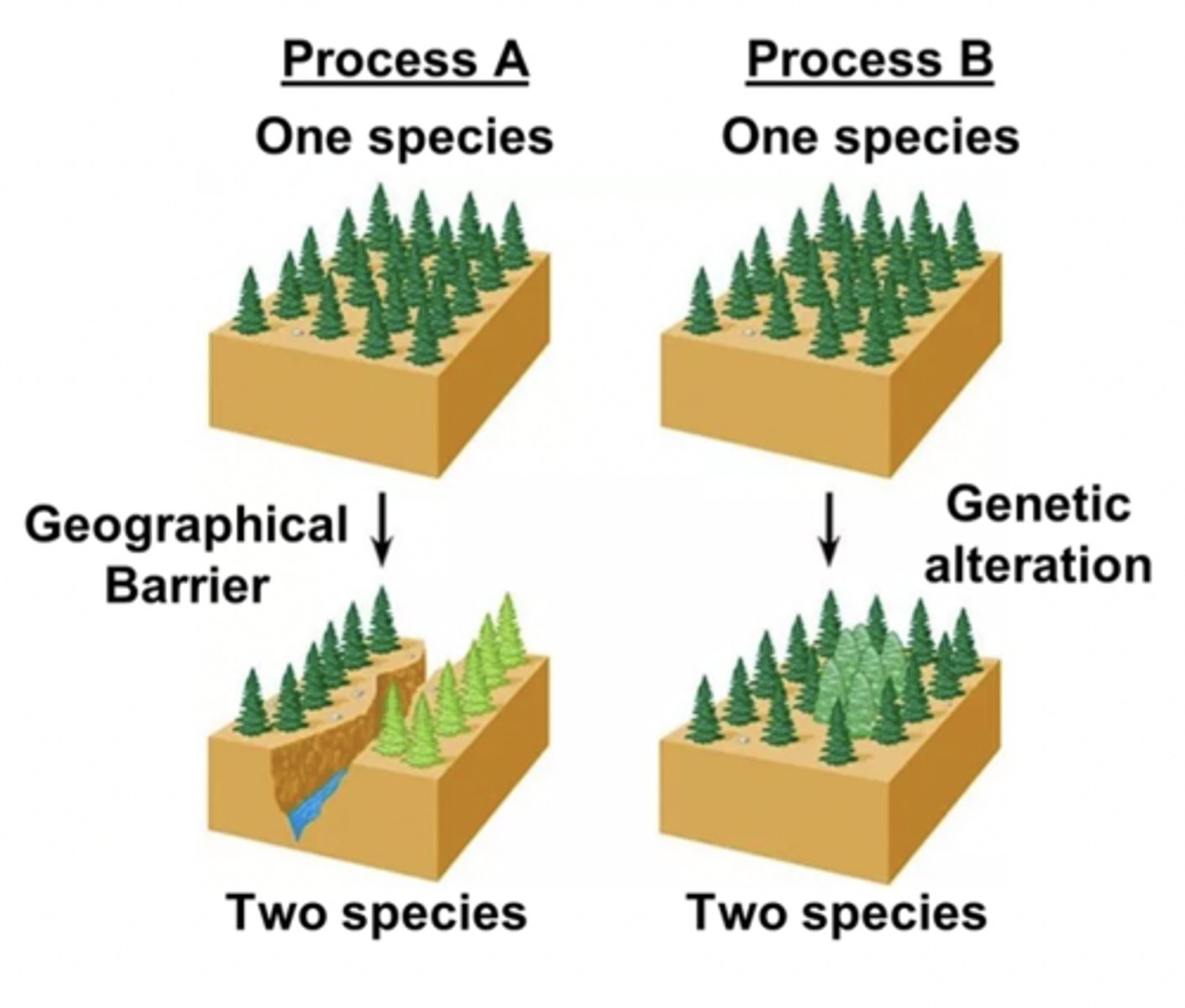
Referring to the figure, what type of speciation does A illustrate?
Allopatric
two organisms of the same species mate and give rise to an offspring with a different ploidy than the parents. the organism is reproductively isolated from the parents but fertile and able to reproduce itself. this new species is a specific example of
autopolyploidy
types of speciation
allopatric
peripatric
parapatric
sympatric
artificial
allo - species separates into 2 separate groups which are isolated from one another, usually by a physical barrier
peri - same as allo but one group is much smaller than the others
para - species is spread out over a large geographic area. is possible for any member of the species to mate with another member, individuals only mate with those in their own geographic region
sym - controversial. no barriers, close together, but new species develops
artificial - creation of a species by people