QUIZ 3: Week 5 Lecture 1: Nitrous Oxide/Oxygen Inhalation Sedation
 Call Kai
 Learn
Learn Practice Test
 Spaced Repetition
 Match
Match Flashcards
 Knowt Play
1/63

There's no tags or description
Looks like no tags are added yet.
Name | Mastery | Learn | Test | Matching | Spaced | Call with Kai |
|---|
No analytics yet
Send a link to your students to track their progress
64 Terms
What are the characteristics of nitrous oxide?
nitrous oxide + oxygen = nitrous oxide/oxygen gas
no known allergies and does not irritate the lungs
colorless, odorless, nonflammable
What is nitrous oxide used for?
patients of all ages to help manage mild/moderate anxiety
What are the properties of nitrous oxide? (what can it do?)
Analgesic Properties (Pain relief, when someone is anxious, their pain threshold is lower and they experience more pain)
Anxiolytic Properties (Anxiety relief)
Amnestic Properties (Time distortion)
What is the onset of action for N2O?
rapid
What is the length and depth of sedation for N2O?
can be used for long or short periods
What is the elimination and recovery of N2O?
rapid
give pt oxygen after for 2 - 5 min
Do pts accept N2O well?
yes, as long as we don't over sedate
Define titration
a method of administering a drug in incremental amounts over time until a desired endpoint is reached
allows us to give the proper amount to the pt and give them a positive experience
Compare N2O and Local Anesthesia
Local anesthesia manages pain by blocking pain response
Nitrous does not block the pain response, but relaxes patients
How is N2O inhaled and absorbed?
inhaled into the lungs by the nose
rapidly absorbed by the lungs
What happens as N2O fills the lungs quickly?
High pressure in the lungs
Causes diffusion of N2O out of the lungs into the blood (difference in partial pressures)
Blood carries the nitrous oxide to the brain quickly and effects are rapid
How is N2O eliminated?
unchanged by the lungs
it is not metabolized, leaves the body in the same form and is not stored
most is exhaled through the lungs 3-5 min after administration and 1% released through urine/sweat
Who benefits from N2O?
Control of anxiety, apprehension
Apprehensive of injections
Those who can't handle long appointments
Children --> dfficult management, apprehension, very young, must be able to respond
What levels of sedation will DH do with N2O?
minimal or moderate
Describe minimal sedation (% given, how the pt responds)
Less than 50% nitrous oxide
Anxiety is reduced & patient is relaxed
Patients can respond normally to verbal commands
Describe moderate sedation (% given, how the pt responds)
>50% nitrous oxide OR <50% nitrous oxide + another sedative
"Conscious sedation"
Produces greater depressed
Consciousness
patients can still respond
Describe Deep Sedation & GA
Beyond DH scope of practice
Patients become less responsive
Spontaneous ventilation is inadequate
Intervention to maintain airway may be required
What are the legal considerations regarding N2O?
Must complete CPR training and maintain
Must use fail-safe equipment, capable of positive pressure respiration
Must complete a course from an accredited institution
12 hours minimum with didactic and administer at least three supervised cases
What does N2O/O2 depress?
the CNS (exact mechanism unknown)
What can chronic exposure to N2O cause?
injury of the nervous system --> numbness and weakness of the extremities are symptoms
How does N2O affect the cardiovascular system?
No negative or significant effects
Blood flow to major organs is not significantly affected
Positive effects due to supplemental oxygen
Blood pressure and pulse may decrease (bc pt is more relaxed)
Vasodilation occurs –-> flushing around the patient’s face and neck may be observed
How does N2O affect the respiratory system with minimal sedation?
Breathes normally
Mild decrease in rate
Gag reflex is reduced
What are the post op side effects of N2O?
Nausea / Vomiting
Dizziness
Reduced heart rate or respiration rate
Diffusion Hypoxia
What are the breathing problems & lung conditions that are contraindications for receiving N2O? (4)
1. Difficulty breathing through nose --> common cold, sinus infection, allergy related symptoms
2. Emphysema or Bronchitis (COPD)
3. Upper respiratory tract infections
4. Cystic Fibrosis
Can pts with asthma receive N2O?
yes
What are other contraindications to N2O? (7)
1. Pneumothorax --> abnormal collection of air in lungs
2. Pneumoencephalography --> cerebrospinal fluid drained from brain
3. Severe phobia, taking sleep inducing medication, antidepressants, or psychotropic --> can cause hallucinations
4. 1st tri of pregnancy
5. Significant bowel obstruction
6. Cancer treatment with bleomycin sulfate
7. Severely phobic individuals
What are conditions that you should seek medical consultation first before administrating N2O? (5)
1. Pernicious / megaloblastic anemia
2. Vit B12 deficiency
3. Cognitive disorders (assess level of understanding, need to be able to communicate)
4. Middle ear disturbances
5. Recent eye surgery with perfluoropropane or sulfur hexafluoride gas
Where is the manufactured product kept?
kept refrigerated until it is directly transferred by insulated trucks in color coded cylinders
What is the pressure (psi) of N2O throughout the procedure?
750 psi until 20% left, then it will start to decrease
How is N2O stored?
as a liquid
What is the pressure (psi) of O2 at full?
2000 psi
How is O2 stored?
as a gas
What is the max N2O that can be administered?
70%
What is the min O2 that can be administered? (we absolutely have to give at least this much)
30%
What is the size range of the tanks?
A - H (A is smallest)
E is most common with 16 gal
What are the systems of N2O?
central or portable
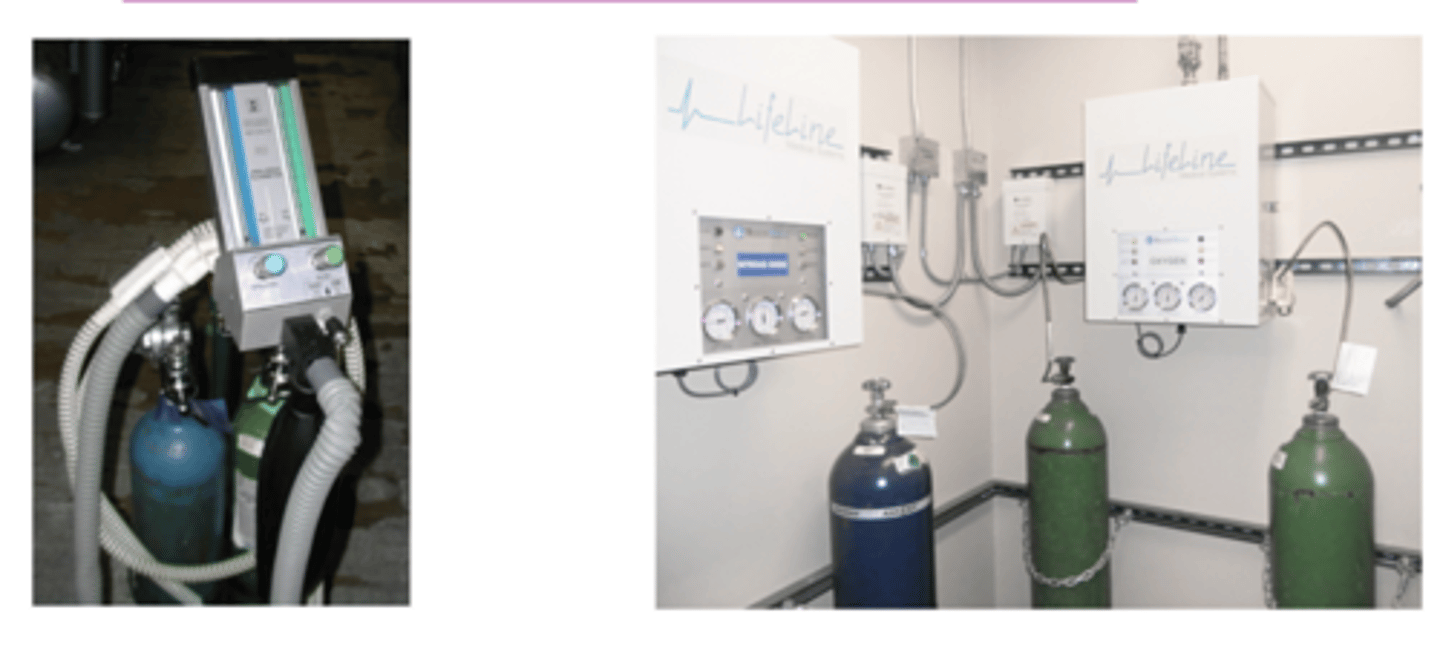
What are the parts of a N2O system?
yoke stand
yoke
pin index system
reducing valve
flowmeter
flowmeter's fail-safe mechanism
reservoir bags
conduction tubing
nasal hood
scavenger system
positive pressure oxygen hookup
What is the yoke stand?
for portable system
back bone and supporting structure for the tanks
What is the yoke?
metal framework that attaches the cylinder to the yoke stand
What is the pin index system?
equipment safety feature that ensures the right connections are made with the right cylinders via geometric shapes specific to each cylinder
What is the reducing valve?
Prevents dangerous pressure buildup
Alter high pressure (750 & 2000 psi) from cylinders to low pressure (50 psi) for patient delivery
What is the flow meter?
indicates the amount of gas being delivered to the patient
What is the flowmeter's fail-safe mechanism?
A valve opens to allow N2O flow only when there is a flow of O2 to the system
Anytime the O2 flow is <30%, N2O stops flowing
What is the percent of oxygen in room air?
21%
critical to maintain an O2 level of at least that present in the ambient air
What is the reservoir bag?
holds the mixed gases
What is the conduction tubing?
tubing through which gas is delivered
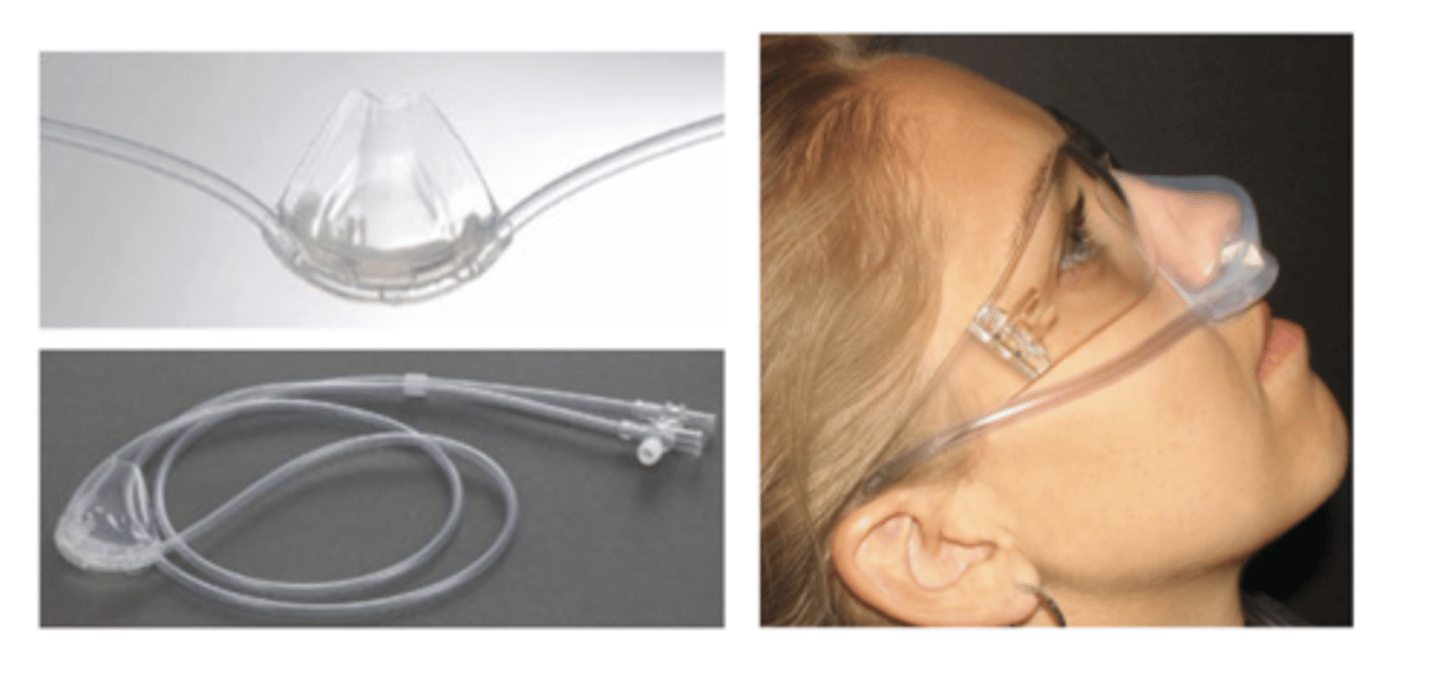
What is the nasal hood?
Where the N2O is delivered
Reusable or disposable
Scented or unscented
Different Sizes
What is the scavenger system?
Removes exhaled gases via vaccuum out of the building
One-way valve with two hoses
What is a silhouette system?
variation of nasal hood, more fitted
pt is more comfortable
easier to work on oral cavity
What is the positive pressure oxygen hookup?
can be attached to the equipment and used in case of emergencies to administer oxygen
What does appropriate sedation look like in a pt?
1. The patient appears comfortable and relaxed --> if asked, the patient may acknowledge a reduced sense of fear & anxiety
2. Signs of relaxation may include shoulders dropping, legs uncrossing, and arms positioned looser on arm rests
3. Patient’s eye activity will likely begin to slow --> eye movement will be reduced, and their blink rate will slow
4. Pts will smile easily, are aware and responsive
5. Some pts feel heavy or light
6. Vasodilation in face and neck / body feels comfortably warm
What does over sedation look like in a pt?
1. Relaxed, comfortable state has disappeared and pt doesn't feel the same
2. Effects may be intensified, symptoms may be intolerable, pts may show signs of agitation
3. Patients may hallucinate
4. Fixed eyes
5. Decreased awareness of surroundings
6. Hearing may change
7. Increased body warmth
8. Slurred words
9. Dizzy / spinning // nausea
Can loss of consciousness occur with oversedation?
YES
What do we do as providers before administering N2O
Prior to appointment, instruct not to eat heavily
Check equipment
Obtain medical history
Take vital signs - for minimal sedation, pre and post operatively -->
BP, Pulse, and Respiration
Informed consent
How do we set up the N2O?
Select the appropriate size and type of scavenging nasal hood
Start oxygen, place nasal hood on patient, and determine tidal volume
Check reservoir bag for flow/tidal volume --> should inflate and deflate
and breathing should be comfortable
Place nasal hood on and use 4 - 5 - 6 rule starting with O2
What is the proper technique while administering N2O?
Begin titration of N2O (.5-1L/minute)
Minimize talking
Assess patient for signs and symptoms of appropriate sedation, continuously monitor the patient, never leave the patient alone
Determine maintenance level
Perform procedure
Describe maintenance level
If pt's tidal volume is 6, the volume of O2 + N2O should always be 6
EX: Start with 5 L O2 and 1 L N2O and keep moving until pt feels properly sedated. Could end up with 3 L O2 and 3 L N2O, just must always equal 6 since that was their tidal volume
What is the proper technique while terminating N2O administrating?
Terminate N2O flow and administer a minimum of 5 minutes of postoperative 100% O2
Take vital signs again (postoperatively)
Document
What do you document post-op?
Vital signs before and after treatment
Maintenance level % and duration
Length of oxygen administration (should be 5 minutes)
Patient reaction and recovery
What is the recovery like of a pt after recieving N2O?
Patient does not usually require an escort
Ask how the patient is feeling --> give additional oxygen if the patient is not feeling back to normal
TRUE OR FALSE:
The amount of N2O required by a patient on any given day or time varies.
TRUE
Is there a direct causal relationship exists between reproductive health and scavenged low levels of N2O/O2?
No evidence --> but every attempt should be made to reduce the level of trace N2O to practitioners.
However, pregnant providers should know the exposure levels of N2O/O2 and use all recommended trace gas scavenging methods
Pregnant providers may choose to avoid the office setting and any N2O/O2 exposure for the 1st trimester.
How can we prevent over exposure to N2O/O2?
scavenging system or personal devices
What are some personal devices used for personal monitoring?
Infrared Spectrophotometry (IR)
Time-Weighted Average Dosimetry
Hand-Held Monitoring Device