Decision making
 Call Kai
 Learn
Learn Practice Test
 Spaced Repetition
 Match
Match Flashcards
 Knowt Play
1/44

There's no tags or description
Looks like no tags are added yet.
Name | Mastery | Learn | Test | Matching | Spaced | Call with Kai |
|---|
No analytics yet
Send a link to your students to track their progress
45 Terms
What is a decision?
Selecting one of two possible actions
Calculating likelihood of events using incomplete information
Knowing exact likelihood with complete information
What are normative theories in decision making?
Concerned with how people should make decisions
Assumption that people act rationally
What are descriptive theories in decision making?
Concerned with how people actually make decisions
What is utility theory?
Assume people act to maximise ‘expected utility’
Expected utility = p(given outcome) x utility of outcome
Utility = Subjective value we attach to a given outcome
Focuses on final amount, not whether gain or loss from starting point → calculate expected utility of each outcome and choose option with greatest expected utility.
What is value function in utility theory?
Describes relationship between utility (=subjective value) and objective gains/losses
Outline an example of utility theory?
100% chance of gaining £500, or 50% chance of gaining £1000/50% chance £0
Many choose first option → utility is not necessarily proportional to monetary amount
To many, £1000 subjectively not twice as valuable as £500
What is prospect theory (Kahneman and Tversky, 1984)?
Individuals identify ‘reference point’ representing current state
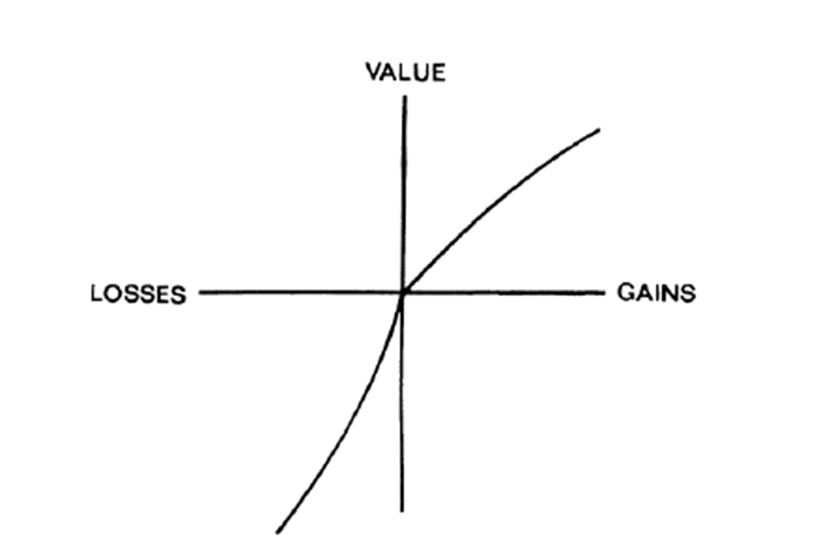
Individuals more sensitive to potential loss than gains (loss aversion)
Individuals overweight rare events
Value function describes how sensitive individuals are to gains/losses
What is an example of prospect theory?
Coin toss: £200 heads, £100 tails
Many refuse this coin toss
How can value function and gains and losses be described in prospect theory?
We value loss and gains disproportionately
E.g. Subjective value of £100 loss greater than subjective value of £200 gain
What is the framing effect?
Decisions influenced by how the situation is framed.
What did Tversky and Kahneman (1981) find in a study of the framing effect using Asian disease problem in gain framing condition:
Programme A: 200 people saved
Programme B: 1 in 3 probability 600 people will be saved, 2 in 3 probability no one saved
72% chose programme A
What did Tversky and Kahneman (1981) find in a study of the framing effect using Asian disease problem in loss framing condition:
Programme C: 400 people will die
Programme D → 1 in 3 probability no one will die, 2 in 3 probability 600 people will die
78% chose programme D (opposite to gain frame condition) → Loss aversion
What did Mandel and Vartanian find in Asian disease problem when ambiguity was presented in option A (at least 200 people saved)?
When programmes completely described (e.g. 200 and only 200 people) framing effect disappeared
Similar to judgements??
What did Almashat et al (2008) find in study of the framing effect in medical scenarios involving cancer treatments?
When ppts explicitly listed advantages/disadvantages of each option and justified their decision → framing effect disappeared.
Engaging in deliberate weighting of options reduces/eliminates effect
What is the sunk cost effect?
Tendency for people to pursue a course of action even after it has proved to be suboptimal, because resources have been invested in that course.
“Throwing good money after bad”
What did Dawes (1988) find in study of sunk cost effect where ppts given scenario → £100 deposit for hotel room, on route to hotel become ill. Think will probably have better time at home. Do you keep going or turn back?
Many decide to keep going → sunk cost
Loss aversion? depending on where to set as starting point…
How did Baliga and Ely evaluate sunk cost effect in study giving business students full information about investments?
Showed opposite of sunk cost → more likely to switch.
Certain groups don’t show effect → not universal?
How do people often overweight rare events?
Think rare events more likely than they are → national lottery, low chances of winning but people still buy tickets
In lab, ppts often overweight described probability of rare events
What did Hertwig find in relation to overweighting rare events in real world decisions that involve experience?
When decisions based on descriptions → overweighted
When decision based on experience → underweighted
Due to low sampling = never experienced rare event?
Availability heuristic?
What is loss neutrality?
E.g. if 50% £1 or 50% -£1 vs 50% £5 vs 50% -£5
Prospect theory predicts loss aversion, should pick 1 not 2
But 50/50 split between choosing 1 and 2, neutral to loss in this situation.
Breaks down when using extreme amounts, e.g. £1000
How can utility and prospect theory be criticised?
Doesn’t explain why we are loss averse
Many predicted phenomena can disappear/be reversed in experimental situations
Doesn’t account for individual differences on its own → high self esteem prefer risky gambles, high narcissism have high sensitivity to reward.
How may loss aversion be explained by emotional and social factors?
Anticipated/actual loss may lead to negative emotions, e.g. anxiety
What did Kermer et al find in relation to loss and emotional factors?
$3 loss predicted to have greater impact on happiness than $5 gain
No difference in actual experience, only anticipation differs
Impact bias → overestimation of intensity/duration of negative emotions to loss
What did Giorgetta et al find in relation to loss and emotional response in computer and ppt decisions?
Loss felt as regret if decision made by participant
Loss felt as disappointment if decision made by computer
Agency affects emotional response to loss
What is omission bias?
Preference for inaction when presented with risk
What did Brown et al and Wroe et al find in separate studies in relation to omission bias and vaccinations?
Parents willing to accept higher risk of child having disease than child suffering adverse reaction to vaccination.
Higher anticipated responsibility and regret if child experienced adverse reaction due to vaccination → i.e. its my fault
What did Aberegg et al find in relation to treating lung disease and omission bias?
Less likely to choose best management strategy when given option to do nothing (40%) vs when not given option (59%)
What is status quo bias?
Prefer to accept status quo than change decision
What did Samuelson and Zeckhauser find in study of status quo bias and retired people?
Retired people keep same allocation of retirement funds, despite no financial cost in changing
What did Simonson and Staw find in relation to accountability and sunk cost effect?
Increased accountability → increased sunk cost effect
Experience greater need to justify initial decision, so stick with it for longer
What steps should decision makers normatively go through in complex decision making (e.g. buying a house)?
Identify attributes relevant to decision
Decide how to weight attributes
List all options under consideration
Rate each option on each attribute
Obtain total utility → select option with highest utility
What did Simon (1957) suggest about bounded rationality in complex decision making?
Decision making bounded by environmental constraints (e.g. information costs) and cognitive constraints (e.g STM capacity).
We are rationale as permitted within these constraints
Satisficing → choosing first option that satisfies individual’s minimum requirements
What is satisficing?
Simplifying the decision-making process by using heuristics and ignoring some relevant information sources
term represents a blend of the words satisfactory and sufficing.
What is elimination by aspects theory (Tversky et al)?
Serial elimination based on specific criteria until one option remains
Order can matter
Can’t handle trade offs → e.g. distance from uni vs rental cost
What two stage process did Kaplan et al suggest within elimination by aspects theory?
Elimination (as per theory)
Detailed comparison of small number of remaining (as per utility theory)
Useful for filtering when many options available
Still entails detailed comparison to make optimal decision from small subset
What did Galotti et al find in study of elimination by aspects theory and US uni students choosing main subject?
Constrained info → focused on 2-5 options at one time
Options considered decreased over time
Constrained information → focused on 3-9 attributes at one time
Attributes considered remained constant over time
Higher ability/more education → more attributes considered at one time
What is memory guided decision making?
Often use past experience to make rapid, pressured decisions
What is recognition primed decision model (Klein, 1998)?
When we need to make rapid decisions, experts retrieve previously similar situation and evaluate whether previous decision appropriate
Experts also typically characterise novel situations as example of familiar situations
Emphasises role of expertise to rapid decisions, memory useful.
Elimination by aspects, more typical for non experts making considered decisions.
What is description-experience gap in prospect theory?
Individuals are more likely to over weigh the probability of rare events when exposed to descriptions than when experiencing events.
What is impact bias?
Overestimation of the intensity and duration of negative emotional reactions to losses and positive emotional reactions to gains.
What did Suter et al. find about prospect theory in affect-poor vs affect-rich decisions?
Explained affect-poor decisions (e.g. money losses) well
Less effective for affect-rich decisions (e.g. medical side effects), where people often ignored probabilities and focused on the worst possible outcome (minimax rule).
What did Shiv et al find using gambling task weher most profitable strategy was to gamble on every round in patients with damage to emotion regions?
Patients with damage to emotion regions gambled significantly more than other brain damaged patients and controls
Which brain areas have been associated with decision making/loss and gains?
Amygdala → response to losses
Ventromedial prefrontal cortex → risk taking
How do individualist and collectivist cultures differ in loss aversion?
Individualistic → more sensitive to losses, more loss aversion
Cushion hypothesis → those in collectivist cultures better supported, provides cushion for loss.
What is selective exposure model?
Explains how individuals tend to seek out information that aligns with their existing beliefs while avoiding contradictory information.
Defence motivation (need to defend one’s own position) increases the individual’s selective exposure to confirmatory information.
Accuracy motivation reduces selective exposure when triggered by goal of making optimal decision but increases when triggered during the search for information.