UK Politics
 Call Kai
 Learn
Learn Practice Test
 Spaced Repetition
 Match
Match Flashcards
 Knowt Play
1/166

There's no tags or description
Looks like no tags are added yet.
Name | Mastery | Learn | Test | Matching | Spaced | Call with Kai |
|---|
No analytics yet
Send a link to your students to track their progress
167 Terms
Representative Democracy
A system in which people elect representatives to act on their behalf and in their best interests.
Direct Democracy
A system in which people decide on policy issues themselves via referendums and incentives rather them indirectly through elected representatives.
Democracy
Power is held by ‘the people’
How is democracy seen in the modern world?
The purest and most effective way of ruling a state.
The United Kingdom
Which nation is seen as the oldest modern democracy in the world?
Enfranchised
Given the right to vote.
Suffarage
The right to vote.
Great Reform Act 1832
This act redistributed seats in the House of Commons and gave representative to larger towns and cities which eliminated rotten borough.
They also enlarged the electorate (number of male citizens who could vote).
This act still required that voters own property.
When did women get enfranchised?
1918 = Over 30, with property.
1928 = 21, equal to men.
Democratic Deficit
Term used to describe the undemocratic elements/nature of an institution that are supposed to support and promote democracy.
9 features of democracy
Elections
Representation
Legitimacy
Participation
Accountability
Rule of Law
Smooth transition of power
Civil Rights
Education and Information
Elections
These should be free, fair, and secret. Everyone has an equal say in the selection of their elected representative irrespective of gender, class, ethnicity, wealth, etc.
Representation
Those elected must act in the best interests of their constituents representing views effectively.
Legitimacy
Governments and legislatures have legitimacy or legal authority as they have been chosen by the people in elections.
Participation
People can get involved and contribute to politics and policy-making in a number of ways.
Accountability
Those elected to government or local councils are held accountable for their actions, which should be transparent, open and free from corruption.
Rule of Law
Principle that the law applies to everyone, even those who govern.
Smooth transition of power
There is a formal process for handing power from one government to the next and this takes place peacefully.
Civil Rights
The rights of the people are protected and defended by the law and throughout the courts.
Education and Information
The public are politically educated and have access to accurate information from trustworthy sources.
Reasons for a participation crisis in the UK
Electoral Participation - Average turnout between 1945-92 was 75%. Since 1997 (71%) the turnout has been historically low.
Party Membership - 1950 = Labour had over 1 million members, Tories had 2.8 million. 1983 = 3.8% of the UK population were party members
End of Corporatism - Thatcher weakened the Unions but now the unions that fought MPs for collective interests or held them accountable are weakened
Reasons against a participation crisis in the UK
Increasing Turnout - Since 2001, increasing turnout for general elections. Lower as a percentage because of the increasing population.
More Parties - 13 parties to vote for increases variety.
Pressure Group Membership - Party membership declining cause more people join pressure groups. Nature of participation changed.
Social Campaigns - Internet and Social Media changed how parties/PGs campaign. e.g. Marcus Rashford and FairShare.
Election
A competitive process where the electorate select individuals to serve in specified positions.
Central feature of the democratic process
MPs held accountable through elections
UK Electoral Functions - Representation
In a representative democracy elections enable a large group (the electorate) to select a smaller group (representative) to act on their behalf
UK Electoral Functions - Citizen Education
Campaigns provide citizens with information on political issues enabling citizens to make an informed decisions on who to vote for.
UK Electoral Functions - Choosing a Government
General Elections determine the composition of the HoC but also the majority party forms the Government.
UK Electoral Functions - Legitimacy
Elections give legitimacy to the winning party and to the political system as a whole, even by voting for the ‘losing’ party.
UK Electoral Functions - Influence over Policy
Elections allow citizens to vote their policy preferences. Party manifestos outline their policies they’d introduce as the government.
The victorious party then claims a mandate to deliver those policies.
UK Electoral Functions - Accountability
The government and individual MPs are held accountable and will be removed from power if the electorate are unhappy with their record.
UK Electoral Functions - Participation
Voting is the key act of political participation for most citizens and allow the UK to be an effective democracy.
UK Electoral Functions - Elite Recruitment
Political parties nominate candidates for constituencies.
More effective the candidate = the higher chance of winning the constituency
Free and Fair Elections
Require basic civil liberties: freedom of speech and association, the right to join and stand for a party of one’s choice, and free press.
‘One Person, One Vote, One Value’
Democratic Theorists
Prioritise people in the political process.
Focus on bottom-up functions such as: policy influence, participation, and accountability.
Believe the government should act in accordance with the electorates wishes
Elitist Theorists
Believe Elections provide authority and stability for the political system.
Allow the elites to get on with the taste of governing, with only limited acknowledgment of the peoples wishes.
Highlight top-down functions such as legitimacy and elite recruitment.
Political elite decides what is in the best interests of the people.
Elections to devolved assemblies
Elections for the Scottish Parliament (Holyrood), Welsh Assembly (Senedd Cymru), and Northern Irish Assembly (Stormont) which are held every 5 years.
European Parliament Elections
The UK has elected members of the European Parliament (MEPs) every 5 years since 1979.
The UK did take part in the 2019 EP election, with The Brexit Party winning. But since Brexit has been legitimised on the 31st Jan 2020 (11pm) those seats are now vacant and have been either redistricted or left vacant till another election.
Local Elections
Local Councillors are elected in fixed 4yr terms, all councillors face the electorate at the same time in same authorities.
In others only a proportion of members are elected each year.
Some towns and cities also have directly elected Mayors.
General Elections
Elect 650 MPs who make up the HoC. The FTPA 2011 introduced 5 year fixed terms for the government.
Previously the PM could call an election whenever they chose within the 5yr term, now they must seek a 2/3 majority to trigger an early election
Since been repealed in 2022
By-Elections
Held to choose a new representative if a constituency in the HoC, Devolved Assembly, or local authority becomes vacant due to death or resignation of an elected member.
Next one occurring in Makerfield with Andy Burnham representing Labour
First Past the Post
The most significant electoral system in the UK used for general elections.
MPs are elected in 650 single member constituencies.
To win, the candidate needs a plurality of the votes = 1 more than the next candidate to win.
Candidates often fall short of an overall majority
Constituencies
Determined by independent boundary conditions every 8-12 years (very rarely change)
Differ in size are permitted if significant geographical factors are present
English Constituency number and how many represented per MP
533 Constituencies
72,200 people/MP
Scottish Constituency number and how many represented per MP
59 Constituencies
67,200 people/MP
Welsh Constituency number and how many represented per MP
40 Constituencies
56,000 people/MP
Northern Ireland Constituency number and how many represented per MP
18 Constituencies
68,300 people/MP
Safe Seat
A seat in parliament which the incumbent has a considerable majority over the closet rival.
Largely immune from swings in voting choice
E.g. Liverpool Walton, Knowsley, Liverpool Riverside
(Compare to States like California and Florida)
Marginal Seat
A parliamentary seat held by a small majority, could flip at any election.
67/650 seats were won by a 5% or less margin in 2019.
In 2024 the top 3 seats were won by 15, 18, and 20 Votes
(Compare to States like Pennsylvania and Arizona)
FPTP leads to a Two-Party System
FPTP tends to encourage tactical voting forcing voters to choose between the 2 major parties (Labour and Conservatives) in their constituency to avoid a ‘wasted vote’.
2019: Labour and Tories combined won over 75% of the popular vote.
2024: Labour and Tories combined won 58% of the popular vote, haven’t lost an election since 1922
2026 Local Elections
The elections for councils and councillors across the UK on May 7th 2026 proved that the UK is no longer a 2-Party State (at least at local level).
Reform UK won 1,452 (1,454 total) councillors and 14 councils
Liberal Democrats won 155 (844 total) councillors and 1 (15 total) councils
Green Party won 441 (587 total) councillors and 5 councils (worse than expected)
Labour were expected to lose a lot and did:
Lost 1,498 Councillors (Now have 1,068) and 38 Councils (Now have 28)
FPTP creates a Winners Bonus
FPTP often boosts the representation of the winning party in terms of seats relative to their share of the popular vote.
Effectively grants a majority in seats compared to a relatively small margin of the popular vote.
2019: Tories won 43.6% of votes but 56.3% of seats
2024: Labour won 33.7% of votes but 63% of seats
FPTP is bias to a major party
FPTP can favour certain parties due to the distribution of their voter base, it comes when one party has support in key constituencies whilst the others have it spread worsening their chances of a majority.
2019: Labour got 32.1% of the vote but didn’t win due to the geographical support of the Tories was more favourable
2024: Labour got 33.7% of the vote and more geographically favourable so won 412 seats
FPTP is discriminatory towards third and smaller parties
FPTP is know for being bad for smaller parties due to the nature of single-member constituencies. Winning requires a majority, lack of support and tactical voting makes it difficult.
2019: Lib Dems won 11.8% of the vote but only 11 Seats
2024: Reform UK won 14% of the vote but only 5 Seats
Advantages of FPTP
Simplicity - Easy to understand and operate, simple ballot paper, familiar system
Clear Outcomes - Normally produces a clear winner ( when it didn’t: 2010 Coalition, 2017 Hung)
Strong and Stable Gov. - Favouring major parties = additional seats and easier to fulfil mandate
Responsible Gov. - Held responsible by the electorate, can vote different if the party fails to fulfil their mandate
Effective Representation - Single member constituencies provide a clear link between voters and parliament
Limit extremist parties - difficult for far-right (e.g. BNP) to win seats.
Restore Britain are a magnet for the far-right but not extremist, are the likely method the far-right can get into Westminster. Them or Reform UK.
Disadvantages of FPTP
Disproportional Outcomes - The number of seats doesn’t always equal the popular vote.
Electoral ‘Deserts’ - FPTP creates areas where parties have little to no representation, Tories do well in South and Rural, Labour do well in the North and Wales
Plurality rather than Majority Support - Victorious doesn’t mean majority. 2010: record 2/3s of MPs failed to reach a majority but won
Votes are of Unequal Value - FPTP doesn’t meet the ‘1 Person, 1 Vote, 1 Value’ principle
Limited Choice - Forced to vote for a candidate because of their party, 1 candidate/party
Divisive Politics - Small shifts in voting patterns provided instability, from 1979-2010 FPTP contributed to long periods of 1 party rule
FPTP no longer does what it’s supposed to do - Less effective at persuading voters and limits the UK to two parties (Prof. John Curtice).
Both in 2010 and 2015 Labour and Conservatives vote share was lower than in any post-war election, yet the Tories won both (with a Coalition with the Lib Dems in 2010)
Supplementary Vote (SV)
How it Works: Two columns of boxes alongside the candidates names on the ballot. One column for their favourite, then for second favourite.
Where is it Used? Example?: London Mayoral Elections - 2021: Sadiq Khan won 40% of the first share, and 69.46% of the second share.
Advantages: Simple for the voter already using other electoral systems, Need wider support then FPTP, Greater Legitimacy
Disadvantages: Takes a while for the result, No need for a majority, No proportional outcome if used in general elections
Single Transferrable Vote (STV)
How it Works: Multi-Member constituencies where voters rank their choices in order of preference. A quota is worked out based on number of seats and total number of votes cast. The candidate with more first preference votes then the quota is immediately elected.
Where is it used? Example?: Northern Ireland Assembly (Stormont) elections - 2022: Sinn Fein won 28% of the vote so were elected
Advantages: Fewer wasted votes as less are cast, Offers a wide range of representatives for the electorate, No safe seats meaning candidates can’t be complacent, More equal
Disadvantages: Less accurate in translating votes into seats, Large multi-member constituencies weaken the link between representatives and constituents.
Additional Member System (AMS)
How it Works: Voters have two ballot papers, on one is the list of candidates for local MP, on the second is a list parties for seats in parliament. The winner of each will be elected.
Where is it used? Example?: Scotland’s Parliamentary (Holyrood) Elections - 2026: denied SNP an absolute majority.
Advantages: Allows the electorate to vote on a favoured MP, then the favoured party (don’t have to be the same), More proportional
Disadvantages: Risk of a bad representative because of the victorious party, More pressure on the MP.
Is FPTP fit for purpose?
It reduces the risk of extremist parties gaining momentum (e.g. BNP)
Simplicity allows for people who don’t always focus on politics to understand it.
Allows for a strong and stable government responsible for their elections.
If it was proportional, Reform UK would’ve won 94 MPs in 2024, compared to the 5 MPs they actually won with FPTP.
Is FPTP unfit for purpose?
Not one area supports an MP with 100%, leading to ‘wasted votes’
Labour only won 33.7% of the vote but got 63.2% of the seats in 2024
Not effective in representing the vote.
Matters more where the MP is rather than the votes they get. In Rushcliffe (2024), 56% of votes were for different parties to Labour, yet Labour still won.
Arguments for Proportional Voting in the UK are limited
Arguments against FPTP for more proportion is limited by the fact that no election since 1951 has the winning party not also won the popular vote.
In 1951: Winston Churchill and the Conservatives won the Election (321 v 295)
But Clement Attlee and Labour wont the Popular Vote (43.4% v 46.1%)
Not had anything like it since.
Referendum
A popular vote in the UK where Direct Democracy occurs and the people vote on a singular issue granted by the Government.
E.g. EEC (1975), Alternate Voting System (2011), BREXIT (2016)
Local Referendums
Referendums have been used more frequently at regional levels since the 1990s to approve/reject structural changes to local government and to authorise local policy.
Establishing directly elected Mayors - By 2016, 52 referendums had been held on direct mayors, only 16 approved.
Congestion Charges - Edinburgh (2005) and Manchester (2008) referendums on introducing congestion charges, both rejected with ¾ of the vote so dropped.
Council Tax increase - Must hold a referendum if they want to raise it above government threshold, 2015 Bedfordshire rejected an increase proposed by the PCC.
Neighbourhood Plans - Localism Act 2011 requires referendums on neighbourhood plans for housing developments, by end of 2015, 126 held and all approved (33% turnout)
Parish Polls - Local Gov. Act 1972 allows voters to request that a parish council holds an “advisory referendum” on local issues.
National Referendums
Much less common then local ones, but still have occurred in recent years, more post-Blair then pre-Blair.
Constitutional Agreement - Referendum on replacing FPTP with AV in 2011, failed but showed usage of direct democracy for the constitution.
Constitutional Change - The Blair government held referendums to approve proposals for constitutional change, Devolution in 1997.
Party Management - By calling the 1975 EEC and 2016 EU referendums Wilson and Cameron hoped to resolve long term internal divisions on the issue of European Integration, neither was successful.
Political Pressure - Momentum towards the Scottish Independence Referendum (2014) was unstoppable after the SNP victory in 2011. The rise of UKIP and Nigel Farage in the media forced Cameron’s hand in 2016.
But governments are unlikely to hold referendums on issues they believe will lose (less democratic)
Referendum Regulations
Political parties, elections, and referendums Act 2000 gave the electoral commission specific responsibilities on regulating referendums
Wording - The commission comments on the unambiguousness if proposed questions, they need to be simple and easy to understand and not misinterpreted.
Campaign Participation - Groups and individuals who expect to spend more than £10,000 on referendum campaigning must register as participants with the electoral commission, designating the lead organisations for each side.
Campaign Spending - The commission ensures that organisations and individuals adhere to limits on spending and funding
Conduct of the Campaign - After the referendum, the commission issues a report on administration and spending, “Vote Leave” in 2016 bended the rules of a campaign.
Positives of Referendums
Most direct form of democracy
People may be more likely to respect and conform decisions in a referendum over by the government
May prevent governments making unpopular decisions
Entrench constitutional change/values
Negatives of Referendums
Some issues may be to complex for people to understand
They may undermine respect for representative institutions
May represent the “Tyranny of the Majority”
May use referendums as a verdict on the general popularity
May produce an emotional rather than rational response (EU Referendum 2016?)
Ideology
A set of beliefs and values that guides one’s actions
Policy
A strategy proposed to tackle an area of government or a particular issue
The political spectrum
A way of seeing differing political views in relation to one another. The can be mapped across one or more axes.
Centrist
Lib Dems, Liberalism
Favours less state intervention but some government regulations
Left Wing
Labour, Greens, Communism, Socialism
Favours nationalisation of public services and large state intervention in social and economic policy.
Right Wing
Conservative, Reform UK, conservatism, Fascism
Favours privatisation of some public services and greater laissez-faire attitude of government with greater personal autonomy.
Horseshoe Theory
Believes that the ‘far-right’ and ‘far-left’ are closer then opposites as they have ‘similar’ policies and aims.
Less clear cut in terms of political sides then the “Left Right Political Spectrum”
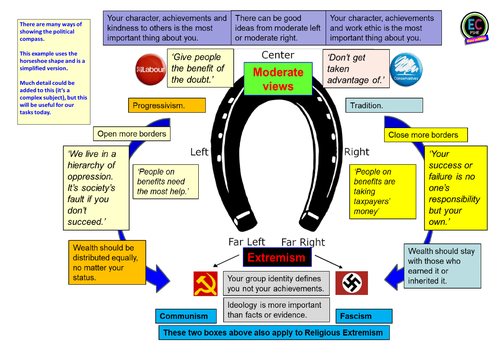
Authoritarian
Government requires a strict obedience to the state authority with total state control and often have a dictator.
E.g. Nazi Germany and Adolf Hitler
Libertarian
Individual rights are favoured over the state and the government is believed to hinder individual freedoms.
E.g. Switzerland is considered the closest modern example
The Political Compass
A 4-way political spectrum which indicates people aren’t just either ‘left’ or ‘right’ but rather places them based on their economic and social beliefs.
Economic - Depending on if they believe in state control of the economy (Left Wing) or believe in privatisation and deregulation (Right Wing).
Social - Depending on if they believe in self-regulating communities that have no state impact (Libertarian) or believe in strict state controlled on all societal aspects (Authoritarian)
Political Party
A group of like-minded individuals who seek to realise their share goals by fielding candidates in the hope of securing election to public office.
Most mainstream seek victory in general elections, how distant that goal may appear
Manifesto
The policies of a party set out in a pre-election document which tells the voters what the party would put in place if they win.
Mandates
The right of a governing party to pursue the policies laid out in the manifesto
Popular support for the winning party at the ballot box is taken to show the public support of the manifesto
Doesn’t require the government to deliver these promises or prevent it from drafting ones not in the original manifesto
Purpose of parties in the UK - Representation
Traditionally, parties reflect the views of their members.
True in the age of mass membership parties, where parties and voters were class divided
Partisan and class delight and the rise of centrist parties undermining primary role.
Purpose of parties in the UK - Recruitment
Political parties engage in electoral activities to compete for public office.
To serve a form of ‘political apprentice’
Purpose of parties in the UK - Engagement
Parties perform an educative function that encourages participation.
The quality of this participation however is dependent on how democratic the parties are themselves and whether they allow members to be fully integrated in these processes.
Purpose of parties in the UK - Stability
Without parties, it is argued that the HoC would simply be a gathering of individuals driven by their own personal goals and political ambition.
Parties present clear choices at general elections.
Purpose of parties in the UK - Formulating Policy
Parties discuss and develop policy proposals before presenting them to voters in their manifesto.
Produces more considerate joined up style of government.
Purpose of parties in the UK - Scrutiny
In a multi-party system, political parties act as checks and balances to each other.
Mainstream Parties
In the modern era, 3 UK political parties have dominated UK politics.
Conservatives - Emerged from Tory, a group within parliament in the mid-1800s
Labour - Formed by trade unions and socialist organisations in 1900 (more centrist since 1995)
Liberal Democrats - Formed when the Liberal party and The Social Democratic Party (SDP) joined together in 1988.
Minority or ‘Niche’ Parties: Nationalists
Parties that aren’t overly successful in elections but still represent certain groups of people based on:
Cultural identity or language of a nation (SNP) or region (Mebyon Kernow)
Campaign for full independence (SNP) or more modest goals (Plaid Cymru)
The British Nationalist Party (BNP) are an exception because they argue for the way of life and values it claims are common to all indigenous UK peoples. Not been any force since 2016.
Instead the arguments are for parties like UKIP, Reform UK, and Restore Britain are nationalists or, to a lesser extent, extremists.
Single Issue Parties
Recent years have seen a rise in the number of parties that represent one particular issue contesting in elections.
In some cases these parties offer a wide ranging programme of policies rooted in a particular ideological perspective (The Green Party)
In other cases they campaign on a particular issue (UKIP) or specific policy (Profile Alliance)
Or a party representing a specific institution, such as Dr Richard Taylor leader of The Kidderminster Hospital and Health Party
Whatever they campaign for, they blur the lines between a political party and a pressure group as they campaign for a certain concern rather than electoral success.
Two-Party System
Two major political parties consistently dominate the political landscape.
E.g. The Democrats v Republicans in the USA
Dominant Party System
A single party continuously dominates election results over opposition groups or parties
E.g. South Africa - African National Congress (ANC) dominated every election since 1994.
Single Party System
Where only a single political party controls the ruling system. Other parties are outlawed, or enjoy limited control.
E.g. Nazi Germany (1933-1945), Bolshevik Party in Soviet Union (1917-1991)
Multi-Party System
More than two meaningful, distinct political parties can run for office and win an election.
E.g. The UK - especially with the rise of Reform UK, Green Party, and Lib Dems.
Majority Government
One party has absolute majority of seats and forms the government.
All government ministers are members of one party.
E.g. Sir Keir Starmer’s Labour Government with a landslide victory in 2024 with 412 seats
Minority Government
No political party has an absolute majority of seats in parliament.
A party without a majority but largest number of seats forms the government but must secure support from other parties in order to pass key measures.
Minister are members of the ‘majority’ party.
E.g. Theresa May’s Conservative Government relying on the support of the DUP after the 2017 Snap Election.
Coalition Government
No party has an absolute majority of seats in parliament forcing two or more parties to agree on a deal to form a government through negotiations and a formal agreement on policy.
Ministerial positions are shared between various governing bodies.
E.g. The Lib Dem-Conservative coalition from 2010-15 was the first and only time a Coalition has occurred in the UK.
The Conservative Party
Founded in 1834
Has had 12 PM since 1945
Notable Politicians: Churchill, Eden, Macmillan, Heath, Thatcher, Major, Johnson

The Conservative Party - One-Nation Conservatism
Most of the 20th Century, the party were rooted in pragmatism and gradual improvements.
Forum of collectivist or paternal conservatism which favoured pluralism and social inclusion. Holding that authority should be centralised while the state should be benevolent and care for the neediest.
‘Nice Tories’ who support a universal welfare state.
The Conservative Party - Thatcherism (New Right)
Common in the 1970s-80s, saw a new form of literal conservatism on both sides of the Atlantic (Reaganism in the US).
Combined Monetarism with Neo-Liberalism with a more orthodox conservative approach in the sphere of social policy.
Ended the post-war consensus and the rise of more adversarial politics
Favoured the importance of the individual over the needs of society as a whole: Deregulation, Privatisation, Statutory limits on the power of trade unions, National sovereignty.
The Conservative Party - 21st Century
David Cameron (2010-2016) - One Nation: Directly tackled poverty, didn’t cut NHS or education, legalised gay marriage (Marriage (Same-Sex Couples) Act 2013). Thatcherism: Big cuts to local gov. services, reduced size of government, promoted competition in public sector. Traditionalist but Populist for the EU.
Theresa May (2016-2019) - One Nation: Compassionate conservatism, active gov. Thatcherism: Lack of compassion to migrants (as Home Sec.), drastically cut public spending. Classic Traditional conservatism in her approach.
Boris Johnson (2019-2022) - One Nation: Expanded the circle of potential allies for care. Thatcherism: 5yrs of financial crisis allowed him to adopt more Thatcherite economic policy. Very much Traditional, but mostly Thatcherite.
Liz Truss (2022) - One Nation: Focus on social mobility, was Welfare & Public Services secretary, public spending increased. Thatcherite: Privatisation, small gov., Social Conservatism. Traditional but very much Thatcherite.
Rishi Sunak (2022-2024) - One Nation: Wet, Cameronite Liberal, introduced the Gov. Furlow Scheme (as Chancellor). Thatcherism: Heir to Thatcher, economic policy and views. Populist as he tires to panda between both sides: socially conservatist and ‘anti-woke’.
Kemi Badenoch (2024-) - One Nation: Not very one nationalist, nothing aligned with their views. Thatcherism: ‘Anti-woke’, ‘No nonsense style’, anti-gender neutral toilets and maternity pay ‘‘excessive”. Largely populist anti-woke aims to prioritise the ‘needs of the common-people’.
The Labour Party
Founded on the 27th Feb 1900
Has had 7 PMs
Notable Politicians: Attlee, Wilson, Callaghan, Blair, Brown, Corbyn, Starmer