Physics Chapter 7: Electric and magnetic fields
 Call Kai
 Learn
Learn Practice Test
 Spaced Repetition
 Match
Match Flashcards
 Knowt Play
1/43

There's no tags or description
Looks like no tags are added yet.
Name | Mastery | Learn | Test | Matching | Spaced | Call with Kai |
|---|
No analytics yet
Send a link to your students to track their progress
44 Terms
What is a force field?
A region in which a non-contact force is experienced by a corresponding interacting particle.
What is an electric field?
A region in which a charged particle will experience a non-contact force.
What is electric field strength?
The force per unit charge experienced bu a charged particle when placed at that point in the field.
State the equation used to calculate the force a charge experiences in an electric field.
Force = Electric Field Strength x Charge
F=EQ
What law determines the magnitude of the electric force between two charges?
Coulomb’s Law
State Coulomb’s law in words.
The force between two charges is directly proportional to the product of their charges and inversely proportional to the square of their separation.
Give Coulomb’s law in equation form.
F=kQq/r² where k = 1/4πε₀
Describe the electric field pattern around a positive point charge.
A radial field, acting outwards.
Describe the electric field pattern around a negative point charge.
A radial field, acting inwards.
Describe the uniform electric field between parallel plates.
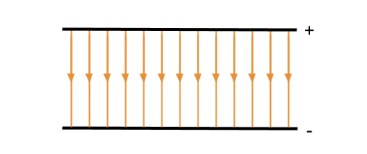
What equation is used to calculate the electric field between parallel plates?
E=V/d
What is electric potential?
The amount of energy required to move a positive test charge from infinity to a given point in an electric field.
How do you calculate electric potential for a radial field?
F=kQ/r where k = 1/4πε₀
What are equipotentials?
Equipotentials are lines along which the electric potential remains the same.
How do you calculate the work done in moving a charge along an equipotential?
No work is done when moving a charge along an equipotential since the electric potential doesn’t change.
What does a capacitor do?
Capacitors are used to store charge in a circuit.
What two factors determine how much charge can be stored by a capacitor?
The potential difference across it
The capacitance
What is capacitance?
Capacitance is a measure of how much charge can be stored by a capacitor per unit potential difference across it.
State the equation used to calculate the capacitance from the charge and potential difference.
Capacitance = Charge / Potential Difference
C=Q/V
What is the unit of capacitance?
CV^-1
What is represented by the area under a capacitor’s charge-potential graph?
The energy stored by a capacitor.
What is represented by the gradient of a capacitor’s charge-potential graph?
Capacitance
Give three equations to calculate the energy stored by a capacitor.
W=1/2QV
W=1/2CV²
W=1/2Q²/C
Descrbe a charge-time graph for charging a capacitor. What does the gradient represent?
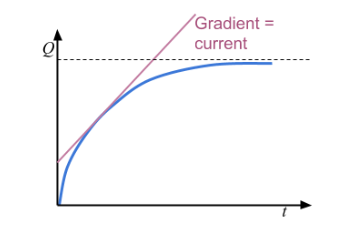
Describe a current-time graph for charging a capacitor. What does the area represent?
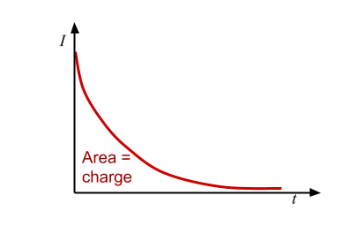
Describe a voltage-time graph for charging a capacitor.
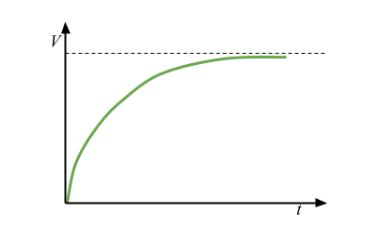
What value is given by the product of resistance and capacitance?
The time constant of the circuit.
What does the time constant of a circuit tell you?
The time the capacitor will take to reach 63% of its total charge, and the time taken for it to discharge to 37% of its full charge.
What is a magnetic field?
A magnetic field is a region in which a magnetic pole will experience a non-contact force.
In which direction do magnetic field lines point?
From North to South.
What is magnetic flux density?
Magnetic flux density is a measure of the strength of a magnetic field. It can be viewed as the number of magnetic field lines that pass through a given area.
What three factors determine the force exerted on a charge moving through a magnetic field?
The magnetic flux density
The charge of the particle
The velocity of the particle perpendicular to the field
State the equation used to calculate the force exerted on a charge moving through a magnetic field.
F=Bqvsinθ
What is the relationship between the direction of a charge’s motion and the direction of the magnetic force it experiences?
The force is always perpendicular to the charge’s motion.
Describe and explain the path taken by a charge in a magnetic field.
The charge will move in a circular path. This is because the magnetic force always acts perpendicular to the charge’s motion and so acts as a centripetal force.