Intelligent Systems
 Call Kai
 Learn
Learn Practice Test
 Spaced Repetition
 Match
Match Flashcards
 Knowt Play
1/21

Earn XP
Description and Tags
General Flashcards on the information required
Name | Mastery | Learn | Test | Matching | Spaced | Call with Kai |
|---|
No analytics yet
Send a link to your students to track their progress
22 Terms
Definition of Fuzzy Logic
Fuzzy Logic uses words and sentences to describe complex environments. It exploits vagueness and the inherent ill definition of most real world problems to characterise uncertainties, using fuzzy sets to express how certain we are that a property is true, false, or somewhere in between.
Principle of Incompatibility
States that the precision and transparency of a model are incompatible properties. White box models are transparent (interpretable) but less precise, black box models are more precise but less transparent. Fuzzy logic finds a compromise point to both properties for an optimal outcome.
Compositional Rule of Inference
Find the output fuzzy set B that corresponds to the input fuzzy A, taking into account the knowledge (relational matrix) R
B = A ∘ R
𝜇B(v) = max[ min[ 𝜇A(u), 𝜇R(u,v)]]
Given the knowledge ‘R’ and an input set ‘A’, we are always guaranteed an answer fuzzy set ‘B’
The quality of the output set ‘B’ will depend on how rich the knowledge represented by ‘R’ is
This is equivalent to an interpolation problem
Extension Principle
Given a fuzzy set A defined in the Universe of Discourse U relating to the variable u, and another fuzzy set B defined in the Universe of Discourse V for the variable v, mapped via a function g such that: v = g(u)
B = g(A) = { (v,𝜇B(v)) ; v = g(u) 𝜇B(v) = 𝜇A(u) }
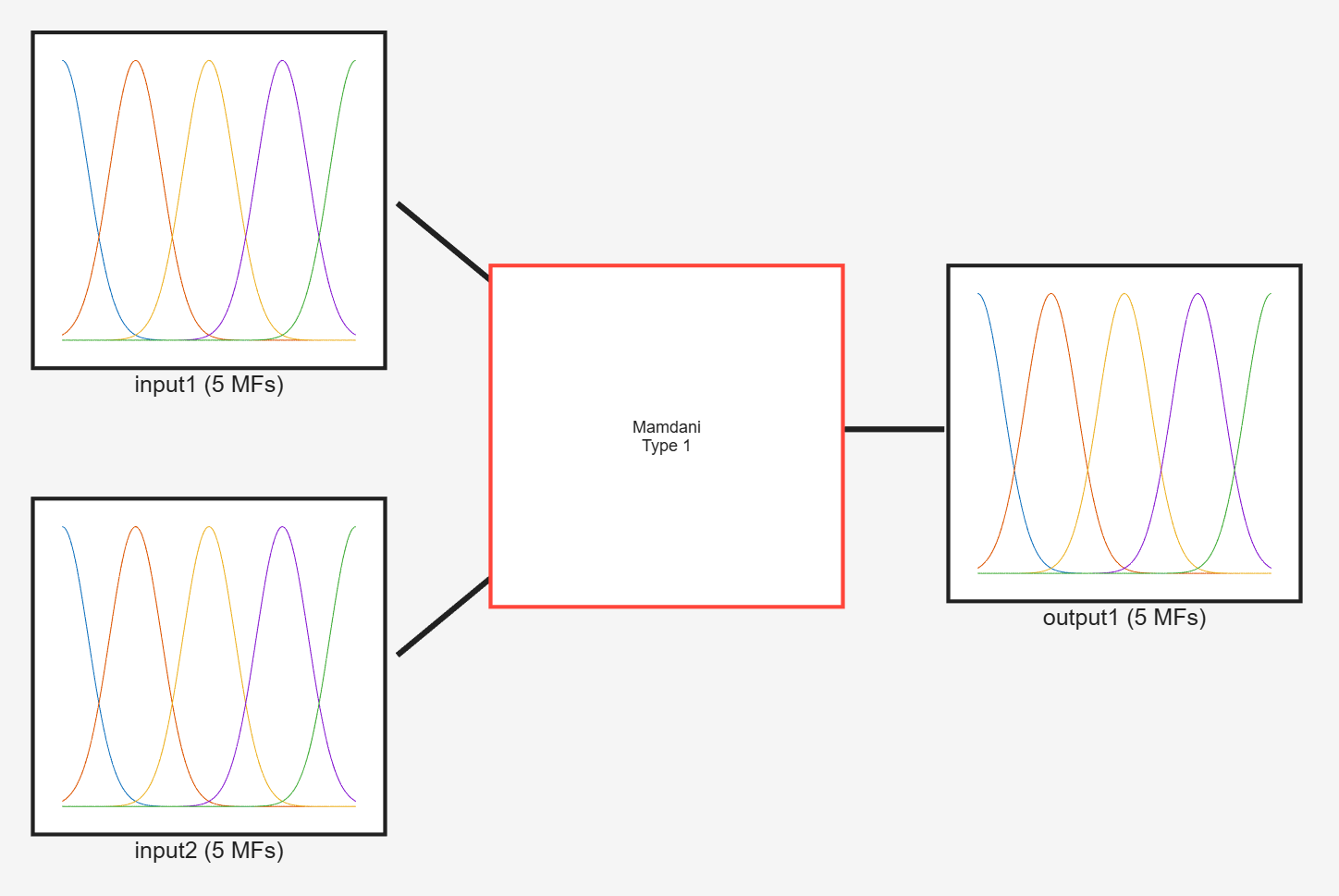
Mamdani Type Systems
Antecedents (inputs) and Consequents (outputs) are represented by fuzzy sets
Fuzzy rules are fully transparent
Fuzzy rules can easily be maintained by expert knowledge
Most commonly used option when fuzzy logic is the logic of choice
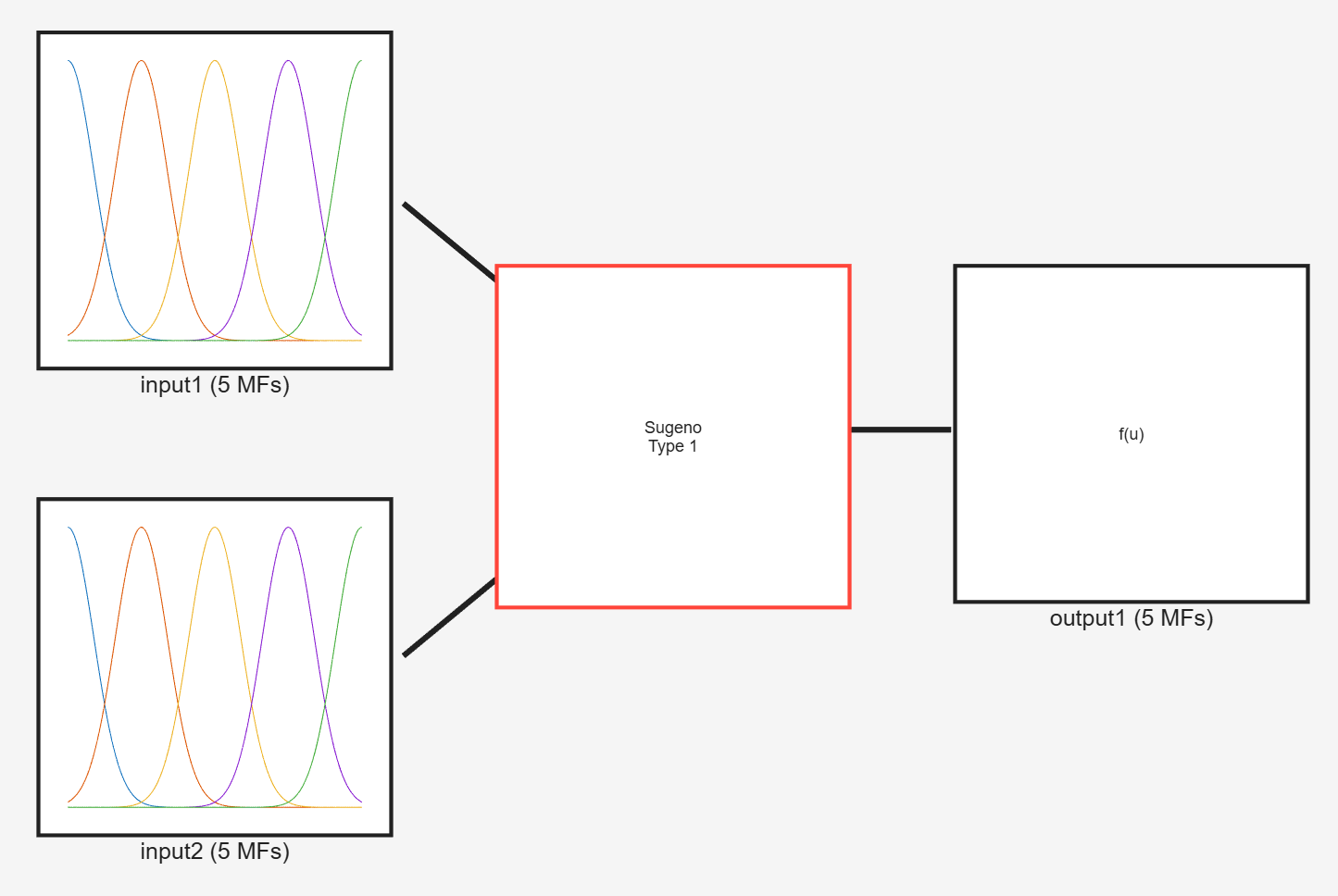
Takagi-Sugeno-Kang Type Systems
Only Antecedents are fuzzy sets, Consequents are represented by deterministic functions
Fuzzy rules are not fully transparent
Fuzzy rules are not easy to maintain
Computationally more efficient
ANFIS (Adaptive Network Fuzzy Inference System) Architecture
A hybrid architecture that uses the interpolating power of ANN (Artificial Neural Networks) to optimise the TSK-based fuzzy rules of a fuzzy system using input and output data
ANFIS Advantages
Fuzzy rules obtained automatically
Fuzzy MFs optimised automatically
Raw input/output data needed (without normalisation)
ANFIS Disadvantages
Input/output data needs to be provided
Type and number of MFs for the inputs needs to be defined
Type of TSK functions needs to be defined
PD Fuzzy Control
Uses Error (Kp) and Error Rate (Kd)
Output is control signal
PI Fuzzy Control
Uses Error (Ki) and Error Rate (Kp)
Output is an incremental control signal, which when passed through an integrator gives a control signal
Input and Output Scaling
Scaling all domains of the inputs and outputs which relate to the definitions of all fuzzy sets in an interval (e.g. [-1 +1]).
Done to avoid the problems with under-exploitation or violation of the domain which the Universe of Discourse exists within
Properties for a fuzzy rule base
Completeness
Continuity
Consistency
Completeness
The rule base should always fire at least one fuzzy rule
Continuity
There is no gap between neighbouring rules (always some overlap)
Consistency
There are no contradictory rules - no different decisions for the same input.
ANFIS Network Diagram
Rule 1: IF x is A1 AND y is B1 THEN f1 = a1x + a2y + c1
Rule 2: IF x is A2 AND y is B2 THEN f2= b1x + b2y + c2
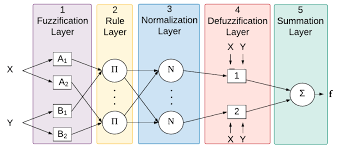
ANFIS Layer 1
Fuzzification Layer:
Inputs = Inputs to the system
Outputs = Membership Values
ANFIS Layer 2
Rule Layer:
Inputs = Membership Values
Outputs = Weighting
E.g. W = 𝜇A1(x) . 𝜇B1(y)
ANFIS Layer 3
Normalisation Layer:
Inputs = Weights
Outputs = Normalised Weights
E.g. W̅1 = W1/(W1 + W2)
ANFIS Layer 4
Defuzzification Layer:
Inputs = Inputs to the system and Normalised Weights
Outputs = Weighted deterministic functions
E.g. W̅1f1 = W̅1(a1x + a2y + c1)
ANFIS Layer 5
Summation Layer:
Inputs = Weighted deterministic functions
Outputs = Sum of weighted deterministic functions
E.g. f = W̅1f1 + W̅2f2