(4) Lungs in acid/base balance
 Call Kai
 Learn
Learn Practice Test
 Spaced Repetition
 Match
Match Flashcards
 Knowt Play
1/19

There's no tags or description
Looks like no tags are added yet.
Name | Mastery | Learn | Test | Matching | Spaced | Call with Kai |
|---|
No analytics yet
Send a link to your students to track their progress
20 Terms
What factors can challenge the acid- base status?
metabolism (anaerobic glycolysis, lactic acid), ingestion, lifestyle (exercise=lactic acid), and pathology (diabetes=more acetoacetic acid (ketones), diarrhea=loss of HCO3-, vomiting=loss of H+)
What 3 primary mechanisms regulate pH of body fluids?
buffering systems; respiratory systems; kidney system
Proton buffer
anything that minimizes a change in pH
How to calculate Ka for reaction of weak acid
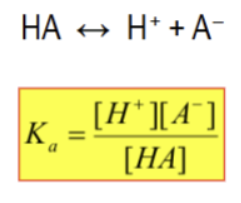
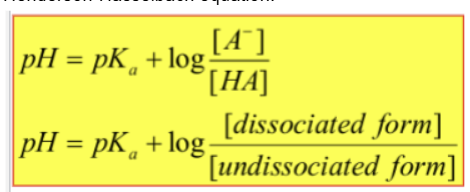
Henderson-Hasselbach equation
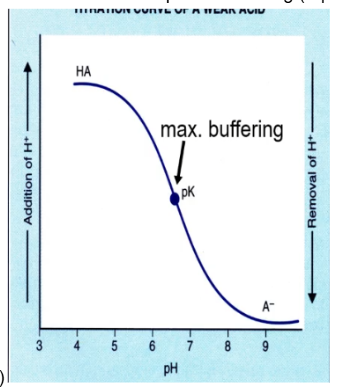
pK
pH where you maximal amount of proton buffering (equal amounts of A- and HA form of weak acid)
Aspects of a good proton buffer for the body?
pK is in physiological pH range (about 7.4) and needs to be high conc. In plasma,
Phosphate buffer
physiological buffer with a pK=6.8 and 1-2mM in plasma. Contributes significantly to proton buffering
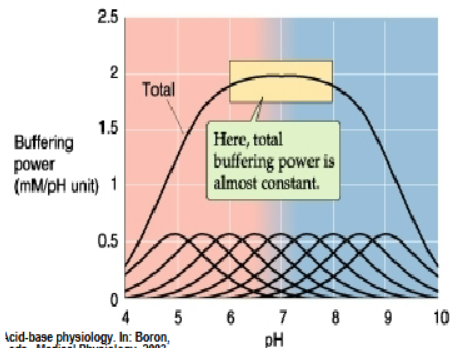
Average buffering power in the body
25 mM per pH unit (graph is incorrect)
CO2/HCO3- buffer system
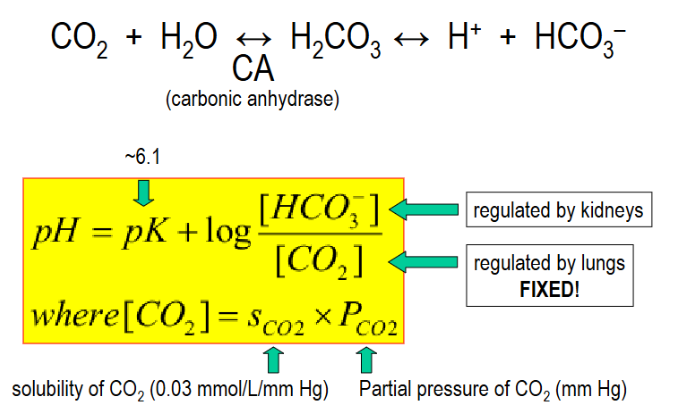
most important buffering system in body. pK is about 6.1 but bicarbonate conc. is high and CO2 can be expelled by lungs. This allows the reaction to go from right to left as needed.
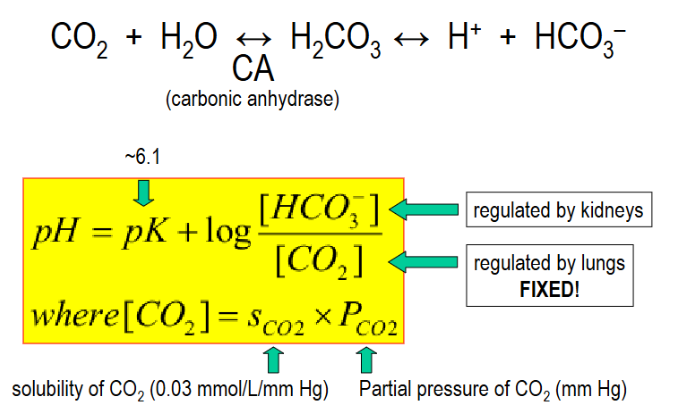
Carbonic anhydrase
catalyzes reaction of CO2+ H2O into H+ and HCO3- for the CO2/HCO3- buffer system
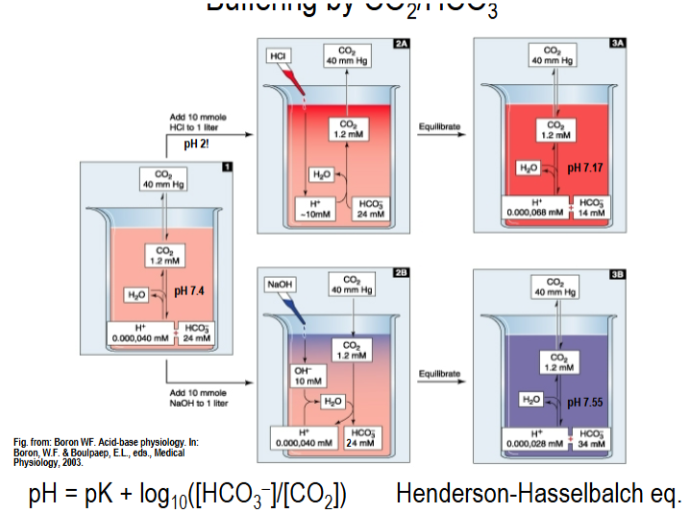
Show how buffering by CO2/HCO3- prevents changes in pH using the beaker analogy (one beaker has HCl added and the other has NaOH)
HCl decreases bicarbonate conc. But CO2 is blown out and a constant CO2 conc. is maintained. NaOH causes bicarbonate conc. To raise
Open system vs closed-system buffering
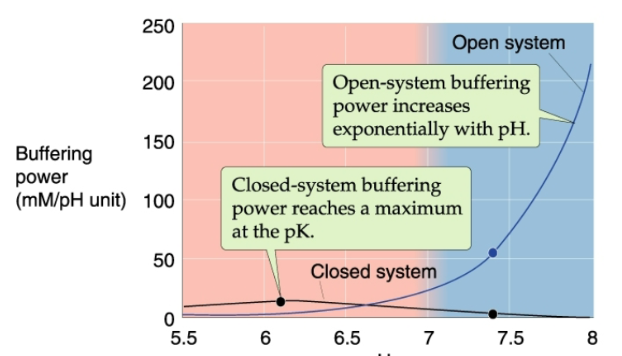
is the bicarbonate buffer system open or closed? why?
The bicarbonate buffer system is considered an open buffer system because its components are not confined to a single, static container (CO2 is able to exhaled by the lungs)
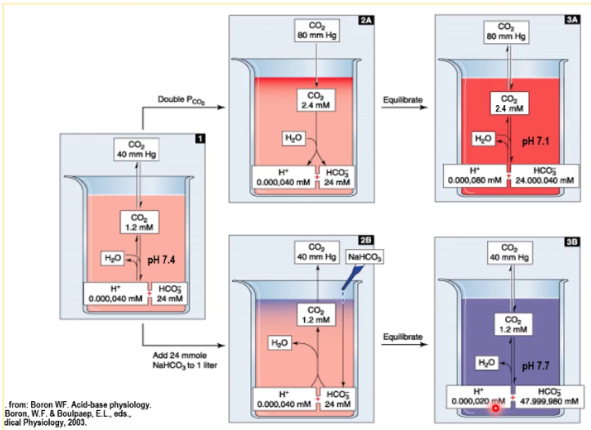
If you doubled CO2 in a fluid with a CO2/HCO3- buffer, what effect would this have?
it would increase H+ conc. (decreasing pH slightly)
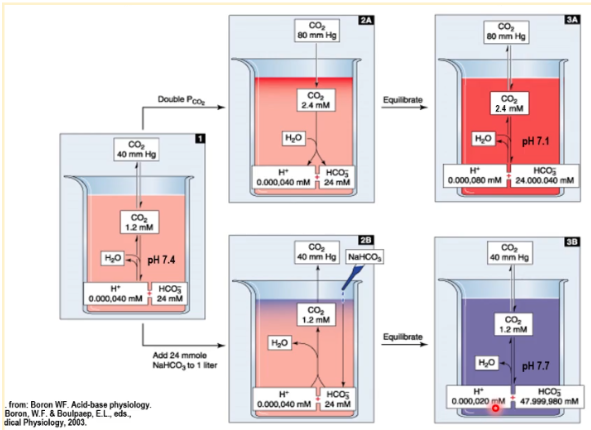
If you doubled HCO3- in a fluid with a CO2/HCO3- buffer, what effect would this have?
it would decrease H+ conc. (increasing pH slightly)
Respiratory acidosis
caused by increased PCO2. this can be caused by decreased alveolar ventilation or lung diffusion capacity or a ventilation-perfusion mismatch

Respiratory alkalosis
caused by decreased PCO2. this can be caused by increased alveolar ventilation such as in cases of hypoxia, anxiety, aspirin intoxication, etc.

Metabolic acidosis
caused by addition of other acids than CO2 or H2CO3 or removal of alkali (fixed PCO2). This can be caused by lowered urinary secretion of H+, ketoacidosis, lactic acidosis or HCO3- loss (as in severe diarrhea)

Metabolic alkalosis
caused by removal of other acids than CO2 or H2CO3 or addition of alkali (fixed PCO2). This can be caused by HCO3- load or loss of H+ (as in severe vomiting)
