Gastrointestinal 3 - Viscera

0.0(0)
Studied by 0 people
call kaiCall Kai
learnLearn
examPractice Test
spaced repetitionSpaced Repetition
heart puzzleMatch
flashcardsFlashcards
GameKnowt Play
Card Sorting

1/44

encourage image

There's no tags or description

Looks like no tags are added yet.

Last updated 1:33 AM on 6/2/26
Name
Mastery
Learn
Test
Matching
Spaced
Call with Kai

No analytics yet

Send a link to your students to track their progress

45 Terms
1
New cards
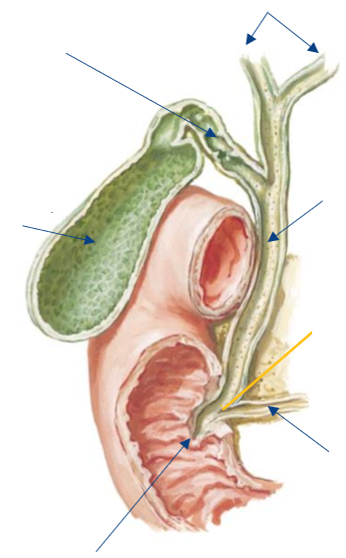
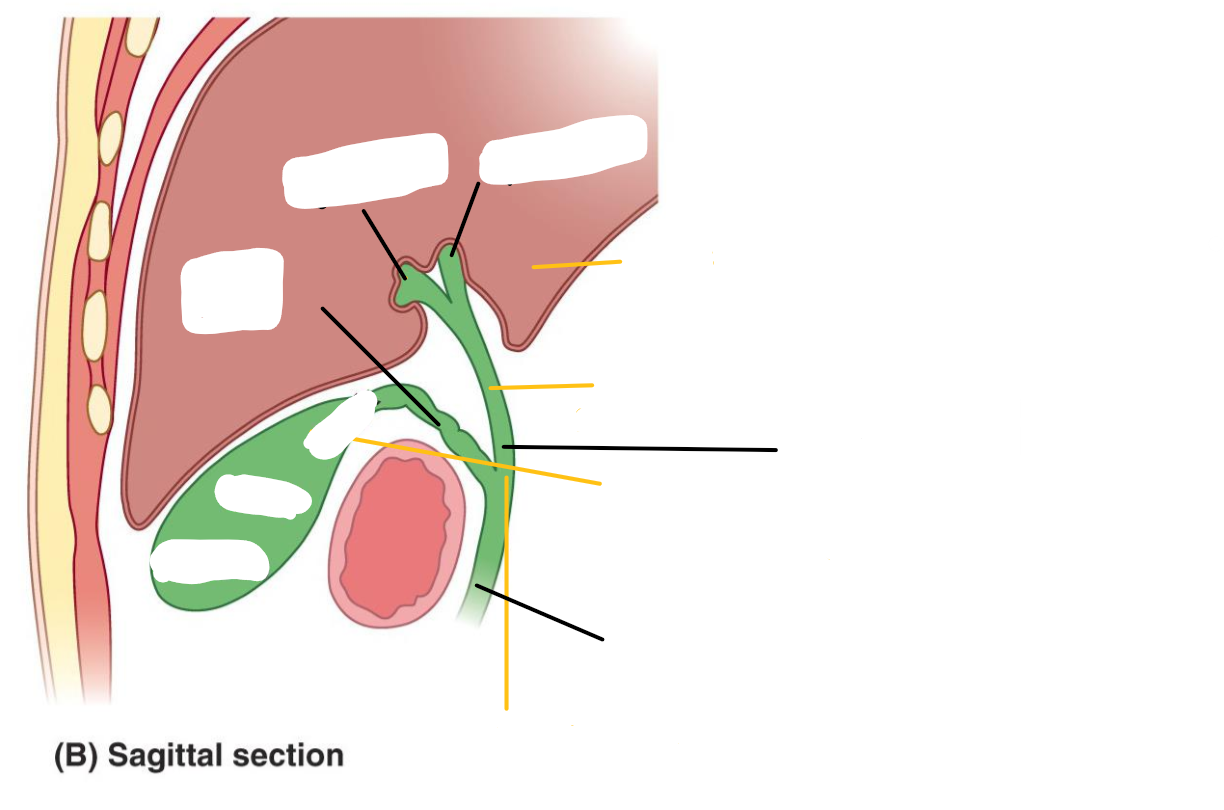
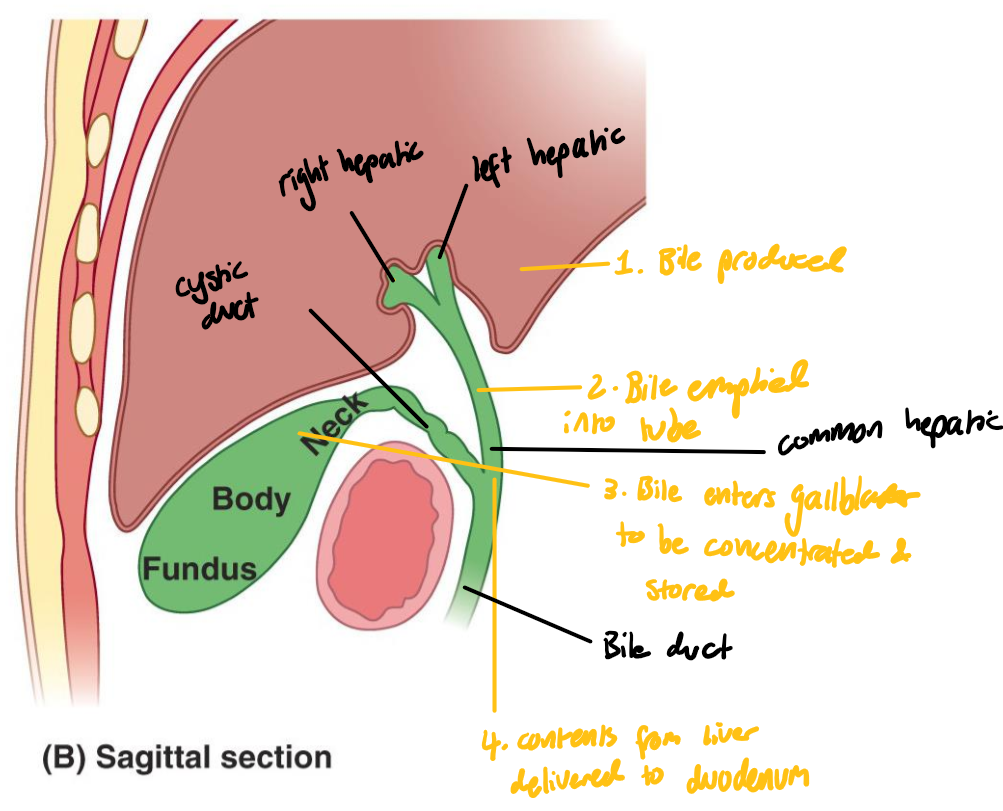
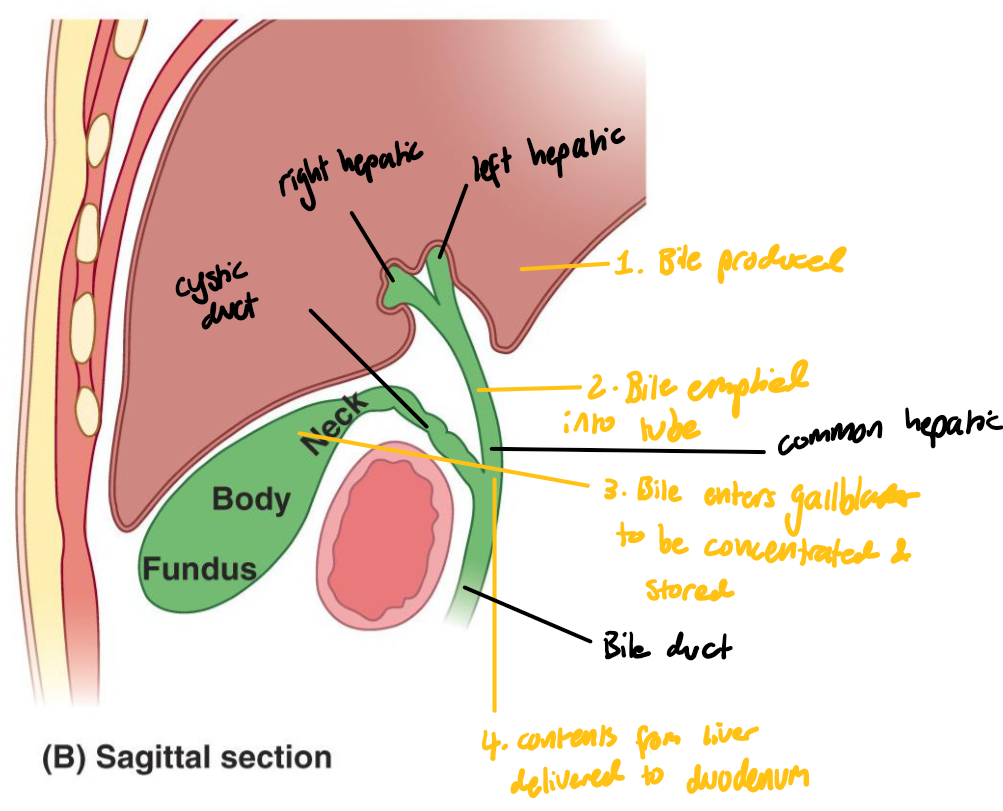
<p>Label the following diagram of the <strong>gallbladder</strong></p><p>(Ignore the yellow lines)</p>

Label the following diagram of the gallbladder

(Ignore the yellow lines)
knowt flashcard image
2
New cards

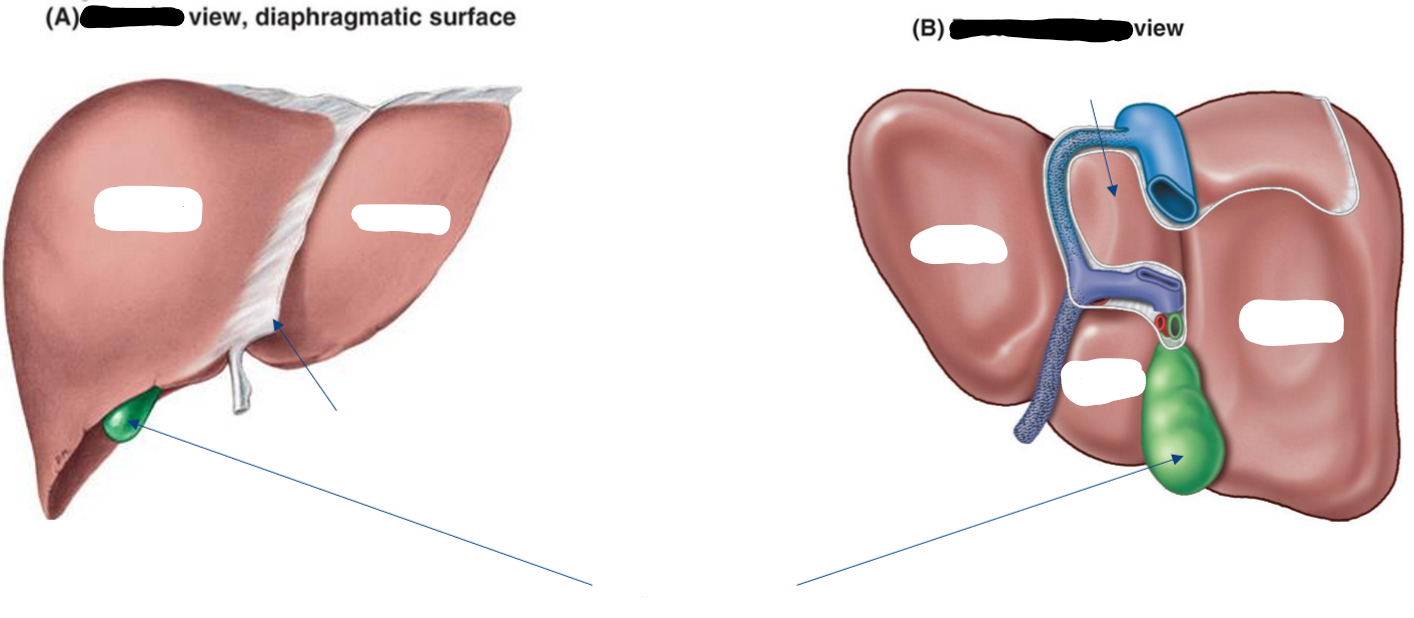
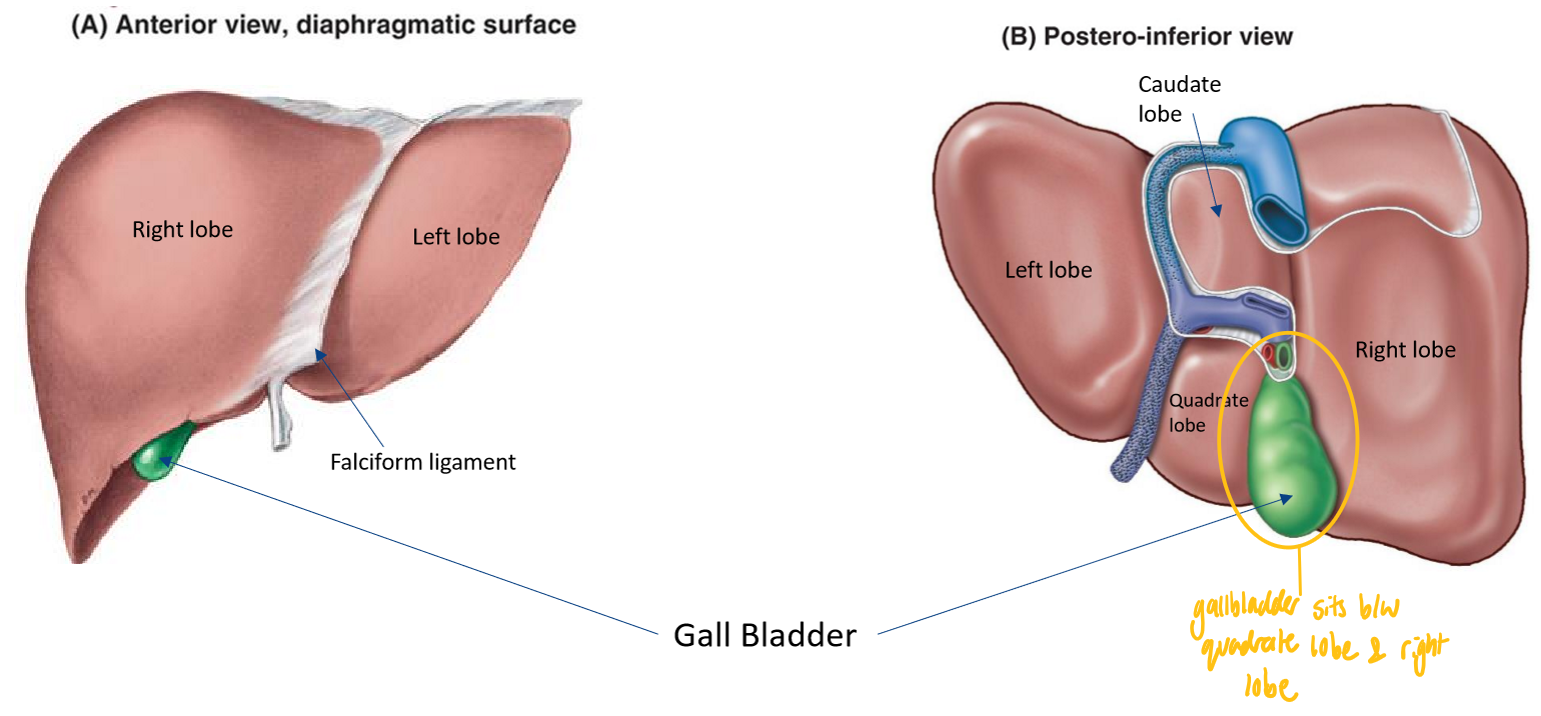
What is the gallbladder?

Pear-shaped sac on visceral surface of liver, wedged in a fossa b/w the right & quadrate lobes
<p>Pear-shaped sac on <strong>visceral</strong> surface of <strong>liver</strong>, wedged in a <em>fossa </em>b/w the <strong>right</strong> &amp; <strong>quadrate</strong> lobes</p>
3
New cards

What is the role of the gallbladder?

Receives, concentrates & stores bile from the liver

4
New cards

What are the 3 major components of the gallbladder?

  • Fundus: concentrates bile

  • Body

  • Neck: site of retrograde bile flow into gallbladder if bile is not needed

5
New cards

What does the gallbladder empty into?

The cystic duct, a component of the bile duct system

6
New cards

Describe the movement of bile from the liver to the gallbladder

  1. Bile is produced in the liver

  2. Bile is flows into the right hepatic & left hepatic ducts

  3. Bile flows into the common hepatic duct & then into the cystic ductgallbladder for storage

  4. Bile flows into the bile duct to be delivered to the duodenum
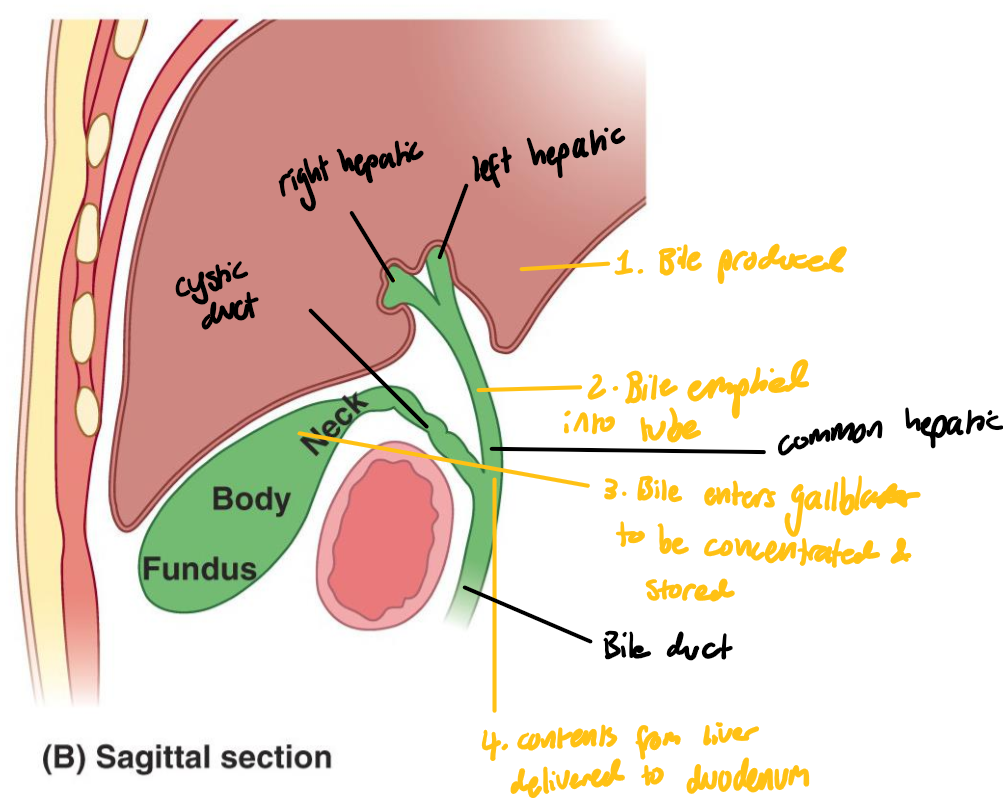
<ol><li><p>Bile is produced in the <strong>liver</strong></p></li><li><p>Bile is flows into the <strong>right hepatic</strong> &amp; <strong>left hepatic</strong> ducts</p></li><li><p>Bile flows into the <strong>common hepatic duct </strong>&amp; then into the <strong>cystic duct</strong> → <strong>gallbladder</strong> for storage</p></li><li><p>Bile flows into the <strong>bile duct</strong> to be delivered to the duodenum</p></li></ol><p></p>
7
New cards
<p>Label the following diagram to show the positioning of the <strong>gallbladder</strong></p>

Label the following diagram to show the positioning of the gallbladder
<p></p>
8
New cards
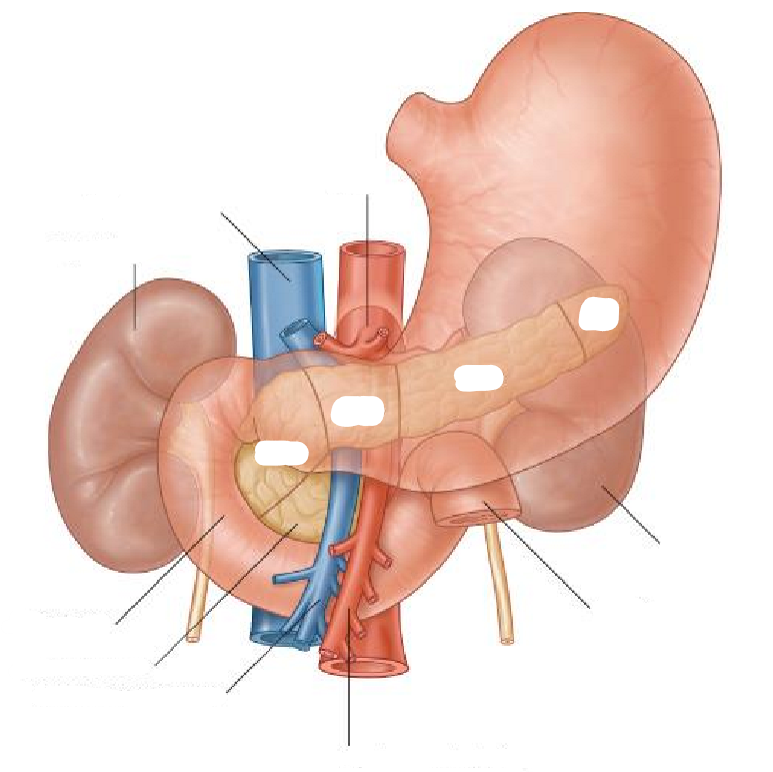
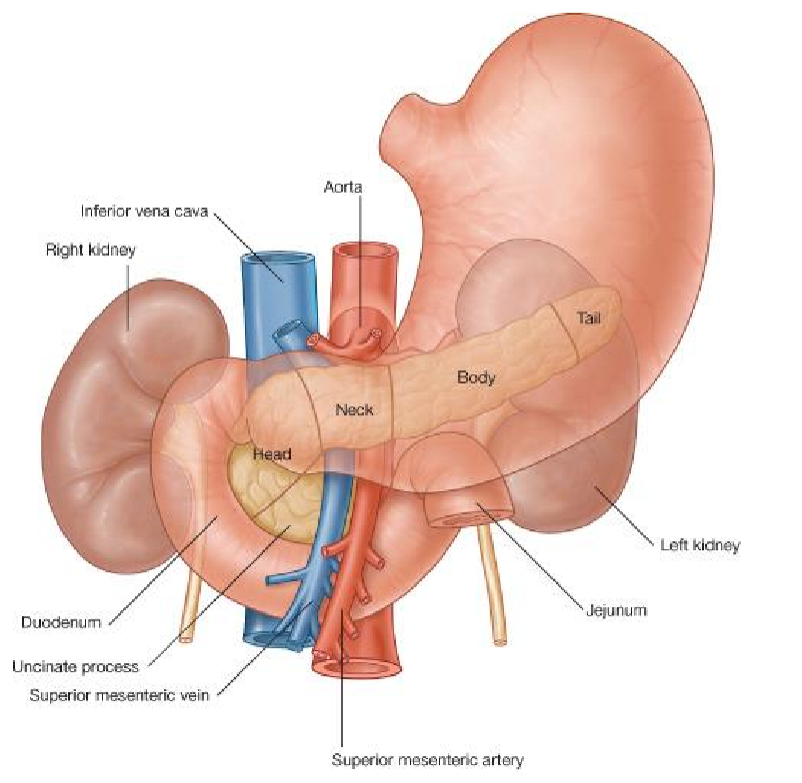
<p>Label the following diagram of the <strong>pancreas</strong> &amp; associated structures</p>

Label the following diagram of the pancreas & associated structures
knowt flashcard image
9
New cards

For the pancreas, state:

  • What type of organ it is

  • Whether it is more superficial or deep, & retroperitoneal or intraperitoneal

  • Major components

  • Associated structures

  • Appearance

  • Exocrine & endocrine glandular tissue

    • Mostly exocrine in GIT; → signalling molecules + enzymes into ducts

  • Very deep & retroperitoneal

  • Major components:

    • Head (w/ uncinate process): surrounded by duodenum

    • Neck: near superior mesenteries (large blood vessels)

    • Body

    • Tail (near spleen)

  • Associated structures:

    • Duodenum

    • Stomach

    • Spleen

    • Superior mesenteric vessels

    • Bile duct

  • Distinct lobulated appearance w/ no capsule; looks very fatty
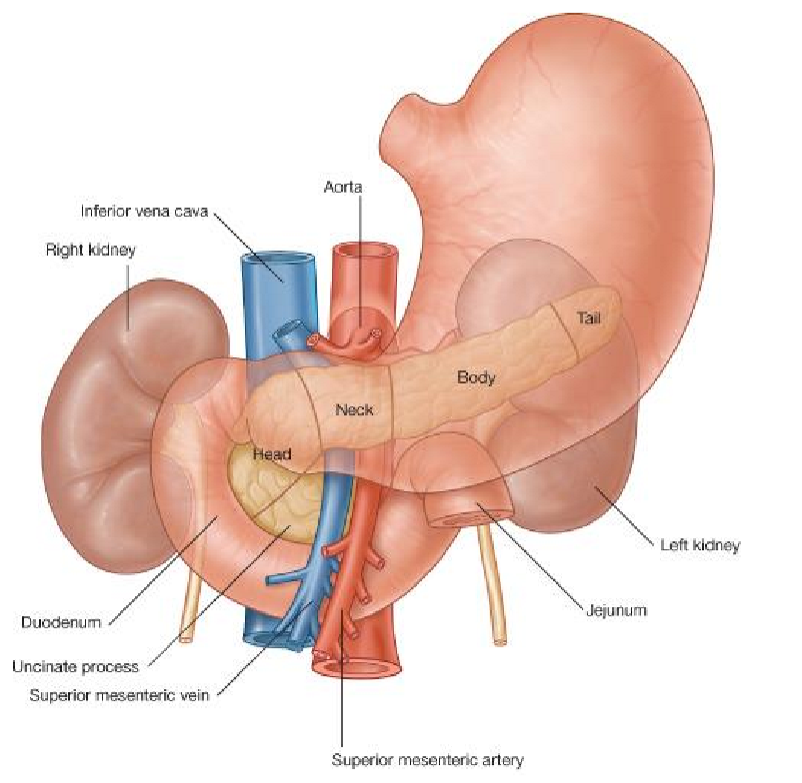
<ul><li><p><strong>Exocrine</strong> &amp; <strong>endocrine</strong> <em>glandular</em> tissue </p><ul><li><p>Mostly <strong>exocrine</strong> in GIT; → signalling molecules + enzymes into <em>ducts</em></p></li></ul></li><li><p>Very <strong>deep</strong> &amp; <strong>retroperitoneal</strong></p></li><li><p><u>Major components</u>:</p><ul><li><p><strong>Head</strong> (w/ <strong>uncinate process</strong>): surrounded by duodenum</p></li><li><p><strong>Neck</strong>: near superior mesenteries (large blood vessels)</p></li><li><p><strong>Body</strong></p></li><li><p><strong>Tail</strong> (near <strong>spleen</strong>)</p></li></ul></li><li><p><u>Associated structures</u>:</p><ul><li><p><strong>Duodenum</strong></p></li><li><p><strong>Stomach</strong></p></li><li><p><strong>Spleen</strong></p></li><li><p><strong>Superior mesenteric vessels</strong></p></li><li><p><strong>Bile duct</strong></p></li></ul></li><li><p>Distinct <strong>lobulated</strong> appearance w/ <strong>no capsule</strong>; looks very <strong>fatty</strong></p></li></ul><p></p>
10
New cards

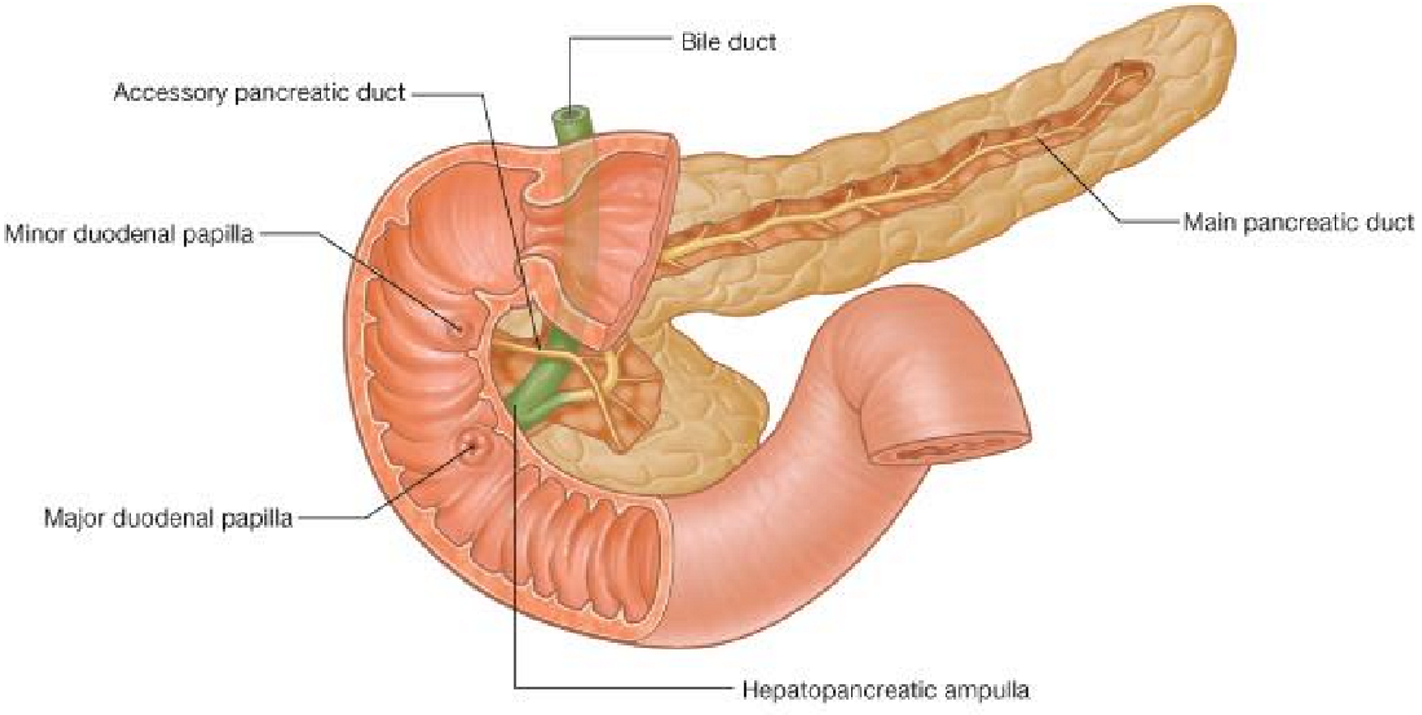
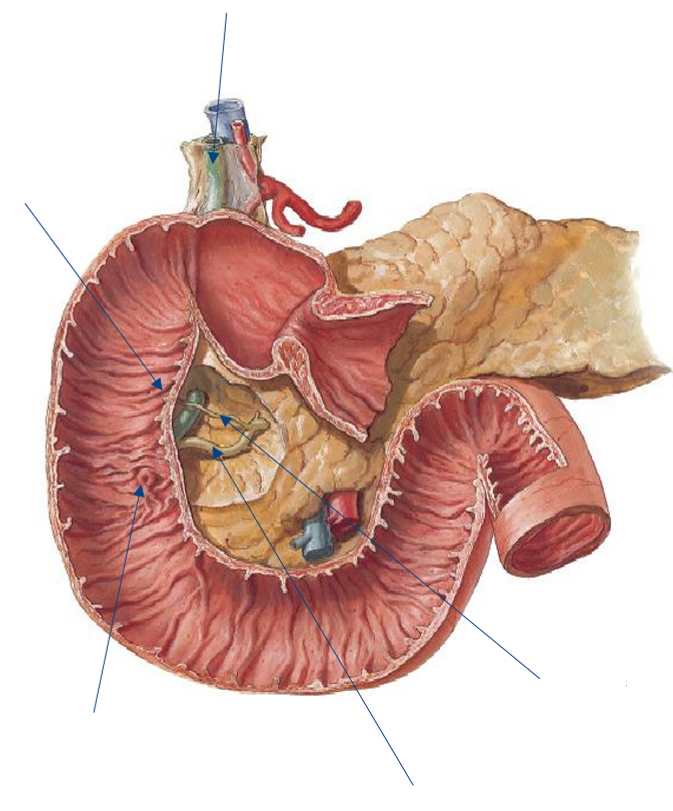
Label the following diagram of the pancreatic ducts
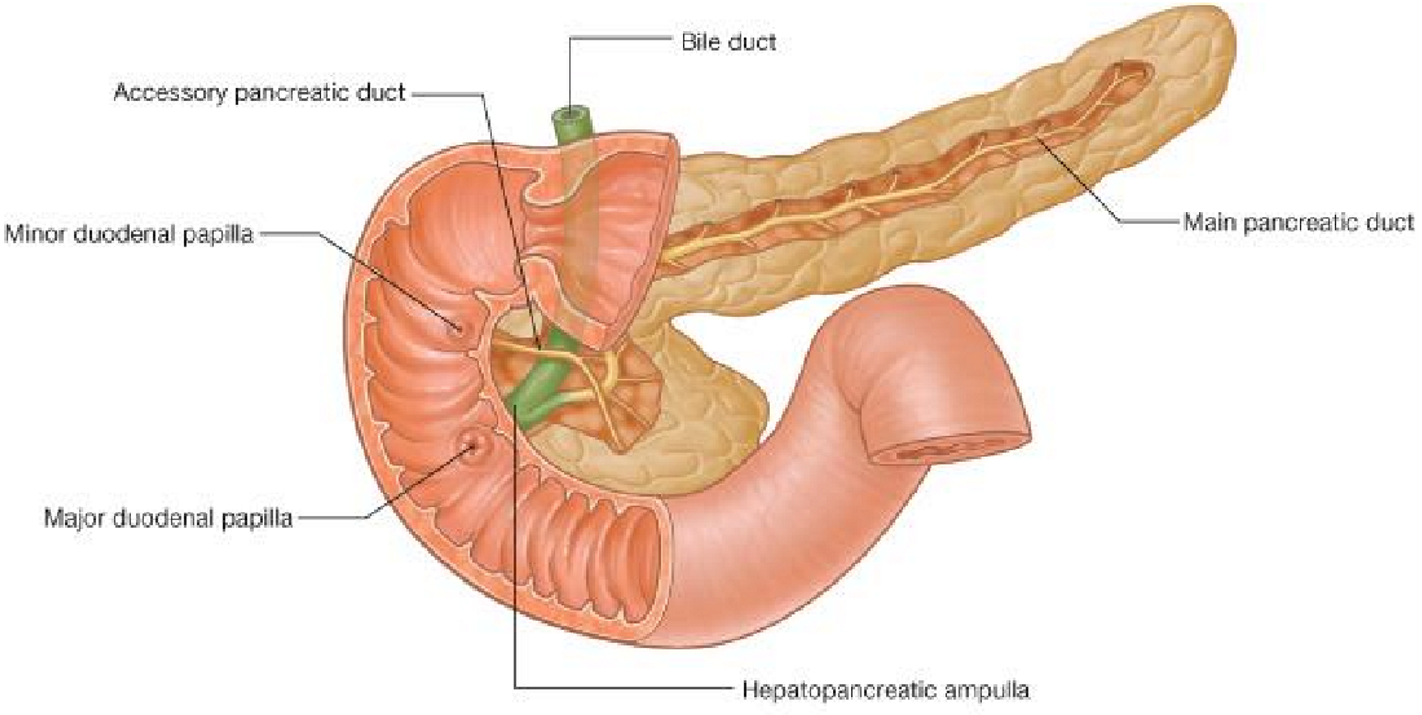
knowt flashcard image
11
New cards
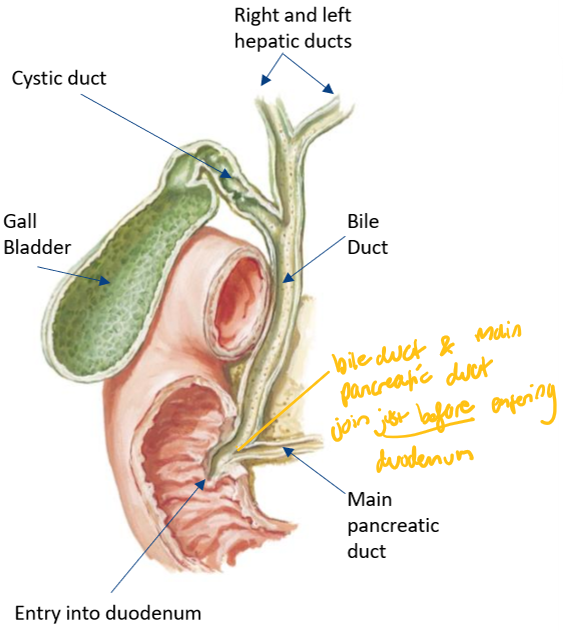
<p>What does this diagram show about the relationship between the bile &amp; pancreatic duct?</p>

What does this diagram show about the relationship between the bile & pancreatic duct?

They join just before entering the duodenum
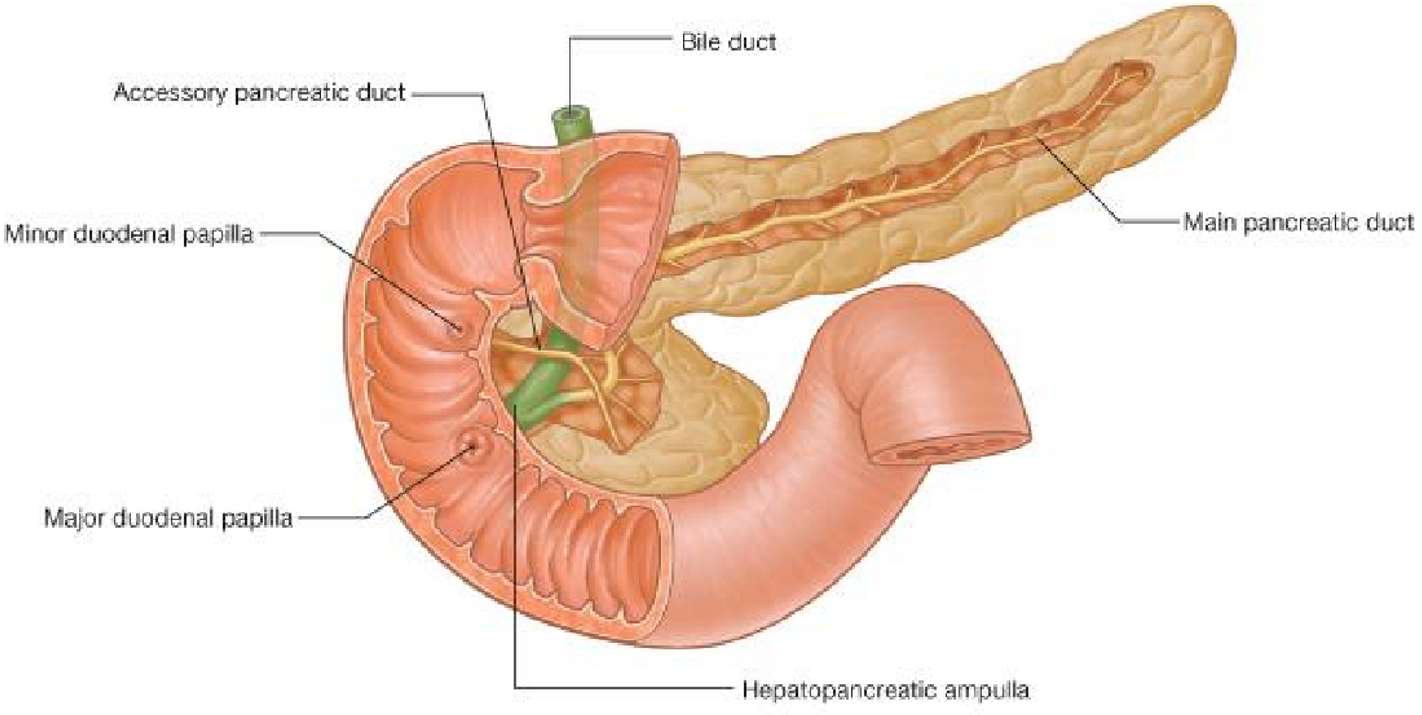
<p>They <strong>join</strong> just <strong>before</strong> entering the <strong>duodenum</strong></p>
12
New cards

Where do the minor duodenal papilla & major duodenal papilla of the pancreas enter?

Enter the second part of the duodenum

13
New cards

Where are the minor duodenal papilla & major duodenal papilla positioned with respect to the abdominal wall?

  • Fixed on the abdominal wall → more stable

  • First part of the duodenum bends & twists (comes off abdominal wall)
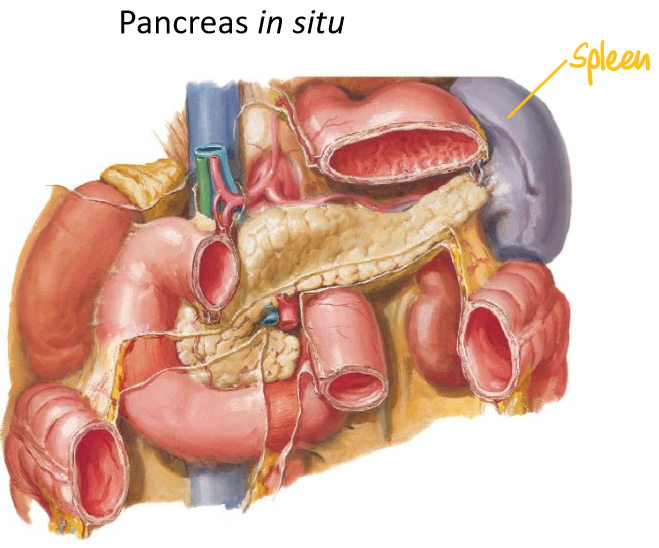
<ul><li><p><strong>Fixed</strong> on the abdominal wall → more <strong>stable</strong></p></li><li><p><em>First</em> part of the duodenum bends &amp; twists (comes off abdominal wall)</p></li></ul><p></p>
14
New cards
<p>Label the following diagram of the <strong>bile</strong> &amp; <strong>pancreatic ducts</strong></p>

Label the following diagram of the bile & pancreatic ducts
knowt flashcard image
15
New cards

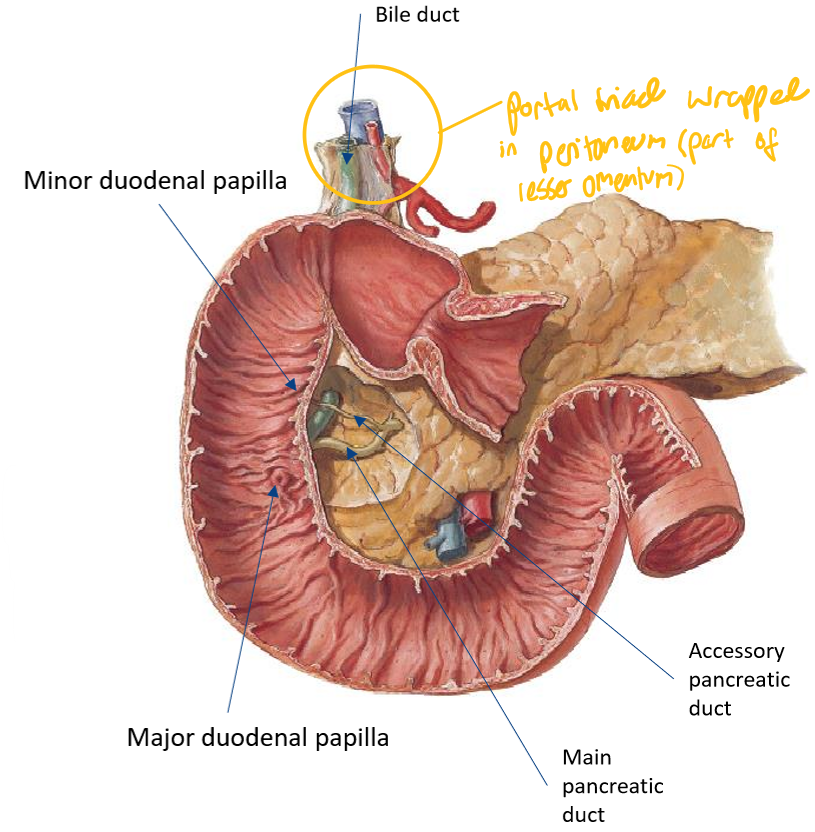
What is the portal triad wrapped in?

Peritoneum; part of the lesser omentum
<p><strong>Peritoneum</strong>; part of the <strong>lesser omentum</strong></p>
16
New cards
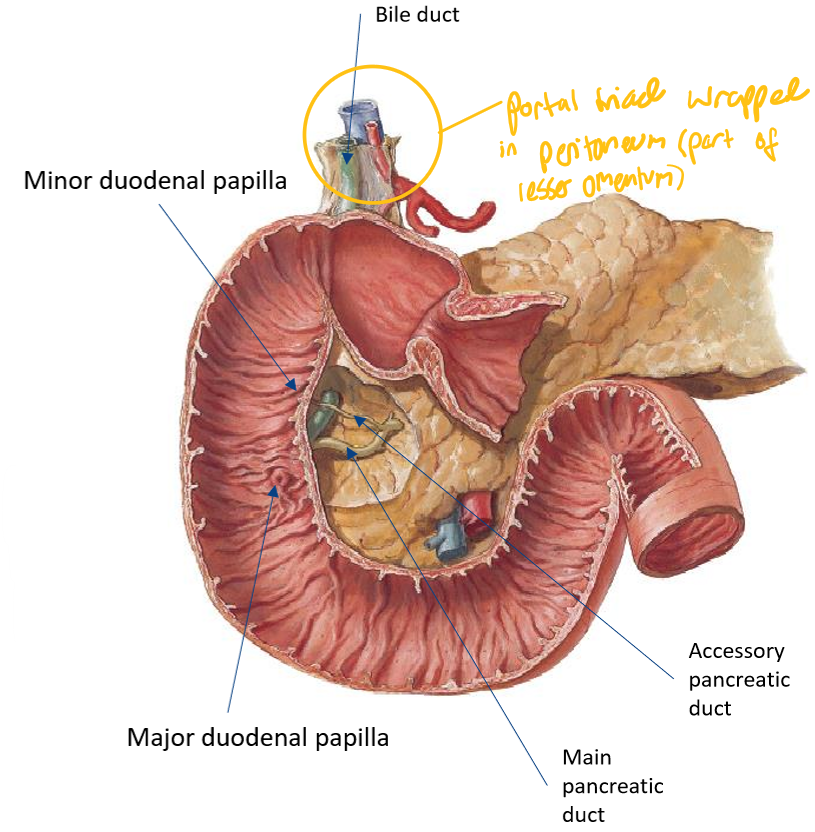
<p>Label the following diagram of the <strong>pancreatic </strong>&amp; <strong>bile ducts</strong></p>

Label the following diagram of the pancreatic & bile ducts
knowt flashcard image
17
New cards

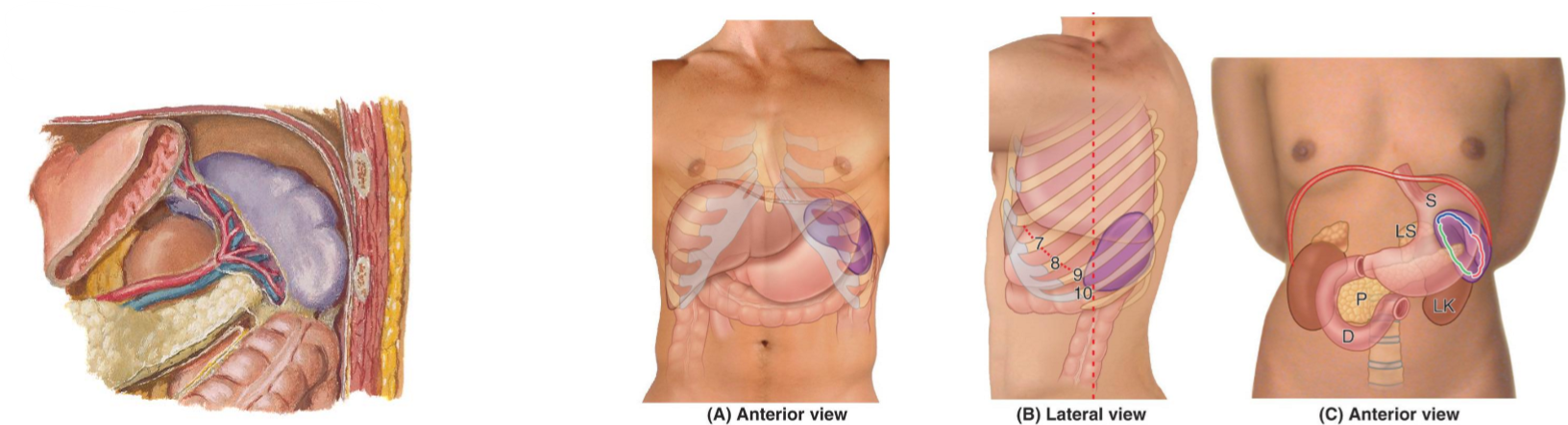
What is the spleen & what is its role?

Vascular organ & the largest lymphatic viscera but is NOT part of the digestive pathway

  • Role: produces white blood cells (but its role changes throughout development, puberty & adulthood)
<p><strong>Vascular</strong> organ &amp; the <strong>largest lymphatic</strong> viscera but is NOT part of the <em>digestive pathway</em></p><ul><li><p><u>Role</u>: produces white blood cells (but its role changes throughout development, puberty &amp; adulthood)</p></li></ul><p></p>
18
New cards

For the spleen, state:

  • Where it is located & implications of this location

  • Shape

  • Whether it is intra- or retroperitoneal

  • Close anatomical relationship to another structure

  • Deep in upper left quadrant to left ribs 9-10/11

    • Risk of injury from rib fractures → life threatening due to possibility of major blood loss

  • Variable in shape

  • Intraperitoneal

  • Splenic hilum close to pancreatic tail
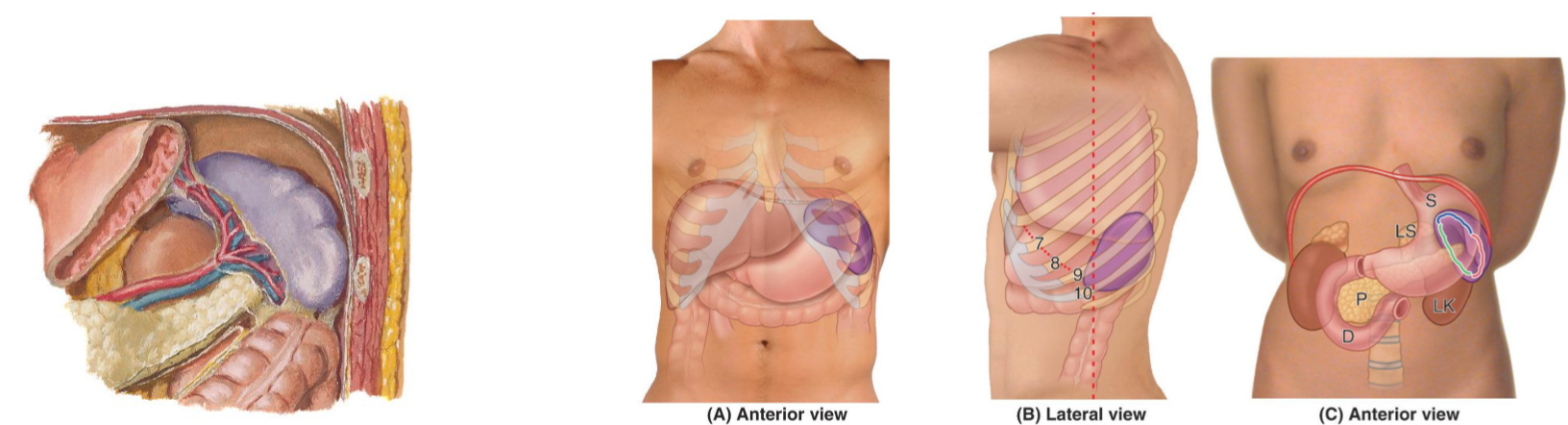
<ul><li><p><strong>Deep</strong> in <strong>upper left quadrant</strong> to <strong>left ribs 9-10/11</strong></p><ul><li><p>Risk of injury from rib fractures → life threatening due to possibility of <em>major blood loss</em></p></li></ul></li><li><p><strong>Variable</strong> in shape</p></li><li><p><strong>Intraperitoneal</strong></p></li><li><p><strong>Splenic hilum</strong> close to <strong>pancreatic tail</strong></p></li></ul><p></p>
19
New cards
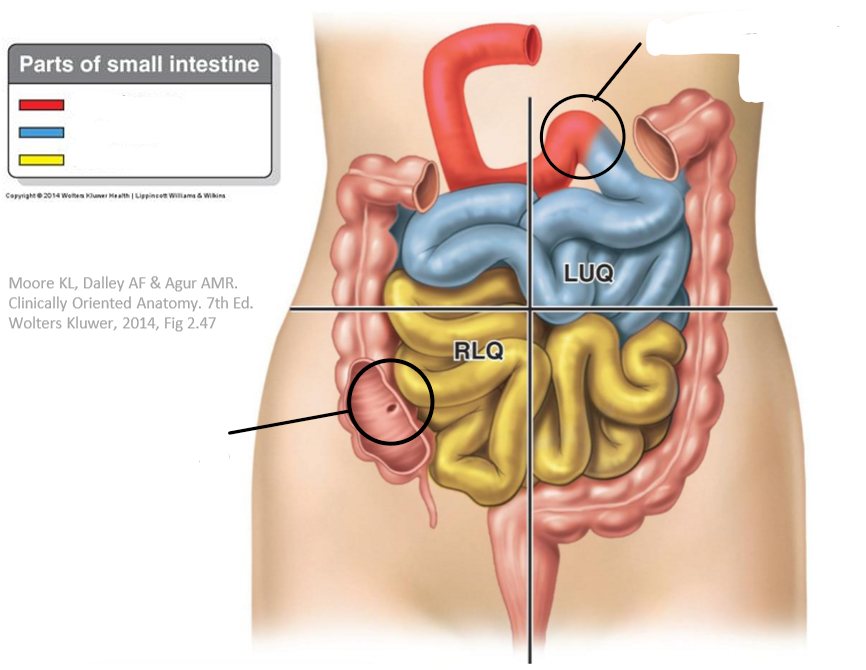
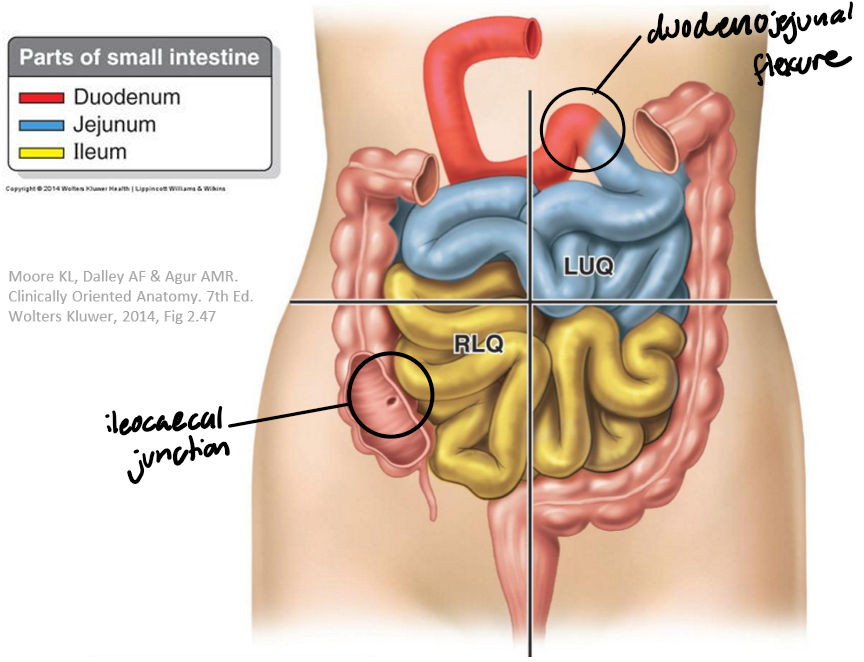
<p>Label the following diagram</p>

Label the following diagram

knowt flashcard image
20
New cards

For the jejunum, state:

  • Where it begins

  • Where it is positioned

  • What is comprises

  • Diameter & wall thickness

  • Key feature

  • Begins @ duodeno-jejunal flexure

  • Largely in left upper quadrant

  • Comprises proximal 40% of small intestine

  • Large diameter + thick wall

  • Prominent plicae circulares (luminal folds) → ^ SA for absorption
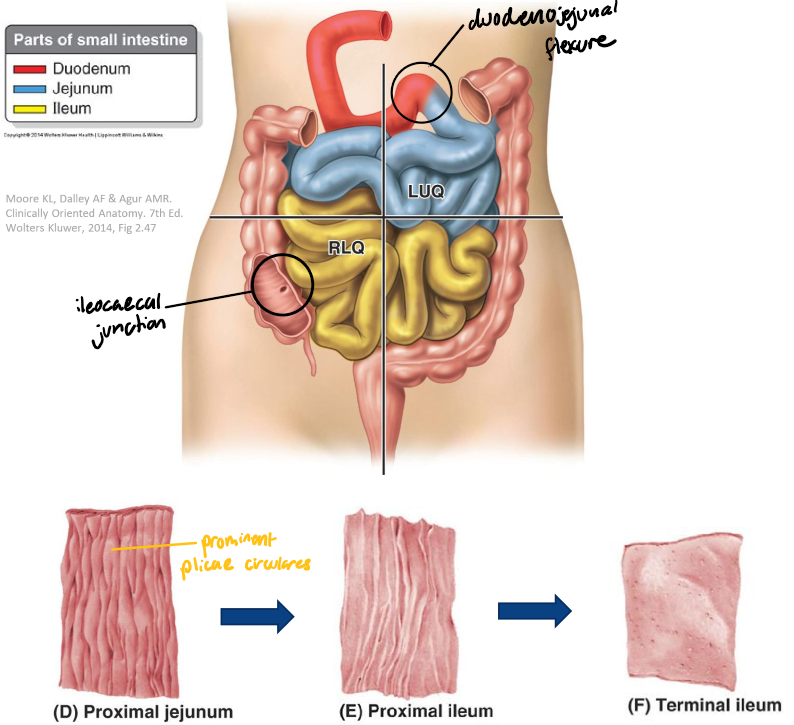
<ul><li><p>Begins @ <strong>duodeno-jejunal flexure</strong></p></li><li><p>Largely in <strong>left upper quadrant</strong></p></li><li><p>Comprises <strong>proximal 40% </strong>of <strong>small intestine</strong></p></li><li><p><strong>Large</strong> diameter + <strong>thick </strong>wall</p></li><li><p>Prominent <strong>plicae circulares</strong> (luminal folds) → ^ SA for absorption</p></li></ul><p></p>
21
New cards

For the ileum, state:

  • Where it begins

  • Where it is positioned

  • What is comprises

  • Diameter & wall thickness

  • Key feature

  • Where it ends

  • Poorly defined transition from jejunum to ileum

  • Largely in right lower quadrant

  • Comprises distal 60% of small intestine

  • Narrow diameter + thin wall

  • Less prominent & prevalent plicae circulares (b/c there is less stuff to absorb as food travels through the SI)

  • Ends @ ileocaecal junction → empty contents into initial large intestine
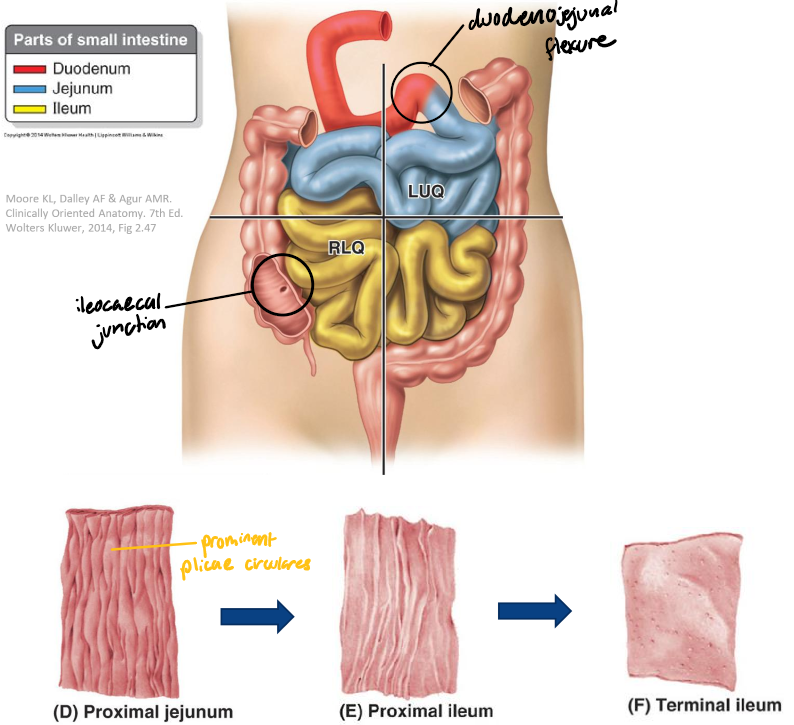
<ul><li><p>Poorly defined transition from jejunum to ileum</p></li><li><p>Largely in <strong>right lower quadrant</strong></p></li><li><p>Comprises <strong>distal 60% </strong>of <strong>small intestine</strong></p></li><li><p><strong>Narrow</strong> diameter + <strong>thin</strong> wall</p></li><li><p>Less prominent &amp; prevalent <strong>plicae circulares</strong> (b/c there is less stuff to absorb as food travels through the SI)</p></li><li><p>Ends @ <strong>ileocaecal junction</strong> → empty contents into <strong>initial large intestine</strong></p></li></ul><p></p>
22
New cards
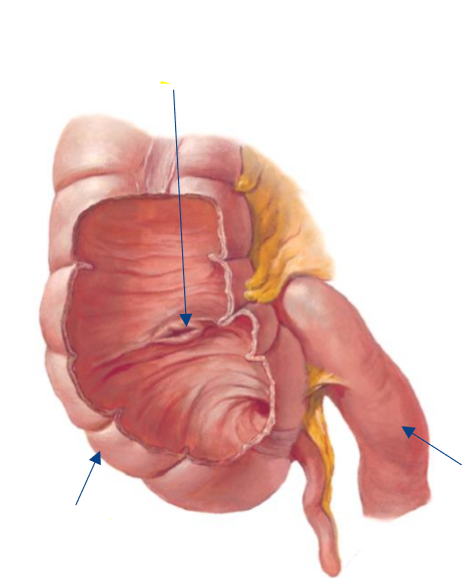
<p>Label the following diagram</p>

Label the following diagram

knowt flashcard image
23
New cards
<p>Label the following diagram</p>

Label the following diagram

knowt flashcard image
24
New cards

How does the diameter & length of the large intestine compare to the small intestine?

  • Larger diameter of LI

  • Shorter length of LI

25
New cards

What does the large intestine begin as?

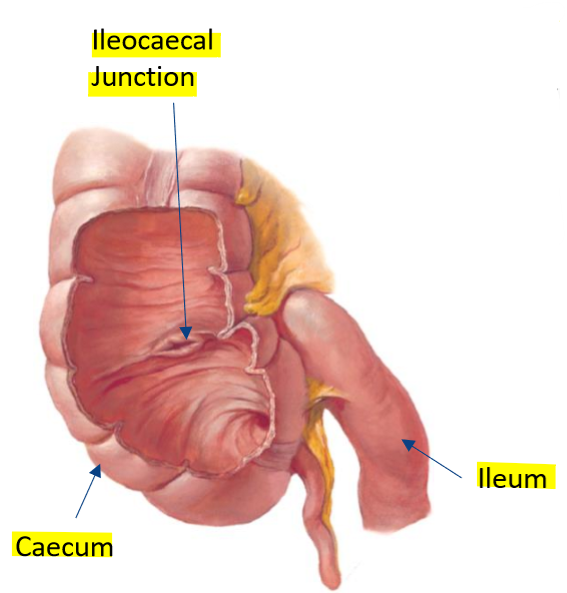
The caecum at the ileocaecal junction
<p>The <strong>caecum</strong> at the <strong>ileocaecal junction</strong></p>
26
New cards

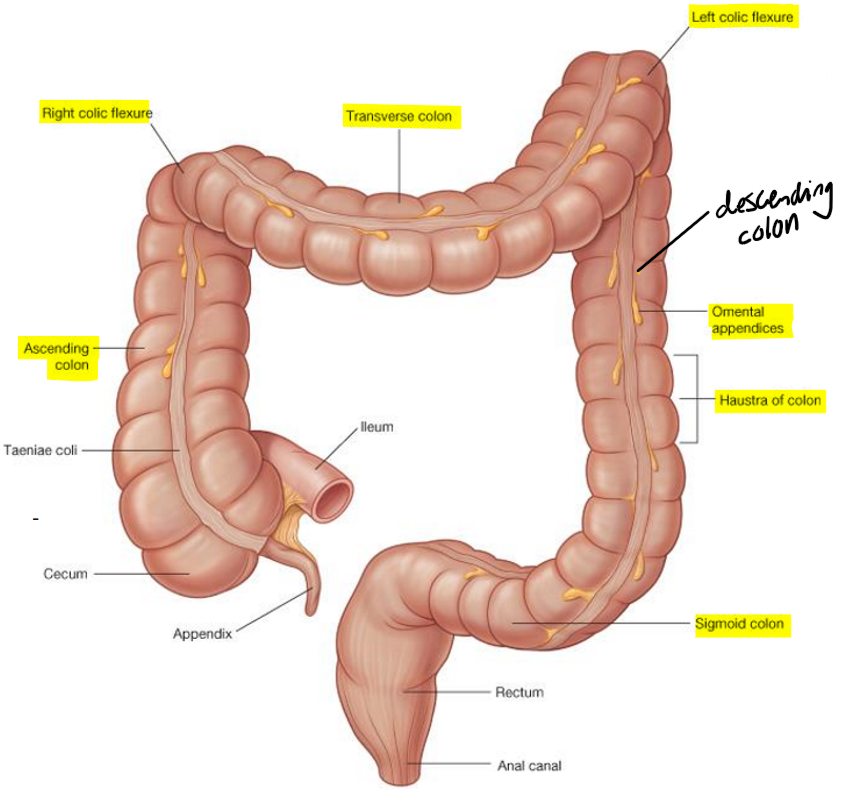
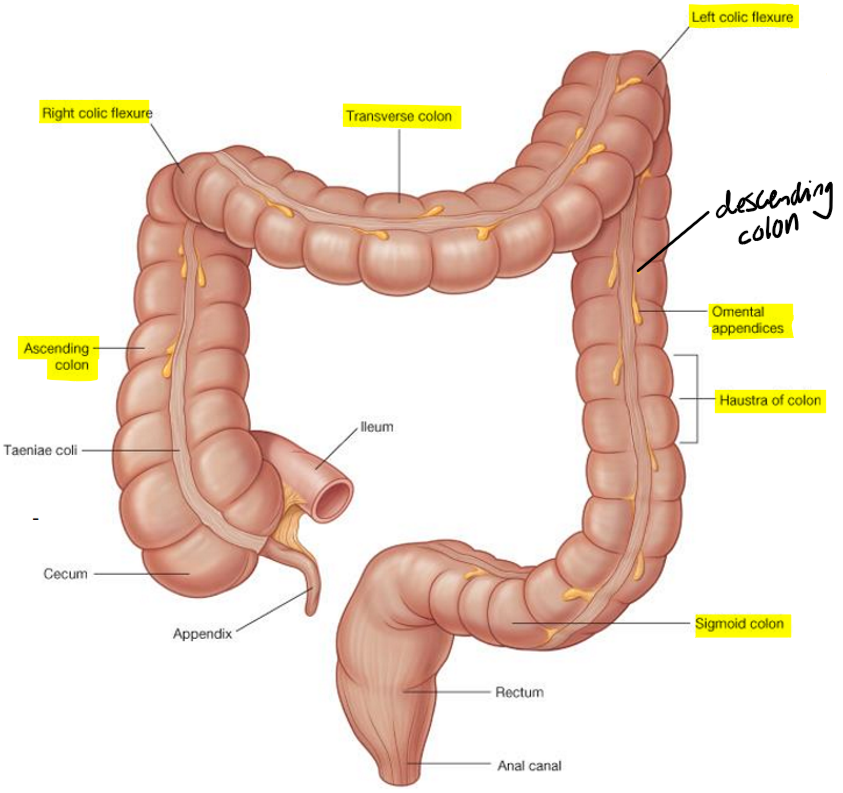
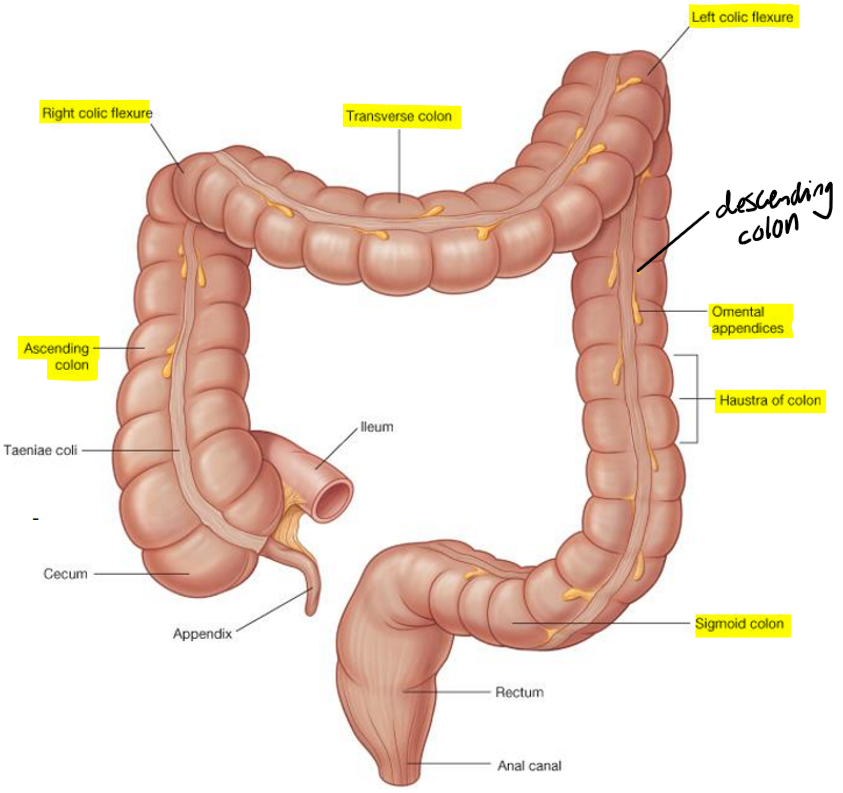
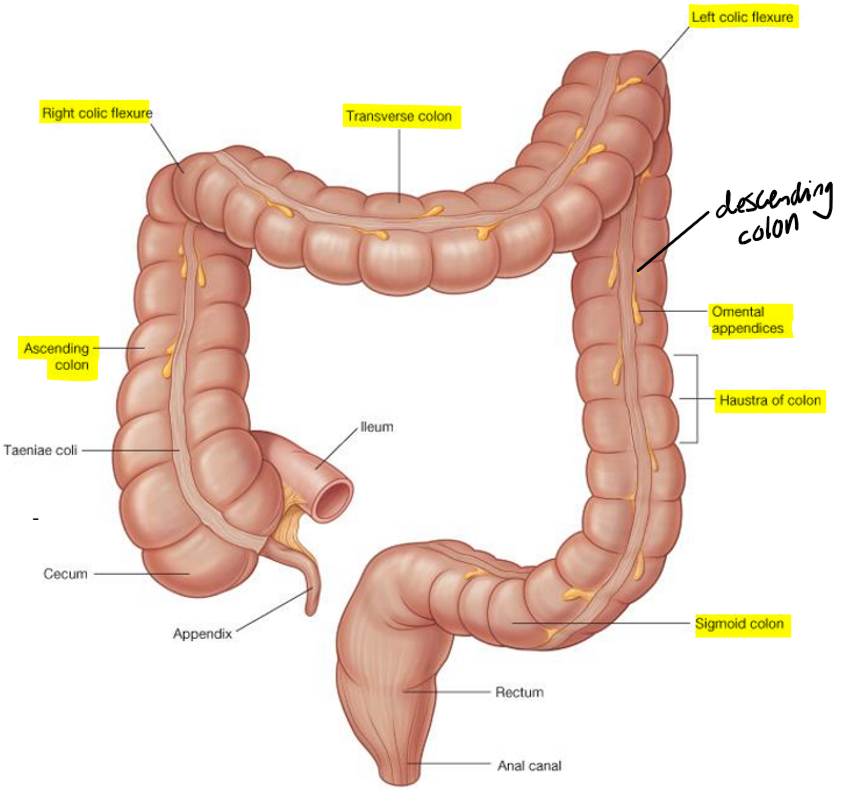
What are the 5 key components of the large intestine?

  1. Caecum (+ appendix)

  2. Ascending colon

  3. Transverse colon

  4. Descending colon

  5. Sigmoid colon

<ol><li><p><strong>Caecum</strong> (+ <strong>appendix</strong>)</p></li><li><p><strong>Ascending colon</strong></p></li><li><p><strong>Transverse colon</strong></p></li><li><p><strong>Descending colon</strong></p></li><li><p><strong>Sigmoid colon</strong></p></li></ol><p></p>
27
New cards

What are the 2 major flexures of the large intestine

  • Hepatic (right colic) flexure

  • Splenic (left colic) flexure

<ul><li><p><strong>Hepatic</strong> (<em>right colic</em>) flexure</p></li><li><p><strong>Splenic</strong> (<em>left colic</em>) flexure</p></li></ul><p></p>
28
New cards

Name 3 distinctive features of the large intestine

  • Taenia Coli: longitudinal bands of smooth muscle

  • Haustra: sacculations (small pouches) of the colon

  • Omental appendices: small pouches of peritoneum filled w/ fat
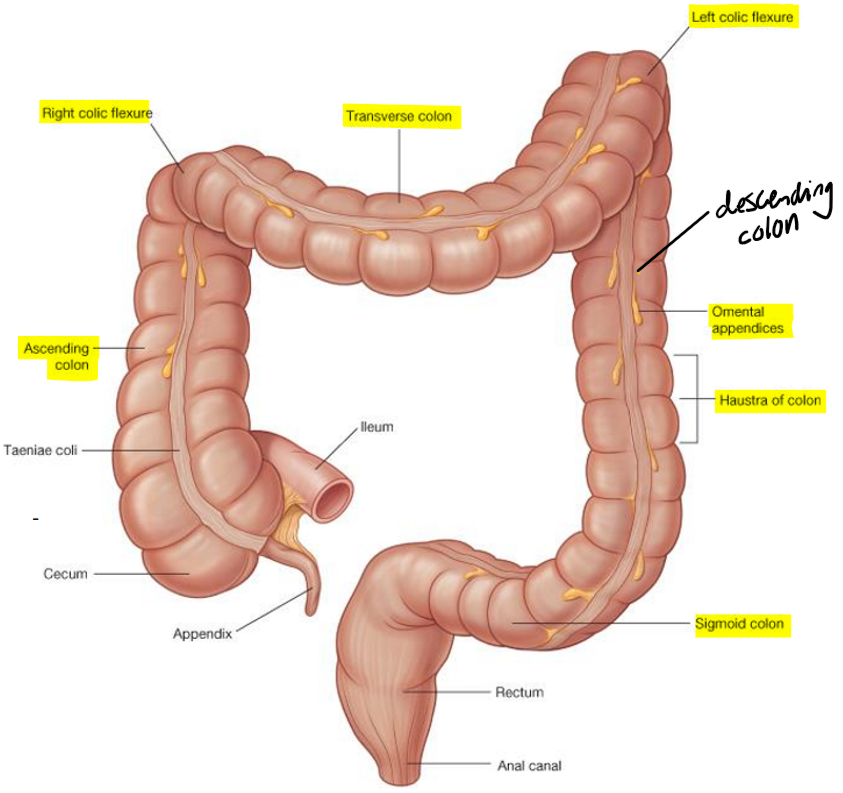
<ul><li><p><strong>Taenia Coli</strong>: <em>longitudinal </em>bands of <em>smooth muscle</em></p></li><li><p><strong>Haustra</strong>: <em>sacculations</em> (small pouches) of the colon</p></li><li><p><strong>Omental appendices</strong>: small pouches of <em>peritoneum</em> filled w/ <em>fat</em></p></li></ul><p></p>
29
New cards
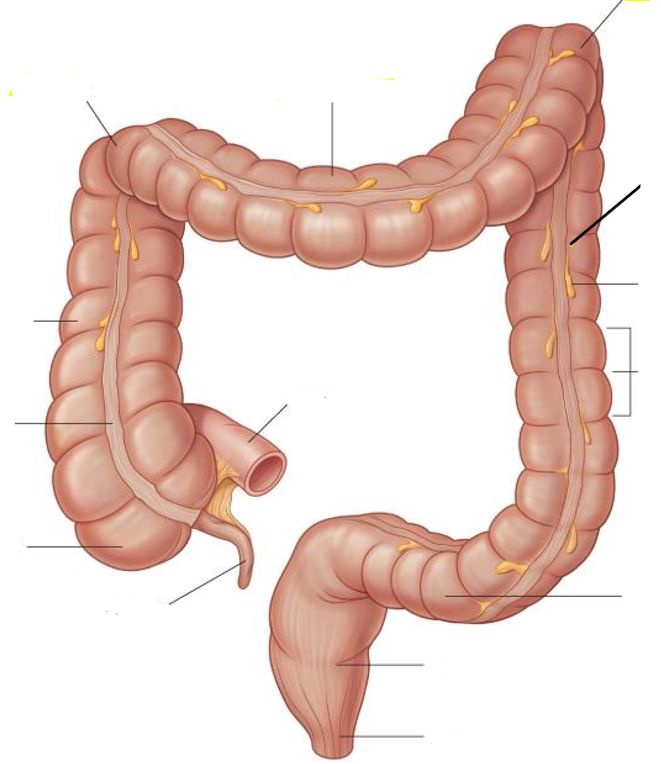
<p>Label the following diagram</p>

Label the following diagram

knowt flashcard image
30
New cards

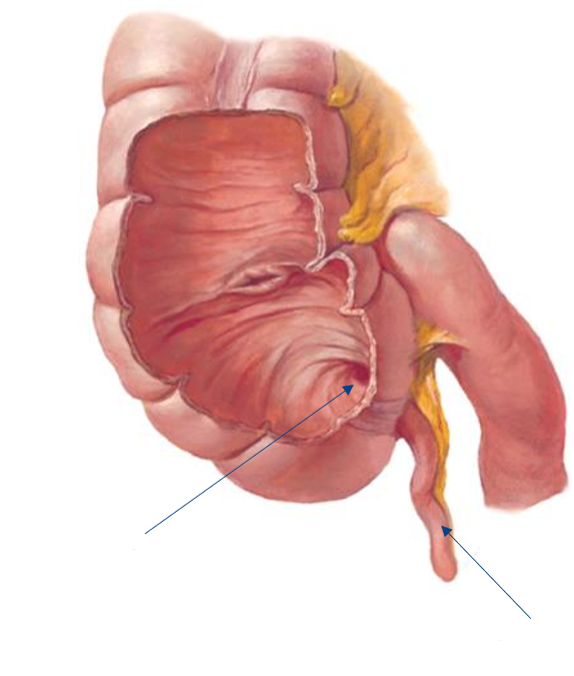
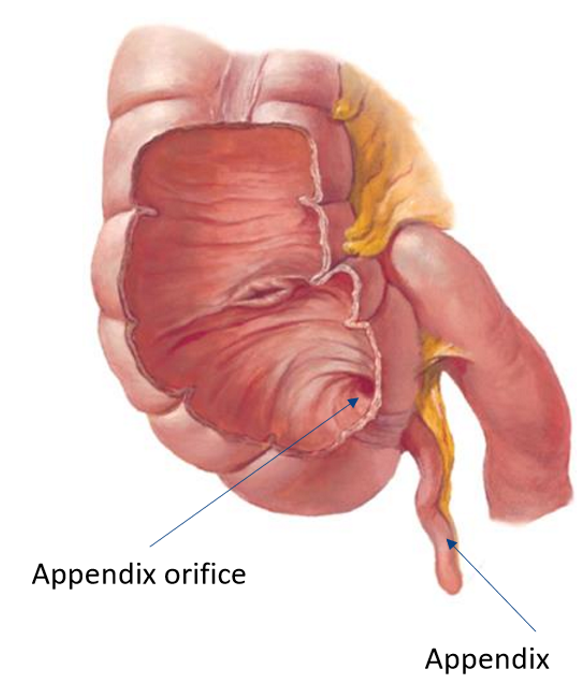
For the appendix, state:

  • Shape

  • Orientation

  • Clinical implications

  • Key feature

  • Vermiform (worm-like)

  • Variable orientation w/ its own mesentery (mesoappendix)

  • Prone to sudden implicationsappendectomy

  • High proportion of lymphoid tissue

<ul><li><p><strong>Vermiform</strong> (worm-like)</p></li><li><p><strong>Variable</strong> orientation w/ its own <strong>mesentery</strong> (<strong>mesoappendix</strong>)</p></li><li><p>Prone to <strong>sudden implications</strong> → <strong>appendectomy</strong></p></li><li><p>High proportion of <strong>lymphoid tissue</strong></p></li></ul><p></p>
31
New cards
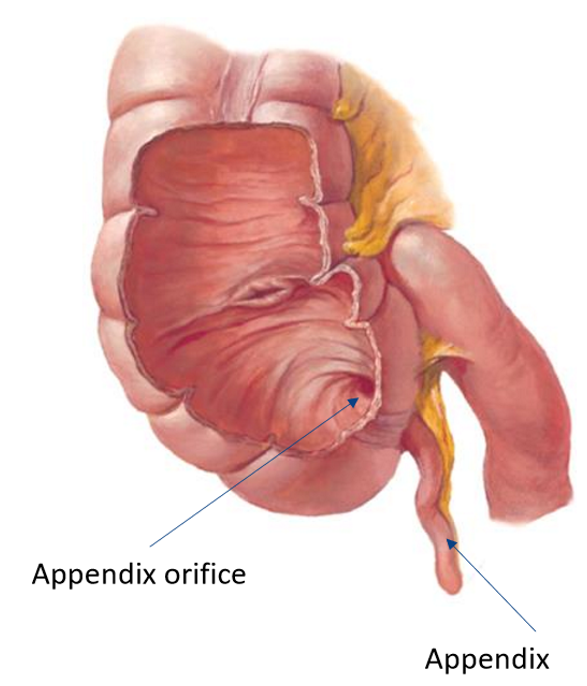
<p>Label the following diagram</p>

Label the following diagram

knowt flashcard image
32
New cards

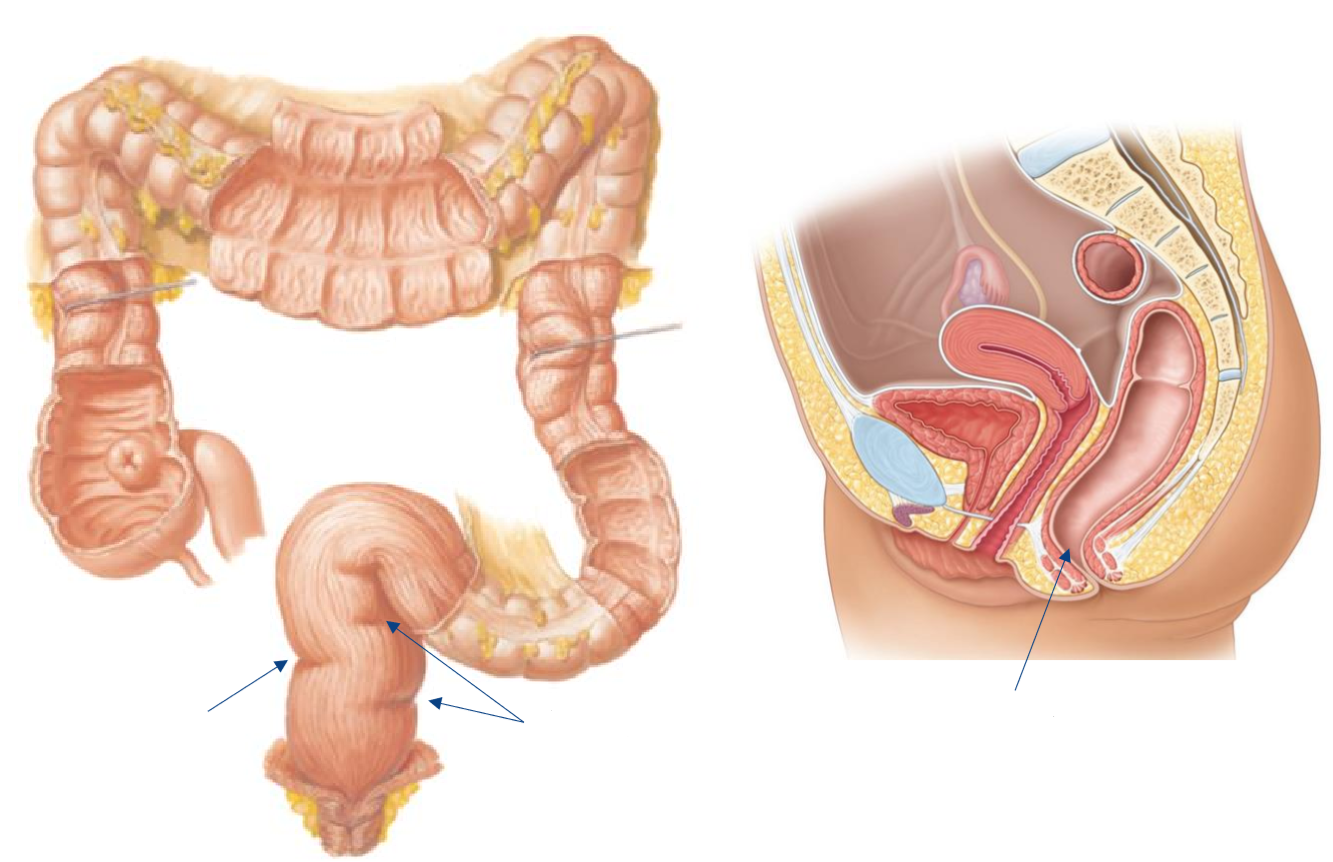
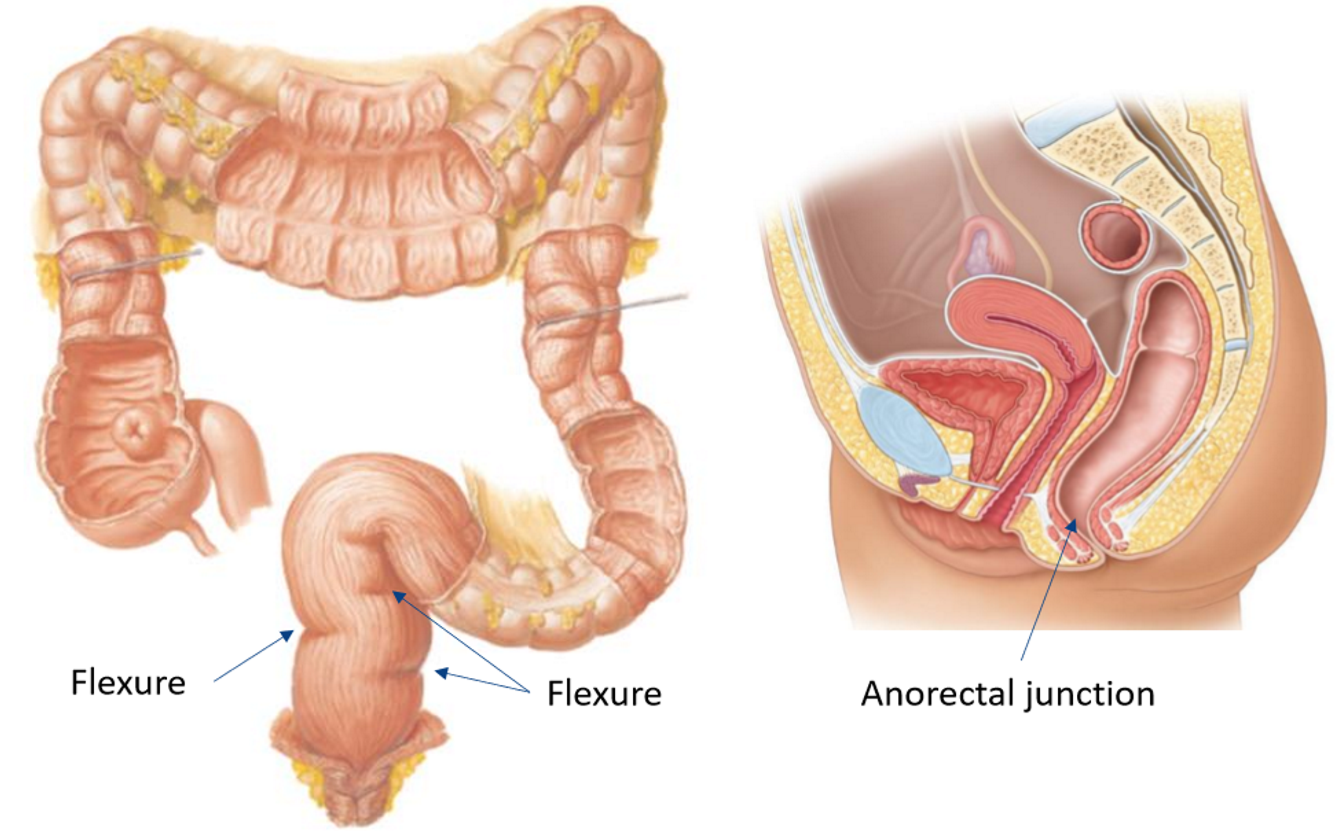
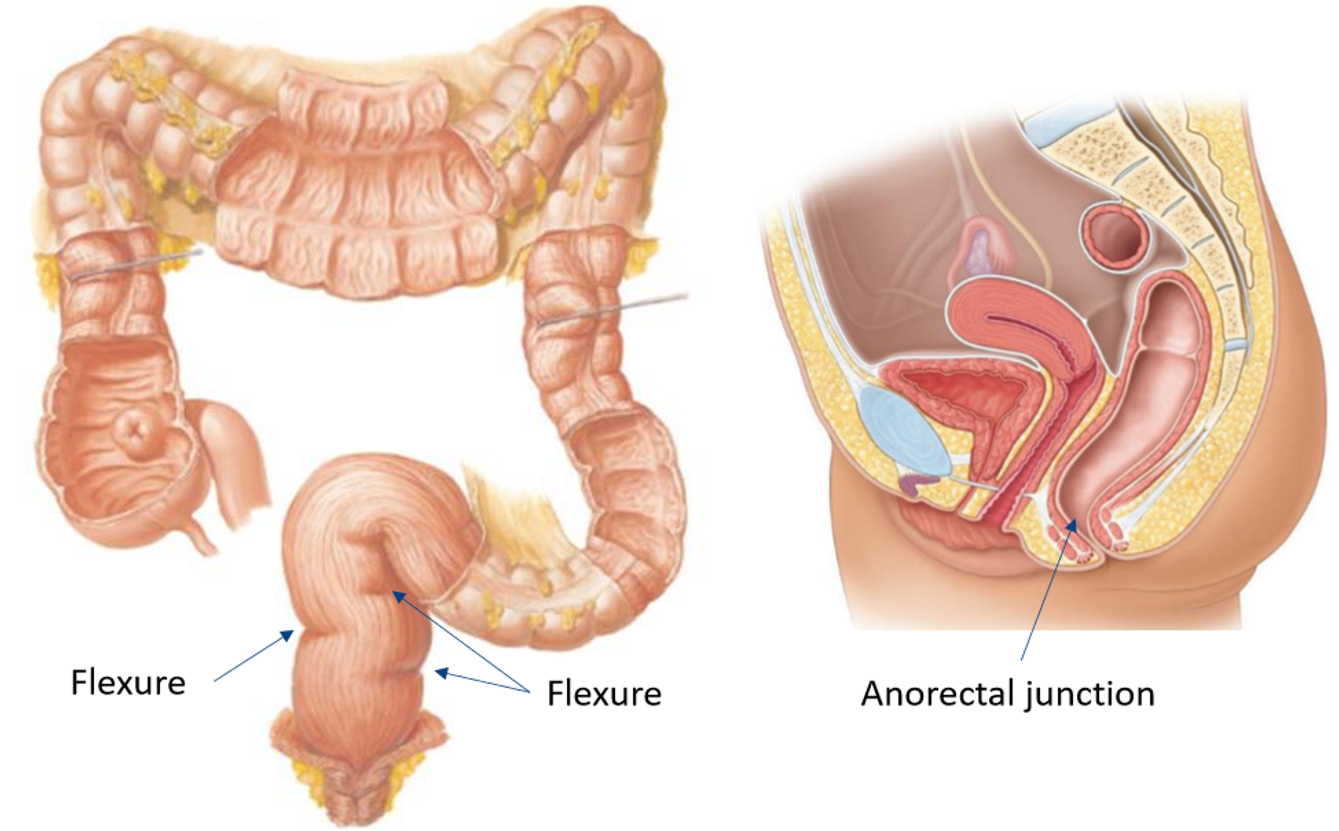
For the r3ctum, state:

  • Where it begins

  • What it follows & where it finishes

  • Change in musculature

  • What can typically be seen from an anterior view

  • Begins at rectosigmoid junction

  • Follows convexity of sacrum & finishes at tip of coccyx (→ @nal canal)

  • Change in external musculature for sigmoid colon to r3ctum

    • Taeniae coli blending into broad, continuous, longitudinal bands

  • Anterior view → 3 distinct flexures

<ul><li><p>Begins at <strong>rectosigmoid junction</strong></p></li><li><p>Follows <em>convexity</em><strong><em> </em></strong>of <strong>sacrum</strong> &amp; finishes at <strong>tip of coccyx</strong> (→ <strong>@nal canal</strong>)</p></li><li><p>Change in <em>external</em> musculature for <strong>sigmoid colon</strong> to <strong>r3ctum</strong></p><ul><li><p><strong>Taeniae coli</strong> blending into <strong>broad</strong>, <strong>continuous</strong>, <strong>longitudinal</strong> bands</p></li></ul></li><li><p>Anterior view → 3 distinct <strong>flexures</strong></p></li></ul><p></p>
33
New cards
<p>Label the following diagram</p>

Label the following diagram

knowt flashcard image
34
New cards

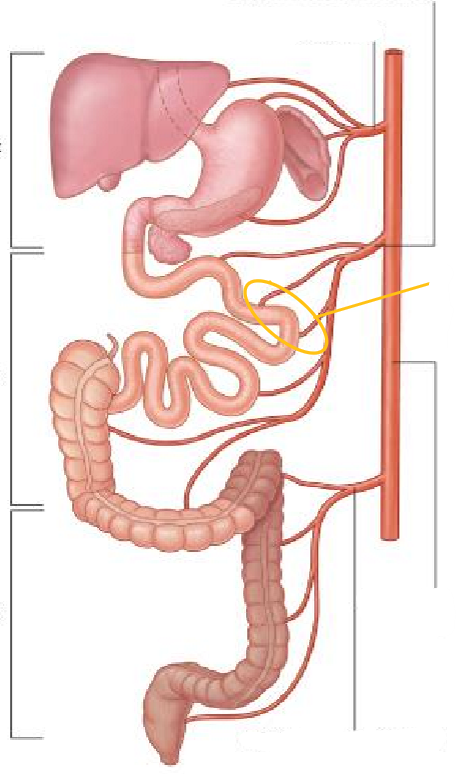
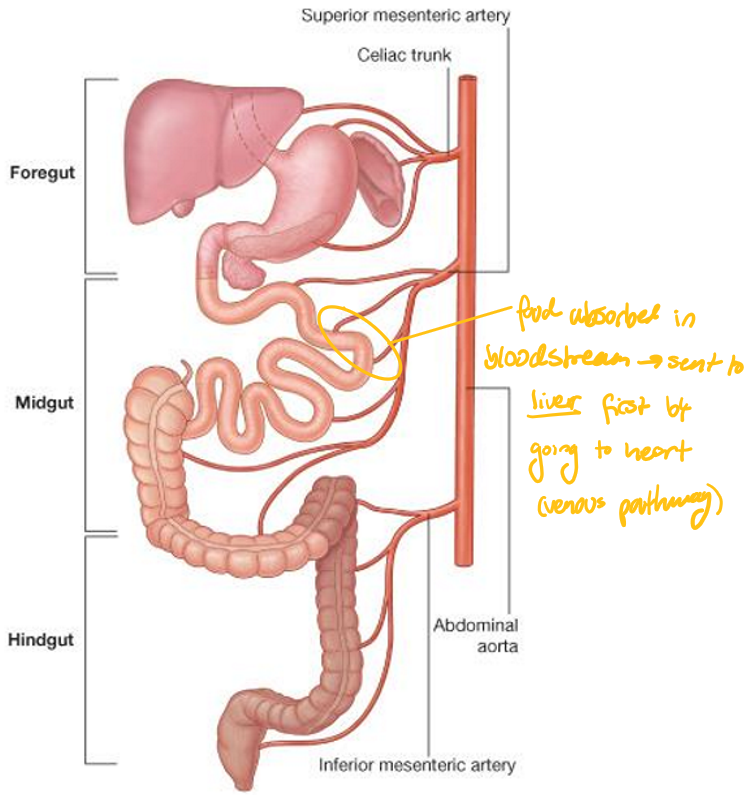
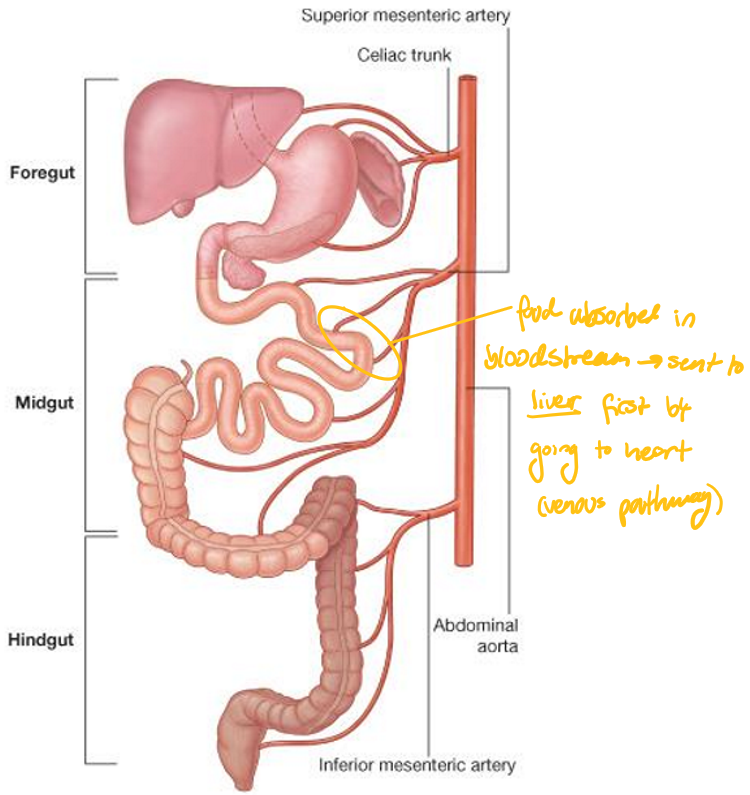
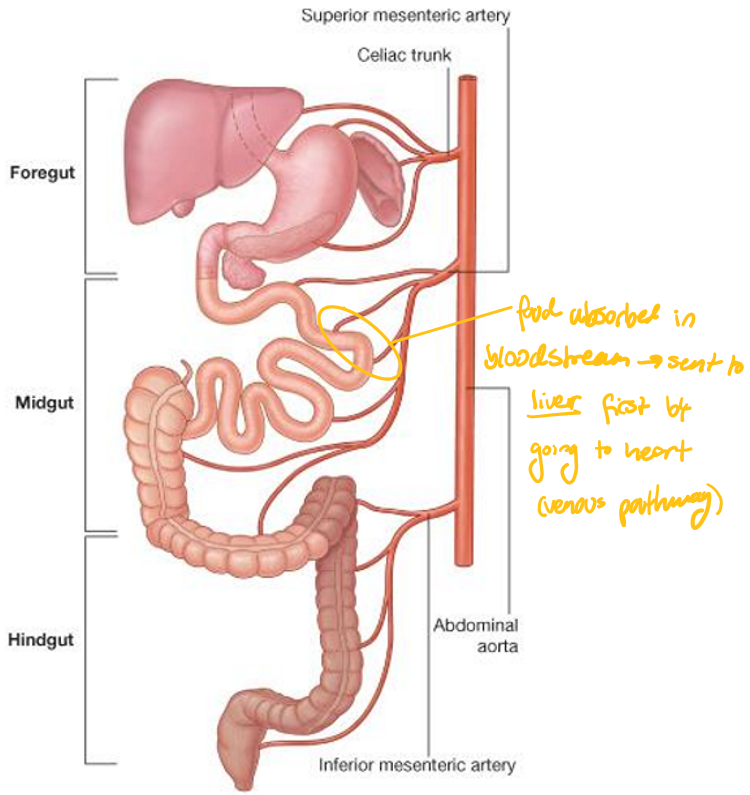
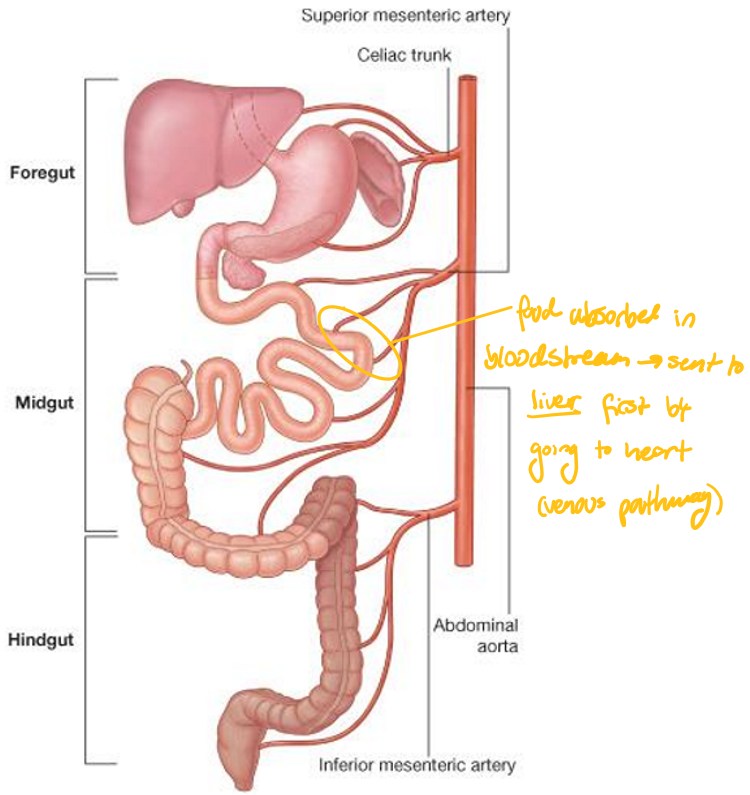
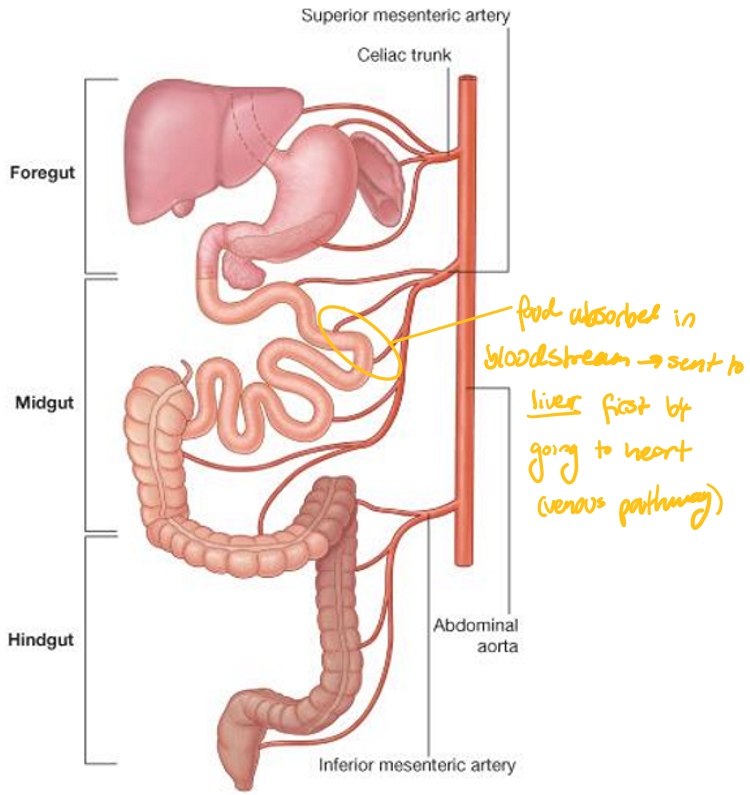
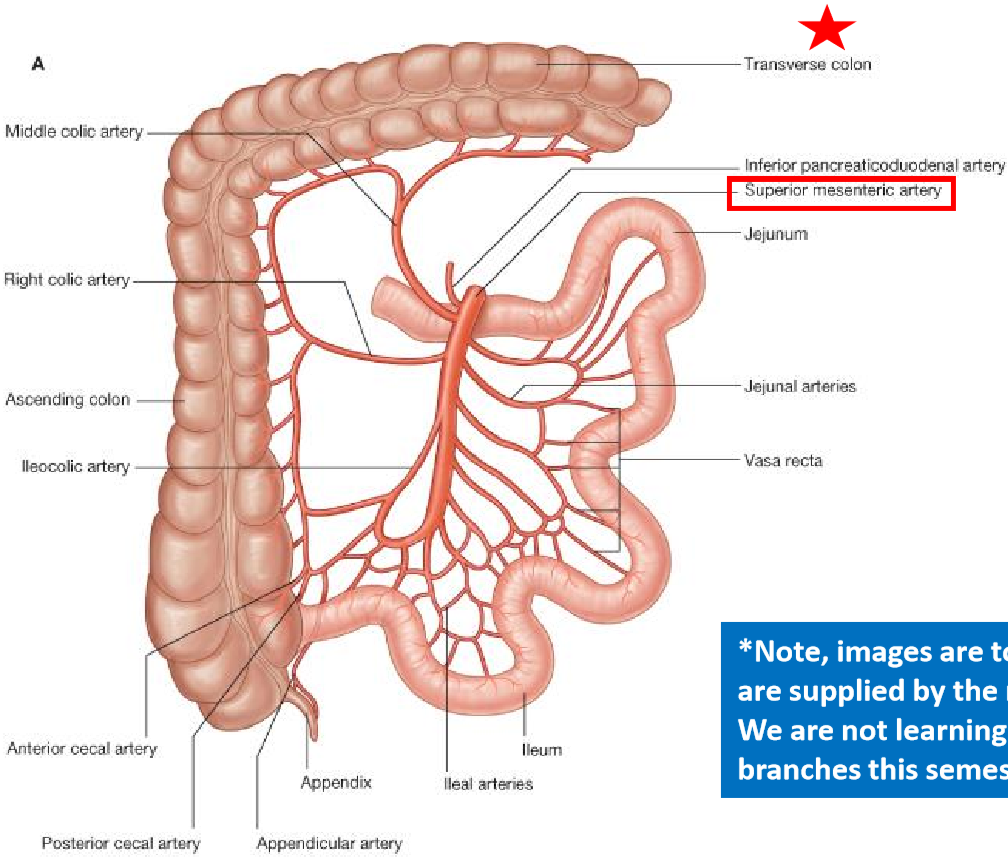
Name the major arterial supply to the abdominal viscera & the names of the 3 branches

3 major unpaired branches from abdominal aorta:

  1. Celiac trunk

  2. Superior mesenteric artery

  3. Inferior mesenteric artery

<p>3 major <strong>unpaired</strong> branches from <strong>abdominal aorta</strong>:</p><ol><li><p><strong>Celiac trunk</strong></p></li><li><p><strong>Superior mesenteric artery</strong></p></li><li><p><strong>Inferior mesenteric artery</strong></p></li></ol><p></p>
35
New cards

What does the celiac trunk supply?

Foregut:

  • Liver

  • Gallbladder

  • Spleen

  • Stomach

  • Pancreas

  • Duodenum

<p><u>Foregut</u>:</p><ul><li><p>Liver</p></li><li><p>Gallbladder</p></li><li><p>Spleen</p></li><li><p>Stomach</p></li><li><p>Pancreas</p></li><li><p>Duodenum</p></li></ul><p></p>
36
New cards

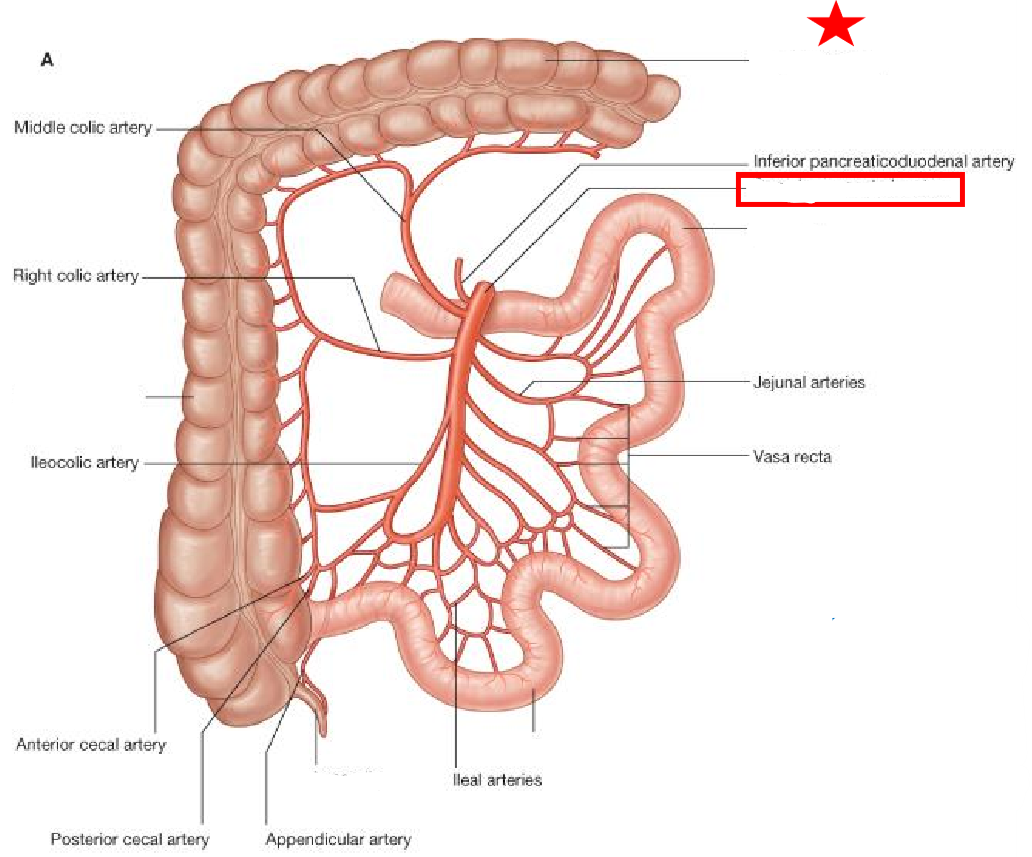
What does the superior mesenteric artery supply?

Midgut:

  • Pancreas

  • Duodenum

  • Jejunum

  • Ileum

  • Caecum

  • Appendix

  • Ascending colon

  • Transverse colon

<p><u>Midgut</u>:</p><ul><li><p>Pancreas</p></li><li><p>Duodenum</p></li><li><p>Jejunum</p></li><li><p>Ileum</p></li><li><p>Caecum</p></li><li><p>Appendix</p></li><li><p>Ascending colon</p></li><li><p>Transverse colon</p></li></ul><p></p>
37
New cards

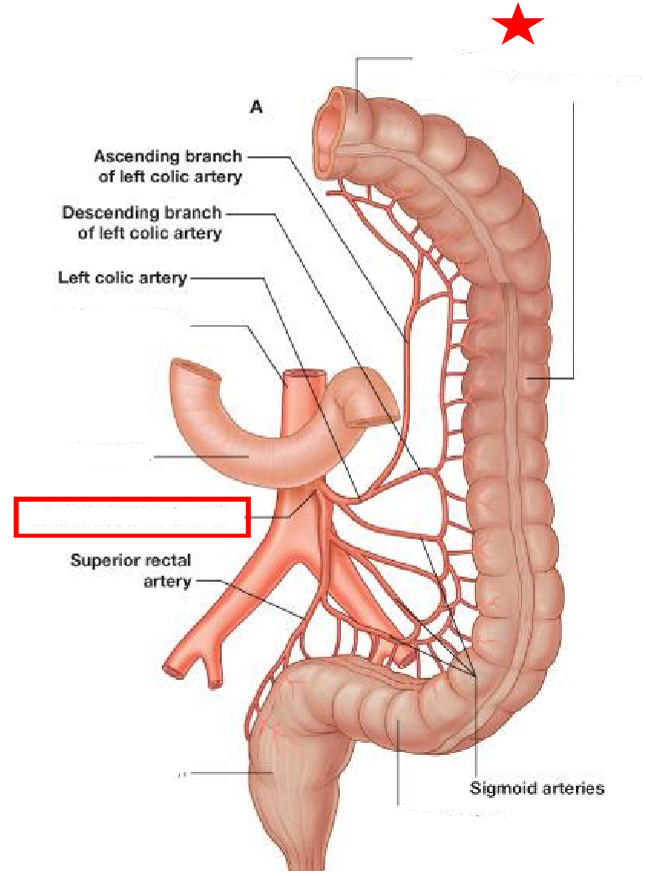
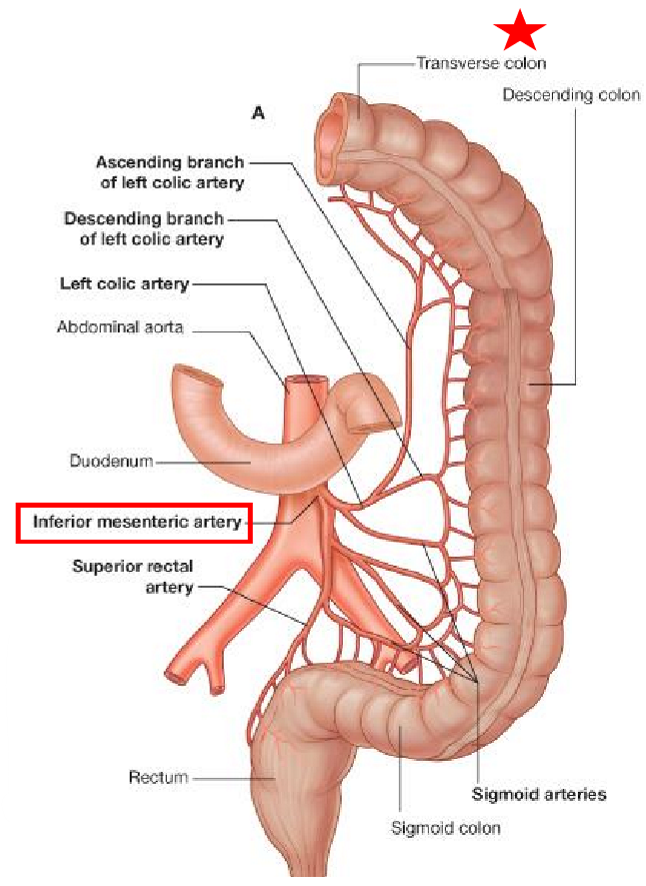
What does the inferior mesenteric artery supply?

Hindgut:

  • Transverse colon

  • Descending colon

  • sigmoid colon

  • R3ctum

<p><u>Hindgut</u>:</p><ul><li><p>Transverse colon</p></li><li><p>Descending colon</p></li><li><p>sigmoid colon</p></li><li><p>R3ctum</p></li></ul><p></p>
38
New cards

Which abdominal viscera receive blood from 2 branches of the abdominal aorta, & which branches are they?

  • Pancreas + duodenum: receive blood from celiac trunk + superior mesenteric artery

  • Transverse colon: receives blood from superior mesenteric artery & inferior mesenteric artery
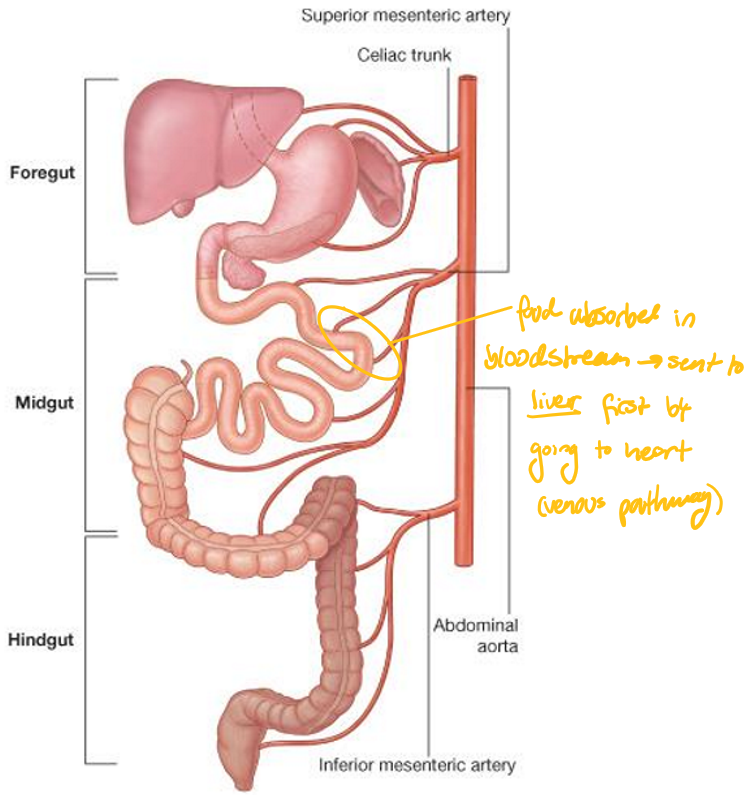
<ul><li><p><strong>Pancreas </strong>+ <strong>duodenum</strong>: receive blood from <em>celiac trunk</em> + <em>superior mesenteric artery</em></p></li><li><p><strong>Transverse colon</strong>: receives blood from <em>superior mesenteric artery</em> &amp; <em>inferior mesenteric artery</em></p></li></ul><p></p>
39
New cards
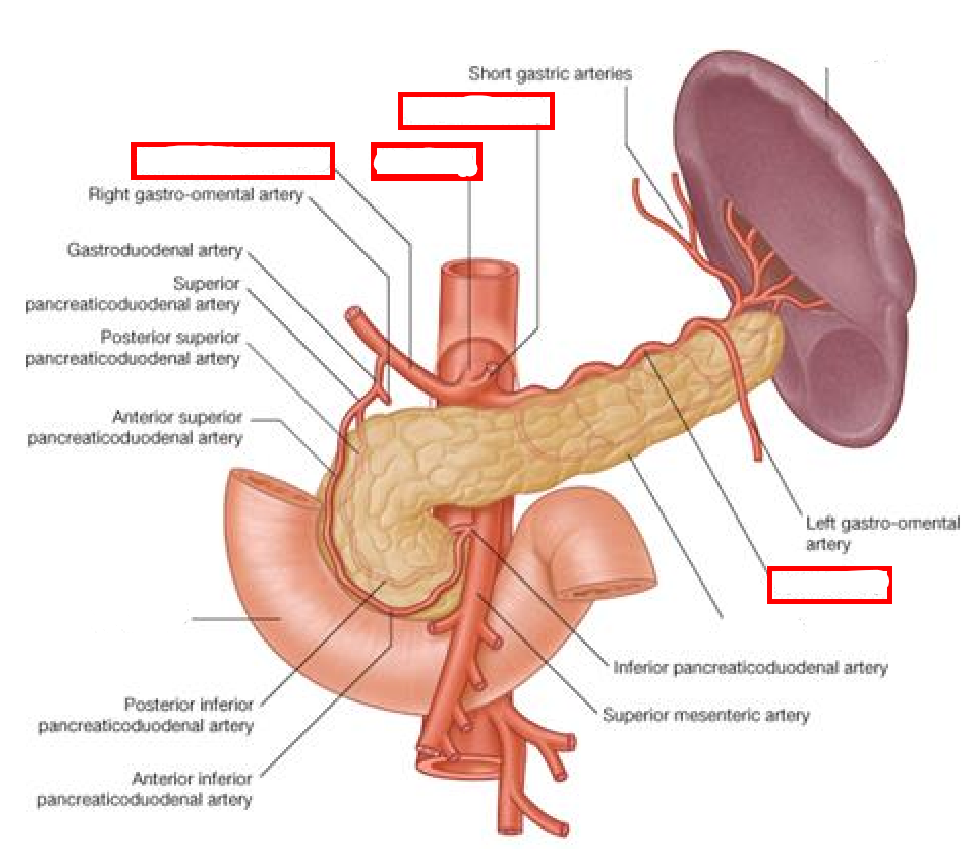
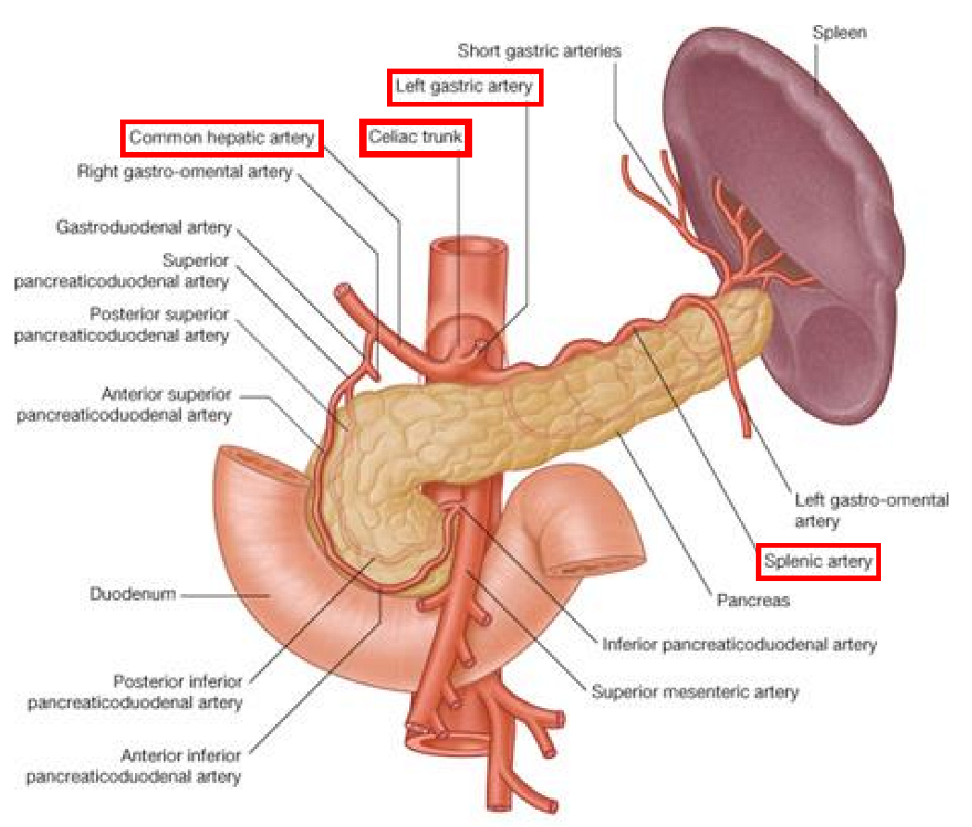
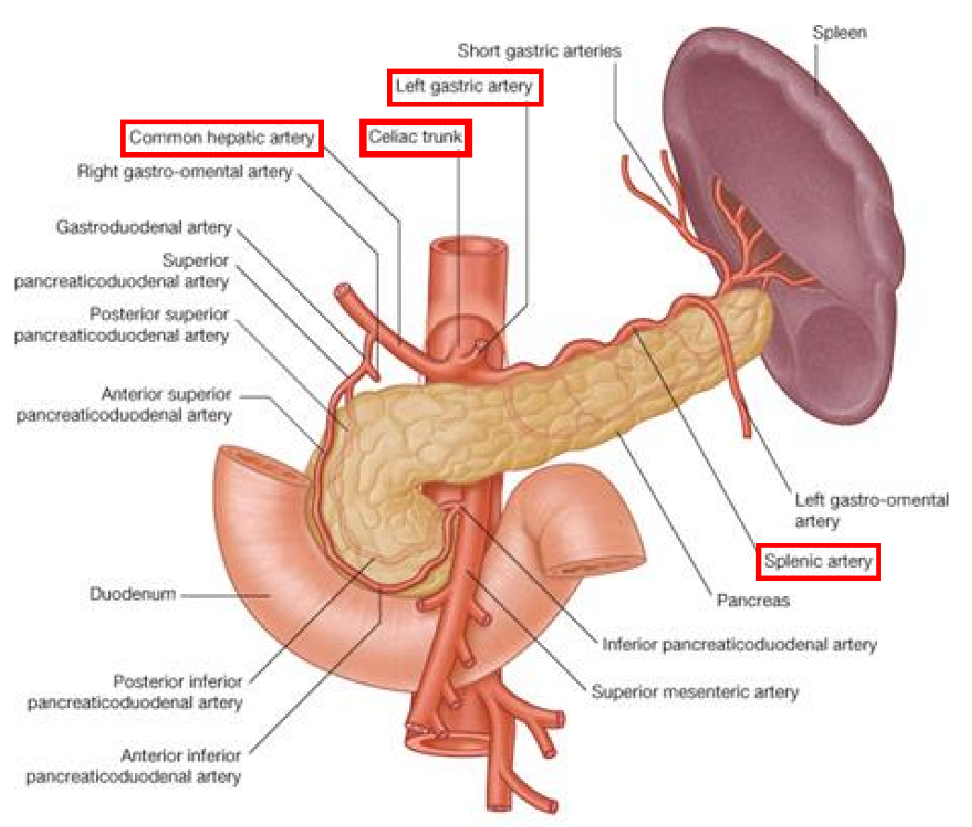
<p>Label the following diagram of the <strong>celiac trunk</strong>, its branches, &amp; surrounding structures</p>

Label the following diagram of the celiac trunk, its branches, & surrounding structures
knowt flashcard image
40
New cards

Name the 3 major branches of the celiac trunk & what they each supply, & where they are found

  • Splenic artery: pancreas, stomach, spleen

    • Tortous appearance

    • Moving towards upper left quadrant

  • Common hepatic artery: stomach, duodenum, liver & gallbladder

    • Moving towards upper right quadrant

  • Left gastric artery: stomach & oesophagys

    • Shorter branch

<ul><li><p><strong>Splenic artery</strong>: pancreas, stomach, spleen</p><ul><li><p>Tortous appearance</p></li><li><p>Moving towards <em>upper left quadrant</em></p></li></ul></li><li><p><strong>Common hepatic artery</strong>: stomach, duodenum, liver &amp; gallbladder</p><ul><li><p>Moving towards <em>upper right quadrant</em></p></li></ul></li><li><p><strong>Left gastric artery</strong>: stomach &amp; oesophagys</p><ul><li><p><em>Shorter</em> branch</p></li></ul></li></ul><p></p>
41
New cards
<p>Label the following diagram</p>

Label the following diagram

knowt flashcard image
42
New cards
<p>Label the following diagram</p>

Label the following diagram

knowt flashcard image
43
New cards

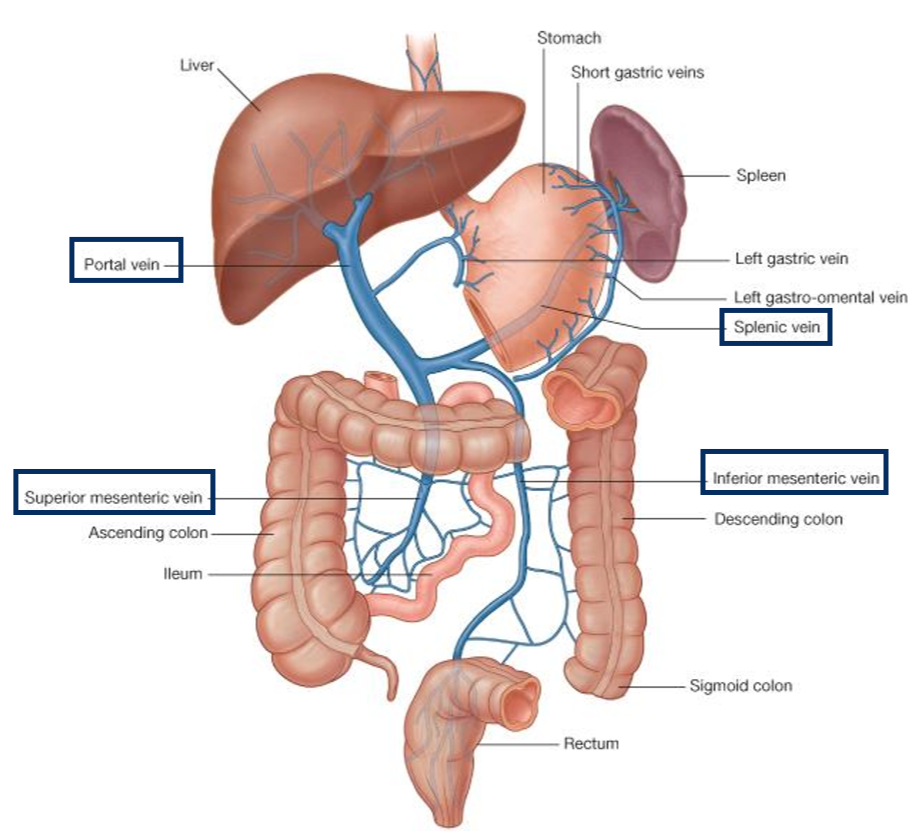
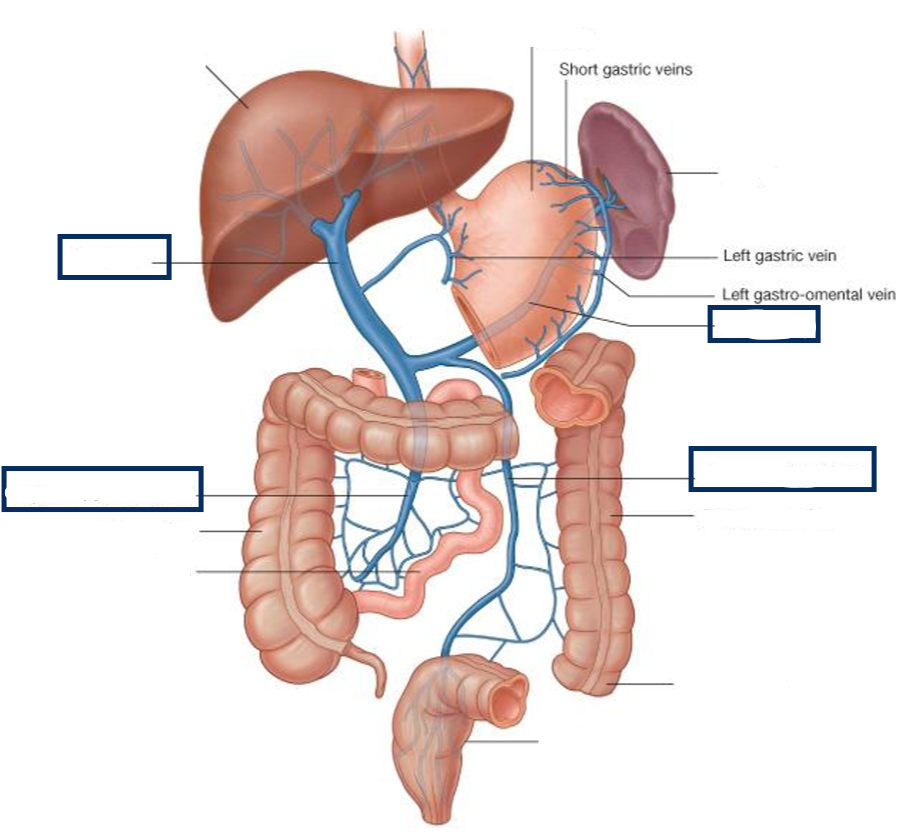
Compare the venous & arterial system of the abdominal viscera

  • Both have 3 major unpaired branches:

    • Celiac trunk (arterial) & splenic vein (venous)

    • Superior mesenteric (both)

    • Inferior mesenteric (both)

  • Arteries originate from abdominal aorta

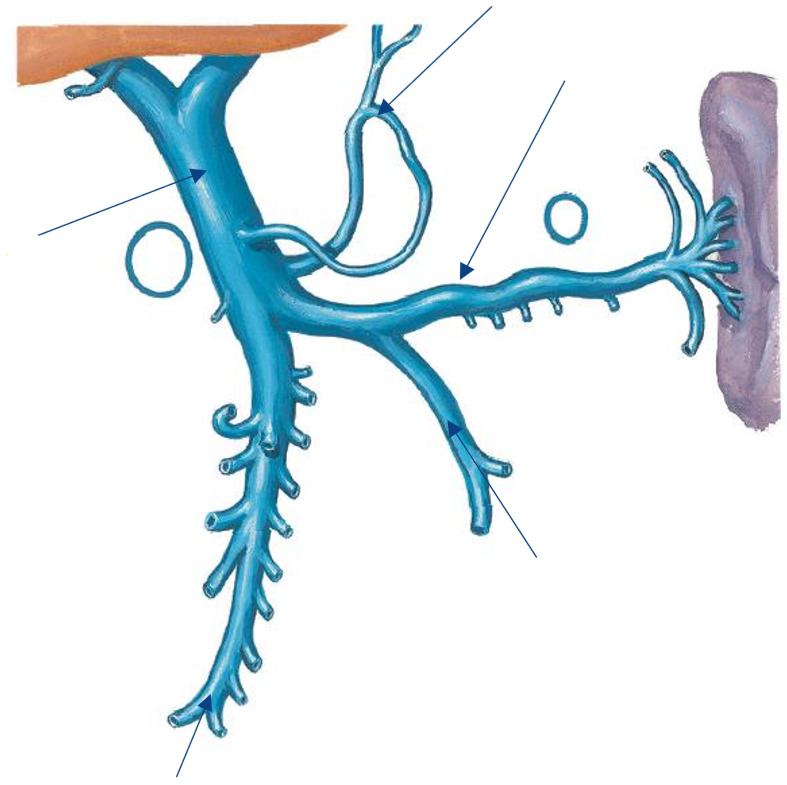
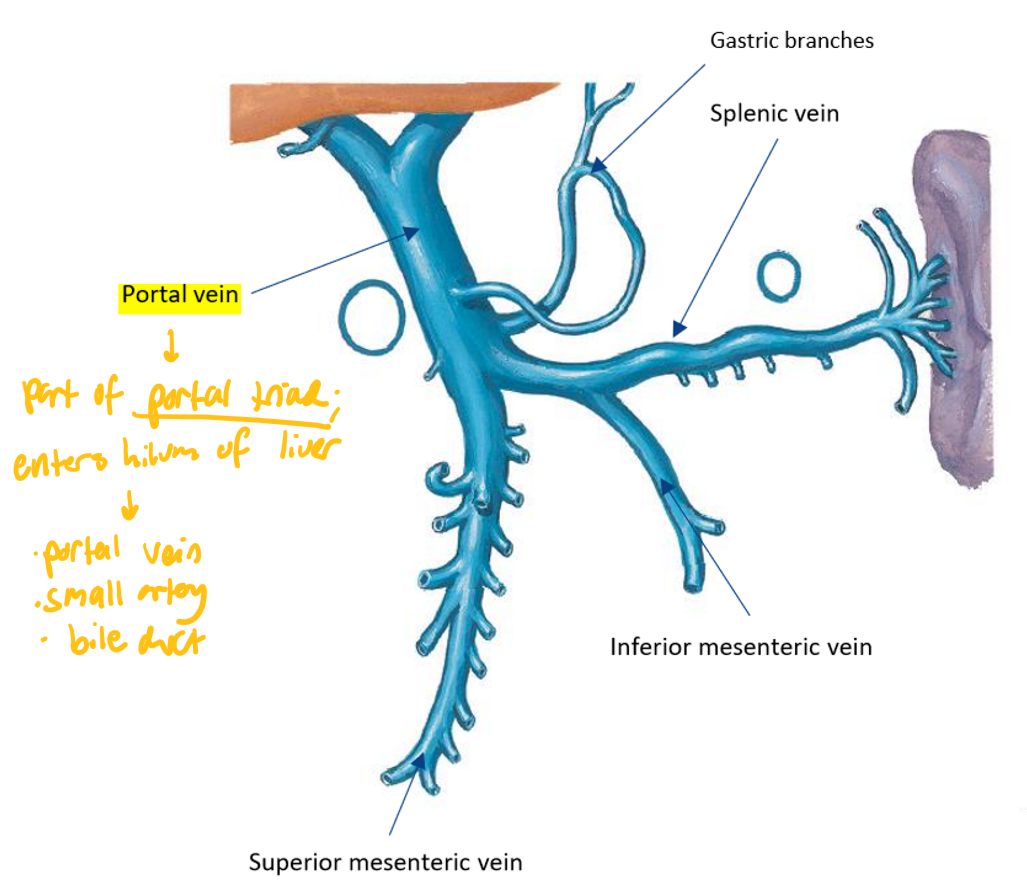
  • Veins drain into portal vein (NOT directly into IVC)
44
New cards
<p>Label the following diagram</p>

Label the following diagram

knowt flashcard image
45
New cards
<p>Label the following diagram</p>

Label the following diagram

knowt flashcard image