Biology 3rd Term
 Call Kai
 Learn
Learn Practice Test
 Spaced Repetition
 Match
Match Flashcards
 Knowt Play
1/17

Earn XP
Description and Tags
everything biology 3rd term
Name | Mastery | Learn | Test | Matching | Spaced | Call with Kai |
|---|
No analytics yet
Send a link to your students to track their progress
18 Terms
What are microorganisms?
Microorganisms are defined as “living organisms too small to be seen with the naked eye”, with exceptions to viruses. Viruses are not really alive but are microscopic. Microorganisms are said to be ubiquitous i.e. they are present everywhere.
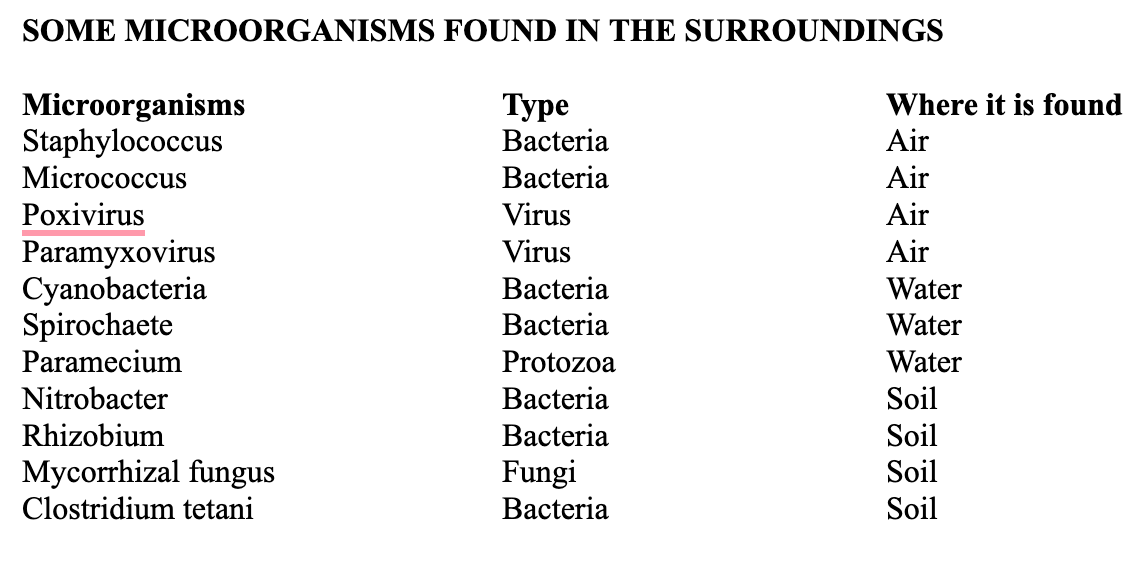
What are some microorganisms found in the surroundings?
What are some ways of identifying microorganisms?
1. Morphology: microorganisms differ in their arrangement, structure, size and shape.
2. Use of stains: A different group of microorganisms shows different staining reactions. Simple stains like methylene blue and crystal violet bring out the size, shape and cell arrangements of the microorganisms.
3. Characteristics of colonies: When microorganisms are cultured in different types of media the various characteristics of the colonies they form, can help us identify different species of the microorganisms. The characteristics include colour, size, and shape.
4. Biochemical tests: Biochemical tests can identify the metabolic activities of different groups of microorganisms, for instance, if they ferment sugar or utilize carbon.
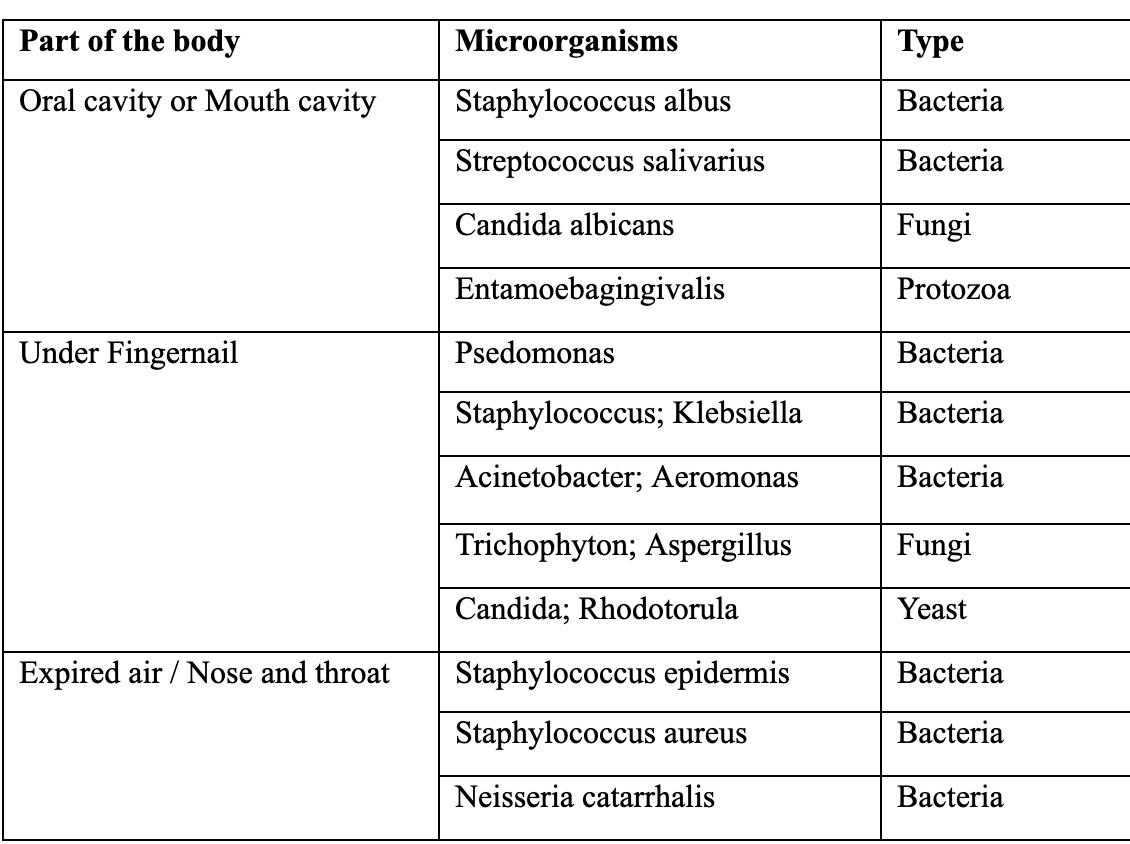
What are some microorganisms found in the human body?
What are some beneficial and harmful effects of microorganisms on the body of an adult?
Normal microflora on and in the body of a healthy adult prevent or interfere with the invasion of the body by pathogens.
Some bacteria are needed for food digestion
Microorganisms are used to break down sewage, in food and chemical industries, in agriculture and in pollution control.
Some normal microflora can become pathogenic when the host’s resistance becomes low. For example, the spirilliae commonly found in the mouth becomes pathogenic and causes throat infection in women with anaemia.
Streptococcus ferments refined sugar and produce acid which cause tooth decay.
Microorganisms cause food spoilage and diseases in humans, livestock and crop.
What are some carriers of microorganisms?
Air, water and food are non-living agents that carry microorganisms from one lace to another. Animals are the living agents that carry microorganisms from to place. The animals that carry pathogenic microorganisms are known as vectors.
What are some examples of vectors?
Insects like houseflies, cockroaches, fleas, mosquitoes, tsetse-flies etc. Housefly with its hairy, sticky body and filthy habits mechanically carries microorganisms from place to place. Animals like rats, dogs and cats are also vectors.
Microorganisms carried mechanically include Shigella sp., Salmonella enteriditis, Salmonella typhi etc. In biological method of transfer of microorganisms, a part of the life cycle of the pathogen takes place in the body of the vector e.g. Aedes mosquito carries the virus that causes fever. Tsetse-fly carries the protozoa, Trypanosoma, which causes sleeping sickness in humans.
What is a colony?
A colony is composed of a large number of microorganisms of the same kind clumped together. Each colony is formed by growth of a single microorganism. Colonies can be seen by the naked eye, but individual microorganisms are invisible to the naked eye. Most microorganisms, especially bacteria and fungi, form characteristic colonies. The appearance of a colony helps in the identification of the microorganism. The features of a colony that should be noted are as follows:
Colour and pigmentation
Texture (smooth, rough)
Size (in millimeters)
Edge (entire, wavy, irregular)
Translucent or opaque
Effect on culture medium
What is growth of microorganisms?
Growth of microorganisms refers to increase in population size i.e. the number of individuals rather than increase in cell size. Reproduction is responsible for the increase in population size.
What are some ways of measuring the growth of microorganisms?
1. Directly by counting the cell numbers i.e. direct microscopic count using a counting chamber. This method counts both dead and live cells in the sample culture.
2. Indirectly by measuring the turbidity of a culture of cells suspended in a liquid: For a sample of cells suspended in a nutrient broth, the growth of the microorganisms can be determined by measuring the turbidity of the nutrient broth at regular intervals. A spectrophotometer is used to measure the turbidity of the sample. In a spectrophotometer, a beam of light is passed through a tube of microbial cells in a suspension. Turbidity affects the scattering of light by the cells in the suspension. If there are more cells in a suspension, greater amount of light is scattered and the greater is the turbidity.
3. Plate count: In this method, a culture in liquid is diluted, transferred to an agar plate and spread over the plate with a glass rod. After incubation, the number of colonies on the plate is counted. It is assured that each colony is formed from a single cell which is known as a colony-forming unit. Since the cell must have been alive to grow and form a colony, only viable cells are counted. The number of microorganisms in the original sample is equal to the number of colonies that grow on the plate.
What can be used to describe the growth if microorganisms?
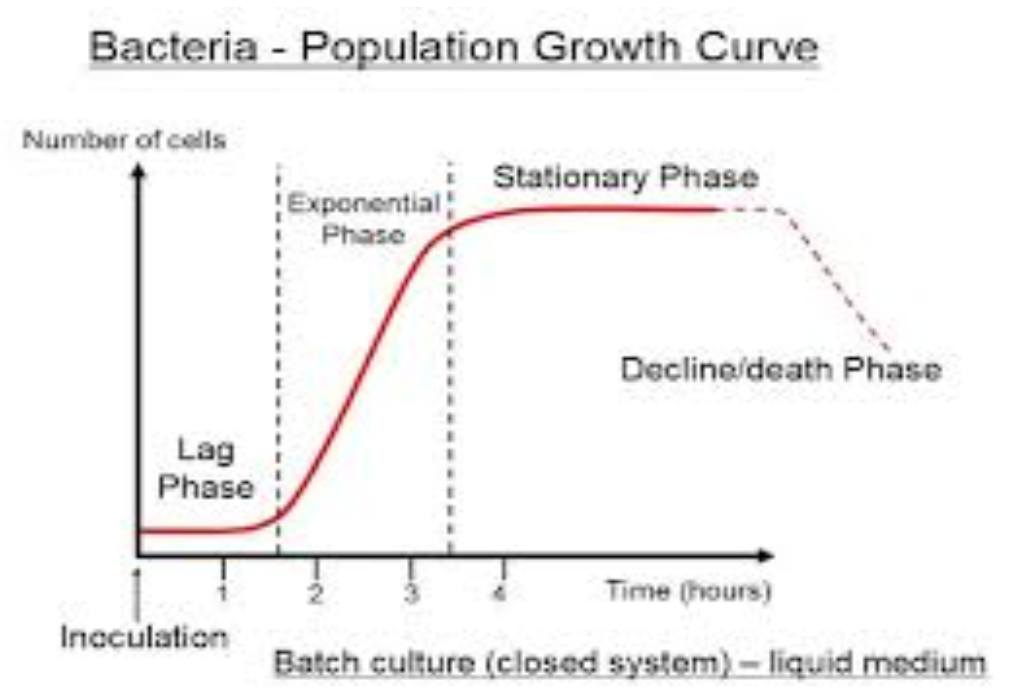
A growth curve can be used to describe the growth curve can be used to describe the growth of microorganisms in an environment with limited resources. It is a typical sigmoid curve. The four stages of the growth curve are as follows:
Lag phase: Growth is slow as the microorganisms are adapting to the conditions in the environment.
Log/Exponential phase: The microorganisms reproduce rapidly and their numbers increase exponentially.
Stationary phase: Eventually, the nutrients in the environment are exhausted. Toxic byproducts have also accumulated in the medium. At this stage, the net growth is zero and the number of microorganisms stabilizes.
Death phase: In this stage, cells die faster than they are replaced and the microbial population decreases in size rapidly.
What are beneficial effects of microorganisms in nature?
Beneficial Effects of Microorganisms in Nature
Microorganisms play an important role in
Maintaining soil fertility: The activities of saprophytic bacteria and fungi convert dead parts of organisms and their wastes into humus which improves soil fertility
Recycling of nutrients in ecosystems: In nature substances such as carbon, nitrogen, oxygen, water, phosphorus and sulphates are built up into large organic molecules such as proteins and carbohydrates by various autotrophs including microbial ones. These compounds are set free, mainly by microbial decomposers as carbon dioxide when the microorganisms die.
Synthesis of vitamins
The intestinal bacteria in Man can synthesis Vitamin K, which is required for proper blood clotting. The synthesis of Vitamin B12 is also produced entirely by the bacteria in the intestines. This vitamin is essential for the functioning of red blood cells and the maintenance of a healthy nervous system.
Beneficial Effects of microorganisms in Medicine
The best known antibiotic is penicillin produced by the fungus Penicillium. Other examples include streptomycin and tetracycline produced by the Streptomyces bacteria.
Beneficial Effects of microorganisms in Industries
Tanning of leather: Tanning refers to the process of making leather from the hides of animals. The enzymes produced by some bacterial are used to soften leather during the tanning process. Microorganisms are used to carry out fermentation processes in many food industries. Microorganisms act on certain edible substances or foods to produce foods
Retting
The retting of fibre plants refers to the separation of fibres from the inner stalks of the plants so that they can be processed to make fabric. Bacteria are also involved in this process.
How do we control harmful microorganisms?
Control of Harmful Microorganisms
To prevent infectious diseases from spreading, we have to kill or inhibit the growth of disease-causing microorganisms. The following are some of the common methods of controlling disease-causing agents:
High temperature: Most microorganisms that cause diseases in humans grow and multiply around 37oC, the normal body temperature. At low temperature their growth is inhibited, but at high temperatures they are killed. Hence we can get rid of pathogenic microorganisms
in food by cooking it at high temperature and for a period of time.
In water by boiling it
In contaminated objects by boiling them for 30mins, heating them in an oven at 160oC (dry heat), or heating them in an autoclave (moist heat)
Microorganisms cause milk to become sour very quickly, especially in the tropics. To prevent this, milk is pasteurized by heating to 72oC for 15seconds and cooling rapidly. This destroys most of the microorganisms, thereby allowing it to ‘keep’ for a longer time.
Antiseptics: Antiseptics are chemicals that kill or inhibit the growth of microorganisms found on the external surfaces of the body. Mild chemicals can be applied to wounds or cuts to prevent infection. E.g. ethanol, hydrogen peroxide etc. Disinfectants are chemicals that also kill or inhibit the growth of pathogens, but they are stronger chemicals than antiseptics and so are often used on non-living things and surfaces. Examples of disinfectants are carbolic acid used for disinfecting lavatories and floors.
3. Antibiotics: Antibiotics are produced by microorganisms like bacteria and fungi. They are capable of inhibiting or destroying certain bacteria at low concentrations, but are not effective against viruses. Examples of antibiotics are penicillin, tetracycline etc. Example of anti-fungi antibiotics are amphotericin B and nystatin.
High salinity: Solutions containing high levels of salt inhibits the growth of microbial cell, thereby preventing its multiplication. Salt solution causes the water in microorganisms to be drawn by the process of osmosis, causing the microbial to be dehydrated and killing them in the process. Some food are preserved by salting.
Dehydration: involves the direct removal of water from food in order to stop or delay food spoilage. Drying removes water which is essential for microbial growth. It also create an outer crust on the food which reduces the ability of microorganisms to penetrate the food. Drying processes include sun drying, in this way the ultraviolet in the sun also kill pathogenic microorganisms. Freeze-drying is a method in which food is frozen and water is subsequently removed by means of sublimation.
What are ways of controlling vectors?
Ways of Controlling Vectors
The animals that carry pathogenic microorganisms are known as vectors. The most important vectors of diseases are insects and rodents. Insect vectors include mosquitoes, houseflies, tsetse-flies, lice, cockroaches and fleas. Rodent vectors are rats, mice etc. Ways by which they can be controlled are as follows:
1. Environmental methods, which involve destroying the breeding sites of vectors such as clearing stagnant water to prevent the breeding of mosquitoes.
2. Adding salt to ant-traps, thus making the water unsuitable for egg development.
3. Physical methods, in which nets, traps, or screens are used to trap or keep vectors away from certain areas.
4. Chemical methods which involve the use of natural predators to destroy the larvae of vectors
5. Biological Methods: refers to the use of predators, parasites and pathogens to reduce the mosquito population. Mosquito-eating fishes like the guppies are introduced into ponds and ditches to feed on the larvae and pupae, and thus control the mosquito population.
6. Genetic control includes the release of sterile male mosquitoes into the environment. Sterile male mosquitoes are obtained in the laboratory by exposing normal males to certain chemicals and radiation.
What is refuse disposal?
This is the proper disposal of solid waste to reduce the breeding of vectors and pest that spread diseases. There are two methods of refuse disposal; these are (i) landfill (ii) incineration.
What is sewage disposal?
Sewage Disposal
Proper sewage disposal system acts as barriers that isolates the pathogens in faeces and urine, and prevents them from spreading and infecting healthy people. The common sewage disposal systems are as follows:
i. direct disposal method e.g. it latrine
ii. the conservancy method e.g. the bucket latrine and chemical latrine
iii. water carriage system
What are health organizations?
Health organization provides health services for the people. They categorize into two which are local health organization and international health organization. The local health organizations are various health organizations under the supervision of the ministry of health of each country. They may be government or voluntary agencies. Local health organization includes:
i. National Health Services,
ii. Public Health Authority. Voluntary health organizations include the
iii. Nigerian Red Cross Society,
iv. AkanuIbiam Nigerian National Ambulance,
v. St. John’s ambulance etc.
What are some international health organizations?
i. World Health Organization (WHO) which is a special unit of the United Organization,
ii. United Nations Children’s Fund (UNICEF): This is set up to improve the health and welfare of children.
iii. Food and Agricultural Organization (FAO): The main function of FAO is to raise living standards and improve the production of agricultural products.
iv. International Federation of Red Cross and Red Crescent Societies (IFRC)