unit 5: Post partum
 Call Kai
 Learn
Learn Practice Test
 Spaced Repetition
 Match
Match Flashcards
 Knowt Play
1/123

There's no tags or description
Looks like no tags are added yet.
Name | Mastery | Learn | Test | Matching | Spaced | Call with Kai |
|---|
No analytics yet
Send a link to your students to track their progress
124 Terms
uterine involution
how much does it descend in what time?
when can we not palpate it
how long does it take
uterus contracting to pre-pregnant state
descends 1-2 cm every 24 hours
should not be palpable after 2 weeks pp
takes 6 weeks to fully return
when palpating the uterus
supine
full bladder will displace uterus up and to the right
empty bladder!
autolysis
destruction of excess tissue in uterus
due to decreasing hormones
sub involution
due to?
failure of uterus to contract back down to pre-pregnant state
due to ineffective contractions
can be caused by retained placenta or infection
afterpains
caused by?
primi vs multipara?
contractions/ cramping after birth
caused by natural oxytocin release after baby is born
can also be caused by postpartum pitocin
primipara - milder cramping
multipara - more painful cramping, the muscle takes more work to get back to pre pregnant statee\
placental site healing
will slough off necrotic tissue
usually happens without and issue and will allow for a new placenta to implant
lochia
heavy during?
meds?
less lochia when?
increases with?
hemorrhage or lochia?
heavy during 4th stage of labor
oxytocic medications may make lochia scant
less lochia after C-section
increases with ambulation
may pool in vagina with immobility, do not confuse for hemorrhage when she stand up, and it gushes.
If lochia remains heavy
may be the first sign if hemorrhage
may be caused by retained placenta
always asses firmness of uterus first
cervix post partum
what can it look like
infection?
dilation
cervical os?
may be edematous
lacerations can get infected
2-3 days after birth it is dilated 2-3 cm
7 days after birth it is dilated 1cm
cervical os will permanently appear as a jagged slit
REEDA scale assessment
what does it assess
redness
edema
ecchymosis - not as common, should not be excessive
discharge - none at all
approximation
assesses episiotomies and lacerations
episiotomies and lacerations healing
initial vs completely
what can help healing
Initial healing occurs within 2 to 3 weeks
4 to 6 months to heal completely
with hazel pads, hemorrhoid cream, ice, peri bottle, sitz bath
pelvic muscular changes
how long to regain tone ?
what do we teach
can take 6 months to regain tone
teach Kegel excersises to avoid pelvic relaxation
pelvic relaxation
higher risk if
may lead to?
possible consequence of childbirth
higher the risk the more children she has
can lead to urinary frequency and incontinence later in life
brast changes
early changes
as milk comes in?
engorgement
slight changes observable by mom in first 24 hours
warmness, fullness and tenderness as milk comes in
engorment - lasts 24-48 hrs, can cause elevated temp
engorgement in a non breastfeeding mom
engorgement resolves in 24-36 hrs after milk comes in
avoid stimulation, wear tight bra
ceases in a few days up to 1 week
blood volume changes post-partum
blood loss in vaginal vs c-section
plasma ?
vaginal blood loss - 300-500 ml
c section 500-1000 ml
plasma volume decreases with diuresis
Cardiac output post partum
directly after birth
when does it return to pre labor values
how much does it decrease by weeks 2
when does it go back to pre-pregnant levels
increases directly after birth
returns to pre-labor values during initial recovery period (1hr)
decreases by 30% within 2 week
decreases to pre-pregnant levels in 6-8 weeks
hemorrhoids and varicosities
will regress after birth
hematocrit & hemoglobin of mom
drops when
when is it normal
drops 3-4 days after birth
goes back to normal by 8 weeks
WBC postpartum
can get as high as 30,000
may mask infections
must assess other s/s of infection
coagulation factors postpartum
remains in a hypercoaguable state
r/o VTE
ambulate!
respiratory postpartum
decreases ?
reduced?
decline in ? causes what to rise?
decreased pressure on diaphragm
reduced pulmonary blood flow
decline in progesterone (from loss of placenta) causes PaCO2 to rise
hormones postpartum
what decreases
what stays elevated in who?
thyroid?
estrogen and progesterone decrease
prolactin remains elevated in breastfeeding women
thyroid gland returns to normal 3 months pp
when does Ovulation occur in BF women vs non-BF women
Non BF: 27 days pp
BF: 70-75 days pp
GU postpartum
how does she lose fluid? how long after birth?
caused by?
urge? when does tone come back?
how often should she void
consequences of not losing fluid?
within 12 hrs after birth, mom loses excess fluid via diuresis
caused by drop in hormones and pressure on lower extremities
may also lose fluid via diaphoresis
may not feel urge to void (tone comes back in 5-7 days)
make sure she voids every 2-3 hours with our without the urge
displaced bladder may cause pressure & hemorrhage of the uterus
GI system postpartum
when will she have BM?
difficulties?
interventions?
may not happen for 2-3 days after birth
may be more difficult if she was on opioids (constiption)
lacerations & episiotomies cause fear of a BM & incontinence
most women are on colace pp
encourage fluid, water and ambulation
integumentary postpartum
what does away and what does not?
hair?
melasma recedes, but may come back with hormonal BC use
hyperpigmentation/ linea negra may not fully go away
striae gravidarum will not go away
angiomata (vascular spiders) go away
may have pp hair loss
musculoskeletal system postpartum
abd wall takes how long to return
what is the term for the abd wall muscles separating
joints
6 wks for abdominal wall to return to pre-pregnant state
diastasis recti abdominis - abd wall musscles seperate
joints are stabilized 6-8 wks after birth
nuerologic postpartum
issues that happened in pregnancy will recede (headaches, congestion)
hedaches are common 1week pp
women w/ autoimmune conditions
in pregnancy vs postpartum
may have flare ups after pregnancy
during pregnancy, autoimmune diseases will go through a period of remission
stay after vaginal birth vs c section
2 days vaginal
4 days c-section
when do are women transferred to postpartum / in postpartum care in LDRP setting
When maternal condition is stable
usually 1-2 hours but may take longer
postanestesia recovery
must be cleared by Anesthesia before put into postpartum
what does the L&D nurse say in report to the postpartum nurse for mom?
name, age, MD
GP/ GTPAL
anesthesia
any meds
length of labor
time of ROM (after 24hr r/o infection)
induced or augmented?
vaginal or c-section
laceration or episiotomy?
perineum? incision?
blood type & Rh status
viruses, STDs or other infections?
IV
fundus checks
emotional status
what does the L&D nurse say in report to the postpartum nurse for baby
gender
weight
date and time of birth
any abnormalities
bonding with mom?
Apgar scores?
void or stool
newborns meds given?
what does the length of postpartum stay depend on
physical condition of mom and baby
mental & emotional status of mom (PPD survey?)
support at home
education needs
financial constraints
those at low risk can be discharged when?
birth center vs hospital
as early as 6 hours from a birth center
24-36 hours from the hospital
fundal checks/BUBBLEHE how often
q 15 min for first 2 hours (initial recovery period)
q1hr for first 4 hours
q 4 hours for 24 hours
q shift until d/c
what labs are drawn pp1
CBC
WBC
H&H
platelet count
how de we prevent excessive bleeding 5
ambulation
voiding every 2-3 hrs & drinking lots of fluid
changing pads and being mindful of the blood amount
breastfeeding - increases oxytocin
prevent infection (use peri bottle, wipe front to back, hand washing etc.)
nonpharmacolgic interventions in pp
ambulation
position changes
pharmacolgic interventions in pp
NSAIDs better for cramping than Tylenol
opioids used carefully and sparingly (CNS depressant and constipation)
how do we promote rest
what does it contribute to?
cluster care
keep lights off
limit visitors
keep partner comfortable as well as mom
lack of sleep can contribute to PPD
extreme fatigue can be sign of
anemia
first time mom gets out of bed
needs to be with a nurse or nurse aide
may be dizzy or lightheaded
if she remains dizzy she needs to stay in bed and use call bell when she needs to void
how do we prevent vte if mom is on bed rest and cannot ambulate
In - bed leg exercises
SCDs
when can mom start ab exercise
4-6 wks pp with doctorrs permission
caloric intake for non lactating mom vs BF mom
adjusted for?
non lactating 1800-2200 cals
BF: 450-500 cals more
adjusted in overweight or underweight mom
DHA in breast-feeding diet
amount?
sources?
200-300 mg
low mercury fish (shrimp, salmon, canned white tuna)
If mom H&H are low
foods rich in iron (red meat, green leafy vegetables)
may need IV iron
how soon after birth should she void
6-8 hours
may need to catheterize her
rubella & varicella vaccines
live vaccines CANNOT be given in pregnancy
they can be given postpartum and are safe for breastfeeding
TDAP vaccine
given to mom @ 36 weeks to pass immunity to baby
preventing Rh isoimmunization
titter needs to be drawn
rogham must be given 72hrs pp
s/s of Postpartum Psychosocial Concerns (12)
Unable or unwilling to discuss labor and birth experience
Refers to self as ugly and useless
Excessively preoccupied with self (body image)
Markedly depressed
Lacks a support system
Partner or other family members react negatively to the baby
Refuses to interact with or care for baby; for example, does not name baby, does not want to hold or feed baby, is upset by vomiting and wet or soiled diapers (cultural appropriateness of actions must be considered)
Expresses disappointment over baby’s sex
Sees baby as messy or unattractive
Baby reminds mother of family member or friend she does not like
Has difficulty sleeping
Experiences loss of appetite
sexual activity pp
can be resumed in 2-4 weeks, but she needs to be healed & not bleeding
lacerations & episiotomy may cause discomfort
birth control pp
hormonal bc cannot be used for 6 weeks
should be discussed before the 6 weeks
follow up visits
do all women go
when should It be done
c-section?
40% miss their follow up visits
should be done @ 6 weeks, no later than 12 weeks
if c-section in 2 weeks for surgical post op check
processes of parent-infant relationships
attachment
bonding
proximity
mutuality
acquaintance
claiming process
bonding
the emotions and feelings experienced by the mother (or parent) in relation to the infant
attachment
two-way interaction between the mother (or primary caregiver) and the infant that develops during the first year of the infant’s life
proximity
staying close to the infant
mutuality
the infant’s behaviors and characteristics elicit a corresponding set of parental behaviors and characteristics
acquaintance
eye contact, touching, talking, and exploring to become acquainted with their infant
claiming
first, then finally?
the identification of the new infant
The child is first identified in terms of likeness to other family members, then in terms of differences, and finally in terms of uniqueness
early interaction
skin to skin with mom or partner
helps with bonding and breastfeeding
couplet care / rooming in / dyading
promotes?
drawbacks?
mom and bay stay in the same room for the length of hospital stay
promotes bonding and learning but mom is required to be with baby 24/7
she may lose rest
biorhythmicity
the fetus is in tune with the mother’s natural rhythms, such as her heartbeat
en face is when
baby is 12 inches from mom making eye contact
entrainment
allows for?
what are the babies doing
Newborns move in time with the structure of adult speech
allows babies to begin to acquire speech
They wave their arms, lift their heads, and kick their legs, seemingly “dancing in tune” to a parent’s voice.
Reciprocity
baby’s part
mom’s part
Reciprocity is a type of body movement or behavior that provides the observer with cues
newborn fusses and cries, the mother responds by picking up and cradling the infant,
the baby becomes quiet and alert and establishes eye contact, and the mother verbalizes, sings, and coos while the baby maintains eye contact
back and forth
synchrony
the “fit” between the infant’s cues and the parent’s response
synchronous interaction is mutually rewarding
specific cry in response to different situations such as boredom, loneliness, hunger, and discomfort
Parents learn to interpret
parent may need assistance in interpreting these cries, along with trial-and-error interventions, before synchrony develops
common issues parents face
sexual intimacy
division of responsibilities
financial concerns
balancing work and parental responsibilities
social activities
adolescent moms are more at risk for
5 physiologic
3 emotional
lack of?
more at risk for preeclampsia, anemia, infection, preterm birth, LBW
PPD, IPV, substance abuse
lack of prenatal care
babies of adolescent moms are more at risk for
growth and development issues
language and speech delays / cognitive delays
neglect and abuse
issues with adolescent dads
may not live with mom & baby
limited education
live in poverty
cannot help financially
advanced maternal age issues
may lack time & energy
may have less support
may also be taking care of their own parents
same sex couples at risk for
lack of support bc of attitude of caregiver
visually impaired parents
need oral teaching by health care providers
needs an orientation to the hospital room that allows the parent to move about the room independently. For example, “Go to the left of the bed and trail the wall until you feel the first door. That is the bathroom.”
need explanations of routines.
need to feel devices and to hear descriptions of the devices.
chance to ask questions.
need the opportunity to hold and touch the infant after birth.
Nurses need to demonstrate infant care by touch and to follow with, “Now show me how you would do it.”
Nurses need to give instructions such as “I’m going to give you the baby. The head is to your left side.
hearing impaired parents
Before initiating communication, be aware of the parent’s preferences and capabilities. Do they wear a hearing aid? Do they read lips? Do they wish to have an interpreter
Make certain that the parent sees you approaching to avoid startling the parent.
Before speaking, be directly in front of the parent and have their full attention.
Avoid standing in front of a light or a window while speaking to the parent.
If the parent relies on lip-reading, sit close enough so that the parent can easily see your lip movements.
Speak clearly with a regular voice volume and lip movements while maintaining eye contact.
Speak in short, simple sentences to facilitate understanding.
If the parent does not understand something, it is better to find a different way to say what needs to be communicated rather than repeating the same words over and over.
Written / visual messages aid in communication. A small white or black erasable board can be useful.
Give educational materials to the hearing-impaired parent and ask them to read the materials before doing parent teaching. They can refer to the materials after discharge.
When doing parent teaching, it is helpful for a hearing person (partner or family member) to be present.
Allow ample time to communicate with the hearing-impaired parent; being in a rush can evoke stress and create barriers to effective communication.
Strategies for Facilitating Sibling Acceptance of a New Baby in Prenatal period
take child where 3
involvement
move the child where? when?
questions?
• Take your child on a prenatal visit. Let the child listen to the fetal heartbeat and feel the infant move.
• Involve the child in preparations for the infant, such as helping to decorate the infant’s room.
• Move the child to a bed (if still sleeping in a crib) at least 2 months before the infant is due.
• Read books, show videos or DVDs, and/or take your child to sibling preparation classes, including a hospital tour.
• Answer your child’s questions about the coming birth and what babies are like and any other questions.
• Take your child to the homes of friends who have newborns so that the child has realistic expectations of what babies are like
Strategies for Facilitating Sibling Acceptance of a New Baby During the Stay in the Birth Facility
when the child arrives?
interactions?
help the child do what
give the child ?
• Have someone bring the child to the birth facility to visit you and the infant (unless you plan to have the child attend the birth).
• When the child arrives, make sure your arms are open to embrace the child.
• Do not force interactions between the child and the infant. Often the child will be more interested in seeing you and being reassured of your love.
• Help the child explore the infant by showing how and where to touch the infant.
• Give the child a gift (from you, from the father or your partner, and the infant).
Strategies for Facilitating Sibling Acceptance of a New Baby Going Home
who should stay with the child
who should Carry the baby
• Have the grandmother or another adult available to focus on the child during discharge from the birth facility and on the trip home.
• Have someone else carry the infant from the car so that you can hug the child first.
Strategies for Facilitating Sibling Acceptance of a New Baby after the baby is home
time?
during feedings?
gifts?
praise the child for?
Arrange a special time for the child to be alone with each parent.
Do not exclude the child during infant feeding times. The child can sit with you and the infant and feed a doll or drink juice or milk or sit quietly with a game. You can read aloud to the child while you are feeding the infant.
Prepare small gifts for the child so that when the infant receives gifts, the child will not feel left out. The child can also help open the infant’s gifts.
praise the child for acting age appropriately (so that being an infant does not seem better than being older).
Postpartum Hemorrhage (PPH)
2 defining factors
leading cause of
when is it recognized
(1) cumulative blood loss ≥1000 mL or
(2) bleeding associated with signs/symptoms of hypovolemia within 24 hours of the birth process regardless of type of birth
Leading cause of maternal morbidity and mortality
Often unrecognized until mother has profound symptoms
Early, acute, or primary PPH occurs when
occurs within 24 hours of the birth
Late or secondary PPH occurs when
occurs more than 24 hours but less than 6 weeks after the birth
Estimated vs quantitative blood loss
how much is blood loss underestimated by
EBL is looked at and estimated, under estimated by 50%
QBL is weighed - (blood and any pads or chucks with blood on them)
uterine atony is the ?
#1 cause of PPH
aka marked hypotonia of uterus
inadequate uterine contractions
uterus remains flaccid and rapid blood loss follows
uterine atony is asscoiated with
Overdistended uterus
Macrosmic (Large) fetus
Multiple fetuses
polyhydramnios
high parity
causes of pph other than uterine atony
• Anesthesia and analgesia
• Previous history of uterine atony
• High parity
• Obesity
• Prolonged labor, oxytocin-induced labor
• Chorioamnionitis
• Trauma during labor and birth
• Forceps-assisted birth
• Vacuum-assisted birth
• Cesarean birth
• Unrepaired lacerations of the birth canal
• Ruptured uterus
• Inversion of the uterus
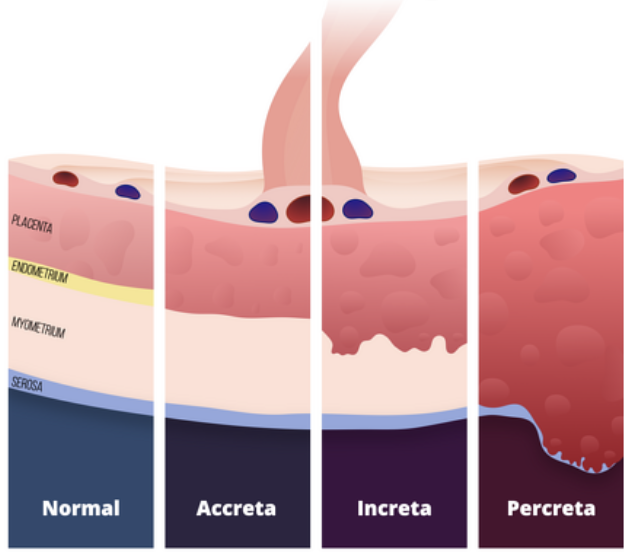
• Placenta accreta syndrome/morbidly adherent placenta (placenta accreta, increta, or percreta)
• Coagulation disorders
• Placental abruption
• Placenta previa
• Manual removal of retained placenta
• Magnesium sulfate administration during labor or postpartum period
• Uterine subinvolution
• Hypertensive disorders
• Intrauterine fetal demise
• Failure to progress during second stage of labor
if the blood is dark red
it originated from veins, usually varicosities
if the blood is bright red
it is from arteries
deep lacerations of the cervix or genital tract
increased risk if vacuum or forceps used
can be trickle of blood or full blown hemorrhage
if there is increased bleeding during placenta separation
indicative of incomplete placental separation
if there is increased bleeding after placenta separation
it is either uterine atony or prolapsed uterus
late or secondary PPH Is indicative of
caused by
s/s?
subinvolution
uterus didn’t contract back down
from retained placenta/ endometriosis/ pelvic infection
Signs and symptoms include prolonged lochial discharge, irregular or excessive bleeding, and sometimes hemorrhage
subinvolution tx
D&curettage
antibitoics if infection
methergine - oxytocic drug
retained placenta
how long do we give the placenta to expel
if it doesn’t come out? what may we give her during this procedure?
what drug works best
after 30 mins of the placenta is not out it can cause PPH
may need manual removal - needs anesthesia & tocolytic to relax uterus so doc can remove easier
terbutaline works fastest
risk of giving tocolytic for manual removal
what can we give to combat?
increases risk of uterine atony bc it relaxes uterus
pitocin, cytotec, hemabate can be given to stimulate contractions after the procedure
unusual placental adherence (placenta accreta)
3 degrees
r/o?
placenta accreta - slight penetration of myometrium
placenta increta - deep penetration of myometrium
placenta percreta - perforation of myometrium and uterine serosa, may involve adjacent organs
r/o PPH and previa for all 3