PRELIMINARY OFFENCES
 Call Kai
 Learn
Learn Practice Test
 Spaced Repetition
 Match
Match Flashcards
 Knowt Play
1/16

There's no tags or description
Looks like no tags are added yet.
Name | Mastery | Learn | Test | Matching | Spaced | Call with Kai |
|---|
No analytics yet
Send a link to your students to track their progress
17 Terms
Preliminary offence meaning
D is punished for conduct leading towards a full crime, even if the final crime does not happen.
D is punished for attempt of crime even if not completed
What is an attempt in crime
D tried to commit an offence and gets punished for it despite not completing it
Why:
Already dangerous and blameworthy before offence is finished
Act for attempts
Criminal attempts act 1981: s1(1)
Explain criminal attempts act 1981
S1(1):
D intends to commit offence = men’s res needed
D does an act to attempt the offence
More than merely preparatory : goes beyond planning + preparation
Offence not completed
More than merely preparatory
Si(1) criminal attempts act
More than ready for crime = beyond prep for offence
(Ar)
explain AR of an attempt + case
Physical element
More than merely preparatory to commit full offence
gone beyond prep
R v Gullefer :not merely preparatory - no attempt
R v hones : beyond prep - attempted murder
started committing full offence
Case for ar of attempt
R v gullefer : not beyond prep
R v joins: beyond - attempted murder
Explain MR of attempt
Mental element
D intended to commit FULL offence (not reckless)
it was D’s main aim, purpose, desire (direct)
Result was virtually certain + d acknowledged it (oblique)
Why is recklessness not MR for attempt
D tries to commit full offence, not merely taking an u reasonable risk
(which means they may not be attempting to commit crime)
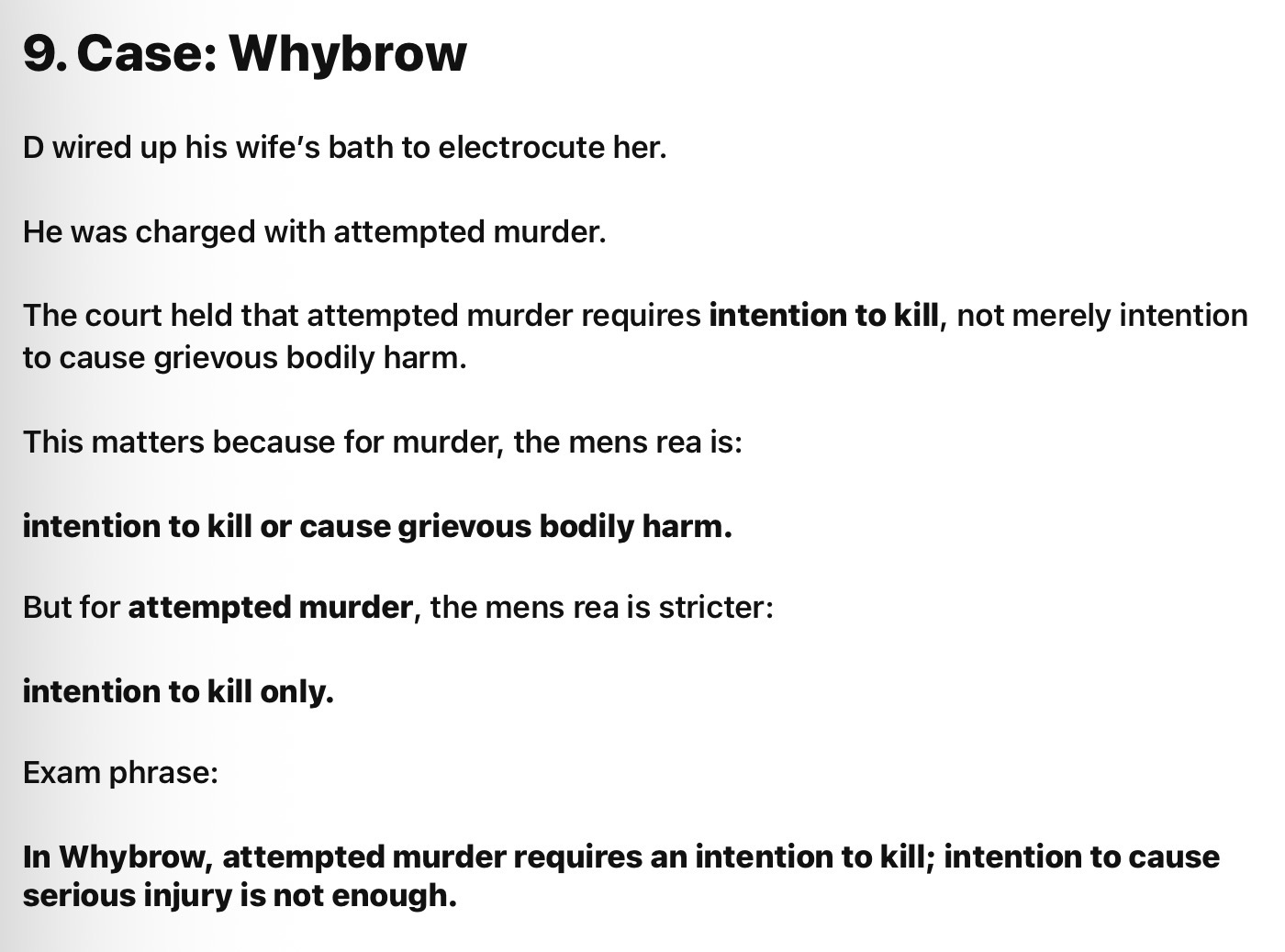
R v Whybrow - charged w attempted murder
R v Millard + Vernon: reckless so no attempt
Case for reckless (MR ) of attempts
R v whybrow - attempted murder
R v Millard + Vernon - reckless so no attempt
Conditional intent meaning
D intends to commit crime only if a certain condition is met
= attempt
Ex: digging into someone’s pocket to see if money is there
AG reference no.1 + 2 1979
Case for conditional intent
AG reference no.1 + 2 1979
Impossibility meaning
D tries to commit a crime, but completing the full offence is impossible.
Factual imposssibility
Legal impossibility
List impossibilities
Factual
Legal
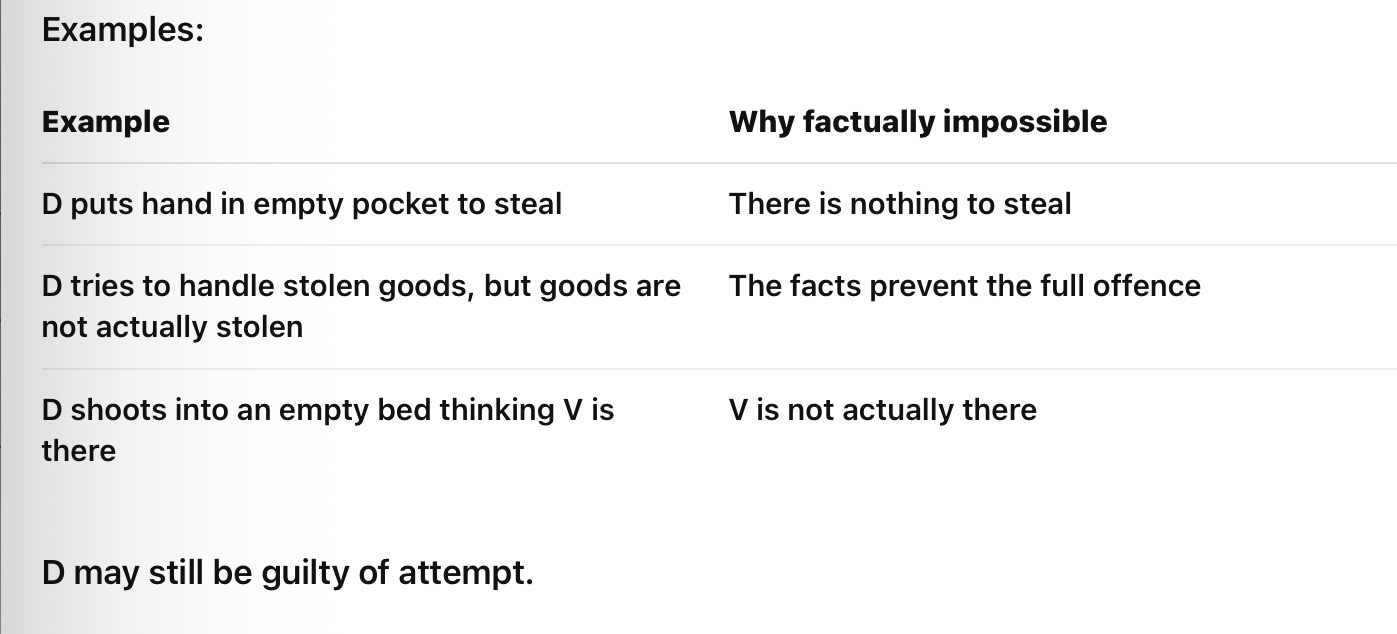
What is factual impossibility
D cannot complete the offence because of some factual circumstance they do not know about.
D thinks crime is possible when it isn’t
R v Shivpuri
What is legal impossibility
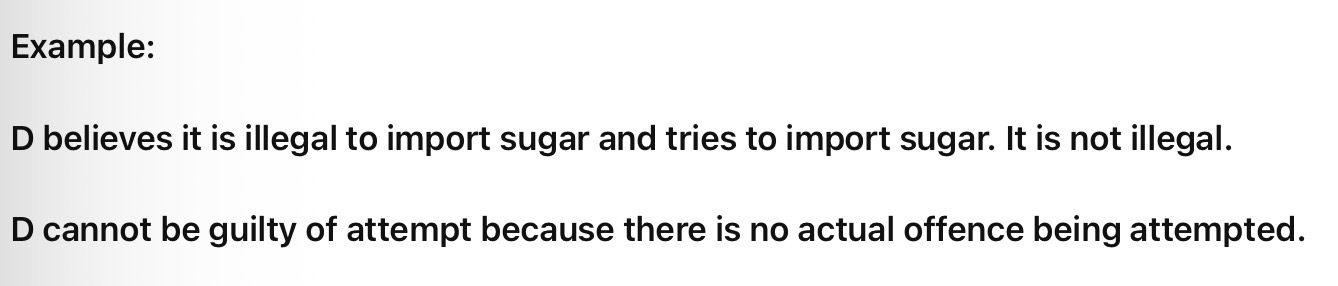
D thinks they are committing a crime, but legally, no crime exists.
= not guilty of attempt
Attempt exam q structure
Identify offence attempted
State law (criminal attempts act s1.1 1981)
Explain ar of attempt
Explain Mr of attempt
Explain impossiblity (types)
Guilty/not