Bio 202 - Meiosis
 Call Kai
 Learn
Learn Practice Test
 Spaced Repetition
 Match
Match Flashcards
 Knowt Play
1/11

There's no tags or description
Looks like no tags are added yet.
Name | Mastery | Learn | Test | Matching | Spaced | Call with Kai |
|---|
No analytics yet
Send a link to your students to track their progress
12 Terms
What are human gametes?
Gametes are cells with half as many chromosomes as somatic cells: 23 in total. Gametes in males are sperm and gametes in females are eggs.
What is the difference between a haploid and a diploid?
Haploids carry a single set of chromosomes “n.” Diploids carry two sets of chromosomes “2n.”
What is the sexual reproductive cycle?
An alternate cycle of fertilization (fusion) and meiosis where a diploid germ cell divides by meiosis into gametes, and the gametes fuse to form diploids. The total number of chromosomes ideally remain constant.
Sex cycle in humans
1) gametes—egg and sperm—fuse into a diploid zygote.
2) zygote produces somatic cells that develop into an adult
3) germ cells in an adult undergo meiosis to form gametes
How does the cell cycle vary between species?
Some organisms are made of haploid cells like male bees, wasps, and ants. Because haploids CANNOT UNDERGO MEIOSIS, the cell cycle varies.
Chromosomes in humans
every human ideally has a karyotype (complete set) of 46 chromosomes: 2 sex chromosomes and 44 autosomes
males have 22 pairs of homologous (parallel structure) chromosomes and a pair of X+Y sex chromosomes.
females have 23 pairs of homologous chromsoomes
Difference between Meiosis I and Meiosis II
Meiosis I: Homologous chromosomes pair and then separate. This reduces the chromosome number per cell by half.
Meiosis II: Sister chromatids are separated, resulting in four daughter cells with half as many chromosomes as the parent.
In I, homologous chromosomes separate, in II, sister chromatids separate!
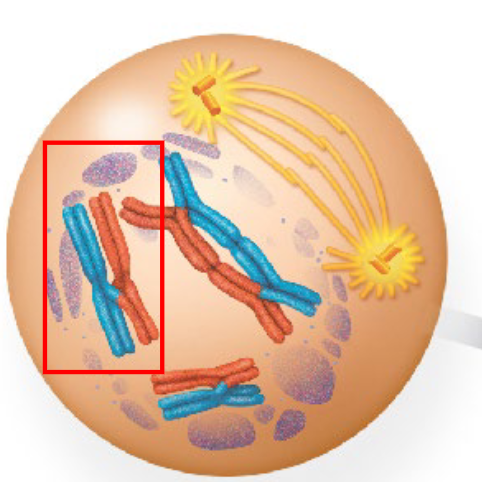
Prophase I - The Pairing Stage
Homologous chromosomes find each other and synapse (pair). Crossing over (recombination) occurs at the chiasmata (the place where the synapse is held) where exchanging DNA segments between non-sister chromatids. This is the longest meiotic phase—taking 90% of meiosis.
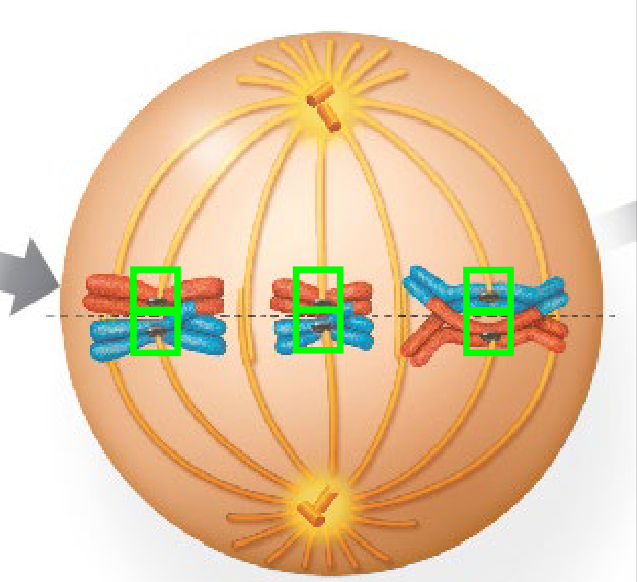
Metaphase I - The Capturing Stage
Homologous pairs (bivalents) are captured by kinetochores and lined up along the cell's equator. Crucially, each pair orients randomly — which homolog faces which pole is independent of other pairs. This independent assortment generates enormous genetic diversity.
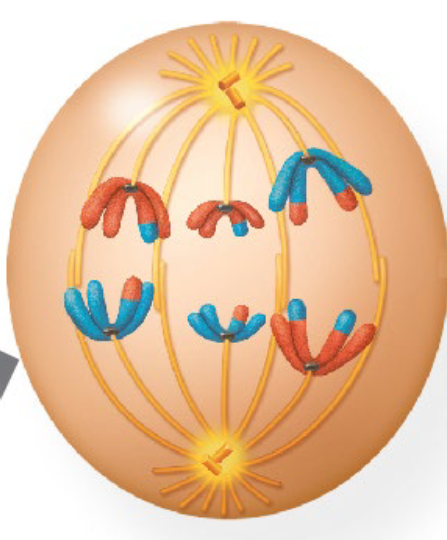
Anaphase I - The Separating Stage
Cohesins linking sister chromatids are cleaved by separase everywhere except the centromeres.
Cohesin cleavage leads to the separation of homologous chromosomes.
Sister chromatids remain together because:
1. Cohesin remains at the centromeres.
2. Their kinetochores are linked.
Telophase I and Cytokinesis
Separated homologous chromosomes cluster at each cell pole. Nuclear membrane may reform around each daughter nuclei. Cytokinesis often follows, producing two haploid daughter cells. No DNA replication occurs before Meiosis II begins.
Each daughter cell chromosomes till holds two sister chromatids. Sister chromatids are no longer identical because crossing over has occurred!
Meiosis II differences
No DNA replication occurs between Meiosis I and Meiosis II. The mechanisms underlying
sister chromatid separation in mitosis and meiosis II are essentially the same.