Nucleotide Metabolism Learning Objectives
 Call Kai
 Learn
Learn Practice Test
 Spaced Repetition
 Match
Match Flashcards
 Knowt Play
1/38

There's no tags or description
Looks like no tags are added yet.
Name | Mastery | Learn | Test | Matching | Spaced | Call with Kai |
|---|
No analytics yet
Send a link to your students to track their progress
39 Terms
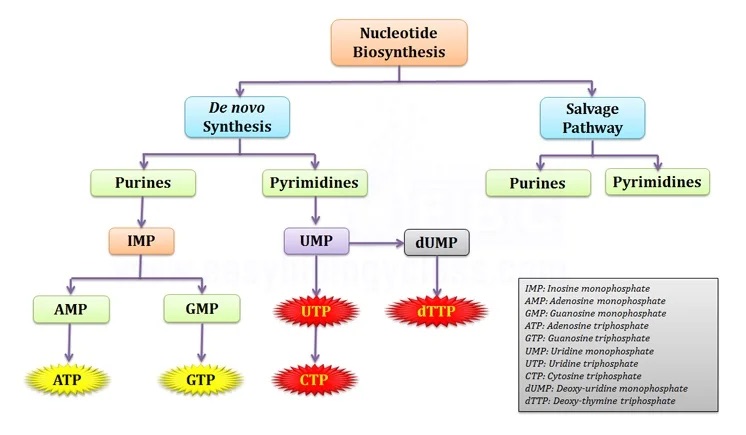
What is nucleotide biosynthesis?
The essential metabolic process of constructing purine and pyrimidine nucleotides, the building blocks of DNA and RNA, through de novo synthesis or salvage pathways
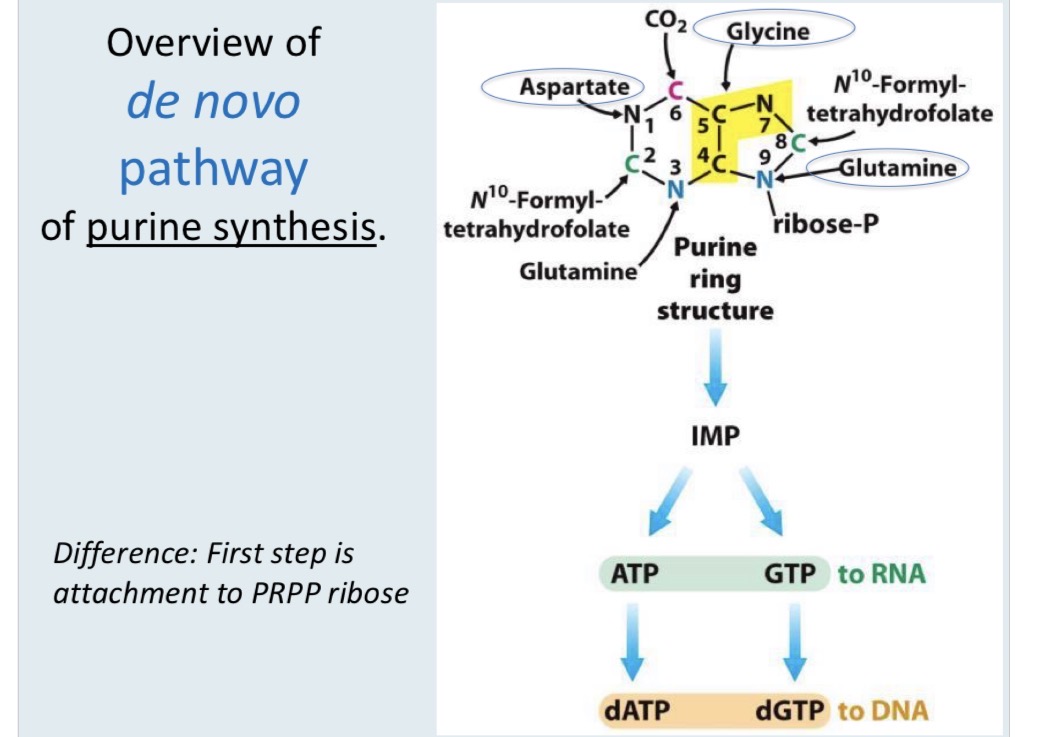
What are the precursors for purines?
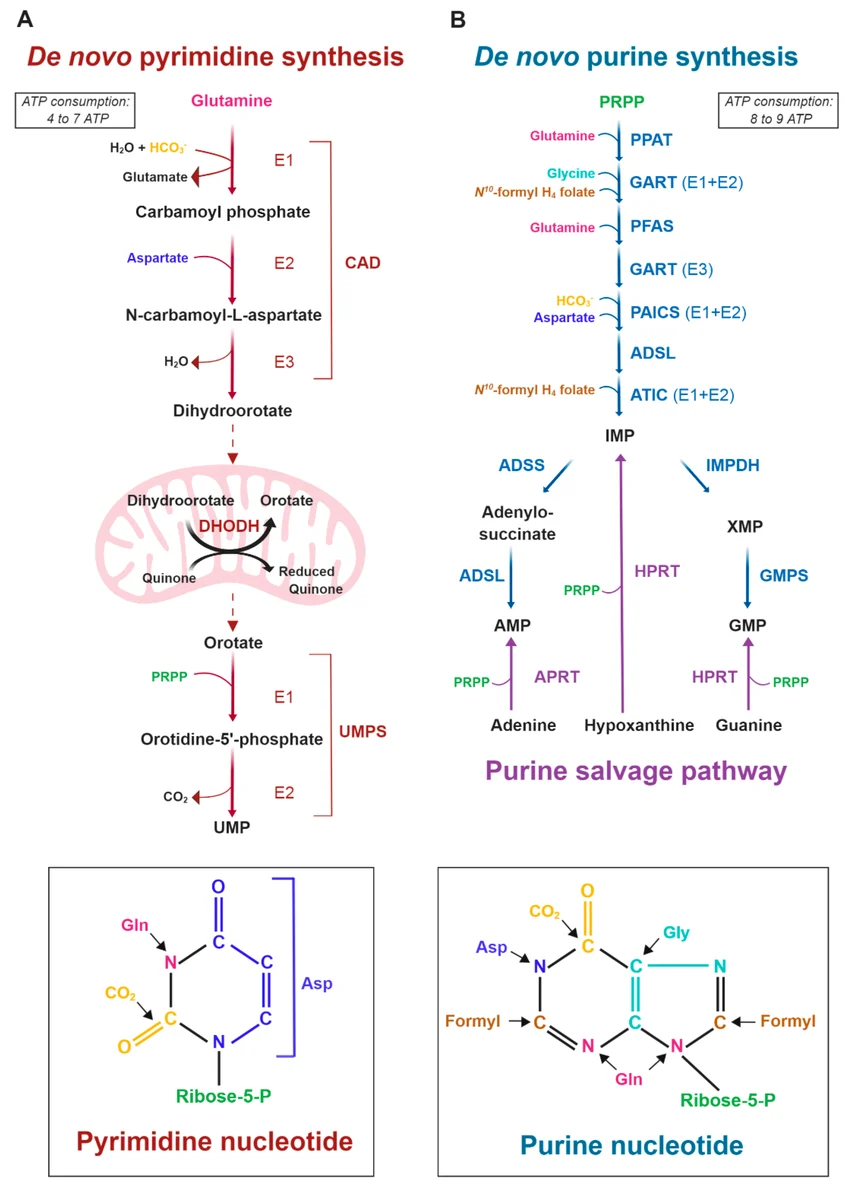
Formed from glutamine, glycine, aspartate, and 10-formyl THF
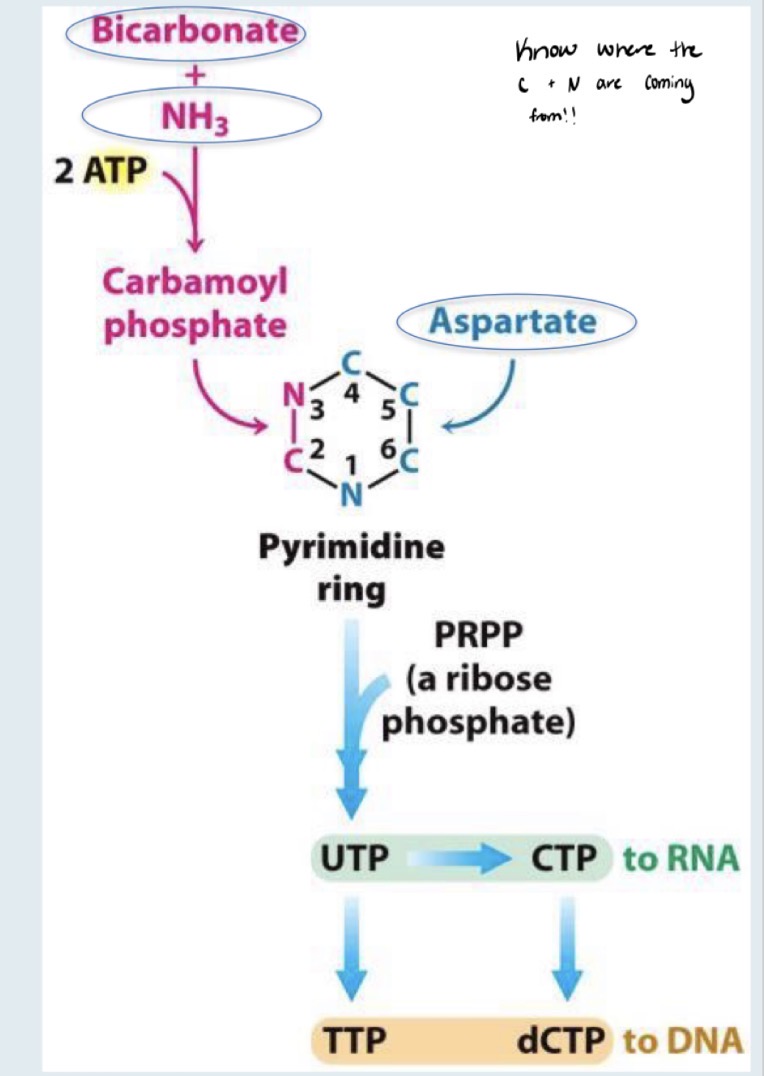
What are the precursors for pyrimidines?
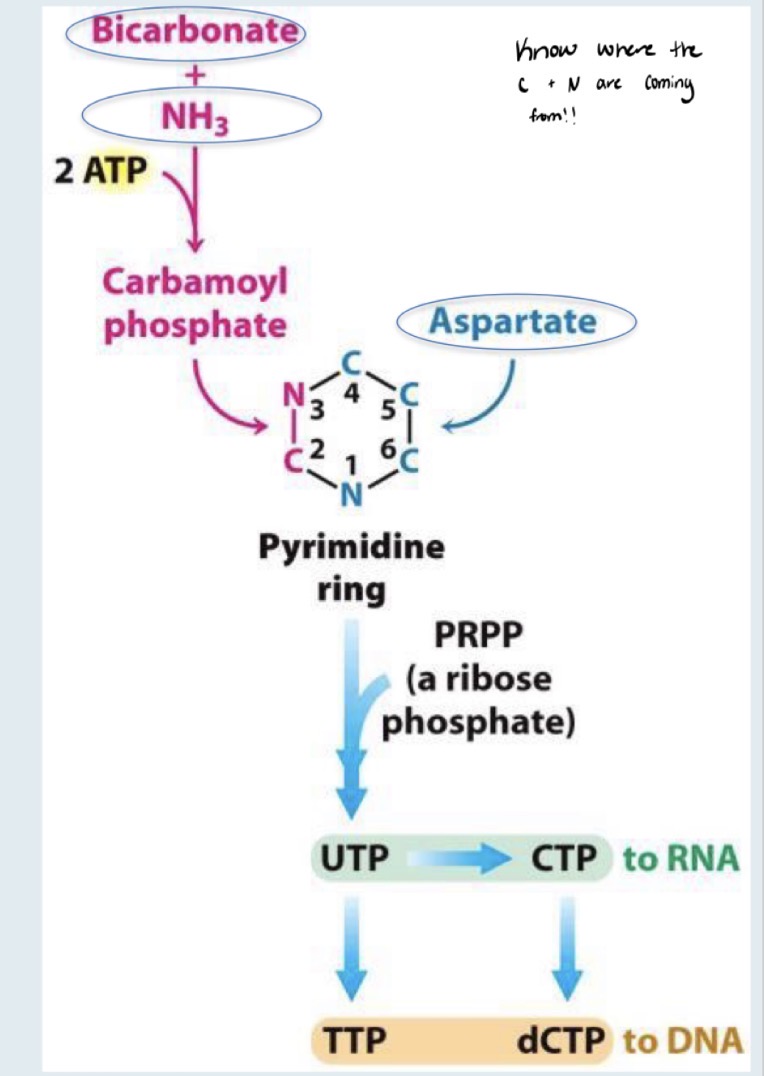
Formed form carbamoyl phosphate and aspartate
Purine and pyrimidine pathways require a significant amount of ATP and energy input. What is the form of this energy input?
In the form of Phosphoribosyl Pyrophosphate (PRPP)
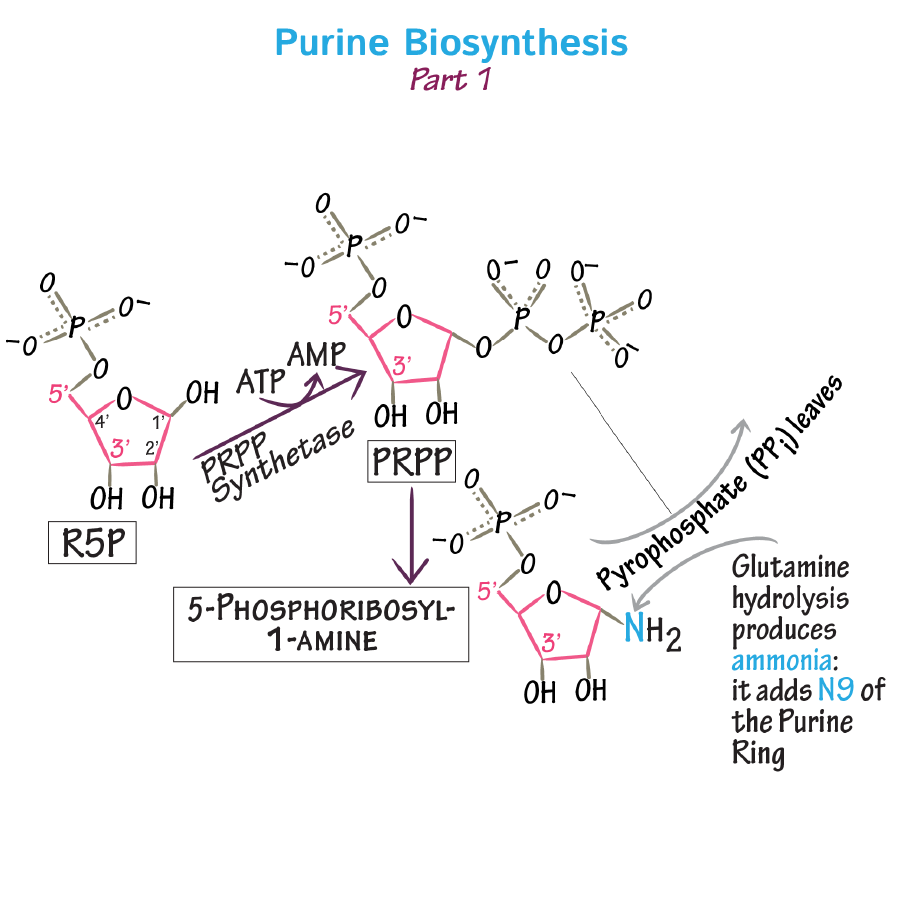
What is phosphoribosyl pyrophosphate (PRPP)?
A vital pentose phosphate compound used in cellular metabolism, acting as a key precursor in the biosynthesis of purine and pyrimidine nucleotides (DNA/RNA building blocks).
How is PRPP formed?
Formed from ribose-5-phosphate and ATP via enzyme PRPP synthetase
What is the primary difference between De Novo and Salvage pathways?
De novo pathways build nucleotides from precursors like amino cids (glutamine, aspartate, glycine) and PRPP, while salvage pathways recycle bases from nucleic acid breakdown
De Novo pathways can be inhibited by specific cancer drugs, which reduces nucleotide pools for DNA synthesis. What is this enzyme that is inhibited?
Inhibiting ribonucleotide reductase
What is ribonucleotide reductase (RNR)?
A vital enzyme that converts ribonucleotide to 2’-deoxyribonucleotides, providing necessary precursors for DNA replication and repair. Functions via a radical-based mechanism, converting a conserved cysteine residue into a thick radical to reduce ribonucleotides to deoxyribonucleotides
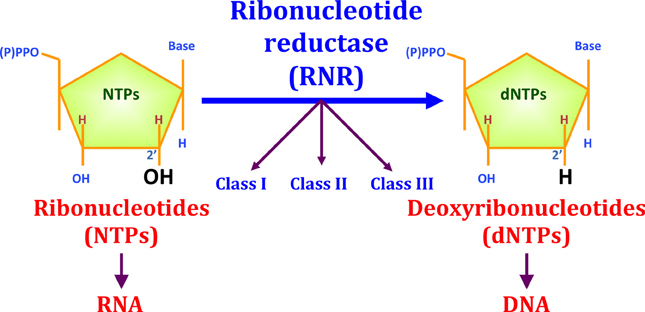
What is the function of Ribonucleotide reductase (RNR)?
RNR is the only enzyme responsible for de novo synthesis of dNTPs (deoxyribonucleotides triphosphates) from NTPs (ribnucleoside triphosphates) in all living organisms. This process involves reducing the ribose 2’-OH group to 2’-H.
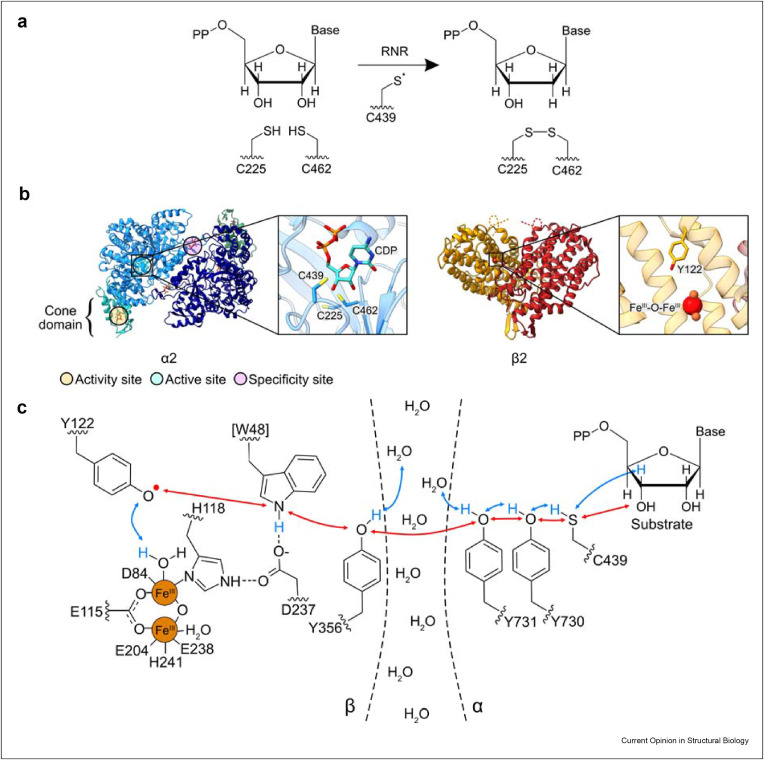
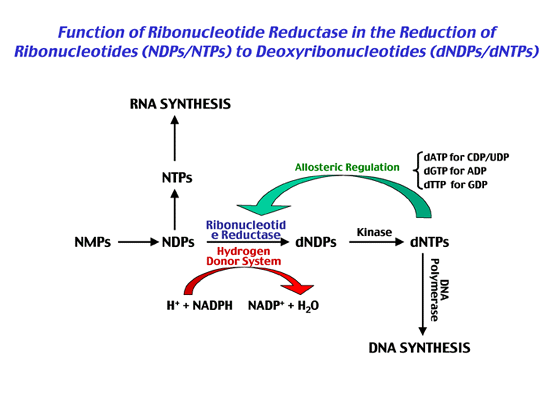
How is ribonucleotide reductase (RNR) regulated?
RNR activity is highly regulated to maintain balanced dNTP pols, which is critical for genomic stability. The enzyme contains allosteric sits that bind effector molecules (like dATP), which can shut down the enzyme to prevent toxic levels of deoxynucleotides
What is the De Novo Pathway (“from scratch” biosynthesis)?
Metabolic processes that construct purine and pyrimidine nucleotides from simple precursors (aa, CO2,, ribose-5-phosphate) to meet cellular needs for DNA/RNA synthesis.
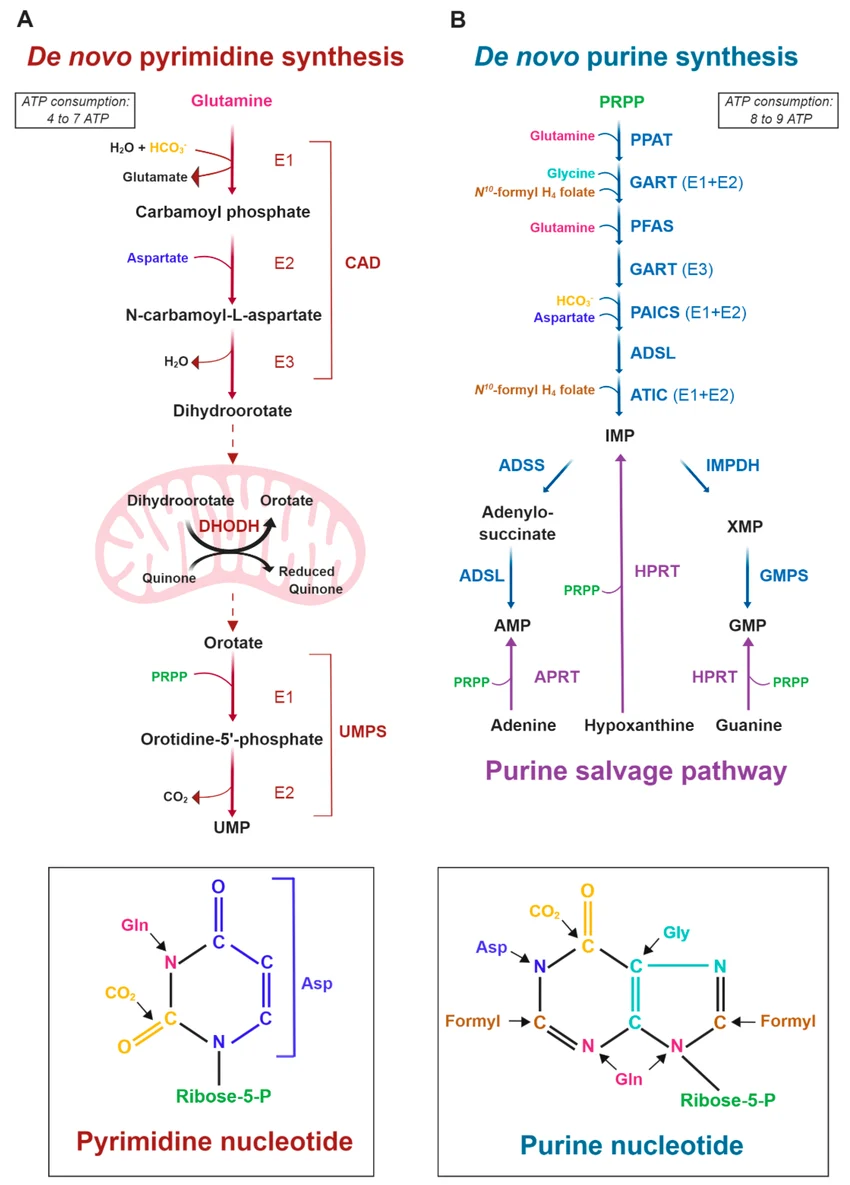
Within the De Novo Pathways, purine synthesis builds the base directly on the sugar, while pyrimidine synthesis builds…?
Pyrimidine synthesis builds the base first and then attaches it to a sugar
How does the de novo pathway of pyrimidine synthesis begin?
Pyrimidine synthesis begins with carbamoyl phosphate synthetase II (CPS II) catalyzing to make carbamoyl phosphate
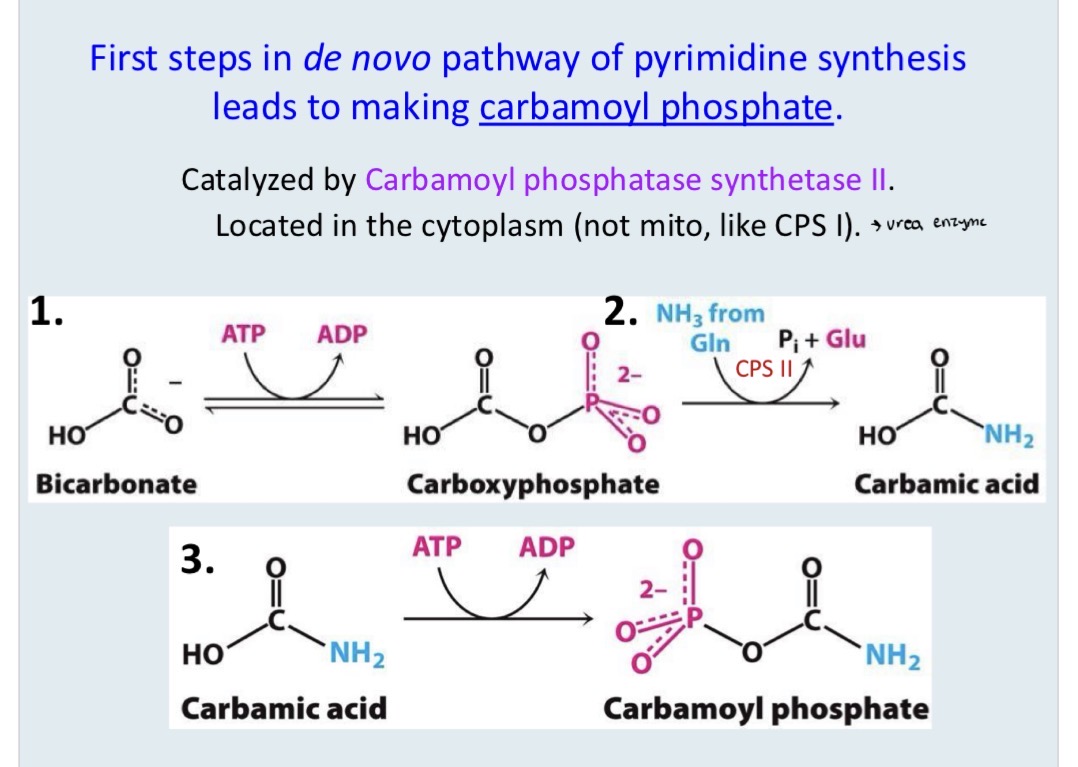
What is the rate-limiting step in the de novo pathway of pyrimidine synthesis?
The synthesis of carbamoyl phosphate catalyzed by CPS II
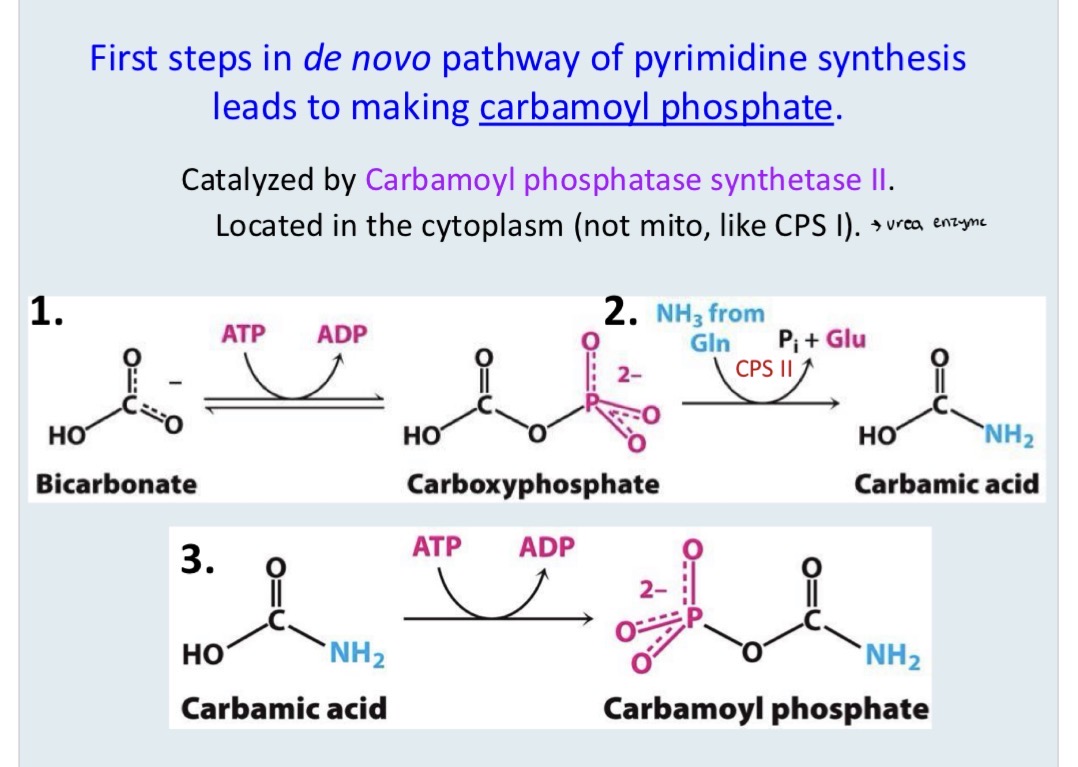
Where is CPS II located?
Located in the cytoplasm (not mito, like CPS I !!)
What are the 6 overall steps to de novo pyrimidine synthesis?
Carbamoyl Phosphate Synthesis
Carbamoyl Aspartate Formation
Dihydroorotate Formation
Orotate Formation
UMP Formation
What are the 5 overall steps of de novo synthesis of purines?
Activation of Ribose-5-Phosphate
Committed step of phosphoribosyl-1-amine
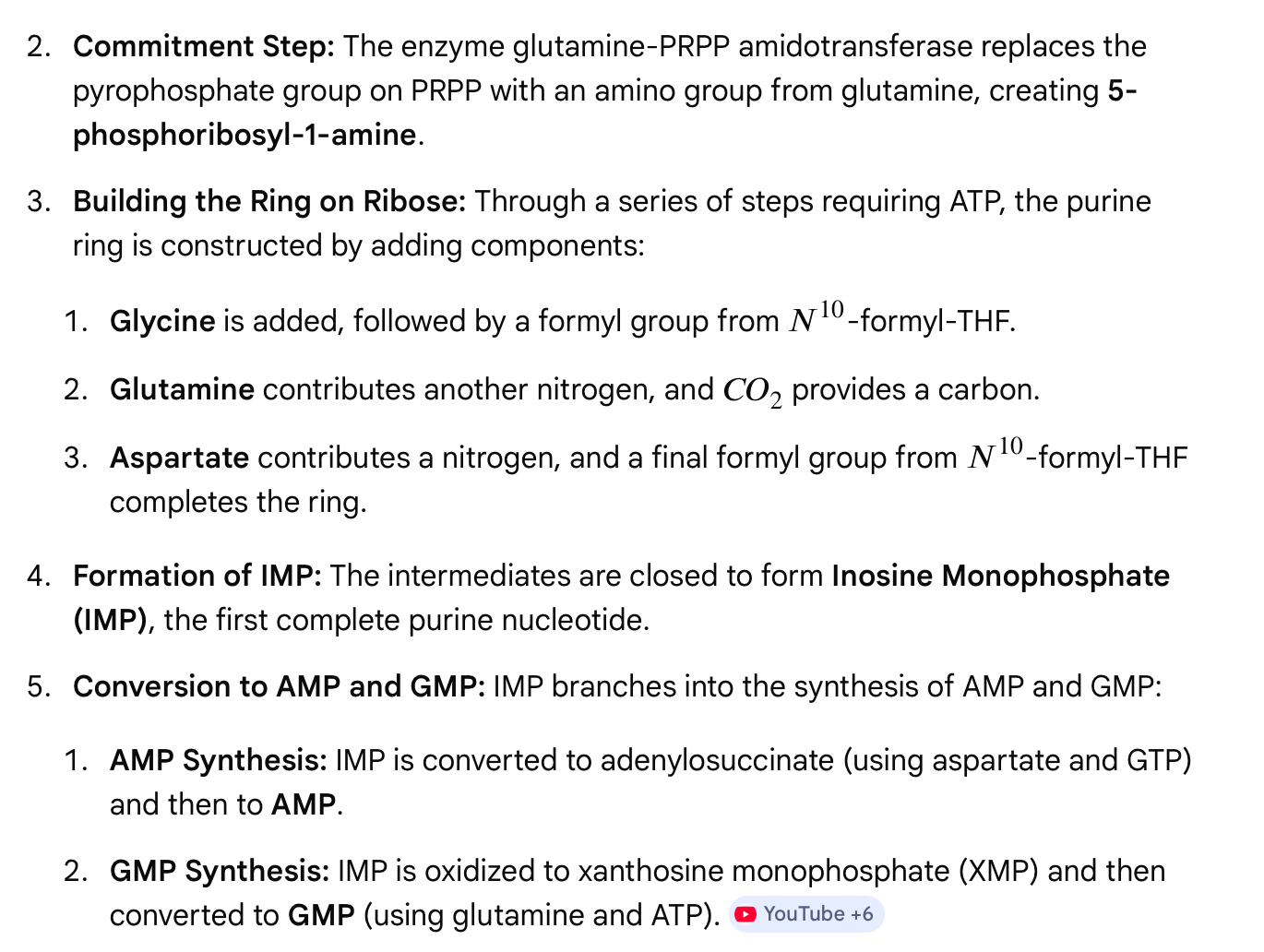
Building the ring on ribose
Formation of IMP
Conversion to AMP and GMP
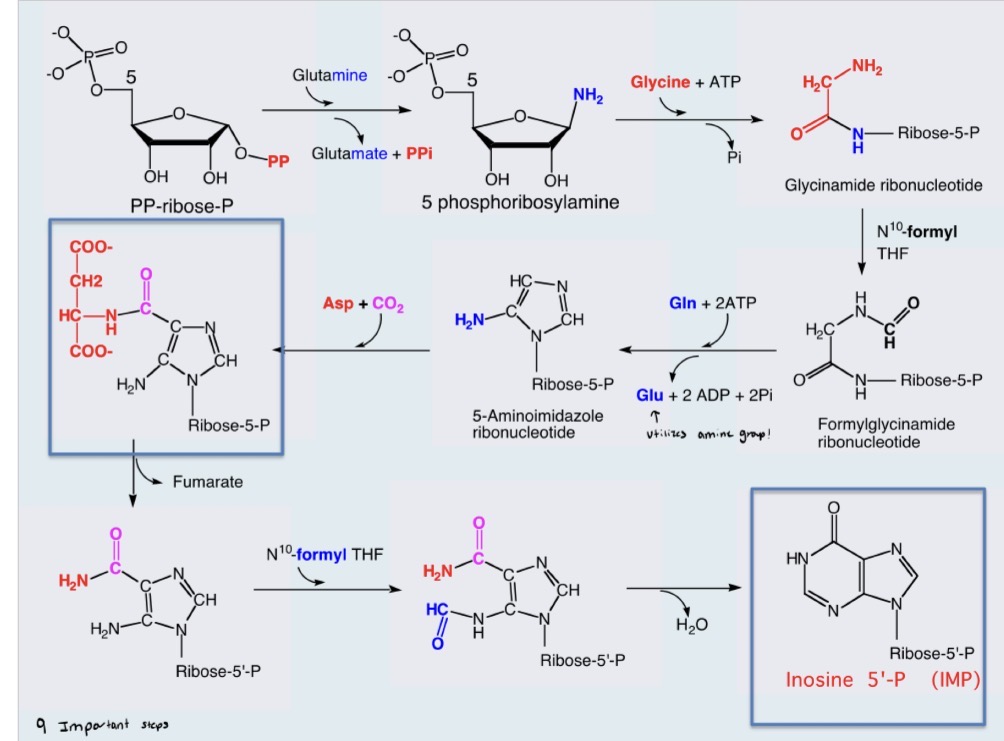
What are the 3 primary steps in building the purine ring on ribose during de novo synthesis?
Glycine is added, followed by a formyl group from N10-formyl-THF
Glutamine contributes another nitrogen, and CO2 provides a carbon
Aspartate contributes a nitrogen, and a final formyl group from N10-formyl-THF completes the ring
Where does de novo synthesis of purines primarily occur?
Primarily in the liver
Where does de novo synthesis of pyrimidines primarily occur?
In the cytoplasm
Describe the overall process of de novo pyrimidine synthesis:
Builds a 6-members pyrimidine ring from glutamine, CO2, and aspartate BEFORE attaching it to ribose-5-phosphate. The process takes place in the cytoplasm and culminates in producing uridine monophosphate (UMP), which is subsequently converted to CTP and TMP
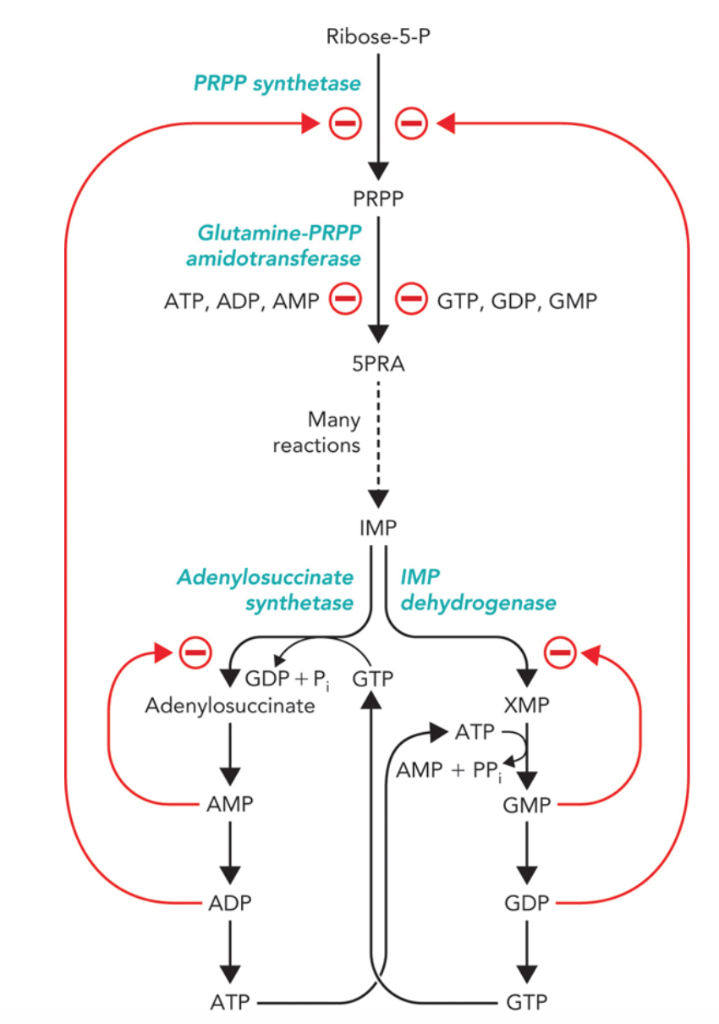
Describe the overall process of de novo purine synthesis:
Process of building the purine ring DIRECTLY upon a ribose-5-phosphate foundation, mainly in the liver. It involves a pathway to form Inosine Monophosphate (IMP), which is then converted into Adenosine Monophosphate (AMP), or Guanosine Monophosphate (GMP). It uses amino acids (glycine, glutamine, aspartate), CO2, and folate derivatives, primarily regulated by PRPP synthase and glutamine-PRPP amidotransferase
What is a nucleotide?
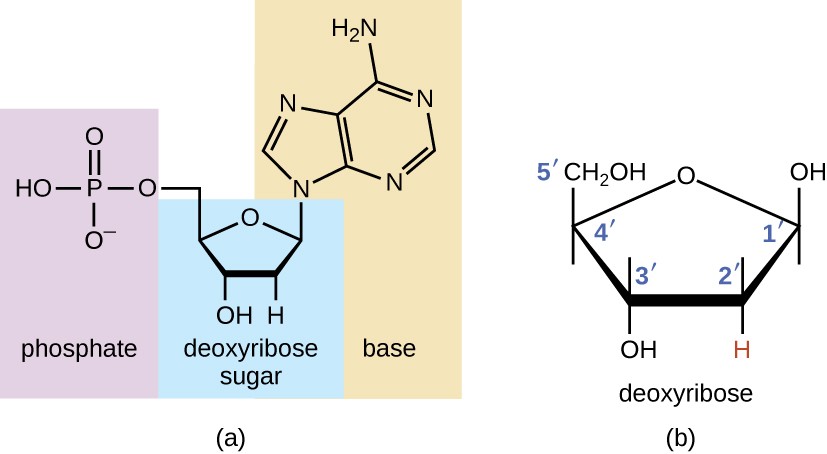
The fundamental building block (monomer) of nucleic acids (DNA/RNA), which store genetic information. Consists of 3 components: A nitrogen-containing base, 5-carbon sugar, and a phosphate group
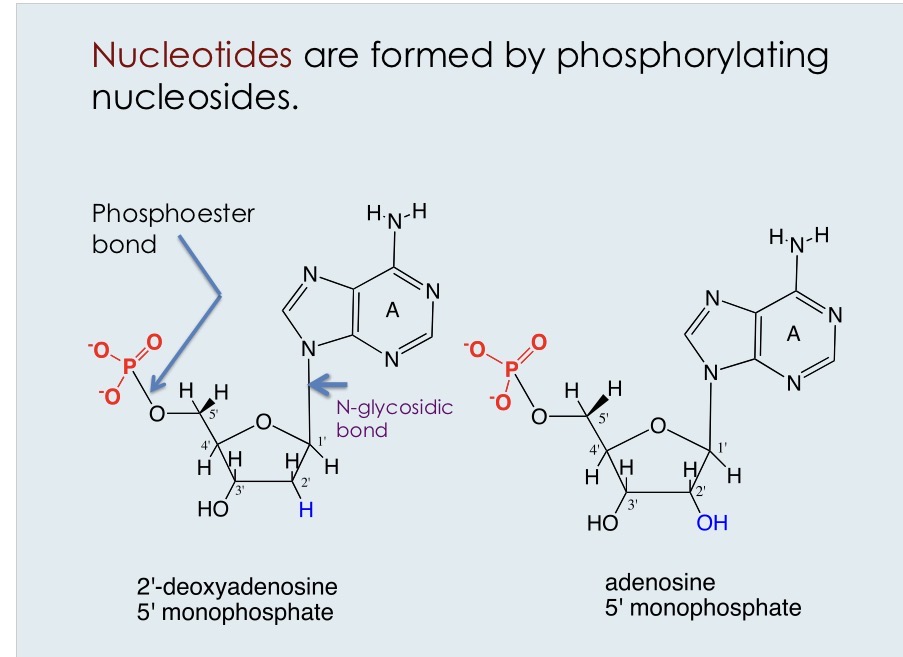
DNA v.s. RNA nucleotides:
DNA: contain deoxyribose and bases A,G, C, T
RNA: contain ribose and bases A, G, C, U
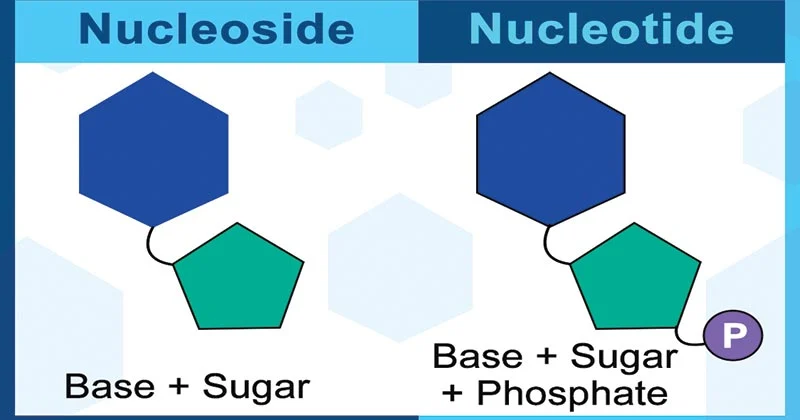
What is a nucleoside?
A structural subunit of nucleic acids (DNA/RNA) formed by joint a nitrogenous base (purine/pyrimidine) to a 5-carbon sugar (ribose or deoxyribose). Do not contain a phosphate group.
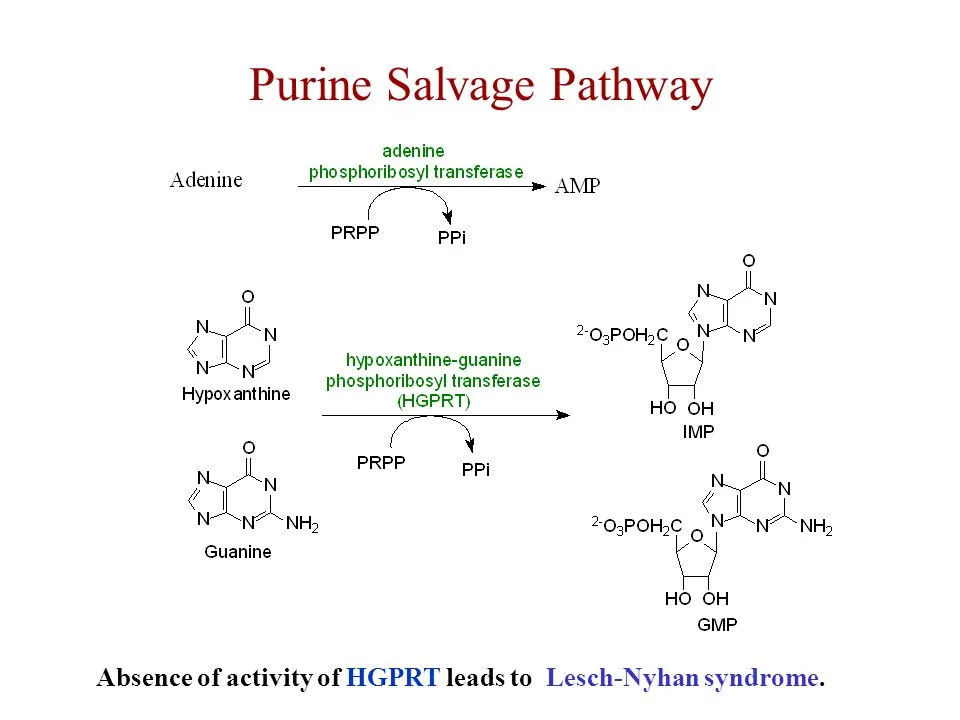
What is the salvage pathway?
A pathway that recovers bases and nucleotides from DNA/RNA degradation to rebuild nucleotides (ATP, GTP, CTP, UTP), serving as an energy-efficient alternative to de novo synthesis. This pathway is crucial for tissues with low de novo capacity (brain, bone marrow) and is often upregulated in cancer
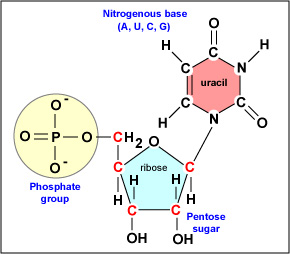
What is a ribonucleotide?
A structural unit of RNA consisting of a ribose sugar, a phosphate group, and a nitrogenous base (A,G,C,U).
Why are ribonucleotides crucial?
As the building blocks of RNA, they are crucial for protein synthesis thesis, cellular regulation, and energy transfer (ATP)
How are ribonucleotides differentiated from deoxyribonucleotides?
Differentiated by the presence of a hydroxyl (-OH) group on the 2’ carbon of the ribose ring
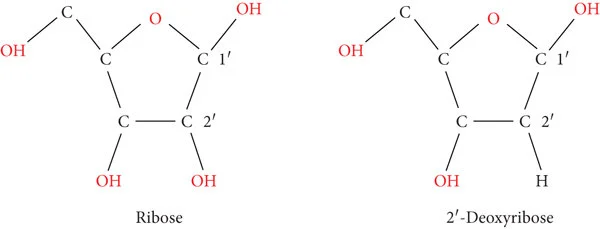
What is a deoxyribonucleotide?
The fondational monomer units of deoxyribonucleic acid (DNA), containing a deoxyribose sugar, a nitrogenous base, and a phosphate group. Essential for action and differ from RNA nucleotides by having a H atom at 2’ instead of -OH
What are Nucleotide Triphosphates (NTPs)?
Molecules consisting of a nitrogenous base, a sugar, and 3 phosphate groups that act as building blacks for RNA
How do dNTPs play a role in DNA?
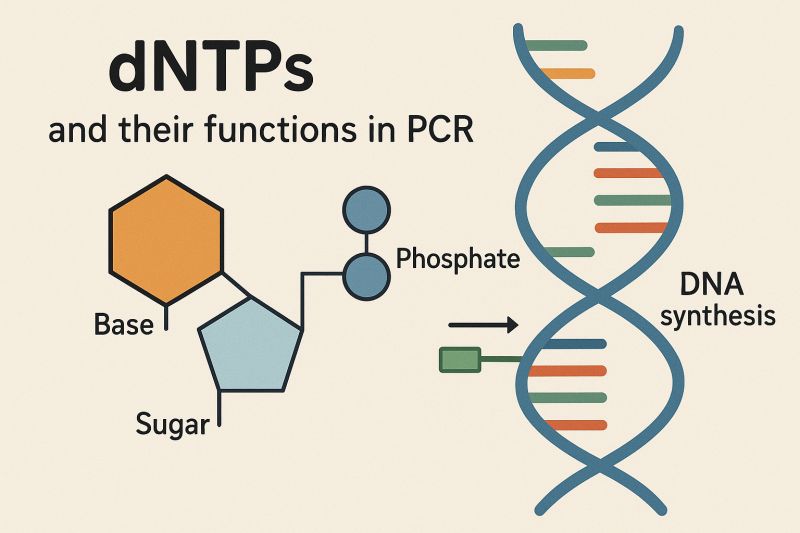
dNTPs (dATP, dCTP, dGTP, dTTP) provide the nucleotides needed by DNA polymerase to synthesize new DNA strands
What are Deoxynucleoside Triphosphates (dNTPs)?
The essential, free-floating building blocks of DNA. Consist of a sugar, phosphate group, and ¼ nitrogenous bases (A, T, C, G). During DNA replication or PCR, they are added by polymerases to synthesize new DNA strands, providing the necessary energy for synthesis
What are the 2 types of nitrogenous bases?
Purines and pyrimidines
Which bases are classified purines (double-ringed)?
Adenine, Guanine, Hypoxanthine, and Xanthine
Which bases are classified pyrimidines (single-ring)?
Cytosine, Thymine, and Uracil
What is the cause of gout?
Excess uric acid from purine metabolism
What is the cause of lesch-nyhan syndrome?
A failure in the salvage pathway (HGPRT deficiency)