8.24 - Experience & Endowment effect
 Call Kai
 Learn
Learn Practice Test
 Spaced Repetition
 Match
Match Flashcards
 Knowt Play
1/14

There's no tags or description
Looks like no tags are added yet.
Name | Mastery | Learn | Test | Matching | Spaced | Call with Kai |
|---|
No analytics yet
Send a link to your students to track their progress
15 Terms
ST vs Endowment effect
ST - Subject should have same choice always if feasible set the same
Endowment effect - People more attached to things they already ‘have’
Knetsch (1989) recap
3 groups
2 Groups given mug or chocolate bar and allowed to swap
Other group had choice of either (no endowment)
ST predicts proportion who end with mug should be consistent in all groups as feasible set the same in all groups
apart from random sampling variation
Evidence shows Endowment effect (90% of initial E vs ~50% in choice group)
Why introduce a market to test Endowment effect
Knetsch (1989) results could be from weak lure of endowment that ‘tie-breaks’ if nearly indifferent
Only if many are indifferent between M / C
Choices in real life often money vs good (not good vs good)
EE might not survive if “keeping the endowment” is “giving up money”
i.e. not selling
Kahneman et al (1990) - OV
Look at their experiment 1
11 rounds of market exchange involving different goods - repeated market context
Induced value tokens + mugs + pens
Can test for endowment effect for relevant good in each round
Can test for survival of endowment effect in later rounds after earlier experience
Design
Each round 50% of subjects endowed with 1 unit of good
These subjects asked for a range of prices if they would sell at that price
Other subjects asked if would buy at these prices
Given responses experimenter selects price to match S & D - market price
Subjects then trade if they said they would
Innovative method at the time but not best practice now
small samples + experiment in class
Kahneman et al (1990) - Theory
ST
Call the 50% who like the good most ‘likers’ + others ‘haters’
If subject a Liker or Hater shouldn’t be affected by endowment
Regardless of endowment, after trading those holding the good should he those who want the good - Coasian insight
Random allocation of subjects means Endowed group comprises 50%
Likers and 50% Haters
Therefore endowed haters will trade to non likers but endowmed likers wont
Volume of trade should be 50% (those endowed but haters)
Endowment effect
Fewer that 50% of units traded
Kahneman et al (1990) - Induced value tokens
Tokens have no intrinsic value
value induced by willingness of experimenter to buy them for cash at end of experiment - only value from disposal
Induced values can be varied by subject
Experimenters can induce distributions of willingness to sell/buy at different prices, creating Likers and Haters
For Mugs / pens value is from subjects own preferences
more chance good kept
Kahneman et al (1990) - RESULTS
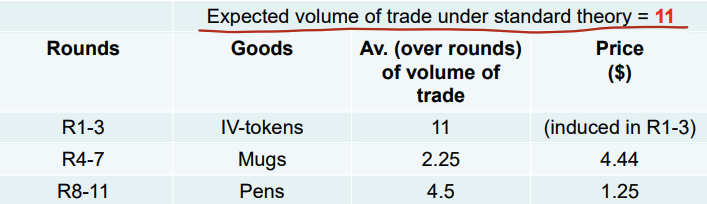
No EE for induced value tokens - ST holds
Volume of trade much lower that ST for M/P
EE persists over all rounds
EE only for goods people expect to keep
List (2003) - OV
Sports trading cards field experiment - 2 different goods (small market for both goods)
test for EE in setting that:
Feels natural to participants - Sports memorabilia marketplace
Offers much of control that lab offers
Has measurable variation in participants’ prior market experience
Wide variation in trading experience - dealers make more trades + 80% male + avg age = 36
List (2003) - Design
On entering show (or, for dealers, at their stalls), subjects asked if would fill out survey about participation in similar events
Information on prior trading experience
In return for agreeing,, subject immediately given either good A or good B
Pseudo-random allocation, based on clock
After completing survey, the other good is shown and subject given chance to swap
List (2003) - Theory
ST
same feasible set so preference should vary with which card given 1st
swap rate should be ½ (indpendent of proportion preferring either)
prefer A = p prefer B = 1- p → avg swap rate = (1-p+p)/2 = ½
List (2003) - RESULTS
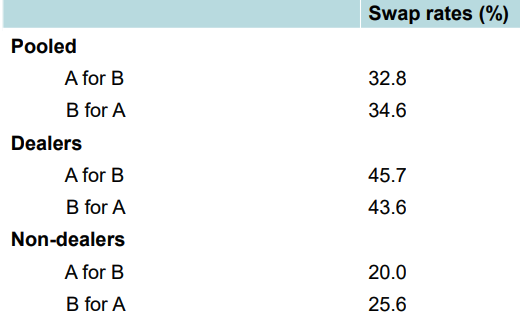
Swap rates higher for dealers - not sig different from 50%
Non-dealers show EE (BUT experience non-dealers also have 50% swap rate)
Experience shown to push preferences towards ST
Increasing Trades per month → less EE
EE found outside lab with non-students
List (2003) - Caveats
Resale - dealers + high-volume traders may never intend to keep good
EE not expected to hold
Good-specificity - Participants have specialised interest in unusual goods
does this trading experience erode EE in other contexts or just sports trading
Reverse causality - Does trading experience / dealership erode endowment effect or do people with weak endowment effects select into dealership / trade a lot
List (2004) - OV & results
Uses Mugs & candy in same trading market-place
addresses resale + good-specificity issues
Results
No EE for dealers or high-volume traders
Strong EE for non dealers (aggregate + low-volume traders)
List (2011) - OV & results
Focuses on group who will commit to come back again to sports trading place
reduces observations
Treated group get additional gift of multiple pieces of memorabilia
may increase their trading between events
Test EE between treated & untreated groups
RESULTS
Some evidence that gifts (induced extra trading experience) weaken subsequent EE
Causality of trading experience causing reduced EE
Although sample size very small
Critique of List’s approach
The market consumers have an extremely specialised interest - does external validity improve from normal set of students?
market experience is of a particular kind - dealers trade on both sides of the market
being a dealer is uncommon
Experience highlighted role (dealer vs non-dealer) + extent of experience (intensity - volume of trades)