Reproductive Cyclicity: The Luteal Phase

0.0(0)
Studied by 0 people
call kaiCall Kai
learnLearn
examPractice Test
spaced repetitionSpaced Repetition
heart puzzleMatch
flashcardsFlashcards
GameKnowt Play
Card Sorting

1/54

encourage image

There's no tags or description

Looks like no tags are added yet.

Last updated 2:37 AM on 5/18/26
Name
Mastery
Learn
Test
Matching
Spaced
Call with Kai

No analytics yet

Send a link to your students to track their progress

55 Terms
1
New cards
<p>What are the three major processes of the luteal phase?</p>

What are the three major processes of the luteal phase?

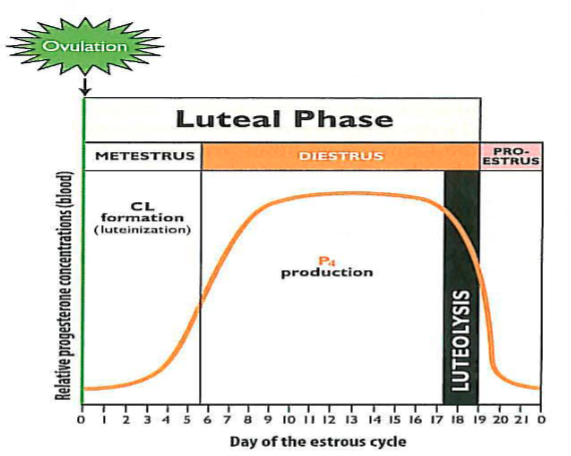
These processes allow preparation for pregnancy and eventual return to a new follicular phase if pregnancy does not occur.

  1. Luteinization: transformation of follicular cells into luteal cells after ovulation

  2. Synthesis and secretion of large quantities of progesterone by the corpus luteum

  3. Luteolysis: structural and functional regression of the corpus luteum

2
New cards
What stages of the estrous cycle compose the luteal phase?
The luteal phase consists of metestrus and diestrus. It begins immediately after ovulation and continues until luteolysis of the corpus luteum near the end of the cycle.
3
New cards
What is the dominant hormone of the luteal phase?
Progesterone is the dominant hormone of the luteal phase. It is secreted by the corpus luteum and exerts major effects on the hypothalamus, uterus, mammary gland, reproductive behavior, and cyclicity.
4
New cards
What is a corpus hemorrhagicum?

The immediate postovulatory structure formed when blood vessels rupture during ovulation, causing hemorrhage within the collapsed follicle. It has a bloody appearance and represents the earliest stage of corpus luteum development.

5
New cards
How does the corpus hemorrhagicum transform into the corpus luteum?
After ovulation, the follicular wall collapses into folds and granulosa and theca interna cells intermingle. LH stimulates luteinization, transforming these follicular cells into luteal cells. The hemorrhagic appearance gradually disappears while progesterone secretion increases and the corpus luteum enlarges.
6
New cards
What is luteinization?

The LH-controlled transformation of follicular granulosa and theca interna cells into luteal tissue after ovulation. This process forms the progesterone-secreting corpus luteum.

7
New cards
What structural changes occur in the follicle during luteinization?

The basement membrane separating granulosa and theca cells deteriorates, the follicle collapses into folds after loss of follicular fluid, and granulosa and theca cells intermingle to form luteal tissue supported by connective tissue remnants of the basement membrane.

8
New cards

What are the two major luteal cell types, and where do they originate?

Luteal tissue contains large luteal cells derived from granulosa cells and small luteal cells derived from theca interna cells. Both cell types are steroidogenic (ability to produce steroids) and capable of secreting progesterone.
9
New cards
What are the characteristics of large luteal cells?
Large luteal cells (granulosa-lutein cells) are 20–70 μm in diameter depending on species. In ruminants they contain dense secretory granules that store oxytocin during the estrous cycle and possibly relaxin during pregnancy. They undergo hypertrophy as the corpus luteum develops.
10
New cards
What are the characteristics of small luteal cells?
Small luteal cells (thecal-lutein cells) are usually less than 20 μm in diameter, irregular in shape, and contain numerous lipid droplets. Unlike large luteal cells, they do not contain dense secretory granules. They undergo hyperplasia during corpus luteum development.
11
New cards
What is a corpus albicans?
A corpus albicans (“white body”) is the scar-like remnant left after luteolysis destroys the secretory luteal tissue. Connective tissue remains after luteal regression.
12
New cards
How does the corpus luteum change throughout the estrous cycle?
The corpus luteum enlarges progressively during metestrus and reaches maximal size and progesterone secretion during diestrus. During luteolysis it regresses structurally and functionally, becoming pale, smaller, and eventually transforming into a corpus albicans.
13
New cards
What determines the “vigor” of the corpus luteum?
The vigor or functional capability of the corpus luteum likely depends on the number of luteal cells present and the degree of vascularization of the luteal tissue.
14
New cards
Why is vascularization important for corpus luteum function?
High vascularization allows efficient delivery of cholesterol, gonadotropins, oxygen, and nutrients to luteal cells while facilitating progesterone secretion into circulation. Angiogenic factors within follicular fluid likely contribute to this vascularization.
15
New cards
How can insufficient luteal function contribute to reproductive failure?
A corpus luteum secreting suboptimal progesterone may fail to properly prepare the uterus to support embryo survival and development, resulting in early embryonic loss.
16
New cards
<p>What are the primary target organs for progesterone? </p>

What are the primary target organs for progesterone?

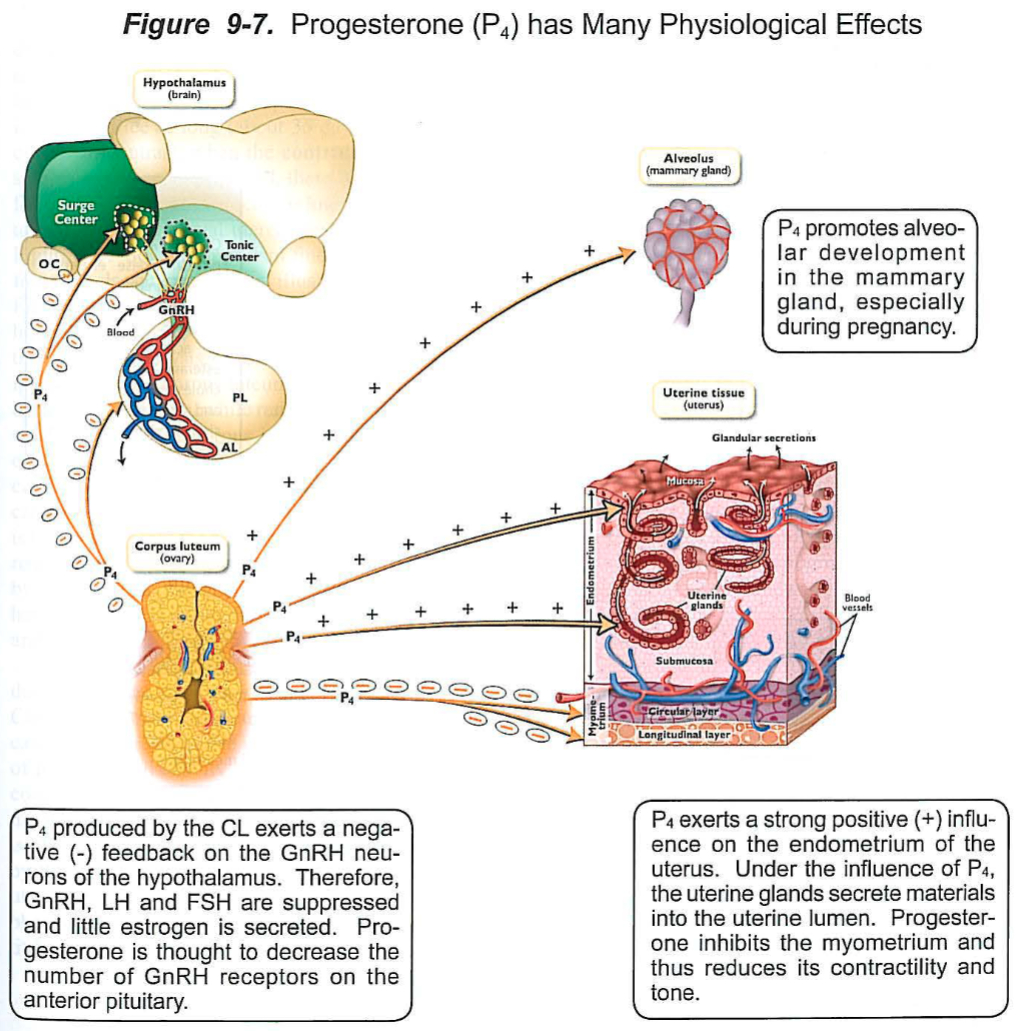
The major target organs are the hypothalamus, uterus, and mammary gland. Within the uterus, progesterone acts on both the glandular endometrium and muscular myometrium.
17
New cards
How does progesterone affect the uterine endometrium?
Progesterone strongly stimulates secretion by the endometrial glands. These secretions support the “free-floating” embryo after it enters the uterine lumen and before implantation/attachment.
18
New cards
How does progesterone affect myometrial activity?
Progesterone suppresses myometrial contractions and decreases uterine tone, producing “uterine quiescence.” This creates a stable environment favorable for embryo survival and attachment.
19
New cards
Why is the mare an exception regarding progesterone’s effects on myometrial tone?
In mares, progesterone does not suppress myometrial contractions to the same extent as in cows, pigs, and ewes. Mild contractions continue and help move the embryo throughout the uterus.
20
New cards
How does progesterone affect the mammary gland?
Progesterone stimulates final alveolar development of the mammary gland during pregnancy, preparing the gland for lactation.
21
New cards
<p>What is required for progesterone synthesis by luteal cells and how does LH stimulate it? </p>

What is required for progesterone synthesis by luteal cells and how does LH stimulate it?

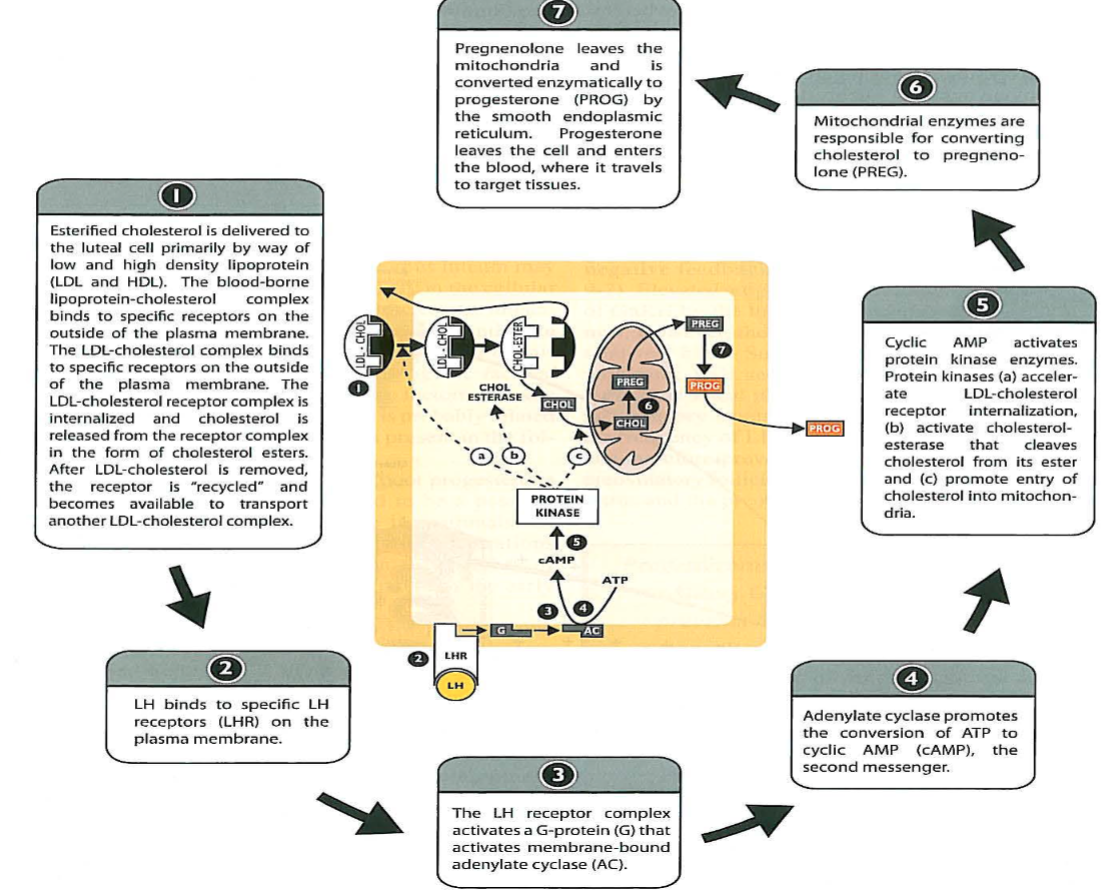
Progesterone synthesis requires cholesterol as a substrate and tonic LH stimulation. LH activates intracellular signaling pathways that convert cholesterol into progesterone. LH binds to LH receptors on luteal cells, activating G-proteins and adenylate cyclase, which increases cAMP production. cAMP activates protein kinases that promote cholesterol transport into mitochondria and conversion into pregnenolone and ultimately progesterone.

22
New cards
How is cholesterol delivered to luteal cells for progesterone synthesis?
Cholesterol is delivered primarily through LDL and HDL lipoproteins. LDL-cholesterol complexes bind to membrane receptors, become internalized, and release cholesterol esters into the cell.
23
New cards
What role does cAMP play in progesterone synthesis?
cAMP functions as the second messenger activated by LH signaling. It activates protein kinases that stimulate cholesterol ester hydrolysis, cholesterol transport into mitochondria, and steroidogenesis.
24
New cards
Why is progesterone considered an inhibitor of reproductive cyclicity?
Progesterone suppresses GnRH pulse frequency, prevents behavioral estrus, inhibits the preovulatory LH surge, and reduces myometrial tone. Together these effects prevent ovulation and sexual receptivity during the luteal phase.
25
New cards
How does progesterone affect GnRH secretion?
Progesterone exerts strong negative feedback on the tonic GnRH center in the hypothalamus, reducing GnRH pulse frequency and therefore suppressing LH secretion.
26
New cards
Why can follicles still develop during the luteal phase despite progesterone inhibition?
Although progesterone suppresses GnRH pulse frequency, LH pulse amplitude remains relatively high and tonic FSH secretion continues. This permits limited follicular growth, though follicles cannot achieve preovulatory status until progesterone declines.
27
New cards
How does progesterone influence reproductive behavior?
Progesterone almost completely suppresses estrous behavior and sexual receptivity. Females under progesterone dominance generally do not display standing estrus or permit copulation.
28
New cards
What is progesterone priming?

Refers to the phenomenon in which prior exposure to progesterone enhances the intensity and duration of estrous behavior induced later by estradiol.

29
New cards

What is luteolysis?

The irreversible functional and structural regression of the corpus luteum. It results in:

  • Cessation of progesterone secretion

  • Structural regression to form a corpus albicans

  • Removal of negative feedback by progesterone upon GnRH secretion, which results in a new follicular phase.

30
New cards
Why must luteolysis occur before a new follicular phase can begin?
As long as the corpus luteum secretes progesterone, GnRH and gonadotropin secretion remain suppressed. Luteolysis removes progesterone inhibition, allowing increased GnRH, FSH, and LH secretion and initiation of a new follicular phase.
31
New cards
What is the luteolysin in domestic mammals?
Prostaglandin F2α (PGF2α) secreted by the uterine endometrium is the primary luteolysin responsible for regression of the corpus luteum in most domestic mammals.
32
New cards
How was it demonstrated that the uterus is required for luteolysis?
Uterectomy dramatically prolongs corpus luteum lifespan. In ewes, removal of the entire uterus extends luteal lifespan from about 17 days to approximately 148 days, similar to pregnancy length.
33
New cards
What evidence supports a local uterine effect on the ipsilateral ovary?
Removing the uterine horn ipsilateral to the corpus luteum greatly prolongs luteal lifespan, whereas removing the contralateral horn has little effect. This demonstrates a local uterine influence on the adjacent ovary.
34
New cards
What are the requirements for luteolysis in subprimate mammals?

Successful luteolysis requires:

  1. Oxytocin receptors on endometrial cells

  2. A critical level of oxytocin

  3. Endometrial synthesis of PGF2α.

35
New cards
How does the utero-ovarian countercurrent transport system function?
PGF2α secreted by the uterus enters the uterine vein at high concentrations and diffuses into the closely associated ovarian artery through countercurrent exchange, delivering high local concentrations directly to the ovary and corpus luteum.
36
New cards
Why is countercurrent transport important for PGF2α?
Most PGF2α is rapidly metabolized in the lungs, especially in cows and ewes. Countercurrent transfer prevents dilution and pulmonary degradation by delivering PGF2α directly to the ipsilateral ovary.
37
New cards
Which species possess a utero-ovarian countercurrent transport system?
The countercurrent transport system is well developed in the cow, ewe, and sow, but not in the mare.
38
New cards
Why is a countercurrent system less important in mares?

Mares metabolize PGF2α less rapidly than cows and ewes, and the mare corpus luteum is highly sensitive to PGF2α, reducing the need for specialized local transport
39
New cards
When is the corpus luteum sensitive to exogenous PGF2α in cattle?
The bovine corpus luteum becomes responsive to PGF2α after approximately day 6–7 of the cycle. Before that time, exogenous PGF2α has little or no luteolytic effect
40
New cards
How does oxytocin participate in luteolysis?
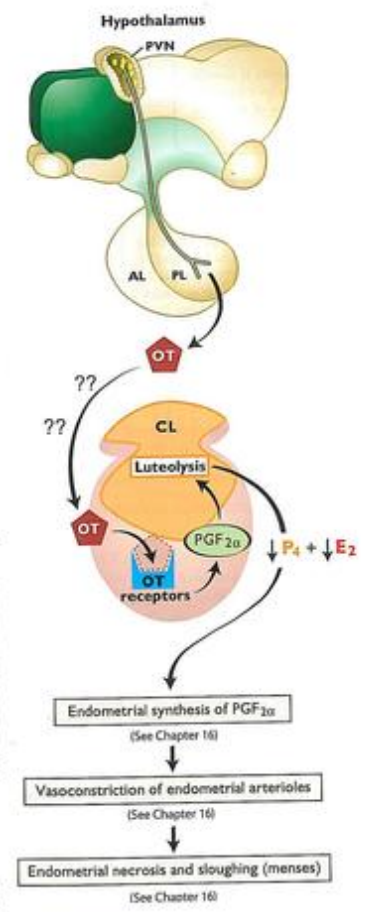
Large luteal cells secrete oxytocin. Oxytocin stimulates uterine PGF2α secretion, while PGF2α stimulates ovarian oxytocin release, creating a positive feedback loop that amplifies luteolysis.
41
New cards
How does PGF2α secretion change during late diestrus?
During late diestrus, PGF2α secretion becomes pulsatile with increasing frequency and amplitude. Approximately five pulses within 24 hours are thought necessary to induce complete luteolysis in the ewe.
42
New cards
Why is progesterone believed to regulate timing of PGF2α secretion?
Progesterone initially blocks formation of uterine oxytocin receptors, preventing PGF2α release early in the cycle. Later, progesterone receptor numbers decline, allowing oxytocin receptor formation and PGF2α secretion.
43
New cards
How is PGF2α thought to cause luteal cell death?
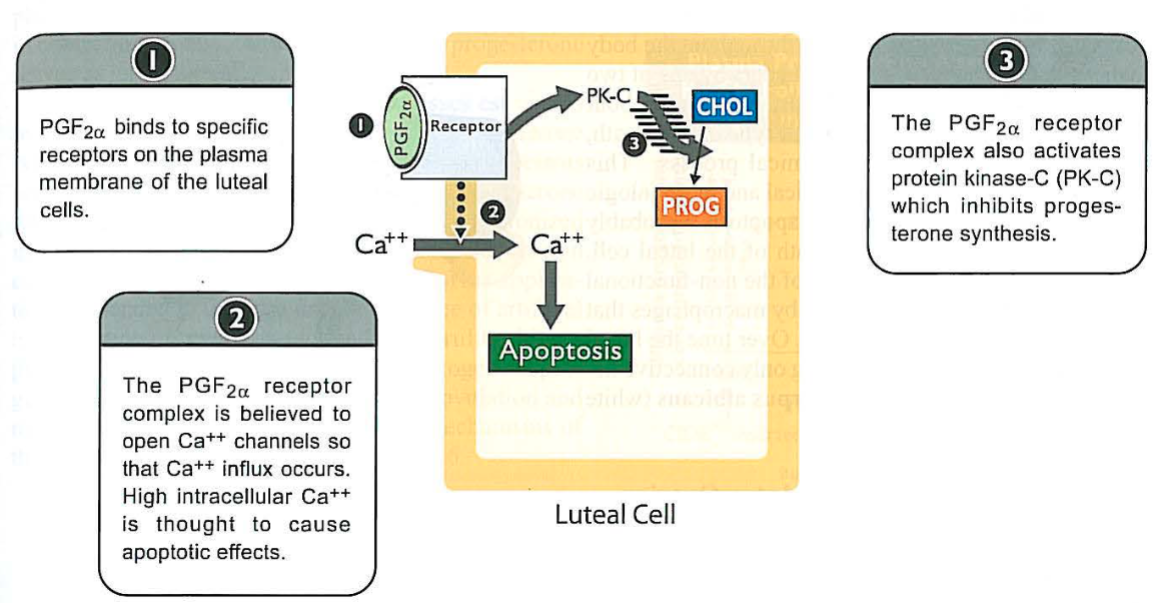
PGF2α binds to luteal cell receptors, increases intracellular calcium concentrations, activates protein kinase-C, inhibits progesterone synthesis, and promotes apoptotic pathways leading to luteal regression
44
New cards
<p>What is apoptosis, and how does it relate to luteolysis?</p>

What is apoptosis, and how does it relate to luteolysis?

Apoptosis is programmed cell death involving organized biochemical and morphological cellular destruction. It is believed to represent the final mechanism responsible for death of luteal cells during luteolysis.
45
New cards
How may the immune system participate in luteolysis?
Immune cells infiltrate the corpus luteum during luteolysis. Cytokines from lymphocytes activate macrophages and may directly inhibit progesterone synthesis and promote luteal cell death.
46
New cards
<p>How does luteolysis differ in primates compared with domestic mammals?</p>

How does luteolysis differ in primates compared with domestic mammals?

In primates, luteolysis is primarily an intra-ovarian event and does not require the uterus. PGF2α involved in luteolysis is thought to originate locally within the ovary.

47
New cards
Why does uterectomy not affect ovarian cyclicity in women?
Because primate luteolysis is intra-ovarian rather than uterine-dependent, removal of the uterus does not prevent normal ovarian cyclicity or luteal regression.
48
New cards
How does luteolysis initiate menstruation in primates?
Luteolysis causes progesterone concentrations to fall, which promotes endometrial PGF2α synthesis. PGF2α causes vasoconstriction of endometrial arterioles, leading to endometrial necrosis and sloughing (menstruation).
49
New cards
How does exogenous progesterone manipulate the estrous cycle?
Exogenous progesterone acts like an artificial corpus luteum by suppressing GnRH, gonadotropins, follicular development, estrus, and ovulation. Removal of progesterone allows synchronized return to estrus and ovulation.
50
New cards
How does a CIDR device synchronize estrus in cattle?
A CIDR (Controlled Internal Drug Release device) releases progesterone intravaginally for about 7 days, suppressing GnRH and ovulation. Removal of the device plus PGF2α administration causes progesterone to fall rapidly, allowing synchronized estrus 2–3 days later.
51
New cards

What is Regu-Mate, and how is it used in mares?

Regu-Mate contains altrenogest, a synthetic progestin. It suppresses GnRH and estrous behavior while administered daily. After withdrawal, mares typically enter estrus within 4–5 days.

52
New cards
How is exogenous PGF2α used to synchronize estrus in cattle?
Administration of PGF2α between days 7–17 of the estrous cycle induces luteolysis, causing progesterone to decline and estrus to occur approximately 60–80 hours later.
53
New cards
What is the Ovsynch protocol?
Ovsynch is a synchronization protocol using timed GnRH and PGF2α injections to synchronize ovulation and allow timed artificial insemination without estrus detection.
54
New cards
How does the Ovsynch protocol work physiologically?
  1. GnRH either ovulates an existing dominant follicle or stimulates continued follicular growth

  2. PGF2α seven days later lyses the corpus luteum, initiating a follicular phase

  3. A second GnRH injection induces ovulation of the dominant follicle, followed by timed insemination.

55
New cards
What is the purpose of the Presynch protocol?
Presynch uses two PGF2α injections before Ovsynch to ensure cows enter the synchronization protocol at more favorable stages of the estrous cycle, improving synchronization success and fertility.



