Cellular Processes
 Call Kai
 Learn
Learn Practice Test
 Spaced Repetition
 Match
Match Flashcards
 Knowt Play
1/57

There's no tags or description
Looks like no tags are added yet.
Name | Mastery | Learn | Test | Matching | Spaced | Call with Kai |
|---|
No analytics yet
Send a link to your students to track their progress
58 Terms
How was a membrane split and imaged
freeze-fracture electron microscopy
What is the membrane structure
8nm barrier that surrounds the cytoplasm of cell
50% lipid 50% protein
What bond holds the membrane together
hydrogen bonds
Lipid is barrier to entry or exit of _____ substances
polar
What is the compositition of the lipid bilayer of the cell membrane
two back-to-back layers of 3 types of lipid molecuels
Cholesterol and glycolipids scattered among a double row of phospholipid molecules
What is the composition of phospholipids in the cell membrane
75% lipids
2 parallel layers of molecules
Amphipathic, has both a polar and non-polar region
How is the bilayer of the phospholipids formed
Having the non-charged sides facing towards each other is the lowest energy state, so it is spontaneous
What is a leaflet
one layer of the bilayer of phospholipid
What is membrane fluidity
Lipids can move around within the plane of the membrane leaflet
Lipids rarely flip flop between membrane leaflets
What is membrane fluidity determined by
Lipid tail length - the longer the tail, decreases fluidity
Number of double bonds - more double bonds, increases fluidity
Amount of cholesterol - more cholesterol, decreases fluidity
What are the two types of membrane proteins
Integral: extend completely across cell membrane
Peripheral: attached to inner or outer surface of cell membrane and are easily removed
What is needed to remove integral membrane proteins
detergent
What are the features of integral membrane proteins
amphipathis
have hydrophobic regions that span the hydrophobic core
usually consists of nonpolar amino acid helices
Hydrophillic ends of protein interact with aqueous solution
Functions of membrane proteins
Receptor
Cell identity
Linkers
Enzymes
Ions channels
Transporter proteins
What is it meant by the membrane being selectively permeable
The molecular organisation of the membrane means that is allows some substances but excludes others
What is the lipid bilayer permeable to
Uncharged molecules (O2, benzene) DIFFUSION
lipid soluble molecules (steroids, vitamins, fatty acids)
small uncharged polar molecules (Water, CO2)
What is the lipid bilayer impermeable to
large uncharged polar molecules (glucose, amino acids)
ions (K+, Na+, Cl-)
What do membrane proteins do in terms of transport
mediate the transport of substances across the membrane that cannot permeate the hydrophobic core of the lipid bilayer
What is diffusion
Random mixing of particles in a solution as a result of the particle’s kinetic energy
the movement of molecules from an area of high concentration to lower concentration until equilibrium is reached
What are some things that affect diffusion
Greater difference in concentration - faster rate
Higher temperature - faster rate
Increase surface area - faster rate
Larger size of substance - slower rate
larger distance - slower rate
What are the limits of cells because of diffusion
Cells are limited to 20um
Membrane area can be increased
Thinner membrane
Smaller cells
What are the different gradients across the cell membrane
Concentration gradient
Electrical gradient
ions will be influenced by membrane potential in addition to conc gradient
What enables concentration gradient
the selective permeability of the membrane
How enables electrical gradient
Cells can maintain a difference in charged ions between the inside and outside of the membrane
How much energy is used to maintain concentration and electrical gradients
30%
What do the concentration and electrical gradients
stored energy
What is osmosis
Movement of water through a selectively permeable membrane from an area of high water concentration to an area of lower water concentration
What is osmotic pressure
the pressure applied to a solution to prevent the inward flow of water across a semi-permeable membrane
What are the different processes of cross membrane transport
Non-mediated (no protein)
Mediated (protein)
Passive
Active
What is diffusion through the lipid bilayer
A non-mediated passive transport that is diffusion down the concentration gradient. For nonpolar hydrophobic molecules
What is diffusion through the ion channels
A non-mediated passive transport through an integral transmembrane protein that is a water filled pore that shields ions from the hydrophobic core of the lipid bilayer
What is the structure of the ion channel
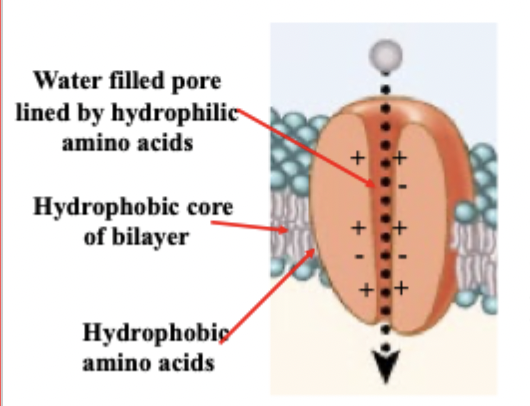
What are the properties of ion channels
Ion selectivity
Gating
Electrical current
What is the ion selectivity of ion channels
Specific amino acids lining the pore determine selectivity of the channel ions
By being selective to a particular ion, the channel can harness the energy stored in the different ion gradients
What is the gating of ion channels
Channels contain gates that control opening and closing of the pore
Different stimuli control the channel opening and closing
Stimuli inculde
Voltage
Ligand
Cell volume
pH
phsophorylation
What is the electrical current in ion channels
Diffusion over 1mill ions/s generates current
The current flowing can be measured by the patch clamp
Current fluctuations represent opening and closing
Channel gating is the conformational changes
What is carrier mediated transport
An active or passive trnasport where the substrate to be transported directly interacts with the transporter protein. The substrate binds and causes a conformational change in the protein
What does carrier mediated transport exhibit
Specificity
Inhibition
Competition
Saturation
What is the saturation of carrier mediated transport
There are only a limited number of binding sites, so once all the sites are saturated, rate of transport cannot increase
What is the facilitated diffusion of glucose
A passive mediated transport which
glucose binds to transport protein (GLUT)
GLUT changes shape and glucose moves down conc. gradient
Kinase enzyme reduces glucose conc inside by phosphorylating to glucose-6-phosphate
Conversion of gluoces meaintains concentration gradient
What is active transport
An energy requiring process that moves molecules and ions against the gradient
What are the two forms of active transport
Primary
Secondary
What are examples of primary active transporters
Na/KATPase
Ca/KATPase muscle
H/KATPase stomach
How does Na/KATPase work
3 Na+ binds
ATP splits, phosphorylates and 3 Na+ is pushed out
K+ binds, phosphate released
K+ pulled in
What does Na/KATPase achieve
The pump generates a current and is electrogenic
maintains a low concentration of Na+ and a high concentration of K+ in the cytosol
Wht us maintaining a difference in ion conentration important
Maintain membrane potential of 80mV
Electrical excitability
Contraction muscles
Cell volume maintenance
Uptake of nutrients via secondary active transporters
maintain intracellular pH
What is the pump-leak hypothesis
Because Na and K are continually leaking back in to cell down the gradient, the