Exam 2 (Ch. 7-11)
 Call Kai
 Learn
Learn Practice Test
 Spaced Repetition
 Match
Match Flashcards
 Knowt Play
1/42

There's no tags or description
Looks like no tags are added yet.
Name | Mastery | Learn | Test | Matching | Spaced | Call with Kai |
|---|
No analytics yet
Send a link to your students to track their progress
43 Terms
Evidence of DNA being genetic material
1. Griffith transformation in 1928 found that transforming principle existed
2. Avery and MacLeod and McCarthy experiments in 1944 determined DNA to be the transforming factor/principle
3. Hershey and chase experiments 1950 concluded DNA was the genetic material
DNA Synthesis needs …
1) Substrate → deoxynucleoside Triphosphates
Needs 2 substrates present
dGTP, dATP, dCTP, dTTP
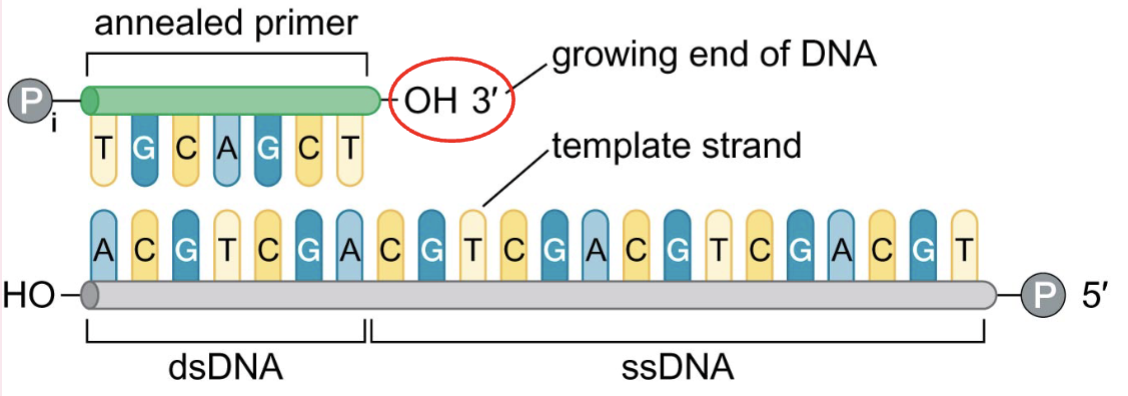
2) A mechanism → Primer:template junction
DNA is synthesized by extending the 3’ end of primer
3’ OH nucleophilic attack to the alpha phosphate on the nucleoside to add a base pair
Bacterial DNA replication
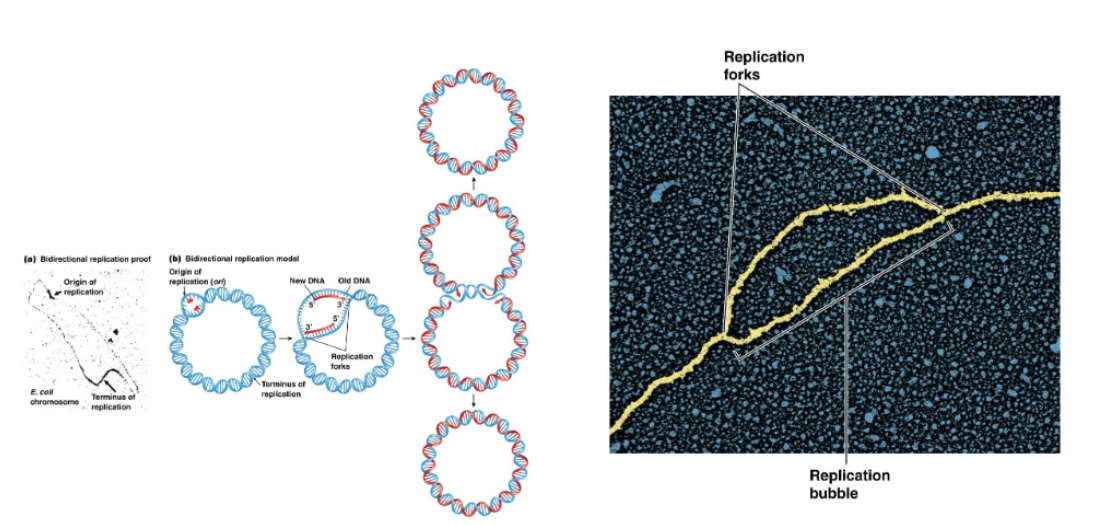
Usually bidirectional, from a single origin of replication
Characterized by an expansion around the origin of replication, forming a replication bubble
At end of replication bubble is a replication fork → replication is complete when the replication forks meet
Players involved in DNA synthesis
Helicase: unwinds the double helix
Topoisomerase: relaxes supercoiling of DNA
Single-stranded binding protein, SSB: Prevents reannealing of separated strands
Primase: synthesizes RNA primers
DNA pol III: synthesizes DNA
Origin of replication
Where DNA replication starts
Have sequences that attract replication enzymes
i..e in E.coli, origin of replication sequence = oriC
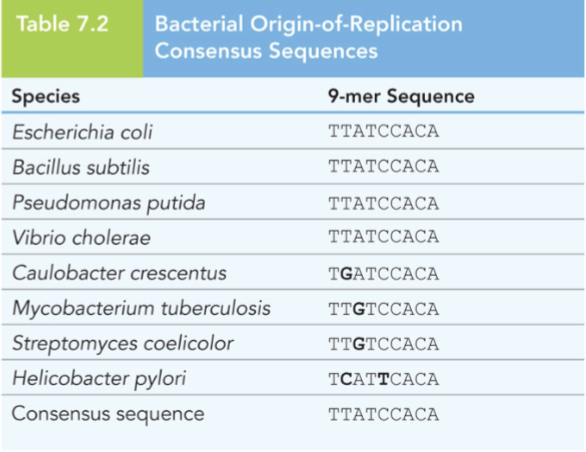
In bacteria, have similar (conserved) but not identical sequences
Consensus sequences
The nucleotides found most often at each position of DNA in the conserved region
DNA pol III: Leading strand
One copy of pol III synthesizes one daughter strand continuously in the same direction as fork progression
DNA pol III: Lagging strand
The other copy of pol III elongates the daughter strand discontinuously in the opposing direction to fork progression, via short segments (Okazaki fragments)
What does DNA pol I do?
Uses two activities to complete replication:
1) It’s 5’-3’ exonuclease activity removes the RNA primers
2) It’s 5’-3’ polymerase activity adds DNA nucleotides to the 3’ end of the DNA segment preceding the primer
What does DNA ligase do?
Seals the gap between the resulting DNA segments
DNA polymerase mechanisms to proofread functions and make sure it’s incorporating the right base at each site
Prevent wrong base from being incorporated via physical interaction
“correct” base pairing has particular angles, so polymerase can recognize that angle
Remove erroneous base if one happens to be incorporated (proofreading)
Incorrect base-pairing stalls the polymerase b/c -OH is misplaced for next incorporation → causes end of growing strand to ‘flip’ into 3’-5’ exonuclease domain → several bases are removed, after which polymerase tries again
Finishing DNA replication in Eukaryotes
Use telomeres and telomerase
Telomeres: the strands of nucleotide sequences at the end of each chromosome that act as a buffer to protect the genetic material inside the chromosome (aka repetitive sequences at the ends of chromosomes)
so they tend to get shorter over time as we age
ensure that incomplete chromosome replication doesn’t affect vital genes
Telomerase: the enzyme that adds telomeres to the end of chromosomes to maintain chromosome length
There must be an intermediate between DNA and protein
Proteins are assembled in the cytoplasm
DNA is confined to the nucleus
RNA is found in both & chemically similar to DNA
Transcription
The synthesis of single-stranded RNA molecule by RNA polymerase
Features of Transcription
Similar to DNA replication chemically and enzymatically but instead uses RNA polymerase/instead of deoxyribonucleotides, the new strand is ribonucleotides
RNA product is displaced nearly immediately from template
Less accurate
Not interested in the whole genome, only sections
Not bidirectional (no tethered polymerase)
Can initiate w/out a primer
RNA polymerase
Catalyzes the addition of each ribonucleotide to 3’ end of the new strand, and forms phosphodiester bonds between nucleotides
Enzyme that catalyzes RNA synthesis
Synthesizes large # of transcripts from a single gene
The two DNA strands re-anneal
Less proofreading in transcription (vs replication that has more proofreading)
Nucleoside vs Nucleotide
Nucleoside: Nitrogenous base linked to 5-C sugar (ribose or deoxyribose)
Nucleotide: Nucleoside that has 1 or more phosphate groups attached
Features of RNA pol
Bacteria: single RNA pol
Eukaryotes: 3 RNA pol (we focus on Pol II)
RNA polymerase core sigma unit for confirmation change
Messenger RNA (mRNA)
Produced by protein-producing genes and is a short-lived intermediary between DNA and protein
The only type of RNA that undergoes translation
Transcription of it is often followed by post-transcriptional processing
Functional RNA
Don’t encode proteins, but instead perform functional roles as RNA itself
Function RNA (eukaryotes only): Transfer RNAs (tRNAs)
Are encoded in dozens of forms and are responsible for binding an amino acid and depositing it for inclusion into a growing protein chain
Function RNA (eukaryotes only): Ribosomal RNA (rRNa)
Combines w/ numerous proteins to form ribosomes
Function RNA (eukaryotes only): Small nuclear RNA (snRNA)
Various types is found in the nucleus of eukaryotes and plays a role in mRNA processing
Function RNA (eukaryotes only): Micro RNA (miRNA) & interfering RNA (siRNA)
Are active in plant and animal cells and are involved in posttranscriptional regulation of mRNA
Bacterial Transcription Process
Promoter recognition and ID
Initiation
Elongation
Termination
Rho-dependent
Rho-independent
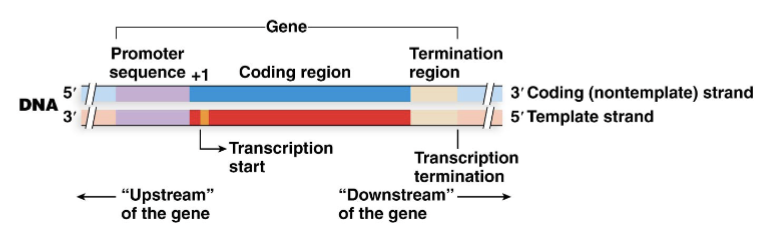
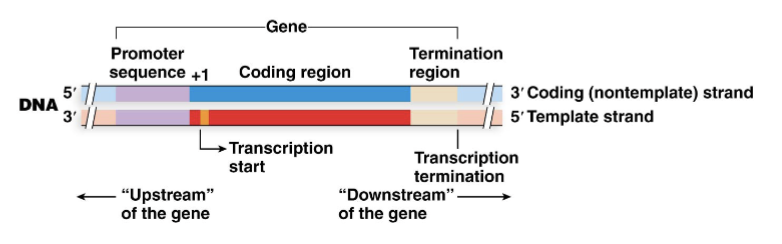
Bacterial Gene Structure: Promoter
Controls the access of RNA polymerase to the gene
Is immediately upstream (5’) to the start of transcription, referred to as the +1 nucleotide
Bacterial Gene Structure: Coding Region
The portion that contains the information needed to synthesize the protein product
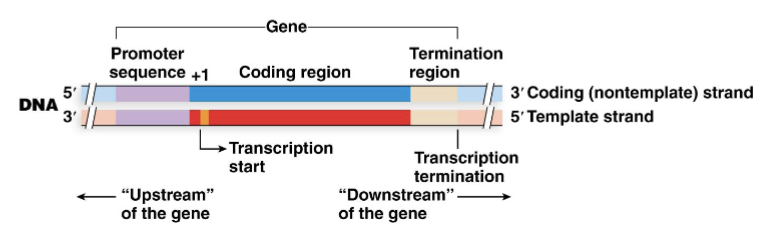
Bacterial Gene Structure: Termination Region
Regulates cessation of transcription
Is immediately downstream (3’) to the coding segment of the gene
Note: only one copy of the DNA that makes up the gene will be transcribed
Promoter recognition
All RNA polymerases
composed of pentameric core enzyme that binds to sigma subunit → core enzyme can transcribe RNA from a DNA template, but cannot bind the promoter or initiate RNA synthesis without the sigma subunit
sigma subunit is what recognizes the promotor at -10 and -35
deviations from these sequences decreases binding strength, impacting whether or not transcription actually starts or the polymerase just falls off → cell uses transcription factor binding to turn on or off making the protein product
Multisubunit enzymes
Pincer shaped
Promoter
A double-stranded DNA sequence that is the RNA polymerase’s binding site
Base pairs are disrupted
“Transcription bubble” forms
Promotes 5’ → 3’ direction
Located a short distance upstream of the coding sequence, within a few nucleotides of +1
RNA polymerase recognizes and binds to promoters by the presence of consensus sequences
Transcription Initiation
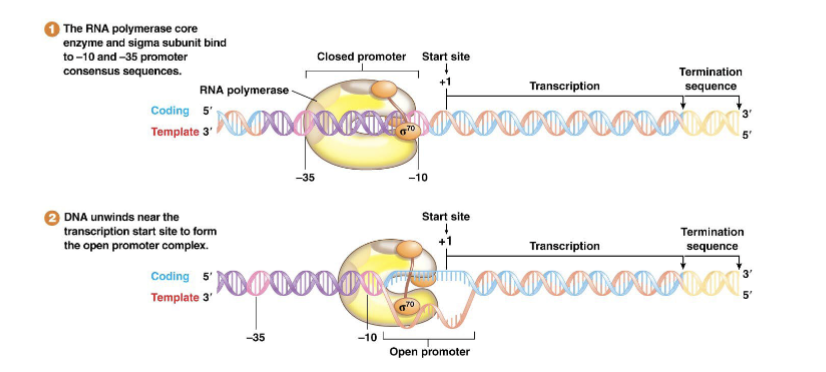
Binding to closed complex - ds DNA
Promoter recognition by sigma subunit
Complex transition to open complex → base pairs “melt” forming “bubble”
Initiation starts when ma polymerase binds and melts DNA “open” to read the template
Next we escape the promotor → start transcribing mRNA and building the first nucleotides
sigma dissociates after a few nucleotides
Transcription Initiation Process Steps
Holoenzyme makes a loose attachment to the promoter sequence, then binds tightly to form the closed promoter complex
Holoenzyme unwinds about 18 bp of DNA around the -10 position to form the open promoter complex
Transcription Elongation
Holoenzyme initiates RNA synthesis at the +1 site
After 8-10 RNA nucleotides have been joined, sigma subunit dissociates from the core enzyme
DNA is unwound ahead of the enzyme to maintain about 18 base pairs of unwound DNA'; the double helix re-forms behind the RNA polymerase
Transcription Termination
When transcription of the gene is completed, the core enzyme dissociates from the DNA