U1 AOS 1 - Nature and Functions of Language
 Call Kai
 Learn
Learn Practice Test
 Spaced Repetition
 Match
Match Flashcards
 Knowt Play
1/87

There's no tags or description
Looks like no tags are added yet.
Name | Mastery | Learn | Test | Matching | Spaced | Call with Kai | Chat |
|---|
No analytics yet
Send a link to your students to track their progress
88 Terms
List the mnemonic for the subsystems (in ascending order)
Please Make Linguistics Students Do proper Study
List the subsystems in ascending order
Phonetics and phonology, morphology, lexicology, syntax, discourse and pragmatics, semantics
What is the subsystem of Morphology?
The study of words and their parts. Each word consists of one or more morphemes, Morphemes are the smallest unit of linguistic meaning or function.
Etymology is included in this subsystem (pre-fixes, suffixes etc)
What is the subsystem of Lexicology?
The study of words - their form, their meaning and how they behave within language
lexeme is a unit of meaning in a language, typically one word.
‘the study of vocabulary’
What are auxiliary verbs?
Supports the main verb of a sentence
The three primary auxiliary verbs: ‘be’, ‘have’ and ‘do’
Primary auxiliary show aspects of tense, time or voice (was/were, had, did, am/are/is, have/has, do/does, will be, will have, will do')
What are modal verbs?
Used to express the possibility, ability, intent, obligation or necessity of an action occurring.
Modal auxiliary verbs express the possibility, ability, intent, obligation or necessity of an action occurring. They modifity verbs to change their mode (the state in which they exist)
can, could, will, would, shall, should, may, might, must, ought
What are adverbs?
Helps to describe, modify, or quality a verb, adjective, other adverb or whole phrase or clause. Expresses elements such a as time, place, manner, circumstance, cause and degree.
What is a determiner?
Is placed in front of a noun and helps to describe the noun. It can specify definiteness, quantity and possession.
What is the subsystem of syntax?
The study of how words are combined into structure that communicate meaning - phrases, clauses and sentences
Includes grammar and punctuation
What is a phrase?
A group of one or more words that, together, from a single structural unit that convesy meaning. It does not contain both a subject and a verb. The type of phrase (noun phrase, very phrase etc.) is named after the word class category of the word that is the most important within the phrase
What is a clause?
A set of words that must contain both a main noun phrase (the subject) and a main verb (part of the predicate). The predicate describes the action of the subject.
What are the 5 sentence structures?
Simple, compound, complex, compound-complex, fragment
What is the semantics subsystem?
The study of meaning - both logical meaning and lexical (dictionary) meaning; the study of understanding and meaning-making when we consider words, phrases, sentences and texts as a whole
Includes all subsystems preceding it
What is the subsystem of Phonetics and Phonology?
Phonetics: Phonetics is the study and classifications of the speech sounds occurring in language.
Phonology studies the way in which the speakers of a particular language systematically use a selection of these speech sounds to express meaning.
What is the subsystem of Discourse and Pragmatics?
Discouse: Written or spoken texts that are longer than a sentence. DISCOURSE analysis is the study of how speakers use language to structure and communicate meaning.
Pragmatics: The study of how language is used within a given context, and how context contributes to meaning
It involves studying speaker/writer intention as well as listener/reader interpretation based on situational and cultural contexts, the other speech or writing it is situated with, and any background knowledge that it relies upon.
What are inflectional affixes?
Bound morphemes that attach grammatical properties to a word, such as tense (in verbs) number (in nouns), or possession (in nouns and pronouns). Inflectional affixes don’t affect the fundamental meaning or form of the root word
Can show grammar tense, possession, comparison, plural number
What are derivational affixes?
Creates or derives a new word from the root or stem that it is attached to.
Change the meaning of the word class (e.g. noun to adjective, or from base to comparative to superlative)
What are interrogative pronouns?
Used to introduce a quesiton
Include ‘what’, ‘which’, ‘who’, ‘whom’ and ‘whose
(e.g. WHO are you?, WHICH would you like?)
What are relative pronouns?
Helps to introduce a relative clause within a larger sentence by relating that clause to the noun that it modifies.
Include the terms ‘which’, ‘what’, ‘who’, ‘whom’, ‘whose’ and ‘that’ (e.g. the man WHO stole the bicycle was arrested. She’ll wait for the train THAT stops her at her station)
What are demonstrative pronouns?
Refers to a particular place, person or thing. Replaces the entire noun or noun phrase it represents
E.g. Do you see the potato cake he’s holding? I gave him THAT. I need to do THIS
What are the 4 forms that verbs can take?
simple, progressive, perfect progressive, and perfect
What are infinitives?
The infinitive form of a verb allows the verb to be used as a noun, an adjective or an adverb.
Generally formed by adding the word ‘to’ before the base form of the verb.
Often used to discuss actions that haven’t actually occurred yet.
E.g. I want TO GO and eat potato cakes. TO boldly GO where no man has gone before.
What are determiners? (elaborate)
A word that’s placed in front of a noun that helps to clarify the noun, specify quantity or indicate possession
can be defined as belonging to one of four categories: articles (the, a, an), quantifiers (all, a lot, many, most, much, some, several, few, a couple, one, none), demonstratives (this, that, these, those) and possessives (my, your, her, his, its, our, their)
What are clauses (more in depth)
A clause is a set of phrases that must, as a minimum, contain both a subject and a predicate (there needs to be a main verb, the predicator and an noun phrase, the subject that acts up on that verb)
Clauses can also contain objects, complements, and adverbials
Can form complete sentences (independent clauses) or part of a sentence (dependent clauses) → subordinators link these two togheter
What is a simple sentence?
One independent clause (consisting of a subject and predicate)
What is a compound sentence?
Two or more independent clauses joined by coordinators.
What are complex sentences?
One independent clause and one or more dependent clauses joined by subordinators.
What are compound-complex sentences?
At least three clauses, where there are at least two independent and at least one dependent clause.
Fragment
No complete clauses (missing either the subject or the predicate)
What is ‘3-Sentence Cap Rule’ structure for analytical commentary introductions (instead of the formulaic MRSCATFA)?
Sentence 1: Context:
The [mode + text type] between [participants] targets [audience].
Sentence 2: Register/Tenor:
The predominantly [formal/informal/hybrid] register constructs a [relationship dynamic].
Sentence 3: Purpose:
This supports the text’s primary purpose of [entertaining/persuading/informing] by positioning the audience as [effect].
What are examples of the AC introduction that follow the ‘3-Sentence Cap’ rule?
1) The spoken interaction between the hosts on the Alpha Blokes podcast targets a young Australian male audience. The highly informal register constructs a mateship dynamic between speakers and listeners. This supports the program’s entertaining purpose by positioning the audience as insiders within the discussion.
2) The spoken interaction between the hosts on the Alpha Blokes podcast targets a young Australian male audience. The highly informal register constructs a mateship dynamic between speakers and listeners. This supports the program’s entertaining purpose by positioning the audience as insiders within the discussion.
3) Constructing a mateship dynamic between hosts and listeners, the Alpha Blokes podcast relies on a highly informal spoken register. This colloquial interaction targets a young Australian male audience and supports the program’s primarily entertaining purpose.
What is the acronym for syntactic patterning?
PAL
Features of syntactic patterning?
Parallelism
Antithesis
Listing
What is syntactic patterning?
Often employed by authors to support a function or purpose, allowing them to create rhythmic and memorable pieces of texts.
Syntactic patterns serve to draw readers’ or listeners’ attention to a component of a text in a way that reinforces meaning and understanding.
Syntactic patterning consists of parallelism, antithesis and listing. (PAL)
Diagram for syntactic patterning
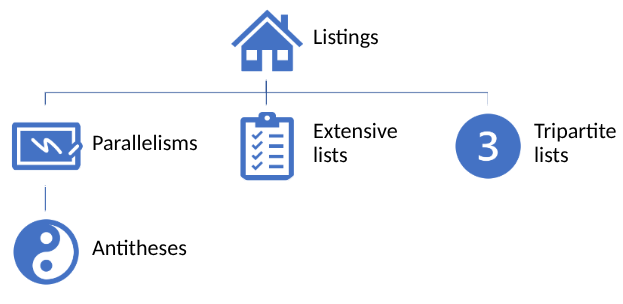
What is parallelism?
The repetition of grammatical structures two or more times in succession.
Examples:
More taxes, more debt, more dishonesty
= adjective + noun repeated structure
work hard, stay focused
= verb + adjective repeated structure
Example Analysis:
The parallelism serves an emotive function as it allows the negatively connoted nouns ‘taxes’, ‘debt’ and ‘dishonesty’ to gain prominence. This in turn aids the text’s purpose of dissuading voters for the opposition party in the upcoming federal election.
What is antithesis?
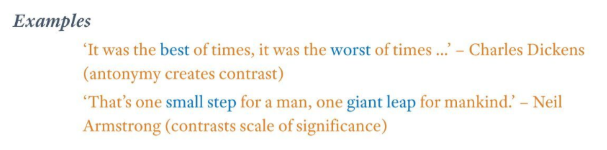
A rhetorical (persuasive) device that presents two contrasting ideas near one another, often in parallel structures. Antithesis is used to create a balance between opposing ideas and to emphasis the contrast.
Antithetical phrases can use antonymy (use of opposites), irony, contrast in scale or other means to juxtapose ideas.
What is listing?
Used to present a series of related ideas, items or elements, usually in a similar grammatical form. Words, phrases or clauses in a list are often introduced by a colon.
Can provide clarity by separating elements into a simple format, to create a rhythm in language and to emphasise a point or build an argument.
Three types: Tripartite, Extensive, Parallelism
Tripartite listing: (or power-of-three lists) are the strongest type of list. It is said to originate from the latin ‘Veni, Vidi, Vici’, or ‘I came, I saw, I conquered’.
EXAMPLE: I’m the better candidate for this job because I am clean, organised and have excellent customer service.
The tripartite list was used to form strength of argument in persuading the audience of the positive qualities deemed important for candidates for the job position.
Extensive listing: is where more than three components are included in a list. As there are many components, it draws the audience’s attention to the number of components, rather than the components themselves.
Before exam week, I need to make sure I’ve finished all my homework, catch up on re-scheduled tasks, take care of my little brother this weekend when he goes to soccer practice, cook for my entire family as I’m the best cook in the house, and adequately revise for all of my exams.
The extensive list draws attention to the abundance of tasks required to be completed by the participant leading up to exam week, conveying they are stressed and time poor. This may have been used to express their doubt in completing all tasks, or could have been used to persuade the audience to assist with the tasks as there are numerous.
Examples:
I need to buy pies, cakes, hot dogs and sausage rolls. ( = enhance clarity)
There are three reasons why this policy should be implemented: reducing costs, increasing efficiency and improving morale. (= places emphasis on each reason to support an argument or explanation.
The room was filled with objects of all sorts: old books with torn covers, vintage furniture coated in dust, faded photographs and a clock that had stopped ticking long ago. ( = creates rhythm in a narrative or descriptive text).
What are phrases?
A phrase is a single word or group of words that are related to each other and form a single unit of meaning
A phrase does NOT contain both a subject and a verb
What is a noun phrase?
A noun phrase is a group of one or more words that contains a noun as the head of the phrase as well as modifiers to the noun.
The modifiers can come before or after the noun
Modifiers = articles (a/the), adjectives (blue, silly, etc.)
E.g: a goat
the laughing goat
Bob’s short spotted fainting goat
the goat who was free and happy
What is a verb phrase?
A verb phrase consists of a main verb and any modifiers
Modifiers = auxiliaries, infinitives, adverbs, adverb phrases, etc.
E.g: prance
was prancing
pranced happily
might have pranced clumsily
What is an adjective phrase?
An adjective phrase consists of an adjective at its head and may include modifiers to that adjective
Modifiers = other adjectives or adverbs
E.g.: The very very happy goat
I want a crazy spotted miniature goat
That fluffy goat is my favourite.
An old grandpa goat
What is an adverb phrase?
An adverb phrase consists of an adverb as its head and may include modifiers.
Adverb phrases describe elements such as time, place, manner, frequency and degree (the same as adverbs do); may modify verbs.
E.g: The goat frolicked very quickly.
He frequently eats the washing.
Mr Goat slept soundly, .
What is a prepositional phrase?
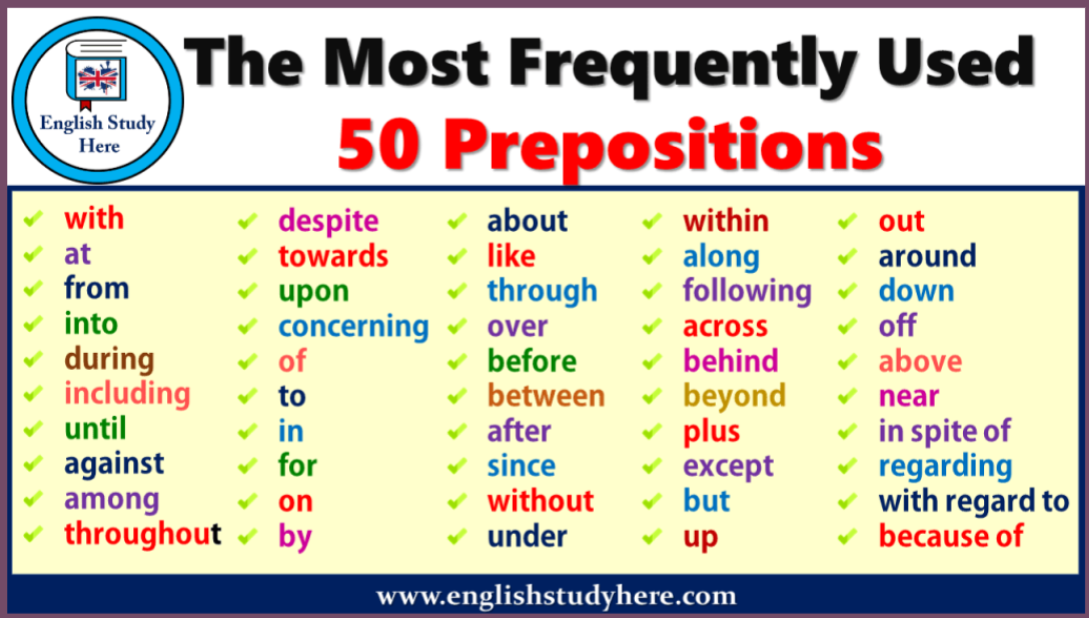
A prepositional phrase consists of a preposition and a noun phrase that is considered to be its object.
The preposition MUST come before the noun phrase in a prepositional phrase.
E.g: The goat dashed through the barn, leaping over the roof, scattering feed across the floor, and grabbing pyjamas off the line, while the farmer chased it around the yard.
Common prepositions:
What are the types of phrases?
Noun
Verb
Adjective
Adverb
Prepositional
Sentences vs Phrases?
Sentences can convey thoughts, ideas and statements of fact, etc.
A sentence must contain at least one independent clause.
A sentence can include multiple clauses.
VS
A phrase is a single word or group of words that are related to each other.
A phrase does not contain both a subject and a predicate (= the main verb of a clause and all of its modifiers)
A clause must have both a ___ and a ___
subject, predicate
What are the elements of a clause?
Subject
Object
Predicate
Complement
Adverbial
What is the subject?
Is the main actor of the clause; subjects are typically noun phrases.
e.g. The cheeky goat jumped joyfully over the giant boulder.
What is the predicate?
Consists of the main verb of a clause and all of its modifiers and because of this…
a predicate may include other dependent clauses.
e.g. I will share my delicious birthday cake with the class, unless anyone is allergic to eggs.
Dorothea, Daisy and Drake should study very hard before the exam on Tuesday.
I am confident about the test if it was like the practice one!
Because it was a warm night, my husband and I walked the dog after dinner.
The cheeky goat will jump.
The cheeky goat has jumped.
The cheeky goat is going to jump.
To analyse a predicate, it is helpful to split it into:
The predicator
The rest of the predicate
The predicator is the verb and its modifiers.
e.g. The cheeky goat will jump joyfully over the giant boulder.
The rest of the predicate contains any objects, complements or adverbials.
e.g. The cheeky goat will jump joyfully over the giant boulder.
What is the object?
Like subjects, objects are also most often composed of noun phrases. However, where subjects come before verbs and are the doer of the action of a verb, objects usually come after the predicate and are the receiver of that action. Such differing distribution can be seen in the underlined aspects of our previous examples:

What is an adverbial?
An adverbial clause is a group of words that work together in order to function as an adverb. Adverbials are optional clause elements
Types include
- place - probability
- time - comparative
- manner - superlative
- degree
Notice how adverbials can be prepositional phrases, adjective phrases, adverb phrases. Notice how the adverbial can be removed and it is still a complete sentence.
What is the complement?
A complement is a word or set of words that is necessary to complete the meaning of a subject or predicate.
They must appear directly after any verbs or phrase that describes.
Examples of describing verbs: to be, feel, appear, seem, grow, find, become
Note: only a subject + predicate is required BUT where there is a describing verb, a complement is also necessary to complete the clause.
Can be subject or object complement
easily recognised provided we understand their function and their form. While adverbials most commonly provide
additional (optional) information about a verb using adverbs, complements instead most commonly use adjectives to
modify the subject or object of a given expression.
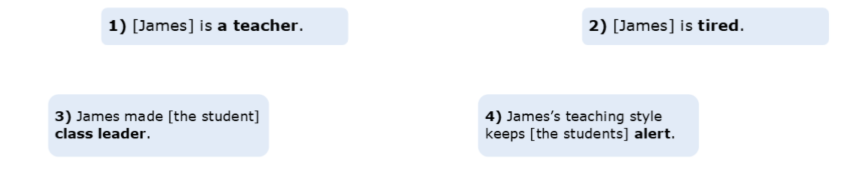
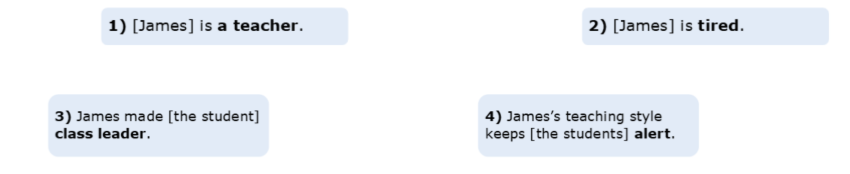
Adverbial vs Complement
An adverbial can be removed and the clause will still make sense!
What are purposes and intents?
Purposes and intents are what the author aims to do or achieve with a text.
The P&I may be closely linked with the function
What are some common purposes and intents?
Building rapport
To form positive and harmonious relationships; create mutual understanding, trust and connection; show respect.
if analysing rapport, must state WHO they aim to build rapport with
POSITIVE POLITENESS
Relates to self-image and need to be liked, admired, respected and appreciated by others; linked with intimacy, in-group, equality, solidarity, and rapport.
supporting aims to build rapport is often politeness. Politeness strategies can be an author’s intent in order to achieve a greater aim of the text
Metalanguage: politeness markers (e.g. thank you), compliments, formal vocatives/honorifics (e.g. madam, doctor)
NEGATIVE POLITENESS
Strategies that aim to communicate in a manner that does not directly challenge or impose upon the audience, while showing respect for their autonomy.
Metalanguage: discourse particles, hedging modal verbs (hedges → discourse’ particle), politeness markers (e.g. please)
REDUCING SOCIAL DISTANCE
If you are aiming to increase intimacy, reduce social distance, you are more likely to use informal language
Reinforcing social distance
If you are socially distant, you are more likely to use formal language; opposite of intimacy.
Establishing expertise:
Demonstrating knowledge, credibility, and authority on a subject or in a particular field; builds trust via demonstrated knowledge.
Jargon, Declaratives (to provide info)
if analysing expertise, must state WHAT they are building expertise in (e.g. medical, educational, interior design)
Authority:
Process of strengthening position of power, control or influence; reinforces hierarchy.
Modal verbs
CLARIFYING
Ensuring clear communication; to be specific, precise and accurate; removes ambiguity.
declaratives, simple syntax
SUPPORTING IN-GROUP
Language that promotes membership to a particular group; fosters belonging and togetherness.
slang, colloquialisms, hypocoristic, suffixation, jargon
One way to know if the aim is to create an ‘in group’ is to consider – who would be the outgroup? is an outgroup created. Slang is an example of a feature that aids this.
Solidarity:
A sense of unity or shared purpose within a group of people.
inclusive pronouns e.g. first-person plural ‘we’ or ‘us’
NEGOTIATING SOCIAL TABOOS
Navigating topics that are sensitive, controversial or offensive.
euphemisms, politeness markers
How to analyse P&I?
1) As you read the text, identify some purposes & intents:
Do you see any of the common ones we’ve just listed? AND/OR
Ask yourself: why does this text even exist? what is the author aiming to achieve?)
2) What language feature helps to achieve that identified P&I? (WHAT)
This MUST be from the Eng Lang study design. If you can’t describe it with metalanguage from our list, don’t analyse it!
3) Describe how your chosen language works; its effect! (HOW)
4)Explain why the author would use that feature; link to the P&I you identified (WHY)
What is ‘himself’? (In The student only had himself to blame)
Reflexive pronoun
What is ‘we’? (In we were telling you about that earlier)
First-person subject pronoun
What is ‘that’? (In we were telling you about that earlier)
Demonstrative pronoun
What is ‘they’? (In They couldn’t believe it)
Third person plural (subject) pronoun
What is ‘it’? (In They couldn’t believe it)
Third-person object pronoun
What is ‘where? (In where should I put this?)
First person subject interrogative
What is ‘me’? (In, 'Suzie gave me her study notes)
First-person object pronoun
What is ‘who’? (In the students who studied the most, always reached their full potential?)
Third person plural subject pronoun
What is ‘their’? (In the students who studied the most, always reached their full potential?)
subject possessive pronoun
What is the acronym to help remember ‘coherence’ features?
CLIF-C
What is the acronym to help remember ‘cohesion’ features?
ECLAIR
What are the coherence features?
Consistency and Conventions
Logical ordering
Inference
Formatting
Cohesion
What are the cohesion features?
Ellipsis, Repetition, Substitution
Lexical meaning (antonymy, synonymy, hyponymy)
Adverbials and Conjunctions
Information Flow (front focus, clefting, end focus)
Reference (anaphoric, cataphoric, deictic)
Discourse refers to how language is organised beyond the sentence to create _ in texts and conversations.
meaning
What is coherence?
Textual coherence is the logical and meaningful organisation of a text. It involves
arranging ideas, information and the elements of a text in such a way that
the sentences, paragraphs and sections create a clear message with smooth
transitions. Coherence is integral as it allows an audience to understand what
is being conveyed. We analyse texts for the following features of coherence:
cohesion, inference, logical ordering, formatting and consistency and
conventions.
What is consistency and conventions?
Consistency occurs when similar concepts or entities are referred to in the same
way throughout the text, without unnecessary variations. Consistent formatting,
as well as the use of consistent punctuation, capitalisation, font and spacing
also contribute to the overall coherence of a text by providing visual cues to the
reader and creating a unified presentation.
Conventions are established rules and expectations for how certain types of
texts are structured, organised or presented. They can include genre-specific
structures, such as the way recipes or analytical essay responses are arranged,
and field- or domain-specific writing norms, such as the standard citation styles
you might use in your VCE studies. Adhering to established conventions in writing
helps readers to follow the text, understand the intended meaning and engage
with the content in a familiar and expected manner.
What is logical ordering?
Logical ordering occurs when we construct a text, as we arrange information
in a way that will maximise understanding. We often do this subconsciously,
but in planned texts it is an intentional process designed to increase audience
understanding.
Common methods to logically order a text include chronological (ordering
a text in relation to when events occurred in time), sequential (ordering
information in a series of steps) and categorical ordering (ordering a text by
topic).
What is inference?
Inference is the meaning that the audience makes when considering a text
that contains information that is not overtly present. We draw inferences from
the available information, context and our own reasoning, allowing us to draw
conclusions beyond what is written. Meaning often relies on a cultural or social
understanding of a particular context.
What is formatting?
Formatting includes the font style, spacing, alignment, headings and
subheadings, lists, text colours, graphics, margins and white space. Each of these
visual features can help give prominence to more important elements of a text.
For instance, large headings are read before smaller text and the connotations of
colours can contribute to the meaning of a text.
What is cohesion?
Cohesion refers to the way we use grammatical and lexical techniques to link
words together to create meaning. It is important as it ensures that an audience
can easily follow what is happening within a text. Cohesion can be created
through lexical choice; ellipsis, repetition and substitution; collocation;
adverbials and conjunctions; information flow; and reference.
How semantically linked a text is
What is information Flow?
Information flow is how new information is supplemented with old (or given) information in a sentence.
We are looking at ‘focus’ and ‘clefting’ when analysing information flow.
As part of our analyses of these two concepts, we must mention the verb phrase “…gives prominence to…” in our analyses.
What is front focus?
Examples:
In 2022, all year 11 students received chocolate bars.
The prepositional phrase (or adverbial) “In 2022” is in front focus to give prominence to the year at which year 11 students received chocolate bars.
Since the windows were open, it is freezing in here.
The subordinating clause “since the windows were open” is in front focus to give prominence to the reason for why it is freezing in the room.
Through there, you’ll see a big map.
The adverbial (or prepositional phrase) “through here” is in front focus to give prominence to the location of the map.
The standard syntax of declarative sentencesis SUBJECT + PREDICATOR + COMPLEMENTS/ADVERBIALS. When, for example, the adverbial, is moved around, this places prominence on that item.
manipulation of important information (personal thought)
What is end focus?
Sentences in ‘end focus’ follow a regular, linear structure. They give prominence to the end of the sentence where new information is provided. In a simple sentence, this will just be the predicate.
We often use end focus because it is cognitively easier to follow a linear syntactic structure, where new information is provided after old (or given) information
Avoid analysing end focus as there isn’t anything particularly interesting about it.
Examples:
The moon will shine brightly.
The students will walk into the classroom with smiles.
What are clefts and what are the two types?
There are two types of ‘clefts’ you need to know:
It-clefts
Wh-clefts (AKA pseudo-clefts)
Clefts are when a sentence has been ‘cleaved’ into two clauses to place prominence on first or second clause.
What are it-clefts?
These always begin with the neuter pronoun, ‘it’, with a proceeding subordinating conjunction.
It was Vi who went to her locker during class.
The it-cleft construction “It was…during class” gives prominence to the main clause “It was Vi”, drawing attention to the person who had went to the locker during class.
It is structure that will save your study schedules.
It will be Scomo who will save the day.
Prominence is placed on the beginning of the sentence that contains the ‘it’ for a specific effect that will differ sentence by sentence.
Be careful – if ‘it’ is the subject – it is _ a cleft.
NOT
E.g:
It can not be! Not the chicken sandwich!
It is the end of the school year and we need to scrub those filthy desks.
What are ‘wh-clefts/pseudo clefts’?
These always begin with a question adverb (what, whom, where, whatever, whoever, why, how). They will have a lexical verb in the clause that will be a form of ‘to be’.
Prominence is placed on what appears after the lexical verb.

What is an ‘anaphora’?
Anaphoric reference: When the reference comes after the referent in a text.
E.g:
Aiden threw the rubbish in the bin. Isn’t he just great?
Jessica jumped over the mountain with one big leap! She’s so amazing!
Jack slept in yet again. No cap. The amazing student needs more rest.
What is ‘cataphora’?
Cataphoric reference: When the reference comes the referent.
E.g:
This country is damned. There is too much sunshine in Australia.
Those are so good. Where did you buy the apples from again?
The demonstrative plural pronoun “those” is a cataphoric reference of the noun phrase ‘the apples’. The semantic link between the reference and referent aids the overall cohesion of the text.
Mariam forgot it again! Where did that homework disappear to?
Mention the semantic link between the reference and referent aid cohesion in the text. You must supplement your analysis with accurate metalanguage too. (see example 2)
What is ‘deixis’?
Deictic reference: When extra contextual information is required to interpret the reference.
E.g. Put those down over there for me.
IMPORTANT: Make sure you check to see if referents are mentioned elsewhere in the whole text before calling it a deictic reference. This does not include the background info.
Mention the semantic link between the reference and the one or more of the contextual elements from MRSCATFA.
E.g: Today, we are learning about cohesion.
The time adverb “today” is a deictic reference that establishes a link between the text and the day the text takes place. By making this link, the deictic reference provides unity which aids the cohesion of the text.
The 1st person plural subject pronoun “we” is deictic reference that establishes a link between the text and the speaker and audience, of whom will be learning about cohesion
What is ‘you’?
Second-person pronoun