Physics M4C11 Waves 1
 Call Kai
 Learn
Learn Practice Test
 Spaced Repetition
 Match
Match Flashcards
 Knowt Play
1/20

There's no tags or description
Looks like no tags are added yet.
Name | Mastery | Learn | Test | Matching | Spaced | Call with Kai |
|---|
No analytics yet
Send a link to your students to track their progress
21 Terms
What is a progressive wave?
Examples?
What happens when medium is displaced in a progressive wave?
An oscillation that transfers energy from one place to the other, but not matter
Oscillations travel through matter or vacuum
Matter vibrates but do no move along the wave
Sound, water ripples etc.
Medium move from their original equilibrium position to a new position, particles in a medium exert forces on each other, displaced particles experience a restoring force from neighbours and get pulled back to its original position.
Define transverse wave.
Properties?
Distinguishing features?
Examples?
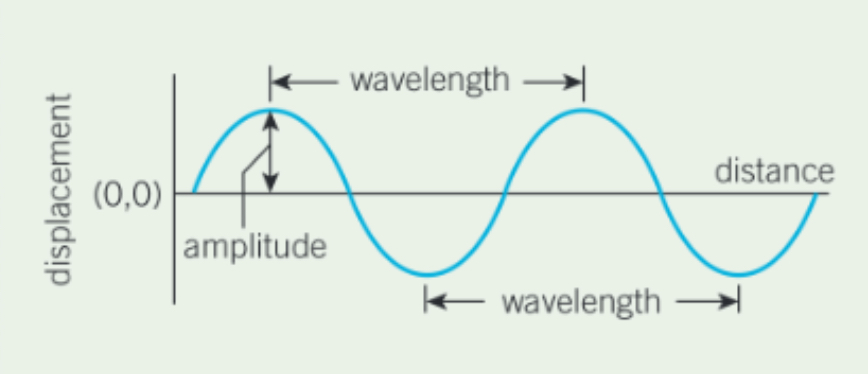
Oscillations are perpendicular to the direction of energy transfer
Peaks and troughs where particles are at a maximum displacement from their equilibrium position
Only transverse waves an be polarised, travel through a vacuum, etc
Water ripples, EM waves, S-waves
Define longitudinal wave.
Properties?
Examples?
What is the restoring force here?
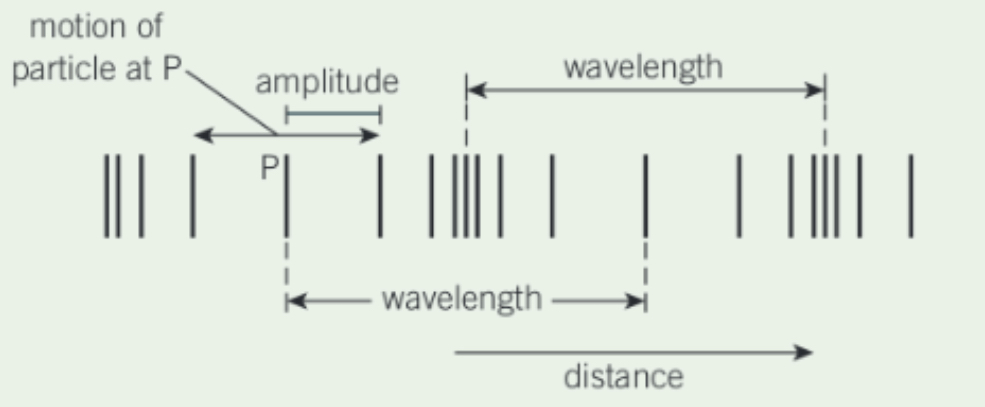
Oscillations are parallel to the direction of energy transfer
Compressions and rarefractions
Sound waves, P-waves
Restoring force are the collisions between particles as they bounce off each other during compressions
Wave equations
V = fλ
f = 1/T
T = 1/f
Define and give units:
Frequency
Time period
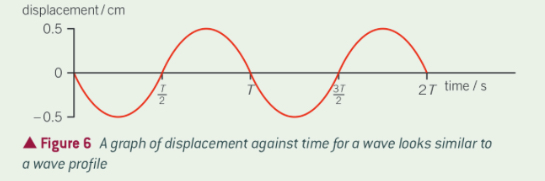
+ How to find from a displacement/time graph
Wavelength
Amplitude
Displacement
Frequency is the number of wavelengths to pass a specific point in 1 second (Hz)
Time period is the time it takes for 1 wavelength to pass a specific point (s)
X-axis time distance of one wavelength
Wavelength is the distance between 2 identical points on a wave (m)
Amplitude is the distance from a peak/crest to the wave’s equilibrium (m)
Displacement is the distance of a specific point on the wave from the equilibrium (m)
What is phase difference?
Equation?
What does in phase mean?
What is an antiphase?
Difference between the displacements of particles on a wave, measured in degrees or radians in terms of the wavelength
360θ×2π
Particles are “in phase” when their phase difference is 360o or 2π
Antiphase is when particles have a phase difference of 180o or π
(e.g. when the one particle reaches its maximum positive displacement while the other particle reaches its maximum negative displacement)
How does the displacement vary with time period on displacement-time graphs?
Displacement-time graph looks the same for both transverse and longitudinal waves
(Depends on the graph)
At t=0 , the displacement is 0
At t=4t , the particle is at its maximum negative displacement (-0.5m)
At t=2t , the particle is at its equilibrium position
And so on…
Describe how to use an oscilloscope to determine wave frequency
Time period is found using the time base, count how many timebases there are in a period, multiply number of timebases by timebase value.
Define reflection
State the law of reflection
What happens to wavelength and frequency?
Reflection is when a wave changes direction at a boundary between 2 media, remaining in the same medium
Law of reflection states that the angle of incidence = the angle of reflection
When waves are reflected their wavelength and frequency are not affected
Define refraction
What is partial reflection?
How do transverse and longitudinal waves refract?
What happens to wavelength and frequency?
In reality, why is Snell’s Law inaccurate for white light?
Refraction is when a wave changes direction as it changes speed when it passes from one medium to the other
Whenever a wave refracts there is always some reflection off the surface (partial reflection)
Transverse waves slow down as it refracts towards the normal, if it speeds up it refracts away from the normal
Sound waves speed up in denser materials?
Frequency is not affected. If a wave slows down its wavelength decrease, if a wave speeds up its wavelength increases
White light has a number of different wavelengths so blue will bend more than red, so snell’s law can only be used for specific wavelengths
Other factors affecting refraction?
Temperature of the medium
Define diffraction
How do waves diffract?
What happens to wavelength, frequency and wave speed?
Diffraction is when waves spread out as they pass through a gap or travel around an obstacle
Diffraction effects are the most significant when the gap is about the same as the wavelength,
Wavelength, frequency and wave speed are all not affected by diffraction
Define polarisation
What is partial polarisation?
Polarisation is when waves oscillate in one direction only (plane polarisation)
Partial polarisation occurs when transverse waves are reflected. This causes more waves oscillating in one particular plane, but not being completely polarised
Define intensity and give its unit
Equation?
Relationship with distance?
Relationship with amplitude?
Intensity of a progressive wave is the radiant power passing through a surface per unit area (Wm−2 )
I=AP=4πr2P
Intensity is proportional to r21 (Distance is radius)
Intensity is proportional to (amplitude)2
What is an electromagnetic wave?
Properties?
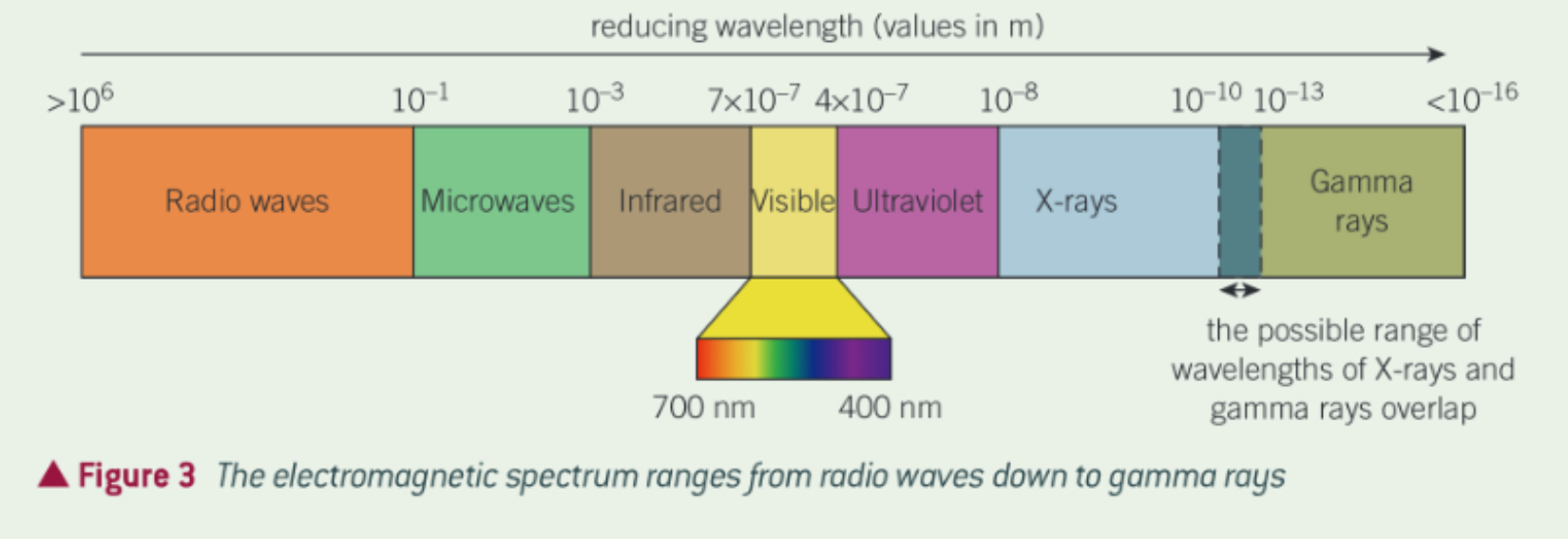
The electromagnetic spectrum and its values
A transverse wave with electric and magnetic fields oscillating perpendicular to each other and both perpendicular to the direction of energy travel
Travel through a vacuum at C, can be reflected, refracted and diffracted
See image
What is (plane) polarisation?
Polarisation of EM
Malus’ Law
How do aerials reduce interference
Plane polarisation is when a transverse wave only oscillates in 1 plane.
Unpolarised => Polarised, intensity halves.
a=acosθ and I=Icos2θ
Aerials can be aligned to transmit certain polarised orientations and the detecting aerials can be aligned to only receive those orientations to reduce interference
Techniques to demonstrate wave effects?
Polaroid filters with light?
Grills with microwaves?
Ripple tank?
First filter plane polarises the light. Second filter decreases the intensity as it rotates, until at 90*, where the intensity is 0.
Light will pass when there is a 0* filter followed by a 45* filter then a 90*. (Notes)
Metal grills aligned 90* to the microwave (usually already polarised) can stop it.
Wave is made using an electric paddle. Depth can be adjusted to show refraction. Slits can be used to show diffraction
Equation for refractive index?
Value for n in air or a vacuum?
Equation for Snell’s law?
n=vc
N has a value of 1 in a vacuum
nsinθ=nsinθ
What is total internal reflection?
Conditions for total internal reflection?
When the light strikes the boundary between 2 medium at a large angle to the normal, all the light is reflected back into its original medium (no light energy refracted out from the original medium)
Two conditions:
Light must be travelling through a medium with a higher refractive index before striking the boundary with a lower refractive index (e.g. glass into air)
The angle to the normal the light strikes the boundary with must be larger than the critical angle (changes with n)
sinθc=n1 (1 is the n of air, if it is another material, use another n)
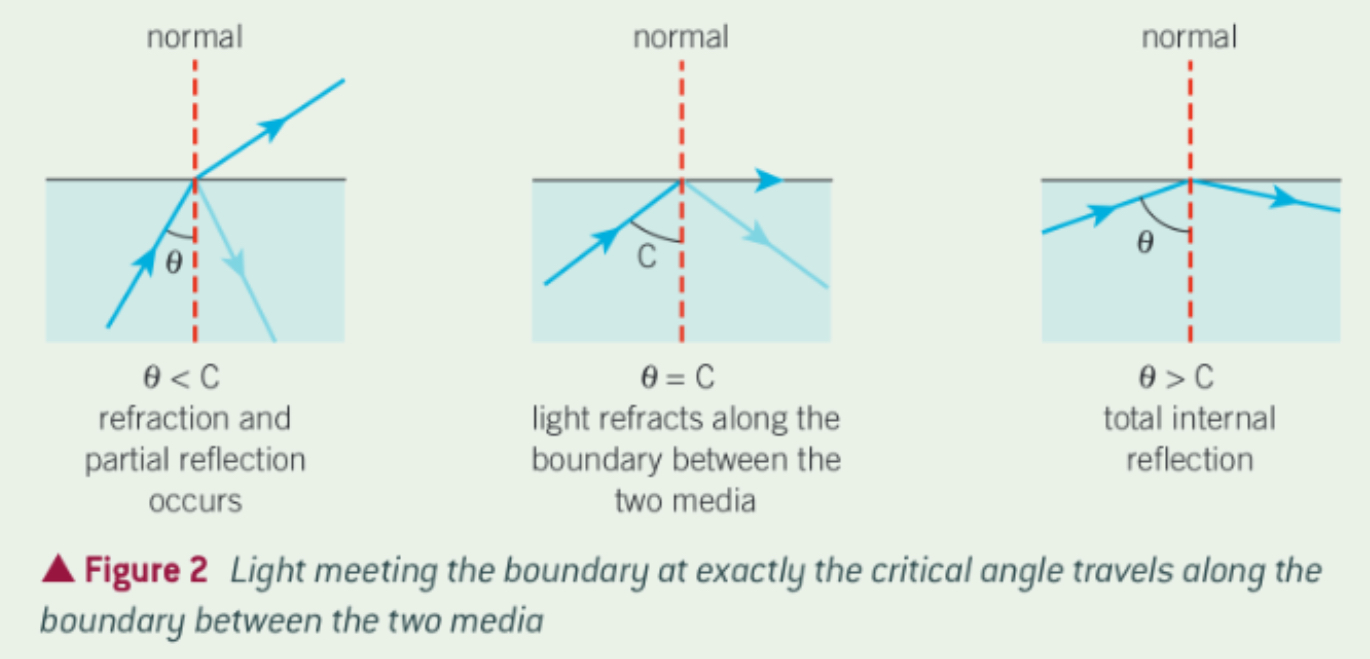
Define critical angle
Angle of incidence in a denser medium at which the angle of refraction in a less dense medium is 90*
Experiment to find critical angle?
Shine light through a semi-circular [x] block so the light enteres at 90* and does not change direction. Measure the angle from the normal when the reflected ray is along the boundary
sinθc=n1 (1 is the n of air, if it is another material, use another n)