Geometry Vocab
 Call Kai
 Learn
Learn Practice Test
 Spaced Repetition
 Match
Match Flashcards
 Knowt Play
1/41

There's no tags or description
Looks like no tags are added yet.
Name | Mastery | Learn | Test | Matching | Spaced | Call with Kai |
|---|
No analytics yet
Send a link to your students to track their progress
42 Terms
0-90
Acute
90
Right
90-180
Obtuse
180
Straight
Original: If two angles are complementary, then they add up to 90°
Turn this into a converse
If they add up to 90°, then two angles are complementary
Original: If two angles are complementary, then they add up to 90°
Turn this into a Inverse
If two angles are not complementary, then they don’t add up to 90°
Original: If two angles are complementary, then they add up to 90°
Turn this into a Contrapositive
If they do not add up to 90°, then they are not complementary
Corresponding Angles
Angles that are in the same position at each intersection when a line crosses two parallel lines
Vertical Angles
Opposite angles formed when two lines intersect
Alternate Exterior Angles
Angles that are on opposite sides of a transversal and outside two parallel lines
Alternate Interior Angles
Angles that are on opposite sides of a transversal and inside two parallel lines
Parallel segments
Line segments that are in the same plane and never meet, staying the same distance apart
Perpendicular segments
Two lines or segments that meet and form a 90° (right) angle.
Equilateral
A shape (usually a triangle) with all sides equal in length
Scalene
A triangle with all sides of different lengths
Polygon
A closed 2D shape made of straight line segments
Regular Polygon
All sides and all angles are equal
Irregular Polygon
Sides and/or angles are not all equal
Convex
A shape with no “caved in” parts; all angles point outward and are less than 180°
Concave
A shape with at least one “caved in” part where an angle is greater than 180°
What is the formula to find the slope of a line when given two points
m = Y2 - Y1 / X2 - X1
Parallel lines
Lines that stay the same distance apart and never meet
Perpendicular lines
Lines that cross and form a 90° angle
Formula of a parallelogram
A= bh
Formula to find the base of the triangle
A= bh / 2
Formula to find the area of a hexagon
A= ap / 2
Secant
A line that passes through a circle at two points
Tangent
A line that touches a circle at exactly one point
Chord
A line segment with both endpoints on the circle
Radius
A line segment from the center of the circle to any point on the circle
obtuse
90-80
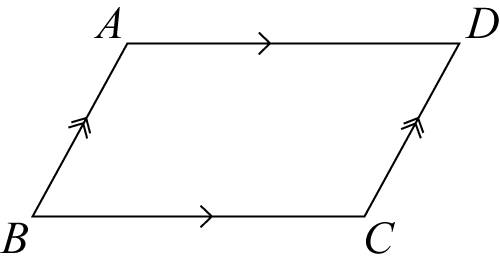
Parallelogram
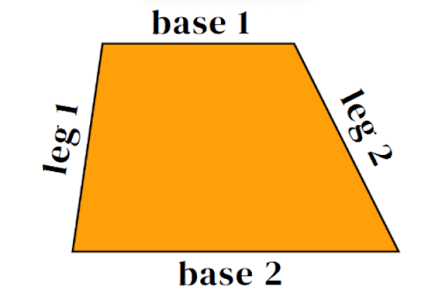
Trapezoid
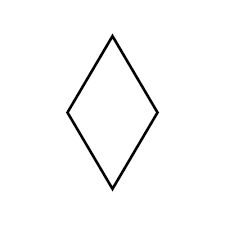
Rhombus
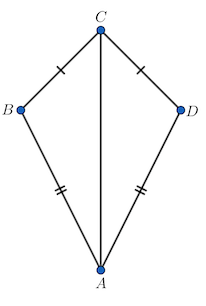
Kite
3 sides
Triangle
4 sides
Quadrilateral
5 sides
Pentagon
6 sides
Hexagon
7 sides
Heptagon
9 sides
Nonagon
10 sides
Decagon